
Marking of shipping containers
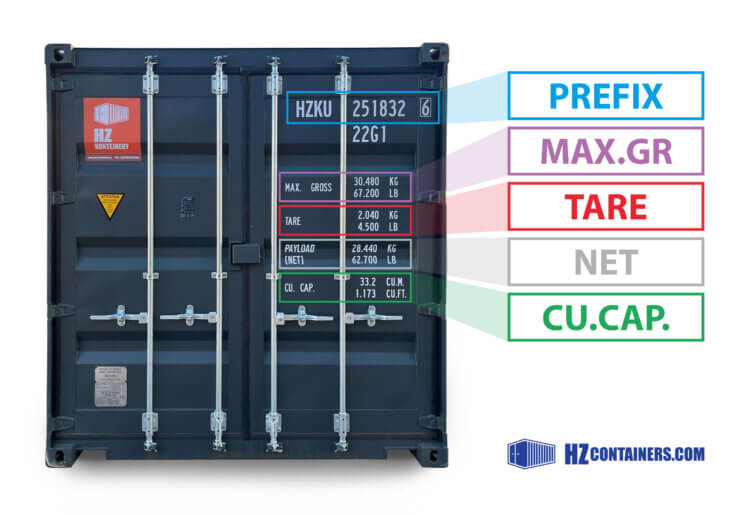
If you drive a car, you have surely already seen terms or markings on shipping containers such as TARE, NETTO, MAX.GR, NET/PAYLOAD on the doors of the container on the truck in front of you.
Have you ever wondered what these codes mean and what they indicate?
For example, they indicate how many kg of cargo can be transported in the container, where the shipping container comes from, or what is the maximum load for the given container?
WHAT DO THE TERMS – TARE, NET/PAYLOAD, MAX. GR, CU. CAP. AND PREFIX MEAN?
Below we describe the individual markings of shipping containers…
CONTAINER MARKINGS
MAX. GR = maximum load (maximum gross weight)
Max. Gross, also known as M.G.W. or Max. Gr. = in the original English version: “Maximum Gross Weight,” translated as: maximum total load. (Max = Maximum | Gross = gross, full, total | Weight = Weight)
This marking on the container indicates the maximum weight of the container including its cargo. This weight of the cargo also includes the goods inside the container.
The maximum weight of a 20-foot High Cube container is, for example, 30,480 kg. This figure may, of course, vary by manufacturer. But it is the weight of the container including the cargo.
As container sizes increase, the maximum weight usually remains similar or the same. The container only offers more internal space. This is useful, for example, for lighter goods.
TARE = weight of the container
TARE is the designation indicating the weight of the empty container. The own weight of a 20-foot container in the image is 2040 kg. Again, this figure may, of course, vary by manufacturer.
NET / PAYLOAD = maximum cargo weight
The NET designation indicates the maximum weight of the cargo for this container. For this 20-foot container, “NET” is approximately 28,440 kg. However, you may also encounter the designation PAYLOAD instead of NET. But it is the same figure.
In general, it can be said that the maximum weight of goods or materials you can load into the container is 28,440 kg including all packaging materials.
CU. CAP = container volume in m³
CU. CAP is the abbreviation for container volume in cubic meters. On the container, it is indicated as a number followed by “CU.M.” A 20-foot container thus offers a volume of CU. CAP 33.2m³ = CU.M.
The “CU.FT.” figure on shipping containers indicates the volume in cubic feet. “CU.FT.” is an abbreviation for “cubic feet.” It is a volume unit used to determine the size and capacity of containers.
The capacity of the container is an important factor in planning cargo transport, as it indicates how much space is available for cargo. This helps in planning and optimizing the amount of goods that can be transported in the container.
It is worth mentioning that cubic feet are an American unit of volume. In Europe and many other parts of the world, the metric system is usually used and container volumes are given in cubic meters (m³), but the italicized “CU.FT.” indicates that the value is expressed in cubic feet.
PREFIX = container owner
Each container has an existing code with 4 letters, always ending with the letter “U”. These letters indicate which company supplied the container, i.e., the owner of the container. For example, HZ KONTEJNERY s. r. o. has the code “HZKU.” All prefixes are registered.
Other container news...
Shipping container 12m (40 ft)
A 12m shipping container is an investment that, if properly selected and cared for, will pay off in decades of trouble-free use. Whether you plan to use it as a warehouse, workshop, garage or the basis for a residential module — the key is careful selection of the condition, a thorough inspection before purchase and high-quality preparation of the base for placement. Take the time to compare offers, check the seller’s references and do not hesitate to personally inspect the container before buying. A properly selected 40-foot container will serve you reliably for many years.
Construction container
A construction container is an investment in safety, order and comfort — whether it is protecting tools from thieves or providing a dignified environment for workers. There are three key decisions: type (storage, residential, sanitary, rubble), form of acquisition (rent vs. purchase) and legislative provision (occupation, building code).

Construction cabin – selection, tips, dimensions and prices
Every construction project – whether a family house, a development project or a reconstruction – starts with the infrastructure. No construction manager, craftsman or investor who needs an on-site office, a changing room for workers or a safe storage for tools can do without a quality construction cell. But navigating the offer is not easy: residential containers, sanitary cells, storage modules, rental, purchase, refurbished pieces… This guide will give you answers to all the essential questions in one place.
Storage container
A storage container is a lockable steel box designed for the safe and dry storage of materials, tools, goods or equipment. Originally created as a shipping container for maritime transport, its durability and versatility have found their way onto construction sites, corporate premises and private land.