
Shipping container 12m (40 ft)
Shipping container 12m — in international terminology known as a 40-foot container — represents one of the most versatile and sought-after types of transport containers on the Czech market. Whether you are looking for a spacious garden storage, a base for a residential module, or you need a reliable solution for corporate logistics, the 12-metre shipping container offers the ideal combination of volume, durability, and availability.
In this article, you will find everything you need to know — from exact dimensions and technical parameters, through current prices in 2026, to practical advice for selection, transport, and placement.
What is a 12m shipping container and what are its dimensions
A shipping container with a length of 12 metres is a standardised ISO container of category 1EE (40 ft), used primarily in maritime, rail, and road transport. Its construction from Corten steel ensures exceptional resistance to corrosion and weather influences, thanks to which it finds wide application outside the transport sector as well.
External and internal dimensions of the 40 ft container
Dimensions vary according to the height variant. On the market, you will encounter two main types:
| Parameter | Standard (40′ DV) | High Cube (40′ HC) |
|---|---|---|
| External length | 12,192 mm | 12,192 mm |
| External width | 2,438 mm | 2,438 mm |
| External height | 2,591 mm | 2,896 mm |
| Internal length | 12,032 mm | 12,032 mm |
| Internal width | 2,352 mm | 2,352 mm |
| Internal height | 2,393 mm | 2,698 mm |
| Internal volume | approx. 67.7 m³ | approx. 76.4 m³ |
| Tare weight | approx. 3,700–3,900 kg | approx. 3,900–4,200 kg |
| Maximum payload | approx. 26,500–28,000 kg | approx. 26,000–27,500 kg |
Key difference: The High Cube variant offers 30 cm of additional height and approximately 13 % greater internal volume. This is essential particularly when planning a conversion into a residential module or when storing bulky materials.
Standard vs High Cube 40 ft container — which to choose
The choice between the standard and High Cube 12m container depends primarily on the purpose:
- Standard (DV) — suitable for ordinary storage, transport of heavier materials, and situations where you do not need maximum internal height. It is generally cheaper and more available.
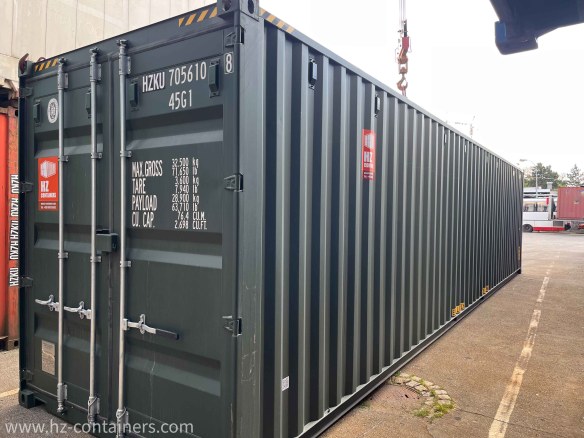
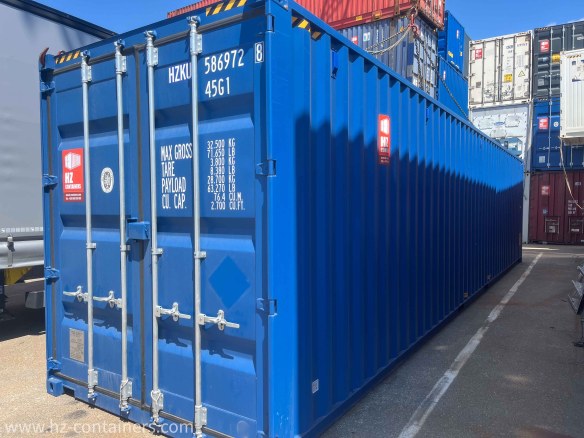
- High Cube (HC) — ideal for conversion into a residential space, a workshop with a higher ceiling, storage of larger items, or as a base for modular construction. The higher ceiling allows comfortable installation of insulation and internal wiring.
Types of 12m shipping containers by condition and design
When choosing a 12m shipping container, you will encounter several categories that differ in condition, price, and suitability for various purposes.
New 12m shipping container (One Trip / after a single voyage)
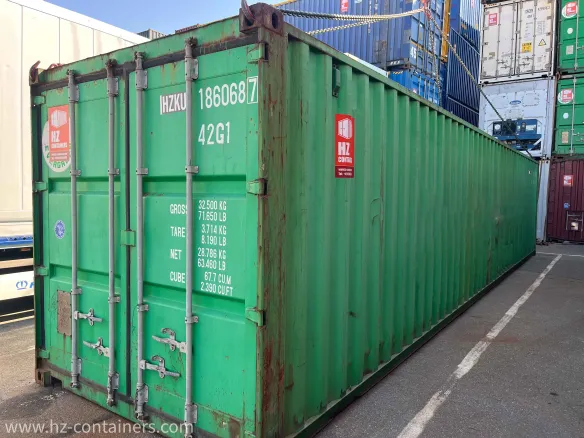
This is a container that has made only one journey with cargo from the factory to Europe. Visually and technically, it corresponds to a new unit — the floor is undamaged, the seal intact, the paint without signs of corrosion. These containers retain a valid CSC plate for 5 years and are ideal for demanding customers who require flawless condition.
Used 12m shipping container (Cargo Worthy / IICL)
Used containers undergo strict inspection according to IICL standards (Institute of International Container Lessors). The designation Cargo Worthy (CW) means that the container is fully suitable for maritime transport — it is waterproof, structurally intact, and has functional doors. For storage purposes, this is the most common and most affordable choice.
Container AS IS (as-is)
Containers sold in “AS IS” condition do not undergo any warranty inspection. They may have dents, local rust, leaks, or a damaged floor. They are suitable exclusively for undemanding storage, or as a basis for more extensive reconstruction.
12m container with side doors
A special variant that, in addition to standard end doors, also features side doors. This solution significantly facilitates access to stored material and is popular especially for workshops, warehouses with frequent handling, or as a sales stand.
Price of a 12m shipping container
The price of a 12m shipping container depends on several factors: condition, height variant, year of manufacture, and seller’s location. The following overview is based on current offers on the Czech market:
| Container type | Condition | Indicative price excl. VAT |
|---|---|---|
| 40′ Standard (DV) | Used CW | 45,000 – 65,000 CZK |
| 40′ Standard (DV) | One Trip / new | 75,000 – 95,000 CZK |
| 40′ High Cube (HC) | Used CW | 48,000 – 72,000 CZK |
| 40′ High Cube (HC) | IICL (excellent) | 70,000 – 90,000 CZK |
| 40′ High Cube (HC) | One Trip / new | 85,000 – 120,000 CZK |
| 40′ HC with side doors | Used | 65,000 – 95,000 CZK |
Prices are indicative and may change depending on the season and current price. For an accurate calculation, contact us or review our current price list.
Important: Most sellers quote prices excluding VAT. Transport must be added to the price, which depending on distance ranges from 5,000 to 15,000 CZK.
What influences the price the most
- Condition and category — the difference between CW and IICL can be 15,000–25,000 CZK
- Height variant — HC is usually 10–20 % more expensive than standard
- Year of manufacture — newer containers (up to 5 years) have a higher price
- Regional availability — containers in Prague and surroundings tend to be more expensive than in Moravia
- Seasonality — in spring and summer, demand grows, which may slightly increase the price
New vs used 12m shipping container — advantages and disadvantages
The decision between a new and used container is one of the most fundamental. Each variant has its place.
Used 12m shipping container
Advantages:
- Lower purchase price (savings of 30–50 % compared to new)
- Fully sufficient for storing tools, materials, or seasonal items
- Patina and minor signs of use do not matter in industrial applications
Disadvantages:
- May have minor dents or surface rust
- The floor may show signs of wear
- Older containers may have limited seal lifespan
- Lower aesthetic value for residential purposes
New 12m shipping container (One Trip)
Advantages:
- Flawless technical and visual condition
- Undamaged floor, without odour
- Valid CSC plate for 5 years
- Ideal for conversion into a residential module or office
- Longer overall service life
Disadvantages:
- Higher purchase price
- Often unnecessary luxury for purely storage purposes
How to choose a 12m shipping container — what to watch out for
When buying a 12m shipping container, it pays to pay attention to several critical points that decide whether the container will serve without problems for many years.
Floor inspection
The wooden plywood floor is the most vulnerable part of the container. Look for signs of rot, mould, cracks, or excessive wear. With used containers, minor wear is common, but the floor must be solid and without holes. For conversion into living space, consider a container with an intact floor, ideally One Trip.
Tightness and roof condition
The roof is exposed to the greatest load — rain, snow, and UV radiation. Inspect it from the inside in daylight — any holes or cracks can be identified by light shining through. Also check the condition of the seal around the doors — dry, cracked, or missing seal means a risk of leakage.
Door functionality
The double-leaf doors must open and close smoothly, without sticking. Check the hinges, locking mechanisms, and sealing profiles. The locking bar must be straight and functional.
Structural condition
The container must stand straight, without visible twisting. Check the corner elements (so-called corner castings) — they must be intact, as they are used for attachment during crane handling. Inspect the walls from inside and outside for extensive corrosion or dents compromising the structural integrity.
Documentation and origin
A quality seller will provide you with information about the category (CW, IICL, AS IS) for the used container. For new containers, check the validity of the CSC plate, which is mandatory for transport.
Uses of a 12m shipping container
The 12-metre shipping container offers exceptional flexibility. Here are the most common uses:
12m shipping container as a garden storage
With an internal volume of over 67 m³ (or 76 m³ for HC), a 12m container represents an ideal high-capacity storage. It will accommodate garden equipment, seasonal gear, building materials, tyres, motorcycles, or a smaller vehicle. Lockable doors ensure security and Corten steel protects the contents from weather influences.
Workshop and garage from a shipping container
Thanks to the internal width of 2.35 m and length of over 12 m, the container can be easily converted into a full-fledged workshop. Installation of lighting, sockets, and a workbench is quick and undemanding. For garaging a passenger car, the 12m container is sufficiently long — after parking, there is still space to store tools and equipment.
Conversion of a 12m container into a residential module
With the growing popularity of tiny houses and modular housing, 12m containers are becoming a sought-after basis for residential buildings. The High Cube version is practically indispensable here — the higher ceiling allows installation of insulation, underfloor heating, and internal wiring, without taking away from the living height. The container can be insulated, equipped with windows, doors, and complete internal installations. The result is a full-fledged living space of approximately 28 m².
Office, sales stand, or construction site facilities
A 12m container is easily converted into a mobile office, sales stand, or facility for a construction company. Thanks to its standardised dimensions, it can be transported on a standard semi-trailer and quickly relocated as needed.
How to transport and unload a 12m shipping container
Transporting a 12m shipping container requires specific logistics that need to be planned in advance.
Methods of transport
- Hydraulic arm (sidelifter) — a truck with a hydraulic arm that unloads the container itself. This is the most practical option, as it does not require additional equipment at the unloading site. Most sellers offer this transport, but it is significantly more expensive than a classic truck.
- Flatbed trailer with crane — the container is transported on a trailer and unloaded on site using a mobile crane. Suitable for harder-to-access locations, more affordable.
- Classic trailer + external crane — requires arranging a crane at the unloading site. The most affordable option.
Conditions for unloading
- Solid and level surface — a reinforced area, ideally concrete or asphalt. On soft ground, the container may sink over time.
- Sufficient space for manoeuvring — a truck with a 12m container needs a space of at least 20 m in length and 5 m in width.
- Concrete footings or panels at the corners — the container must stand on its corners, not on its entire surface. This ensures proper weight distribution and protection of the floor from moisture.
- Maximum slope compliance — the loading ramp and access road should not have a slope greater than 10 %.
Practical tip: Before ordering transport, thoroughly check the access road — the width of the gate, the height of underpasses (min. 4.5 m), the load capacity of bridges, and obstacles in the form of columns or trees.
Where to buy a 12m shipping container
- Stock availability — check current stock inventory. A container near your location can reduce the transport price.
- Transport price — some sellers offer promotional prices with free transport to a certain distance.
- References and reviews — experiences with 12m containers from previous customers will indicate the supplier’s reliability.
The offer of 12m shipping containers in most cities across the Czech Republic with free transport is available at HZ-containers.com
FAQ
What is the difference between a 40 ft and 12m container?
None — it is the same container. 40 feet is the Anglo-Saxon designation, 12 metres is a rounded conversion to the metric system. The actual length is 12.192 m.
What is the payload of a 12m shipping container?
A standard 40-foot container has a maximum cargo payload of approximately 26,500–28,000 kg. The exact value depends on the specific model, year of manufacture, and height variant. The High Cube version has a slightly lower payload (approx. 26,000–27,500 kg) due to its higher tare weight.
How much does the cheapest 12m shipping container cost?
The cheapest used 12m container in AS IS condition can be obtained from approximately 35,000 CZK excluding VAT. For a fully functional used CW container, prices start from 45,000 CZK excluding VAT and up. For the cheapest new one (One Trip), you will pay around 75,000 CZK excluding VAT.
Can a 12m container be used for living?
Yes, a 12m High Cube container is an excellent basis for a residential module. The higher ceiling (2,698 mm internal) allows installation of insulation and wiring while maintaining a comfortable living height. For living, the container must be insulated, equipped with windows, doors, electrical installation, water, and waste. Construction requires a building permit.
What surface must be under a 12m container?
The container must stand on a reinforced and level surface. Ideal are concrete footings at the corners (min. 40×40 cm), which distribute the weight into the subsoil. Alternatively, concrete panels or a compacted gravel bed can be used. The container must not stand on bare ground — there is a risk of corrosion of the lower part and uneven settling.
What do the IICL and CW designations mean on a container?
IICL (Institute of International Container Lessors) is an international standard for container inspection and maintenance. CW (Cargo Worthy) means that the container has passed IICL inspection and is suitable for maritime transport — it is waterproof, structurally sound, and safe. For storage purposes, CW is absolutely sufficient.
How does the conversion of a 12m container into a residential module proceed?
Conversion involves several steps: structural assessment and possible reinforcement of openings for windows and doors, external/internal insulation (PUR foam, mineral wool), installation of windows and doors, electrical installation, plumbing and waste, interior cladding (plasterboard, OSB), underfloor heating or floor insulation, and final surfaces.
Can a 12m container be divided into smaller parts?
Yes, a container can be cut and welded into smaller modules, but at the cost of losing structural integrity. If you need a smaller space, it is more practical to obtain a 10-foot (approx. 3 m) or 20-foot (approx. 6 m) container, which are commonly available on the market and retain full structural integrity.
 Česká Lípa, Czech Republic
  FREE SHIPPING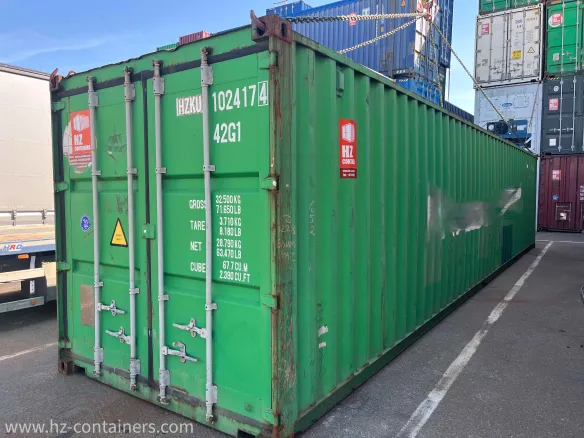
Other container news...

New shipping containers
If you are currently considering purchasing a new shipping container, you are not alone. While just twenty years ago containers were used almost exclusively for maritime transport, today they have found their way into construction, storage, business, and even housing. This growing popularity brings with it a host of questions: Which type should you choose? How much does it cost? How do you recognize quality? How can you avoid falling victim to scammers?

6m shipping container
Are you thinking about buying a 6-meter shipping container but aren’t sure what to look for? You are not alone—this 20-foot container is the best-selling size on the Czech market, and the differences between various types, conditions, and prices can be significant. In this guide, you will find everything you need to know: from exact dimensions and a comparison of categories (such as “one-way,” refurbished, and “Cargo Worthy”) to current prices and shipping advice.
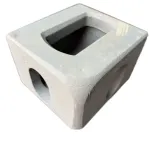
Corner casting steel vs aluminum
Every shipping container in the world — all 40 million of them — rests on eight critical components. Corner castings are the load-bearing blocks at each corner of an ISO shipping container, and they are the universal interface between the container and every crane, twistlock, spreader, and chassis on the planet. When you lift a container, stack it nine high on a ship, or lock it to a truck trailer, every ton of force flows through these fittings.

Construction cabin – selection, tips, dimensions and prices
Every construction project – whether a family house, a development project or a reconstruction – starts with the infrastructure. No construction manager, craftsman or investor who needs an on-site office, a changing room for workers or a safe storage for tools can do without a quality construction cell. But navigating the offer is not easy: residential containers, sanitary cells, storage modules, rental, purchase, refurbished pieces… This guide will give you answers to all the essential questions in one place.