
What is a reefer container?
Reefer container is a temperature-controlled intermodal shipping container equipped with an integrated cooling unit, designed to transport perishable, frozen, or temperature-sensitive cargo across oceans, railways, and highways while maintaining a precise internal climate. The term “reefer” is simply a shortened form of refrigerated container — an abbreviation from the maritime industry that has become the universal standard name for these critical components of the global cold chain.
Key definition: A reefer container is not just an insulated box. It is a self-contained air conditioning system built into an ISO-standard container, capable of maintaining temperatures from -70 °C to +30 °C (-94 °F to +86 °F), depending on the model.
Every banana you eat in winter, every batch of vaccine transported across continents, and every cut flower flying from equatorial greenhouses to northern florists owes its journey to the reefer container. These containers are the invisible backbone of the cold chain — a temperature-controlled supply chain that keeps perishable goods viable from farm to fork, from lab to patient, and from factory to consumer.
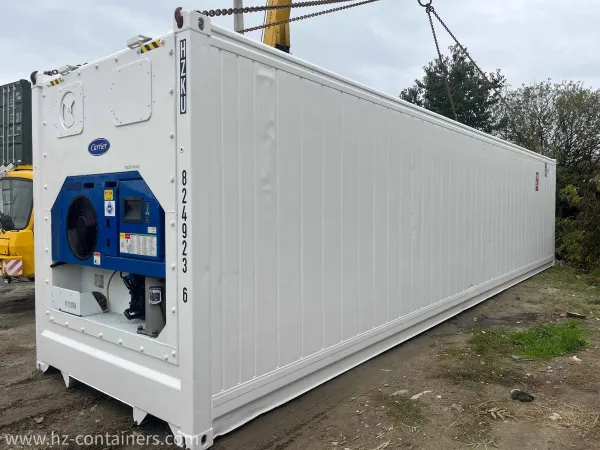
Where Did Reefer Containers Come From? A Brief History
The story of the reefer container is a story of human ingenuity tackling a fundamental problem of distance: how to transport something that spoils before it arrives?
Early Attempts at Refrigerated Transport (1800s)
Before the shipping container even existed, the challenge of transporting perishable goods across oceans was already urgent. In the early 19th century, shippers used ice and salt stacked next to the cargo to slow spoilage. The method was crude, unreliable, and impractical for long voyages. Livestock transported across the Atlantic often died during the journey, and meat products rotted before reaching their destination.
The first major breakthrough came in 1867, when J. B. Sutherland of Detroit was granted the first patent for a refrigerated railcar. His design included ice chambers at each end of the car that circulated cold air through the cargo space. It was a start, but the system was still passive — it could not actively control temperature.
The real revolution began in 1876, when French engineer Charles Tellier — often called the “Father of Cold” — built the first ether-based mechanical refrigeration system, capable of maintaining a stable temperature of 0 °C inside a cargo hold. He installed three of these units on a steamship called Le Frigorifique, demonstrating that mechanical refrigeration could work at sea.
Just a year later, in 1877, another French engineer, Ferdinand Carré, improved Tellier’s design by using compressor-based refrigeration. He successfully transported 150 tons of frozen meat from Sydney, Australia to the United Kingdom in 50 days — a groundbreaking voyage that proved refrigerated intercontinental food transport was commercially viable.
The Birth of Modern Reefer Containers (1900–1970)
The early 20th century brought steady progress. In 1901, the first purpose-built refrigerated ships were put into service — designed specifically to transport bananas. These vessels used CO₂-based machines to lower and control temperature, marking a decisive step forward for the tropical fruit trade.
In the 1930s, American inventor Fred Jones created the first portable refrigeration unit that could be mounted on trucks. This innovation made refrigerated road transport practical and laid the groundwork for the concept of an integrated reefer container.
A pivotal moment came in 1960, when the American shipping company Matson Navigation introduced the first true reefer containers — standard intermodal containers with built-in, electrically powered refrigeration units. For the first time in history, a container could be loaded at a farm, transported by truck to a port, loaded onto a ship, and delivered to a distant market — all while maintaining a constant temperature. This was the birth of the modern cold chain.
By the 1970s, purpose-built reefer containers for container ships had become standard equipment in global shipping. The era of refrigerated break-bulk ships ended, replaced by the much more efficient intermodal reefer.
| Year | Milestone | Significance |
|---|---|---|
| 1867 | J. B. Sutherland patents refrigerated railcar | First temperature-controlled cargo transport |
| 1876 | Charles Tellier builds ether-based refrigeration system | First mechanical refrigeration at sea |
| 1877 | Ferdinand Carré transports 150 t of frozen meat Sydney→UK | Proof of concept for intercontinental refrigerated trade |
| 1901 | First refrigerated ships for banana transport | Birth of specialized refrigerated shipping |
| 1930 | Fred Jones invents portable refrigeration unit | Enables refrigerated road transport |
| 1960 | Matson Navigation introduces first integrated reefer container | Begins the era of the modern reefer |
| 1970 | Purpose-built reefer containers for container ships | Standardization and global adoption |
How Does a Reefer Container Work?
A reefer container is deceptively simple in concept but sophisticated in execution. It does one thing: it removes heat from inside the container and discharges it outside, maintaining a set temperature. The way it achieves this, however, involves several interconnected systems working in precise coordination.
The Refrigeration Cycle
At the heart of every reefer container is a compression refrigeration cycle, identical in principle to a household refrigerator — just scaled up and ruggedized for the marine environment. The cycle uses a refrigerant (a specialized liquid/gas) that circulates through four main components:
- Compressor — Compresses the refrigerant gas, raising its temperature
- Condenser — Cools the hot, compressed gas into a liquid, releasing heat outside the container
- Expansion valve — Rapidly reduces pressure, causing the liquid refrigerant to cool quickly
- Evaporator — Cold refrigerant absorbs heat from inside the container, cooling the air
This cycle repeats continuously. The refrigeration unit is mounted on the front wall of the container (opposite end from the doors), and the entire system is powered by an external electricity source — either the ship’s electrical grid, a shore power outlet, or a portable generator (genset).
Critical insight: A reefer container maintains temperature — it does not lower the temperature of the cargo. Cargo must be pre-cooled to the required transport temperature before loading. Loading warm cargo into a reefer will overload the system, cause uneven cooling, and potentially ruin the entire shipment.
T-Floor and Airflow Design
The most distinctive feature of a reefer container’s interior is its floor. Unlike the flat wooden floor of a dry container, a reefer uses T-profile aluminum planks — also called a T-floor or grating. This design is not cosmetic; it is the foundation of the entire cooling system.
The refrigeration unit pushes cold air through the channels of the T-floor beneath the cargo. The air flows along the bottom of the container, rises up through the cargo at the rear (near the doors), and returns to the refrigeration unit along the ceiling of the container. This creates a continuous convection loop that keeps every part of the cargo at a constant temperature.
For chilled goods (such as fresh fruit, vegetables, and flowers), the cargo must be stacked so that air can flow freely through it. These products are still alive — they breathe, producing heat, water vapor, and CO₂. The airflow carries away these byproducts and prevents hot spots that would accelerate spoilage.
For frozen goods, the opposite approach is used. The cargo is stacked tightly with minimal gaps, blocking airflow to retain the cold and keep the product solidly frozen.
Temperature, Ventilation, and Humidity Control
A reefer container simultaneously controls three environmental parameters:
| Parameter | Range / Options | Why It Matters |
|---|---|---|
| Temperature | Standard: -30 °C to +30 °C / Super Freezer: up to -70 °C | Preserves product integrity; different goods require different setpoints |
| Ventilation | Adjustable fresh air exchange | Removes CO₂, ethylene, and heat from respiring cargo; prevents uncontrolled ripening |
| Humidity | 50% to 85% relative humidity (with dehumidification option) | Prevents condensation (container rain), mold growth, and packaging damage |
The container also has a drainage system that channels away excess water from defrost cycles and condensation, preventing flooding and cargo damage. The drains are designed to let water out but keep insects and seawater from getting in.
What Are the Different Types of Reefer Containers?
Not all reefer containers are the same. The global fleet includes several specialized variants, each designed for specific cargo requirements.
Standard Reefers
The workhorse of the cold chain. Standard reefers maintain temperatures between -30 °C and +30 °C and are available in 20-foot and 40-foot high cube formats. They handle the vast majority of global refrigerated cargo — frozen meat, chilled dairy, fresh produce, and most pharmaceuticals. These containers use a microprocessor-controlled refrigeration unit with data logging, temperature sensors, and adjustable ventilation.
Super Freezer Reefers
When standard reefers are not cold enough, super freezer units step in. These specialized containers can maintain temperatures as low as -60 °C or even -70 °C, achieved through enhanced insulation, more powerful compressors, and specialized refrigerants. They are used for:
- Deep-frozen tuna destined for sashimi markets
- Certain pharmaceuticals and biological substances requiring ultra-low temperatures
- Specialty chemicals that must remain at cryogenic levels of cold
Super freezer containers are rarer and more expensive to operate than standard reefers, but for these specialized applications they are irreplaceable.
Controlled Atmosphere (CA) Reefers
Controlled atmosphere reefers take preservation a step further by actively managing the gas composition inside the container. By reducing oxygen levels and increasing carbon dioxide and nitrogen, CA technology slows the respiration rate of fresh fruit and vegetables, delaying ripening and dramatically extending shelf life.
This is why apples harvested in New Zealand can arrive at European supermarkets a month later still crisp and fresh. CA reefers are essential for high-value perishable products such as:
- Apples, pears, and kiwis
- Avocados and mangoes
- Fresh-cut flowers
- Asparagus and other delicate vegetables
Major shipping lines offer proprietary CA systems — Maersk’s StarCare and Hapag-Lloyd’s ExtraFresh and EverFresh are among the leading examples.
Non-Operating Reefer (NOR) Containers
A Non-Operating Reefer (NOR) is a reefer container with its refrigeration unit switched off. It functions as an insulated dry container, transporting non-perishable cargo such as electronics, textiles, or machinery.
Why would anyone do this? The answer is container repositioning. Global trade flows are unbalanced — a reefer carrying frozen meat from Australia to China may not find refrigerated cargo to carry back. Rather than sending the container back empty, it is offered as a NOR and carries dry goods on the return journey. This reduces repositioning costs and improves fleet utilization. It is estimated that roughly one in three containers worldwide moves empty, and the use of NOR helps mitigate this waste.
| Type | Temperature Range | Best For | Key Feature |
|---|---|---|---|
| Standard reefer | -30 °C to +30 °C | Meat, dairy, produce, pharmaceuticals | Versatile, most common |
| Super freezer | -60 °C to -70 °C | Deep-frozen tuna, specialty pharma | Ultra-low temperature capability |
| Controlled atmosphere (CA) | -30 °C to +30 °C + gas regulation | Apples, avocados, flowers | Extends shelf life through gas management |
| Non-operating reefer (NOR) | Ambient (unit off) | Dry cargo, repositioning | Insulated but not refrigerated |
What Are the Dimensions and Specifications of Reefer Containers?
Reefer containers are built to ISO standard external dimensions, but their internal dimensions are slightly smaller than dry containers due to insulation and the refrigeration unit. Here are the specifications for the most common sizes:
| Measurement | 20-foot reefer | 40-foot reefer | 40-foot high cube reefer | 45-foot reefer |
|---|---|---|---|---|
| External length | 20′ / 6.06 m | 40′ / 12.19 m | 40′ / 12.19 m | 45′ / 13.72 m |
| External width | 8′ / 2.44 m | 8′ / 2.44 m | 8′ / 2.44 m | 8′ / 2.44 m |
| External height | 8′6″ / 2.59 m | 8′6″ / 2.59 m | 9′6″ / 2.89 m | 9′6″ / 2.89 m |
| Internal length | 17.9′ / 5.44 m | 37.9′ / 11.56 m | 38.0′ / 11.58 m | 42.8′ / 13.04 m |
| Internal width | 7.5′ / 2.29 m | 7.5′ / 2.28 m | 7.5′ / 2.29 m | 7.5′ / 2.28 m |
| Internal height | 7.5′ / 2.27 m | 7.4′ / 2.25 m | 7.9′ / 2.40 m | 7.9′ / 2.40 m |
| Empty container weight | 3,080 kg / 6,790 lbs | 4,800 kg / 10,584 lbs | 4,480 kg / 9,880 lbs | ~4,900 kg |
| Payload | 27,400 kg / 60,417 lbs | 27,700 kg / 61,079 lbs | 29,520 kg / 65,080 lbs | ~28,000 kg |
| Volume | 28.3 m³ / 999 cu ft | 59.3 m³ / 2,093 cu ft | 67.3 m³ / 2,380 cu ft | ~75 m³ |
The 40-foot high cube reefer is the most widely used size for international ocean shipping, offering the best balance of cargo volume and compatibility with standard shipping infrastructure.
How Does a Reefer Container Differ From a Dry Container?
While both are ISO-standard intermodal containers, reefers and dry containers are fundamentally different devices. Understanding these differences is essential for proper cargo planning.
| Feature | Dry container | Reefer container |
|---|---|---|
| Main purpose | General cargo, non-perishable goods | Temperature-sensitive perishable goods |
| Insulation | None (bare steel walls) | Polyurethane foam between steel walls |
| Floor | Flat wooden or bamboo floor | T-profile aluminum planks (T-floor) |
| Refrigeration unit | None | Integrated electric refrigeration unit at the front |
| Power requirement | None | Requires 3-phase 440/460 V power (or genset) |
| Empty container weight | Lighter (20 ft: ~2,230 kg) | Heavier (20 ft: ~3,080 kg) due to insulation and machinery |
| Internal volume | Slightly larger | Smaller due to insulation thickness |
| Ventilation | Only passive ventilation openings | Active fresh air exchange system |
| Drainage | None | Active drainage system for defrost water |
| Price | Lower (~$2,000–$5,000 used) | Higher (~$4,000–$45,000 depending on condition and type) |
| Maintenance | Minimal (structural only) | Significant (cooling system, electrical, sensors) |
The single most important difference: a dry container protects cargo from the environment. A reefer container actively manages the internal environment — temperature, humidity, ventilation, and in some cases atmospheric composition.
What Are Reefer Containers Used For?
Reefer containers serve a remarkably diverse range of industries, far beyond the obvious food transport applications.
Food and Beverages
The largest share of reefer cargo by volume. This category includes:
- Frozen meat and seafood — the most common reefer cargo worldwide, transported at -18 °C to -25 °C
- Fresh fruit and vegetables — transported at +2 °C to +13 °C depending on the product, often requiring ventilation
- Dairy products — powdered milk, butter, cheese, usually at +2 °C to +8 °C
- Juice concentrates, wine, and beverages — thermally stable but sensitive to extremes
- Chocolate and confectionery — prone to melting and “blooming,” transported at +14 °C to +18 °C
Pharmaceutical and Healthcare Industry
The pharmaceutical cold chain has grown significantly, especially since the COVID-19 pandemic demonstrated the critical importance of temperature-controlled logistics. Reefer containers transport:
- Vaccines — many require +2 °C to +8 °C, some (such as certain mRNA vaccines) require -70 °C
- Biological substances and clinical trial samples — often requiring precise, monitored temperature ranges
- Insulin and other temperature-sensitive medications
- Medical devices and diagnostic reagents
Reefer containers used for pharmaceutical purposes typically undergo additional validation and certification, and their temperature records are retained as part of regulatory compliance documentation.
Other Industries
- Cut flowers and plants — transported at +2 °C to +8 °C, often with controlled atmosphere to delay flowering
- Chemicals and industrial products — thermally stable solvents, adhesives, resins
- Electronics — sensitive components that can be damaged by condensation or extreme heat
- Art and antiques — valuable items requiring stable climate conditions during transport
How Is a Reefer Container Powered?
The refrigeration unit of a reefer container is entirely dependent on external electricity. There is no built-in battery or fuel source — the unit must be continuously plugged in to maintain temperature.
At Sea: Ship Power
On container ships, reefers are stacked in designated positions with access to the ship’s reefer socket points. These provide 3-phase 440/460 V power at 50 or 60 Hz. A single reefer container typically draws approximately 4.38 kW of power — this figure varies depending on ambient temperature, setpoint, and cargo type. A large container vessel carrying several hundred reefers must dedicate a significant portion of its power generation capacity to cooling.
On Land: Terminal Power and Gensets
At port terminals, reefer containers plug into shore-based electrical outlets — often called reefer stacks or reefer racks. If, however, the reefer is on a truck chassis or in a location without fixed electrical infrastructure, a genset (generator set) is used.
A genset is a portable diesel generator, typically mounted on a chassis beneath the container or on a clamping frame attached to the front of the container. Most gensets can power a reefer for up to 100 continuous hours on a single tank of diesel. This makes them essential for:
- Road transport — moving reefers from port to distribution center
- Remote storage — temporary cold storage at construction sites, events, or humanitarian aid operations
- Backup power — maintaining temperature integrity during port transshipment or power outages
The standard power requirement for a reefer is a 32-amp circuit with a dedicated breaker, typically 460 V / 60 Hz in North America and 380 V / 50 Hz in many other regions.
How Is Cargo Loaded and Stored in a Reefer Container?
Improper loading is one of the most common causes of reefer cargo damage. The T-floor airflow system only works if the cargo is properly stacked.
Loading Chilled Cargo
Chilled goods — fruit, vegetables, flowers, fresh meat — must have airflow through the cargo. The correct approach:
- Pre-cool the cargo to transport temperature before loading
- Leave gaps between cartons and pallets to allow air to circulate
- Do not load above the red line — the maximum fill line marked inside the container
- Use proper packaging — ventilated cartons that allow air exchange
- Ensure the cargo does not block the air return path at the top of the container
Loading Frozen Cargo
Frozen goods require the opposite approach:
- Pre-freeze the cargo to at least -18 °C before loading
- Stack tightly — minimize gaps to block airflow and retain cold
- Fill the container completely if possible — use dunnage to fill voids
- Load directly from cold storage — to minimize temperature fluctuations
Common Mistakes to Avoid
- Loading warm cargo — the reefer cannot cool it down; it will spoil
- Blocking the T-floor channels — flat-bottomed pallets without gaps prevent airflow
- Overloading above the red line — blocks return air and creates hot spots
- Mixing incompatible cargo — ethylene-producing fruit (apples, bananas) will spoil ethylene-sensitive vegetables (lettuce, broccoli)
- Poor door sealing — damaged gaskets let in warm, humid air
How Much Does a Reefer Container Cost?
Reefer container prices vary significantly based on condition, location, size, and market conditions. Below are approximate price ranges for cargo-worthy (used but fully functional) reefers.
Purchase Costs by Region
| Location | 20-foot reefer | 40-foot reefer | 40-foot HC reefer |
|---|---|---|---|
| China | $4,500–$5,000 | $5,500–$6,500 | $5,000–$6,000 |
| United States | $12,000–$15,000 | $5,500–$7,000 | $6,500–$7,500 |
| Europe | $7,000–$8,500 | $3,500–$4,500 | $5,500–$6,500 |
| India | $6,500–$7,000 | $6,500–$7,000 | $7,000–$8,000 |
| UAE | $6,500–$7,500 | $5,500–$6,000 | $5,000–$5,500 |
New reefer containers from manufacturers such as Carrier Transicold, Thermo King, and Daikin cost significantly more — typically $30,000 to $45,000 for a 40-foot HC unit. One-trip containers (shipped once, almost new) occupy the middle price range.
Rental Costs
Monthly rental rates for reefers typically range from $800 to $1,500 per month for a 40-foot unit, depending on location, duration, and condition. Short-term rentals command premium rates. Factors affecting rental price include:
- Geographic location and local availability
- Age and condition of the container
- Length of the rental (longer period = lower monthly rate)
- Whether a genset is included
- Delivery and pickup fees
What Are Common Reefer Container Maintenance Issues?
Reefer containers are complex electromechanical systems operating in a harsh marine environment. Regular maintenance is essential for reliability.
Common Problems and Solutions
- Refrigerant leaks — The most common issue. Symptoms include reduced cooling capacity, ice formation on the evaporator, or continuous unit operation without reaching setpoint. Leaks typically occur at connections, valves, or due to corrosion.
- Compressor failure — Often caused by refrigerant loss, electrical faults, or normal wear. Compressor failure means total loss of cooling.
- Airflow blockage — Usually caused by improper cargo loading, damaged T-floor, or debris in air channels. The result is uneven temperature distribution.
- Sensor and thermostat failure — Faulty temperature sensors cause the unit to run too much or too little. Regular calibration is essential.
- Condenser coil contamination — Salt, dust, and dirt accumulate on the condenser coils, reducing heat dissipation efficiency. The unit works harder and consumes more power.
- Door gasket damage — Torn or compressed gaskets allow warm, humid air to enter, causing condensation and temperature oscillation.
- Ice formation — Excessive frost on the evaporator signals a defrost system malfunction, a humidity problem, or a door gasket leak.
Preventive Maintenance
- Pre-Trip Inspection (PTI) — A comprehensive check performed before every loaded journey. It includes temperature calibration, sensor verification, refrigerant level check, and a full system test.
- Regular condenser cleaning — Especially important in the salty marine environment.
- Door gasket inspection — Check for cracks, permanent deformation, and proper closing with every use.
- Temperature data review — Use the data logger to identify trends before they become failures.
- Professional servicing — Major cooling components should be serviced by certified technicians at least once a year.
What Is the Future of Reefer Container Technology?
The reefer container industry is in the midst of a technological transformation driven by connectivity, sustainability, and efficiency demands.
Smart Reefers and IoT
The modern reefer is increasingly a connected device. Built-in telematics enables:
- Real-time remote temperature monitoring — shippers and carriers can track conditions from anywhere in the world
- GPS location tracking — visibility into container position and estimated arrival
- Automatic alerts — immediate notification of temperature deviations, door openings, or power loss
- Predictive maintenance — data analytics identifies patterns that precede equipment failures, enabling proactive repairs
- Regulatory compliance — automated temperature records for FDA, USDA, and GDP (Good Distribution Practice) requirements
Major carriers like Maersk and CMA CGM now offer visibility platforms that integrate telemetry data from reefers, giving shippers unprecedented control over their cold chain.
Sustainability Trends
The shipping industry is under pressure to decarbonize, and reefer containers are part of this equation:
- Energy-efficient cooling — New compressor designs and variable-speed drives reduce energy consumption by 15–30%
- Alternative refrigerants — The industry is phasing out high-GWP (global warming potential) refrigerants such as R-404A in favor of less harmful alternatives like R-452A and natural refrigerants
- Electric gensets — Battery-powered generator sets are emerging as alternatives to diesel, especially for short transports and urban operations
- Solar-assisted cooling — Experimental systems integrate photovoltaic panels onto container roofs to supplement power, though this remains limited in scope
- Fleet optimization — Better data enables more efficient container routing, reducing empty container movements and associated fuel consumption
The global reefer container fleet currently numbers approximately 4 million TEU (twenty-foot equivalent units), and it is expected to grow steadily, as global demand for fresh and frozen foods, pharmaceuticals, and temperature-sensitive goods continues to rise.
Frequently Asked Questions
What does “reefer” mean?
“Reefer” is simply a shortened form of the word refrigerated. It originated as maritime industry slang and has become the standard term used in shipping, logistics, and cold storage worldwide. There is no difference between a “reefer container” and a “refrigerated container” — they are the same thing.
Can a reefer container cool cargo, or does it only maintain temperature?
A reefer container is designed to maintain temperature, not to lower it. Cargo must be pre-cooled or pre-frozen to the required transport temperature before loading. If warm cargo is loaded into a reefer, the cooling system will be overloaded, the temperature will not drop fast enough, and the cargo will spoil. This is one of the most common and costly mistakes in cold chain logistics.
What is the difference between a reefer container and a refrigerated container?
There is no difference. “Reefer container” and “refrigerated container” are two names for the same piece of equipment. “Reefer” is the informal industry term; “refrigerated container” is the formal description.
How long can a reefer container run on a genset?
Most diesel gensets can power a reefer container for up to 100 continuous hours on a full tank, depending on ambient temperature, setpoint, and genset model. This makes gensets suitable for multi-day road journeys and temporary storage applications.
What is a NOR container?
A Non-Operating Reefer (NOR) is a reefer container with its refrigeration unit switched off. It is used to transport dry (non-perishable) cargo, typically on return journeys where there is no demand for refrigerated cargo. NORs help shipping lines reduce the cost of moving empty containers.
Can a reefer container be used for dry storage?
Yes. When the refrigeration unit is switched off, a reefer container functions as an insulated storage container. It can be used for dry storage, and the insulation provides some protection against external temperature fluctuations. However, the internal volume is smaller than a comparable dry container, and without active ventilation, condensation can become a problem in humid conditions.
What is the lifespan of a reefer container?
A well-maintained reefer container typically has an operational lifespan of 12 to 15 years in active shipping service. After that, many containers are retired from maritime transport and sold on the secondary market for stationary cold storage, where they can serve for additional years. The refrigeration unit itself may require overhaul or replacement during this period.
What is controlled atmosphere in a reefer container?
Controlled atmosphere (CA) is a technology that modifies the gas composition inside a reefer container — typically by reducing oxygen, increasing carbon dioxide, and increasing nitrogen. This slows the respiration rate of fresh fruit and vegetables, delays ripening, and extends shelf life. CA is especially valuable for apples, avocados, kiwis, and flowers, as it allows them to survive multi-week ocean voyages and arrive in market-ready condition.

 Czech Republic
 WITHOUT DELIVERY


More container news...

what is the internal dimensions of a 40 foot container
A standard 40-foot shipping container has internal dimensions of approximately 12.032 meters (39 feet 5⅝ inches) in length, 2.352 meters (7 feet 8⅝ inches) in width, and 2.395 meters (7 feet 10¼ inches) in height. These internal dimensions are significantly smaller than the external dimensions because the corrugated steel walls, structural frame, corner posts, and the floor system—composed of plywood and steel—occupy valuable space intended for cargo.

What Is the Shipping Cost for a 40ft High Cube Container?
The shipping cost for a 40ft high cube container is not a single number — it is a layered calculation spanning purchase price, international ocean freight, and local ground delivery. A used 40ft high cube container typically costs $1,550 to $5,500 to purchase, while a new one-trip unit runs $2,800 to $9,000 depending on condition, location, and whether delivery is included.

Shipping container types
Roughly 80% of everything you own traveled to you inside a steel box. Shipping containers—also called cargo containers, ISO containers, or “conex” boxes—are the backbone of global trade, carrying about 90% of the world’s non-bulk cargo across oceans, rails, and highways. Yet a “shipping container” is not one single object. It is a family of specialized steel boxes, each engineered for a specific kind of cargo: some vent, some freeze, some open from the top, and some have no walls at all.

Where Can I Buy a 40ft High Cube Container?
A 40ft high cube container represents one of the most versatile and cost-effective storage and shipping solutions available today. Whether you are expanding warehouse capacity, starting a container home project, or need secure on-site storage for a construction site, knowing where to buy one — and what to expect — can save you thousands of dollars and weeks of frustration. This guide walks you through every aspect of purchasing a 40ft high cube container, from understanding what it actually is to comparing sellers, navigating delivery logistics, and handling permits.