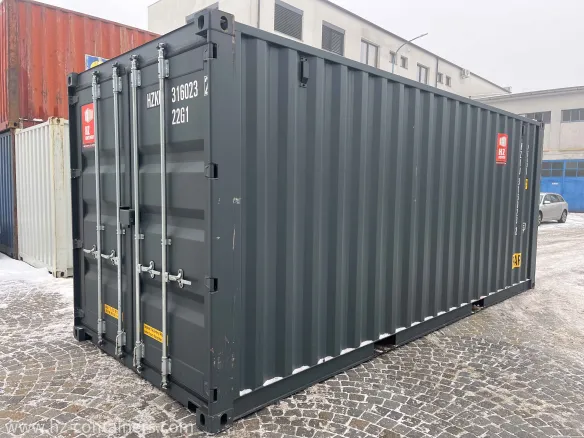
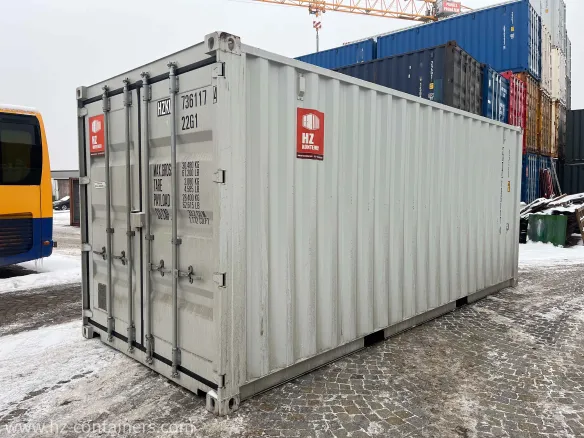
Cargo Container
Cargo container (shipping container, transport container, storage container) is a robust, reusable steel box of standardized dimensions designed for safe and efficient transportation and storage of goods. These containers represent the fundamental building block of the global supply chain, as they enable the transportation of goods across various modes of transport – maritime, rail, and road – without the need for reloading and unloading cargo at each transshipment point. This system, known as intermodal transportation, revolutionized international trade through dramatic cost reduction, minimization of cargo handling, and increased speed and reliability of transportation.
Containers have many designations in English and in practice: shipping container, maritime container, dry box, C-container, freight container, or historically Conex box. Their success lies in the combination of high strength, durability, and uniform dimensions that enable standardized handling techniques in all ports and transportation centers around the world.
Construction material: Most commonly Corten steel (corrosion-resistant) that creates a protective layer and minimizes corrosion in demanding climatic conditions.
Standardization: The International Organization for Standardization (ISO) establishes all key parameters (ISO 668), including dimensions, strength requirements, and corner construction (corner castings). This makes it possible to safely lift, stack, or secure any container to a vehicle anywhere in the world.

Summary: A cargo container is not just an ordinary steel “box”. It is a mobile warehouse that protects goods from damage, theft, and weather effects and enables the implementation of complex logistics operations from manufacturer to end customer.
Brief History: The Birth of Modern Containerization
From “break bulk cargo” to intermodal revolution
Until the mid-20th century, cargo transportation was very inefficient – goods were transported in bags, barrels, boxes of various sizes. Each transshipment point (truck, train, ship) required manual handling, which was time-consuming and costly and increased the risk of damage or theft.
First containers (metal-wooden boxes) appeared as early as the late 18th century, but were not standardized or intermodal. The real breakthrough came only in the 20th century.
Malcolm McLean, an American transportation magnate, noticed in the 1950s the inefficiency of transshipment and proposed a system where a trailer from a truck could be loaded directly onto a ship. This concept led to the creation of the first all-steel, lockable, and easily movable containers.
CONEX boxes: The designation “Conex” comes from the U.S. Army during the Korean War period (1950–53), which developed modular containers “Container Express” to accelerate supply. These containers were already stackable and began to be used in a “move and forget” system – without the need to handle the contents.
Container ship Ideal X in 1956 – the first container ship with 58 containers on deck – launched the era of modern containerization. In the 1960s, international ISO standards were then established, which set uniform dimensions and parameters including corners for safe handling (corner castings).
Advantages of containerization:
- Acceleration of transportation (goods are protected and do not need to be transshipped)
- Reduction of logistics costs
- Minimization of damage and losses
- Simplification of customs processes
The Power of Standardization: ISO Standards and Construction
The most important property of transport containers is their standardization. The International Organization for Standardization (ISO) issues standards (particularly ISO 668) that establish precise dimensions, strength requirements, and construction specifications, including:
- Standardized dimensions: Most commonly 20 feet (6.06 m) and 40 feet (12.19 m). These dimensions enable optimization of cargo space on ships, railways, and roads.
- Corner fittings (corner castings): All containers have 8 massive corner elements with precise holes (ISO 1161) that serve to grip and stack using spreaders and twist-locks.
- Strength and durability: Standards specify minimum strength of walls, roof, floor, and frame and the ability to withstand stacking of up to 9 containers on top of each other fully loaded (so-called stacking test).
- Unique designation: Each container has a unique code according to ISO 6346 (e.g., HZKU 123456 7), which enables global tracking and management.
| Main ISO Standards | Content |
|---|---|
| ISO 668 | External dimensions and maximum weights |
| ISO 1496 | Specifications for individual container types |
| ISO 6346 | Numbering and identification system |
| ISO 1161 | Construction and dimensions of corners (corner castings) |
Significance of standardization:
- The same handling technique can be used in all ports around the world.
- Simplification of capacity planning (ships, railways, trucks).
- Enables truly intermodal transportation without the need to transship contents.
Construction and Parts of a Transport Container
Modern transport containers are austere but purposefully designed for maximum strength, durability, and easy maintenance.
Basic structural elements
- Material: Almost always Corten steel (S355J2W), which is corrosion-resistant and creates a protective patina.
- Frame and corner posts: Massive steel construction with load-bearing corner posts that carry most of the load when stacking.
- Walls: Corrugated steel sheets (14-gauge, approximately 1.6–2 mm), which increase rigidity and resistance to deflection.
- Floor: Steel cross members and strong waterproof plywood (usually 28 mm), often impregnated against pests and moisture.
- Roof: Corrugated steel that drains water and protects against leaks.
- Doors: One (or two) large doors with several locking bars. Doors are equipped with rubber sealing for waterproofing and wind resistance.
- Corner fittings: 8 standardized corners enable safe lifting with a crane, handling with a forklift, and stacking.
Illustrative diagram:
| Part | Description |
|---|---|
| 1. Corner fittings | Enable lifting, stacking, and securing |
| 2. Walls | Corrugated, increase strength |
| 3. Frame | Main load-bearing frame and corner posts |
| 4. Doors | Lockable, sealed against weather |
| 5. Floor | Plywood + steel cross members, high load capacity |
| 6. Roof | Steel, protects contents |
Standard Dimensions and Weight Limits
The basic dimensions of transport containers are established by ISO standards, but in practice there may be minor variations depending on the manufacturer or specific shipping company. The most common variants are:
| Container Type | External Dimensions (L x W x H, m) | Internal Dimensions (L x W x H, m) | Doors (W x H, m) | Tare (kg) | Max. Load Capacity (kg) | Volume (m³) |
|---|---|---|---|---|---|---|
| 20′ Standard | 6.06 x 2.44 x 2.59 | 5.90 x 2.35 x 2.39 | 2.34 x 2.29 | 2,200–2,250 | 28,230 | 33.2 |
| 40′ Standard | 12.19 x 2.44 x 2.59 | 12.03 x 2.35 x 2.39 | 2.34 x 2.29 | 3,780 | 26,700 | 67.7 |
| 40′ High Cube | 12.19 x 2.44 x 2.89 | 12.03 x 2.35 x 2.69 | 2.34 x 2.58 | 4,020 | 26,460 | 76.3 |
Notes:
- Tare = weight of empty container.
- Load capacity is the maximum permitted cargo (cargo + tare = maximum gross weight).
- High Cube variant has increased height (2.89 m) for bulky goods.
Main Types of Transport Containers
Transport containers are not just “dry boxes”, but there is a whole range of specialized variants:
Overview of types
| Type | Description and Use |
|---|---|
| Standard (Dry Van) | Most common type, suitable for general dry goods. Available in lengths 20′, 40′, High Cube. |
| Reefer (Refrigerated Container) | Thermally insulated, equipped with a cooling unit for transporting food, medicines, flowers, etc. (temperatures -25 °C to +25 °C). |
| Open Top | Open roof protected by a tarpaulin, suitable for oversized or bulk goods. Loading by crane from above. |
| Flat Rack | Collapsible or fixed end walls, no side walls or roof. For heavy equipment, machinery, vehicles. |
| Tank Container | Internal stainless steel tank in a 20′ container frame. For transporting liquids, gases, and bulk materials including hazardous substances. |
| Open Side (Side Door) | Doors along the entire length of the side wall, easy loading and unloading with a pallet truck or forklift. |
| Tunnel Container | Doors on both ends for quick loading and unloading (“first-in, first-out”). |
Special containers
- Ventilated containers (for coffee, cocoa)
- Platforms (without walls and roof)
- Bulk containers (for bulk materials)
Ecosystem of Container Transportation
Basic principles
Intermodal transportation: One container can be transported by truck, train, and ship without unloading the contents.
Types of loading
- FCL (Full Container Load): Entire container for one customer, sealed at the point of origin and opened only at the destination. The advantage is speed and security.
- LCL (Less-than-Container Load): Shared container, goods from multiple customers in one box (consolidation), suitable for smaller shipments.
Key services in logistics
- Cartage/Drayage: Short transport of containers, e.g., between port and warehouse/distribution center.
- Freight Forwarding: Transportation intermediation (provision of container, documentation, communication with carriers).
- Blanket Wrapped Freight: Special securing of goods (e.g., furniture) inside the container using blankets.
Marking, Certification, and Safety
Each transport container is marked with a unique designation and safety certificates:
Key marks and labels
- CSC Plate (Convention for Safe Containers): Metal plate on the door, confirms compliance with international safety standards. New containers are valid for 5 years, then periodic inspections.
- ISO code: Identifies the size and type of container.
- Container number: Unique designation (e.g., ABCU 123456 7).
- Weight data: Tare, maximum gross weight, load capacity.
Importance of proper marking:
- Safe handling and stacking
- Customs and transportation control
- Prevention of overfilling or improper use
Second Life of Containers: Use Outside Transportation
After 10–15 years in demanding operation, most containers are decommissioned from international transportation, but due to their robustness, they find new uses.
Most common secondary uses
- Storage containers: Safe storage of materials, goods, equipment on construction sites, in industry, etc.
- Container architecture: Construction of container houses, offices, shops, or schools (so-called cargotecture). Popular due to speed of construction, modularity, and ecology (recycling).
- Mobile solutions: Conversions into mobile workshops, shops, healthcare facilities, data centers, or emergency housing.
 Czech Republic, Hradec Králové
  FREE SHIPPING