
Shipping container types
Roughly 80% of everything you own traveled to you inside a steel box. Shipping containers—also called cargo containers, ISO containers, or “conex” boxes—are the backbone of global trade, carrying about 90% of the world’s non-bulk cargo across oceans, rails, and highways. Yet a “shipping container” is not one single object. It is a family of specialized steel boxes, each engineered for a specific kind of cargo: some vent, some freeze, some open from the top, and some have no walls at all.
Where did shipping containers come from?
The modern container was born from a simple frustration: loading a ship by hand was slow and expensive. Before containerization, cargo was moved piece by piece in bags, barrels, and crates—a process called “break-bulk” shipping. Docks were crowded with longshoremen, and a single voyage could spend more time in port than at sea.
The turning point came from an American trucking entrepreneur named Malcom McLean. In 1956, McLean loaded 58 truck trailers onto a converted oil tanker, the SS Ideal X, and sailed them from Newark to Houston. The trailers—repurposed as steel boxes that could be lifted whole from truck to ship—cut loading costs from $5.86 per ton to just 16 cents. The concept proved itself immediately.
McLean’s insight wasn’t only the box itself; it was intermodality—the idea that a single container could move seamlessly between truck, train, and ship without being unpacked. He then made a decision that shaped the modern world: he released his container patents royalty-free to the International Organization for Standardization (ISO). By the late 1960s, ISO had published the first standards (ISO 668 and later ISO 6346) defining container dimensions, strength, and coding. This standardization is why a container loaded in Shanghai can be lifted in Rotterdam or Chicago using the same cranes and corner castings.
Key concept: An “ISO container” is any container built to the dimensional and structural standards set by the ISO. The corner castings—the hollow steel blocks at each of the eight corners—are what cranes, twist locks, and chassis grab onto, and their exact placement is what makes the whole global system work.
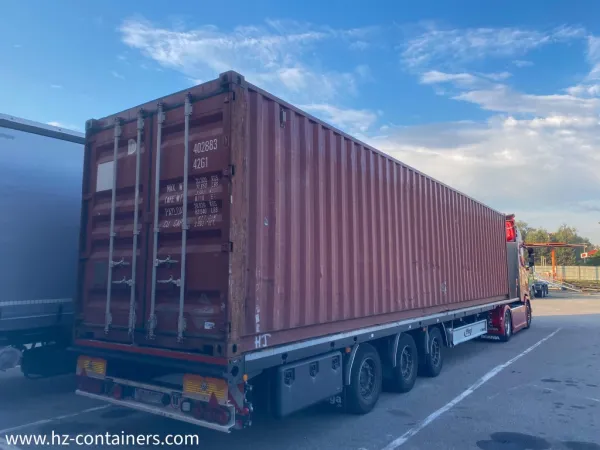
What is the standard size of a shipping container?
The two dominant sizes are the 20-foot and 40-foot container, both 8 feet wide (2.44 m) and, in standard form, 8 feet 6 inches tall (2.59 m). These dimensions define the entire container universe and give rise to the industry’s core unit of measurement.
TEU and FEU: the language of container capacity
The shipping industry measures everything in TEU (Twenty-foot Equivalent Unit). One 20-foot container equals 1 TEU; one 40-foot container equals 2 TEU (also called 1 FEU, or Forty-foot Equivalent Unit). When you read that a ship has “24,000 TEU capacity,” it means the vessel can carry the equivalent of 24,000 twenty-foot boxes—or 12,000 forty-footers, or a mix.
This unit matters because it lets ports, ships, and logistics companies compare and price capacity uniformly:
| Unit | Full name | Length equivalent | Typical use |
|---|---|---|---|
| TEU | Twenty-foot Equivalent Unit | 20 ft (6.06 m) | The baseline unit of container capacity |
| FEU | Forty-foot Equivalent Unit | 40 ft (12.19 m) | A standard 40-ft container = 2 TEU |
| High Cube | N/A (a height class) | 40 ft or 45 ft × 9 ft 6 in tall | Extra vertical cargo capacity |
A 40-foot container holds roughly twice the volume of a 20-footer but does not cost twice as much to ship, which is why “stuffing” cargo into 40-foot (or 45-foot) boxes is often more economical per cubic meter when you have the freight volume.
What are the standard shipping container dimensions?
Exact internal dimensions vary slightly by manufacturer, but these are the widely accepted reference figures. Understanding the difference between external and internal dimensions—and between payload and tare—is critical for planning a shipment.
| Container type | External (L × W × H) | Internal volume | Max payload (approx.) | Tare (empty) weight |
|---|---|---|---|---|
| 20 ft Standard | 20′ × 8′ × 8’6″ (6.06 × 2.44 × 2.59 m) | ~33.2 m³ (1,172 cu ft) | ~21,700 kg (47,900 lbs) | ~2,230 kg (4,916 lbs) |
| 40 ft Standard | 40′ × 8′ × 8’6″ (12.19 × 2.44 × 2.59 m) | ~67.7 m³ (2,390 cu ft) | ~26,700 kg (59,000 lbs) | ~3,750 kg (8,270 lbs) |
| 40 ft High Cube | 40′ × 8′ × 9’6″ (12.19 × 2.44 × 2.90 m) | ~76.3 m³ (2,694 cu ft) | ~26,500 kg (58,450 lbs) | ~3,970 kg (8,750 lbs) |
| 45 ft High Cube | 45′ × 8′ × 9’6″ (13.72 × 2.44 × 2.90 m) | ~86 m³ (3,040 cu ft) | ~27,900 kg (61,500 lbs) | ~4,800 kg (10,580 lbs) |
Tare weight, payload, and max gross—three numbers that matter
Every container has three critical weights, and confusing them causes overloading fines and cargo damage:
- Tare weight is the empty weight of the box itself.
- Payload (net weight) is the maximum weight of the goods you can put inside.
- Max gross (rating) is the combined total—tare plus payload—that the container structure and its corner castings are certified to carry and be lifted by.
A 20-foot container has a lower tare but a higher payload than a 40-footer in many cases, because its smaller internal volume spreads less weight over the same floor strength. For very dense cargo like steel coils or machinery, a 20-foot container is often the only safe choice even if a 40-foot box “fits” more volume.
What are the different types of shipping containers?
The shipping-container family breaks into two broad camps: the ubiquitous general-purpose (dry) container and a range of specialized containers built for cargo that won’t fit the standard box. Below is a full tour, organized by what each type is designed to carry.
| Container type | Best for | Key feature |
|---|---|---|
| Dry (general purpose) | Most boxed, palletized dry goods | Weatherproof sealed steel box |
| High cube | Light, bulky cargo | 1 ft of extra internal height |
| Reefer (refrigerated) | Perishables, pharma | Built-in cooling/heating unit |
| Insulated/thermal | Temperature-buffering, less precise | Insulated walls, no active cooling |
| Open top | Over-height cargo loaded by crane | Removable roof/tarpaulin |
| Hard top | Heavy/fragile tall cargo | Detachable steel roof |
| Flat rack | Oversized machinery, vehicles, pipes | Collapsible or no side walls |
| Open side | Wide cargo that can’t fit through doors | Full-length side doors |
| Double door (tunnel) | Fast loading, long goods (cars, pipes) | Doors at both ends |
| Tank container | Liquids, gases, chemicals | Cylindrical tank in a steel frame |
| Half-height | Dense bulk solids (ores, scrap) | Low-profile open-top bin |
| Swap body | European road/rail transfer | Detachable truck body, not stackable |
Dry container (general purpose container)
The dry container—also called a general purpose (GP) or “dry van”—is the workhorse. It is a fully enclosed, weatherproof steel box with rigid roof, walls, and floor, plus double doors at one end. Around 9 out of every 10 containers moving on the ocean are dry containers.
It carries anything that doesn’t need temperature control: palletized consumer goods, electronics, clothing, furniture, boxed machinery, and dry bagged cargo. Dry containers can be adapted with liner bags or flexitanks to carry dry bulk powder or even certain liquids, extending their reach far beyond boxes and pallets.
High cube container
A high cube (HC) container is essentially a dry container with one extra foot of height—9 feet 6 inches (2.90 m) instead of the standard 8 feet 6 inches. This single foot adds roughly 340 additional cubic feet (about 9.6 m³) of internal volume to a 40-footer.
High cubes suit light-but-bulky cargo: furniture, insulation, empty plastic bottles, automotive parts, or anything that “cubes out” (fills the volume) before it “weighs out” (hits the weight limit). They are typically available in 40-foot and 45-foot lengths. Because of their height, many high-cube floors have a recessed channel at the front to sit lower on “gooseneck” chassis for road transport.
Reefer container (refrigerated container)
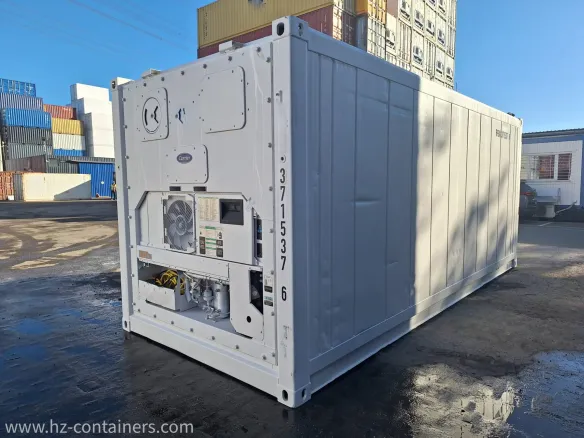
A reefer container is a mobile refrigerator. It uses an integrated electric cooling unit at one end to hold cargo at a precise set temperature, typically from about -30°C to +30°C (specialized units can go colder or hotter). The cooling unit runs on shipboard power at sea and plugs into a generator or shore power at port and on land.
Reefers carry everything from fresh produce and frozen meat to seafood, dairy, flowers, and temperature-sensitive pharmaceuticals—often with remote temperature monitoring in transit. They come in 20-foot, 40-foot, 40-foot HC, and 45-foot HC sizes. Reefers are more expensive than dry boxes both to buy and to move, because running the compressor consumes energy and capacity on a ship.
Insulated (thermal) container
An insulated container sits between a dry box and a reefer. Its walls are lined with insulating material to slow temperature change, but it has no active cooling unit. It protects cargo from rapid temperature swings and condensation during short journeys.
Insulated containers are often used alongside a separate portable refrigeration unit or for goods that only need protection from heat spikes—think certain confectionery, beverages, or chemicals that must be kept above freezing but don’t need active chilling. Because they lack a compressor, they are cheaper to operate than reefers.
Open top container
An open top container has a removable roof—usually a tarpaulin (tarp) secured by ropes and lashing rings, or a rigid lid on some models. The open roof allows loading from above by crane or rolling bridge, which is essential for over-height cargo that cannot be angled through a standard end door.
It carries tall machinery, transformers, large pipes, and bulky finished products. Open tops include lashing rings along the top and bottom side rails and in the corner posts for securing cargo that protrudes above the walls. They come in 20-foot and 40-foot lengths.
Hard top container
A hard top container is a variant of the open top with a detachable steel roof instead of a tarp. This matters when cargo must be loaded from above but also needs full protection from weather and crushing—or when the container itself must be stacked under other containers. The rigid roof allows hard tops to be stacked, which tarpaulin-roofed open tops generally cannot be.
Typical cargo includes heavy raw materials, large industrial components, and any tall load where a soft cover would be inadequate. Hard tops are available in 20-foot and 40-foot sizes.
Flat rack container
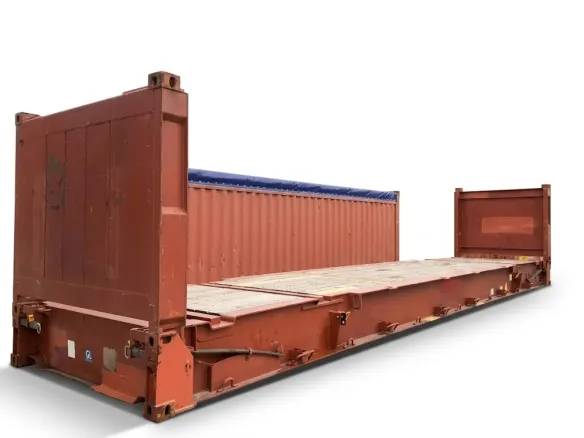
A flat rack container strips away most of the box. It has collapsible or fixed end walls and no side walls or roof, and sometimes a floor only (a “platform” configuration). This open architecture lets it carry cargo that is too wide, too tall, or too irregularly shaped for any enclosed container.
Flat racks handle heavy machinery, tracked vehicles, yachts, large reels of cable, pipe, and construction equipment. Cargo is lashed directly to the lashing points on the frame and end walls. A 40-foot flat rack can carry loaded cargo of up to 45 metric tons in some configurations—among the highest payloads in the container world. Flat racks are essential “out of gauge” (OOG) equipment for oversized project cargo.
Open side container
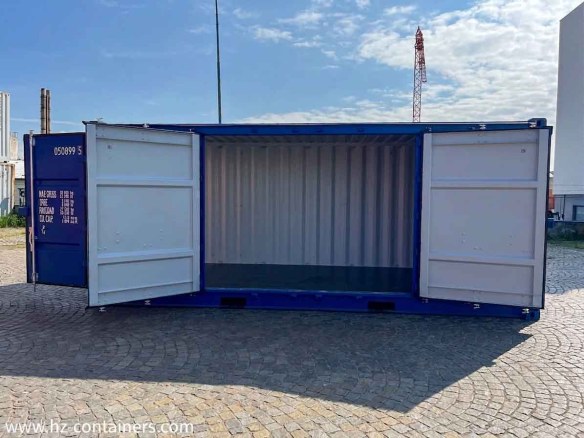
An open side container—also called a side-door container—has doors that open along the entire long side rather than (or in addition to) the front end. This full-width access makes it far easier to load cargo that is wide or that must be slid in sideways with a forklift.
They are used for cargo that won’t fit through standard end doors, such as wide machinery components, sheet materials, or long timber and steel sections. Open side containers come in 20-foot, 40-foot, and 40-foot HC lengths.
Double door container (tunnel container)
A double door container has full cargo doors at both ends, which is why it is also called a “tunnel container”—you can see straight through it when a single set of doors is open. Both doors have identical locking gear and weather-tight seals.
Two doors speed up loading and unloading dramatically, and they allow very long items (steel beams, pipes, vehicles) to be threaded through. Tunnel containers are popular for auto transport and for high-throughput shipping where goods must be both loaded and offloaded quickly. They come in the same dimensions as dry containers and share the same ISO code.
Tank container
A tank container is a cylindrical stainless-steel tank set inside a steel container frame. The frame gives the tank the same twist-lock corner castings and stacking dimensions as a standard container, so it can be handled identically to a “box.”
Tank containers carry liquids, gases, and powders—chemicals, fuels, food-grade liquids (wine, cooking oil, juice), and dangerous goods. The tank is typically made of corrosion-resistant stainless steel and may be insulated, heated, or lined for specific products. Standard tank containers are 20-foot in frame length and can hold roughly 14,000–26,000 liters, depending on the density of the cargo they are certified to carry.
Half-height container
A half-height container is, as the name says, roughly half the height of a standard box—usually around 4 feet 3 inches (1.3 m) tall and open-topped. Its low, sturdy profile is designed for dense, heavy bulk materials that would crush or overload a full-height container if filled to its normal level.
Half-heights carry ores, sand, gravel, scrap metal, and other heavy bulk solids that are gravity-loaded from the top. Because the cargo is so heavy, the shallow depth keeps the total weight within safe lifting limits while keeping the center of gravity low.
Swap body container
A swap body is a specialized unit used mainly in European road and rail intermodal transport. It looks like a container but is designed to be transferred between trucks and trains—or swapped between trucks—without the heavy twist-lock corner castings of a true ISO container.
Swap bodies are lighter and often have folding legs so a truck can “drop” the body and drive away. Unlike ISO containers, most swap bodies are not stackable and are not built for ocean journeys. They exist to optimize high-frequency land transport, mostly within Europe.
How do I read the ISO type code on a container?
Every ISO container carries a four-character size and type code (part of the broader ISO 6346 marking) that instantly identifies its length, height, and type. Decoding it is simpler than it looks.
Example: 42G1
- First character (4): the length code. “2” means 20 feet, “4” means 40 feet, “L” means 45 feet.
- Second character (2): the height code. “2” means standard height (8’6″), “5” means high cube (9’6″).
- Third character (G): the type group. “G” = general purpose, “R” = reefer, “U” = open top/open side, “P” = platform/flat rack, “T” = tank, “H” = insulated.
- Fourth character (1): a refinement of the type (e.g., G1 = dry box with passive vents). “0” often indicates an open-top variant within its group.
Here are the codes you will actually encounter in the field:
| ISO code | Length & height | Type |
|---|---|---|
| 22G1 | 20 ft standard | General purpose / dry |
| 42G1 | 40 ft standard | General purpose / dry |
| 45G1 | 40 ft high cube | General purpose / dry (HC) |
| L5G1 | 45 ft high cube | General purpose / dry (HC) |
| 22R1 | 20 ft standard | Reefer (refrigerated) |
| 42R1 | 40 ft standard | Reefer |
| 45R1 | 40 ft high cube | Reefer |
| 22U1 | 20 ft standard | Open top |
| 42U1 | 40 ft standard | Open top |
| 22P1 | 20 ft | Flat rack (fixed ends) |
| 42P1 | 40 ft | Flat rack |
| 22T1 | 20 ft | Tank |
| 22H1 | 20 ft standard | Insulated |
The full ISO 6346 marking on the door also contains the owner code (three letters, e.g., “MSK” for Maersk), a category identifier (U = freight container), the serial number, and a check digit, followed by the size/type code and other operational marks. Knowing the type code lets you confirm at a glance—by style, not just by looks—whether the box in front of you is a 40-foot high cube or a 40-foot standard.
How do I choose the right shipping container type?
Selecting a container comes down to a short sequence of questions about your cargo, asked in roughly this order:
- Is it dry, liquid, gas, or temperature-sensitive? This is the biggest fork in the road. Dry goods go in a dry box; liquids and gases go in a tank; perishables go in a reefer or insulated container.
- How much does it weigh, and how dense is it? Very heavy, dense cargo may “weigh out” a 20-footer or require a half-height or flat rack. Light, bulky cargo “cubes out” and may need a high cube.
- What is its shape and size? Over-height items need an open top or hard top. Over-width or oversized items need a flat rack or open side. Long items may need a tunnel container.
- How will it be loaded and unloaded? Crane loading from above points to open top or flat rack. Side loading points to open side. Rail or short-haul European transport may call for a swap body.
- What are the origin and destination constraints? Road height limits, chassis availability, and crane capacity at both ends all constrain which container actually works.
A practical decision heuristic:
| Cargo characteristics | Recommended container type |
|---|---|
| Boxed, palletized dry goods | Dry (general purpose) |
| Bulky but light, tall pallets | High cube |
| Perishables, pharmaceuticals, frozen food | Reefer |
| Liquids, gases, chemicals | Tank |
| Over-height machinery loaded by crane | Open top or hard top |
| Oversized machinery, vehicles, pipes | Flat rack |
| Wide cargo needing full side access | Open side |
| Long goods (beams, cars) needing two-end access | Double door |
| Dense bulk solids (ore, scrap) | Half-height |
| Short-haul European road/rail | Swap body |
When in doubt, freight forwarders and shipping lines can review your cargo specifications—dimensions, weight, form, and any special handling needs—and recommend the right equipment. Specialized containers are rarer and booked in advance, so plan early if your cargo isn’t a standard dry load.
What do people get wrong about shipping container types?
Several misconceptions circulate widely, and they can cost real money if you act on them:
- “A high cube is just a bigger box.” Mostly true on volume, but its extra height can trigger road clearance issues and requires high-cube-capable handling. Don’t assume it’s interchangeable with a standard box on every route.
- “A 40-foot container always carries more weight than a 20-footer.” Not by payload. A 20-foot container often has a higher payload rating than a 40-footer because the load is concentrated and the floor is rated to handle dense cargo better.
- “Open top and flat rack are the same thing.” They aren’t. An open top still has four walls and a floor—it’s an enclosed box with a removable lid. A flat rack is essentially a platform with end walls and no sides or roof.
- “Reefers only cool.” Most reefers can both cool and heat, maintaining a set temperature range in either direction. Some cargo needs to be kept warm, not cold.
- “All containers are ocean-going ISO containers.” Swap bodies, for example, look similar but are land-only equipment that usually cannot be stacked or shipped by sea.
Where are shipping container types heading next?
The container fleet is evolving as shipping responds to new pressures:
- Larger and taller boxes: The 45-foot high cube—and, in some lanes, even longer domestic units—continues to grow in share, squeezing more volume per slot.
- Smarter equipment: “Smart containers” with embedded IoT sensors track location, temperature, humidity, shock, and door status in real time, adding a digital layer to the physical box. This is especially transformative for reefer cargo monitoring.
- Specialization: Specialized types—flat racks, tanks, open tops—remain a small but high-value share of the fleet, growing with project-cargo and energy-transition demand (wind turbines, batteries, and grid equipment are flat-rack and open-top heavy).
- Efficiency and emissions: Lighter container materials, better insulation, and more efficient reefer compressors aim to cut weight and energy use, trimming the fuel and power that every box consumes in transit.
- Reuse beyond shipping: Second-life containers—as homes, offices, pop-up shops, and storage—have created a robust aftermarket where retired dry and high-cube boxes dominate, driven by the same standardization that made containers cheap and plentiful in the first place.
The steel box McLean launched in 1956 now comes in a dozen specialized forms, each tuned to a fragment of global cargo. Understanding those differences—not just sizes, but types, weights, and codes—is the difference between shipping cargo and shipping it right.
Frequently Asked Questions
What is the most common shipping container type?
The dry container (general purpose container) is by far the most common, representing roughly 9 in 10 ocean containers. It is a fully enclosed, weatherproof steel box used for boxed and palletized dry goods. When people say “shipping container” without qualification, they almost always mean a dry container.
What is the difference between a 20ft and 40ft container?
The 40-foot container is exactly twice the length of a 20-footer and holds roughly double the volume (~67.7 m³ vs ~33.2 m³). However, because of floor-strength limits, a 20-foot container often has a higher payload rating than a 40-footer for very dense cargo. A 40-footer generally costs less per unit volume to ship, making it more economical when you have the freight to fill it.
What is a high cube container versus a standard container?
A high cube is one foot taller than a standard container—9 feet 6 inches (2.90 m) versus 8 feet 6 inches (2.59 m). This adds about 340 cubic feet of volume to a 40-foot box and suits light, bulky cargo that “cubes out” before it “weighs out.”
What does TEU and FEU mean?
TEU stands for Twenty-foot Equivalent Unit, the baseline measure of container capacity—one 20-foot container equals 1 TEU. FEU stands for Forty-foot Equivalent Unit; one 40-foot container equals 2 TEU or 1 FEU. Ports, ships, and freight rates are all expressed in these units.
Can a reefer container both cool and heat?
Yes. Most reefer (refrigerated) containers can both cool and heat, maintaining a set temperature within a broad range (typically about -30°C to +30°C, with specialized units extending further). This two-way capability is why reefers carry both frozen food and cargo that must be kept warm.
How do I read the ISO code on a container?
The four-character size/type code (e.g., 42G1) encodes length (first character: 2=20ft, 4=40ft, L=45ft), height (second character: 2=standard, 5=high cube), type group (third character: G=general purpose, R=reefer, U=open top, P=flat rack, T=tank, H=insulated), and a type refinement (fourth character). A full ISO 6346 marking also includes the owner code, serial number, and check digit.
Which container type should I use for heavy machinery?
Oversized, heavy machinery is typically shipped on a flat rack container (especially if wider or taller than normal) or an open top / hard top container if it is tall but otherwise fits within the frame. Flat racks offer the highest payloads and open access for lashing; for extremely heavy, dense solids, a half-height container may be the safe choice.

 Czech Republic, Třebíč
 FREE SHIPPING
Other container news...

40 foot container storage uses
The 40 foot container has moved far beyond its original job of hauling cargo across the ocean. Today, the phrase “40 foot container storage uses” describes an enormous and still-growing field: everything from an extra garage behind a house to a full retail storefront, a mobile office, an indoor farm, or a temporary shelter. Because the 40 foot container is the most common size in global shipping, it is also the most abundant, the most affordable, and the most widely converted for storage and building purposes.

How tall is a 20-Foot shipping container?
A 20-foot shipping container stands 8 feet 6 inches (8′ 6″) tall on the outside, or 2.59 meters. Inside, the usable height is slightly less — roughly 7 feet 9–5/8 inches (2.39 m) — because the floor, roof panels, and corner castings consume several inches of the total height.
That is the short answer. But “how tall” hides important nuance: the number changes depending on whether you are measuring a standard unit or a high cube unit, whether you are measuring the exterior or the interior, and whether you actually need to fit something through the door opening, which is the shortest vertical dimension on the entire box.

Shipping container wheel movement kits
A shipping container wheel movement kit is a bolt-on (or twist-lock) hardware system that lets a single person attach wheels to the corner castings of a 20 ft or 40 ft shipping container and reposition it — often without a crane, forklift, or flatbed truck. Instead of hiring a heavy-haul trucker every time you want to nudge a container a few feet on your property, the right wheel kit turns a 4,000–10,000 lb steel box into something a pickup truck, skid steer, or a couple of strong backs with a come-along can move.

How much does it cost to rent a 40ft High Cube container?
The honest answer to how much it costs to rent a 40ft high cube container is that the headline monthly rate is only part of the real bill. Across the United States in 2026, the base rental rate for a 40ft high cube container typically lands between $150 and $300 per month, with most providers clustering around $175 to $250 per month. But delivery fees, pickup charges, term discounts, and the physical condition of the unit can push your true all-in cost meaningfully higher — or, when you negotiate well, pull it down toward the low end of the range.