Door Gasket
What is a shipping container door gasket?
A shipping container door gasket, often referred to by the English term door gasket or simply “container door rubber”, is a crucial component of every shipping, storage, or special transport container. It is a profiled part, most commonly made of dense synthetic rubber (usually EPDM), which is fitted into a groove around the entire perimeter of the container door and at its corners. Its main role is to ensure an airtight and watertight seal of the container’s interior.
A properly installed and maintained gasket protects the cargo from rain, dust, saltwater, insects, and extreme temperature fluctuations. It is especially important when transporting sensitive goods – such as electronics, paper, chemicals, as well as food, pharmaceuticals, and other commodities, where any leakage of moisture or dust can cause irreversible damage.
In the world of global logistics, where containers often travel thousands of kilometers across continents and oceans, gasket failure can lead to the spoilage of multi-million dollar shipments. It is therefore not just a simple rubber strip, but a key technical component subject to ISO standards, manufacturing controls, and material requirements.
In-depth Definition and Basic Functions of Gaskets
A door gasket is not just a passive insulating barrier. It is a dynamic element that must react to changes in pressure, vibrations, thermal expansion of metals, and changes in sealing effectiveness over years of operation. The functions of a gasket can be divided into several areas:
Protection Against Weather and Contamination
- Watertightness: Prevents the penetration of rainwater, condensate, splashing water during washing, or floods.
- Airtightness: Protects the container’s contents from the ingress of dust, sand, pollen, smog, and fumes.
- Pest Protection: Prevents insects, rodents, and other animals from entering the container space.
Maintaining a Controlled Internal Environment
- For refrigerated containers (reefer), the gasket is essential for maintaining stable temperature and humidity. Leaks mean increased energy costs and the risk of cargo spoilage.
- For storage containers, it is crucial for preventing mold, corrosion, and degradation of stored material.
Ensuring Structural Integrity and Security
- The gasket fills the space between the door and the frame, dampening vibrations during handling and transport.
- It hinders unnoticed entry – a damaged gasket is a clear sign of an attempted break-in or unauthorized intervention.
Insulation in Modified Applications
- For residential, office, or sanitary containers, it also serves as thermal and acoustic insulation – increasing user comfort inside the shipping container home, for example.
Material Composition and Technical Specifications
EPDM – The Gold Standard for Container Gaskets
The most common material for manufacturing door gaskets is EPDM (Ethylene Propylene Diene Monomer) rubber. Its properties:
- Excellent resistance to UV radiation, ozone, weathering, aging, and most chemicals.
- Operating temperature range: –40 °C to +120 °C, short-term up to +150 °C without loss of elasticity.
- High elasticity and shape memory – the gasket retains its sealing ability long-term, even after compression and repeated opening/closing.
- Does not absorb water – minimizes the risk of water absorption and subsequent degradation.
Alternatively, in some cases, you may encounter silicone-based gaskets (for special applications requiring higher chemical or temperature resistance), or NBR (for higher oil resistance).
Key Technical Parameters (according to ISO standard and manufacturers):
| Property | Typical Value | Practical Significance |
|---|---|---|
| Material | EPDM, alternatively NBR | Resistance, durability, non-flammability |
| Hardness (Shore A) | 65–75 | Resistance to deformation, elasticity |
| Tensile strength | min. 7 MPa | Resistance to mechanical damage |
| Elongation at break | min. 300 % | Flexibility |
| Density | 1.2–1.4 g/cm³ | Affects mechanical properties and sealing |
| Ozone resistance | 100 h/50 pphm/40 °C | Prevention of outdoor aging |
| Operating temperature | –40 °C to +120 °C | Usability in various climatic conditions |
Gasket Typology and Design – Profiles, Corners, Application
Container door gaskets are not universal. They differ according to container type, manufacturer, and installation location.
Basic Gasket Profiles
| Profile Type | Description and Use | Illustrative Image |
|---|---|---|
| J-type | Most common, double sealing line, mainly for the main door frame | – |
| C-type | Supplementary gasket for areas with less space | – |
| T-type | For special applications, e.g., top edge of doors | – |
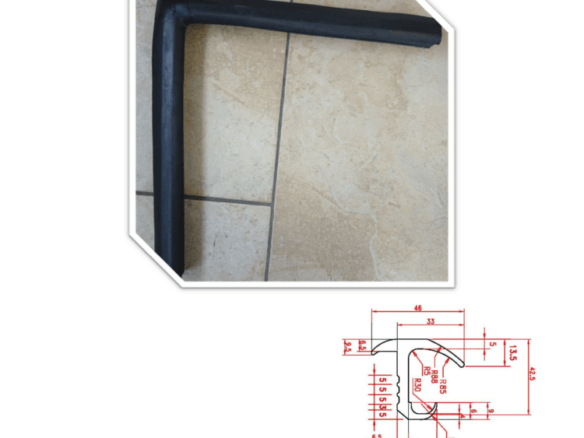
| Corner pieces | Specially shaped pieces (e.g., 30 x 30 cm), for perfect sealing of corners, preventing “weak spots” | – |
- Each profile type has a precisely defined cross-section that matches the groove in the door frame and is certified according to the ISO standard.
- Note: For some containers (especially older ones or from different manufacturers), profiles may not be interchangeable – it is always necessary to verify the specific dimension and type.
Gasket Arrangement on Double-Leaf Doors
- Right door leaf (closes first): gasket around the entire perimeter.
- Left door leaf (closes second): gasket on the top, bottom, and outer edge.
- Middle overlap: the leaves overlap, the gasket is only on one of them – ensuring reliable sealing without a double layer.
Specifics of Refrigerated Container Gaskets
- Multi-chamber profiles to minimize thermal bridges.
- Often higher and with greater compressibility.
- Stricter requirements for material purity and hygiene (food-grade standard).
Gasket Installation, Maintenance, and Replacement
Installation
- The gasket is inserted into a pre-prepared groove in the container door frame.
- Fixation is ensured by a retaining strip, usually made of stainless steel, which is riveted or screwed to the frame.
- Corner pieces (e.g., J-type 30×30 cm) are installed in the door corners, where they ensure sealing even in the most stressed areas.
- Recommended procedure: start at the corners, continue along the edges, ensuring even tension and proper seating in the groove.
Maintenance
- Visual inspection: Regularly (1–2 times a year) check the condition of the gasket – cracks, swelling, deformation, leaks.
- Light test: Close an empty container, observe light penetration around the doors – this signals gasket damage.
- Cleaning: Remove dust, salt, and dirt with a soft cloth and lukewarm water. Avoid aggressive chemicals, as they could damage the EPDM.
Replacement
- The lifespan of a quality EPDM gasket is 10–15 years, depending on the intensity of operation and location (exterior/interior).
- Replacement process:
- Removal of the old gasket and strip (drilling out rivets, screws).
- Thorough cleaning of the groove (from rubber residues, rust, dirt).
- Installation of the new gasket – with emphasis on correct corner fitting and not stretching the profile.
- Attachment of the new strip and fastening (new rivets/screws).
- For sectional repairs, use a special sealing compound at the joints.
- For the bottom gasket, it is often necessary to lift the container.
- Replacement cost (material only): from 40 EUR per corner (J-type), a complete gasket set for one 20′ container from approx. 160–250 EUR excluding VAT (2024).
Importance of Gaskets in Various Container Applications
| Container Type | Gasket Importance | Specifics/Tips |
|---|---|---|
| Shipping and transport | Protection against water, salt, dust, pests | Adhere to standardized profiles and certifications |
| Storage | Prevention of mold, corrosion, degradation | Regularly check condition in exterior |
| Refrigerated (reefer) | Temperature, humidity, hygiene preservation | Use original multi-chamber profiles |
| Office/residential | Insulation against noise, humidity, temperature | Supplement with additional insulation layers as needed |
| Special/fireproof | Increased material requirements | Verify fire and chemical certification |
Standards, Certifications, and Inspections
Relevant Standards
- ISO 1496–1 (container construction)
- ISO 17708 (container watertightness)
- GB/T15846-2006 (Chinese standard for watertightness and sealing)
- EN 681-1 (European standard for rubber gaskets)
Certifications and Certificates
- Reputable manufacturers provide material and test sheets, ISO compliance certifications, and hygiene certificates (for food contact, etc.).
- In practice, it is advisable to request documentation when purchasing spare parts and entire containers.
Common Mistakes and Practical Recommendations
- Using non-original profiles: Cheap universal gaskets may not fit precisely into the groove, leading to leaks and rapid degradation.
- Underestimating corner replacement: The most common point of leakage is a poorly fitted or omitted corner piece.
- Lack of regular maintenance: Aggressive environments (salt, frost, dust) significantly shorten gasket lifespan without maintenance.
- Incorrect installation: Excessive stretching of the profile during assembly causes a reduction in cross-section and loss of sealing.
Frequently Asked Questions (FAQ)
- What is the best material for container door gaskets?
Definitely EPDM rubber certified according to ISO/EN; it has the best combination of durability, flexibility and resistance. - How long do door gaskets last?
10-15 years with normal operation and maintenance, more frequent inspection is recommended for refrigerated containers (aggressive environment, temperature cycles). - Can I repair a damaged gasket locally?
Yes, there are sectional repair parts and sealants, but in case of more extensive damage we recommend replacing the entire set on the given wing. - How do I know that the gasket is failing?
Visible cracks, swelling, deformation, light penetration when the door is closed or signs of moisture inside. - Are gaskets for refrigerated containers different?
Yes, they have more complex multi-chamber profiles, higher tightness and insulation capacity, often also food certifications.
 Czech Republic
  WITHOUT SHIPPING