
20ft High Cube Shipping Container
20ft high cube shipping container is a standardized intermodal cargo container that shares the same length and width as a regular 20ft unit, but adds one extra foot of vertical space — standing 9 feet 6 inches tall instead of the standard 8 feet 6 inches. That single foot translates into approximately 15% more interior cubic capacity, making the 20ft high cube one of the most versatile tools in global logistics, on-site storage, and modular construction. Whether you are shipping bulky cargo across an ocean, setting up secure storage at an urban job site, or planning a container home with cathedral-height ceilings, understanding this equipment in full detail changes the way you specify, buy, and use it.
Quick definition: A 20ft high cube (often abbreviated as 20′ HC, 20ft HC, or 20′ High Cube) is an ISO-standard dry cargo container measuring approximately 20 feet long × 8 feet wide × 9 feet 6 inches tall on the outside, offering roughly 1,320 cubic feet (37.4 m³) of interior storage volume.
What are the exact dimensions of a 20ft High Cube container?
Every inch and millimeter counts when you are planning a load, ordering transport, or designing a conversion. The dimensions of the 20ft high cube container are governed by ISO 668, the international standard that ensures containers can be handled by the same cranes, chassis, and ship cells anywhere in the world.
Exterior dimensions
A 20ft high cube shipping container shares its exterior footprint with the standard 20ft container in length and width. The height is the distinguishing feature:
- Exterior length: 20 ft (6,058 mm)
- Exterior width: 8 ft (2,438 mm)
- Exterior height: 9 ft 6 in (2,896 mm)
Interior dimensions
The interior space — where your cargo actually lives — reflects the thickness of the corrugated CORTEN steel walls, the roof structure, and the floor:
- Interior length: 19 ft 4 in (5,898 mm)
- Interior width: 7 ft 8 in (2,352 mm)
- Interior height: 8 ft 10 in (2,689 mm)
Door opening dimensions
Door clearance is critical when you are loading palletized goods with a forklift or walking tall equipment through the rear opening:
- Door width: 7 ft 8 in (2,340 mm)
- Door height (new): 8 ft 5 in (2,566 mm)
- Door height (used): 7 ft 6 in (2,286 mm) — varies with wear
The difference between a high cube and a standard container becomes obvious when you stand them side by side:

| Dimension | Standard 20ft container | 20ft High Cube container | Difference |
|---|---|---|---|
| Exterior height | 8′6″ (2,591 mm) | 9′6″ (2,896 mm) | +1′0″ (305 mm) |
| Interior height | 7′10″ (2,385 mm) | 8′10″ (2,689 mm) | +12″ (304 mm) |
| Door opening height | 7′5″ (2,261 mm) | 8′5″ (2,566 mm) | +12″ (305 mm) |
| Interior volume | 1,172 ft³ (33.2 m³) | 1,320 ft³ (37.4 m³) | +148 ft³ (4.2 m³) |
| Typical pallet capacity | 9–10 standard pallets | 9–10 standard pallets | Same floor, more height |
How much weight can a 20ft High Cube container hold?
Weight limits are where many buyers complicate their lives. A 20ft high cube shipping container carries three distinct weight figures you must understand: tare weight, payload, and maximum gross weight.
Tare weight
The tare weight of a container — the weight of the empty unit itself — is approximately 2,300 kg (5,070 lbs) for a new or one-trip unit. Because the high cube uses additional steel in the taller corner posts and side panels, it is marginally heavier than a standard 20ft container, whose tare runs around 2,200 kg (4,850 lbs). A used high cube may have a slightly lower tare — roughly 4,980 lbs — due to floor wear and thinner paint.
Payload
The payload is the weight of cargo you can legally and safely load inside. For a 20ft HC, the payload capacity is up to 28,180 kg (62,126 lbs). This figure assumes the container is in good structural condition and that you do not exceed road weight limits. In practice, many loads in a 20ft footprint are limited by volume rather than weight — which is exactly why the high cube makes sense: you can load lighter, bulkier goods without hitting the weight ceiling.
Maximum gross weight
The maximum gross weight — the tare weight plus the payload — is 30,480 kg (67,200 lbs). This number is stamped on the container’s CSC safety approval plate and is the absolute limit for stacking, lifting, and transport. Exceeding it voids insurance, violates maritime and road regulations, and risks structural failure.
| Weight metric | Standard 20ft | 20ft High Cube |
|---|---|---|
| Tare weight | ~4,850 lbs (2,200 kg) | ~5,070 lbs (2,300 kg) |
| Payload capacity | ~62,170 lbs (28,200 kg) | ~62,126 lbs (28,180 kg) |
| Maximum gross weight | 67,200 lbs (30,480 kg) | 67,200 lbs (30,480 kg) |
Losing roughly 44 lbs of payload on the high cube compared to a standard 20ft container is a negligible trade-off for gaining an additional 148 cubic feet of volume.
How did High Cube shipping containers come about?
The 20ft high cube shipping container did not appear in a vacuum. It is the product of decades of evolution in global trade infrastructure.
The birth of containerization: Malcolm McLean, 1956
In 1956, American truck entrepreneur Malcolm McLean loaded 58 standardized aluminum truck bodies onto a converted tanker called Ideal X in Newark, New Jersey, and sailed them to Houston, Texas. That single voyage launched the era of intermodal containerization — the idea that a sealed steel box could move seamlessly from truck to ship to train without ever being unpacked. McLean’s insight was not the container itself (simple boxes had been used before), but the system: a standardized unit that cranes, ships, and chassis could all handle identically.
ISO standards and the 8′6″ starting height
In the 1960s, the International Organization for Standardization (ISO) formed Technical Committee 104 (“Freight Containers”) to issue dimensions that would govern global container design. The resulting ISO 668 standard codified the 20-foot length as one TEU (Twenty-foot Equivalent Unit) and the 40-foot length as one FEU (Forty-foot Equivalent Unit), with a standard height of 8 feet 6 inches.
That 8′6″ height was a compromise designed to fit under bridges, through tunnels, and on the road networks of the 1960s. It served well for decades. But shippers of bulky, lightweight goods — furniture, insulation, automotive parts, agricultural products — repeatedly ran out of vertical space before they reached the weight limit. A 20ft container could hold 62,000 lbs of cargo, yet many loads “cubed out” (filled the space) at just 30,000 lbs.
Why the High Cube was invented
The high cube container emerged in the 1980s and 1990s as an industry solution to this volume-versus-weight problem. By extending the corner posts and side panels by exactly one foot (305 mm), manufacturers created a unit that still fit within most port crane profiles and ship cell guides, but offered roughly 15% more interior space. The ISO standard eventually incorporated the 9′6″ height as an approved variant, and shipping lines began deploying high cube containers on routes where volume cargo dominated. Today, high cube containers — particularly the 40ft variant — represent a substantial and growing share of the global container fleet, with the 20ft high cube filling a niche for smaller shipments carrying tall cargo.
How does a 20ft High Cube differ from a standard 20ft container?
The differences go beyond a single extra foot of height. The choice between standard and high cube affects loading strategy, transport logistics, modification options, and total cost.
Height: the defining difference
A standard 20ft container is 8′6″ tall on the outside; a high cube is 9′6″. Inside, the difference is roughly 12 inches (304 mm). When you stand inside a standard container, the ceiling is tight above the heads of most adults. In a high cube, you can raise your arms, install ceiling lighting without stooping, and walk tall shelving units through the doors.
Volume gain
The interior cubic capacity rises from approximately 1,172 ft³ (33.2 m³) to 1,320 ft³ (37.4 m³). That is a gain of 148 cubic feet — roughly the size of a large walk-in closet or a small bathroom. For businesses shipping expanded foam insulation or hollow plastic components, that extra volume means fewer containers per shipment, lower per-unit transport costs, and fewer handling operations.
Door opening height
A standard 20ft container has a door opening height of approximately 7′5″ (2,261 mm). A 20ft high cube offers approximately 8′5″ (2,566 mm) — a full extra foot. That is not negligible when you are running a forklift carrying a pallet stacked 7′10″ tall. In a standard container, such a pallet will not clear the door header. In a high cube, it passes through with room to spare.
Weight penalty
A high cube is approximately 100–150 lbs heavier than a standard container due to the additional steel in the corner posts and longer side panels. Payload capacity drops by a corresponding tiny amount. The maximum gross weight limit remains identical at 67,200 lbs. For practical purposes, this weight difference is irrelevant for most cargo profiles.
| Feature | Standard 20ft | 20ft High Cube | Practical impact |
|---|---|---|---|
| Exterior height | 8′6″ | 9′6″ | HC fits in most ship cell guides; may require a low-profile chassis for road transport |
| Interior clear height | 7′10″ | 8′10″ | HC allows upright walking, tall shelving, ceiling fixtures |
| Door clearance | 7′5″ | 8′5″ | HC accepts taller pallets and machinery |
| Interior volume | 1,172 ft³ | 1,320 ft³ | HC carries 12.6% more volume |
| Typical 48″×40″ pallets | 9–10 | 9–10 (same floor) | HC allows taller pallet stacking |
What are common uses for a 20ft High Cube container?
A 20ft high cube shipping container hits a sweet spot: small enough to deliver on a tilt-bed truck to a residential driveway, large enough to store the contents of a two-bedroom apartment, and tall enough to feel genuinely spacious.
Cargo and transport applications
For international maritime shipping, a 20ft HC is classified as 1 TEU of dry cargo container. It is used extensively for volume cargo — furniture, automotive components, plastic goods, textiles, and agricultural equipment — where shippers run out of space before the weight limit. Its compact length makes truck transport easier through urban areas and placement on tight job sites compared to a 40ft unit.
On-site storage
Construction firms, retail operations, and event organizers use 20ft high cube containers as secure, weather-resistant storage units. The extra height allows stacking racks three or four levels high, creating substantially more organized storage in the same footprint. A 20ft HC can hold tools, building materials, inventory, furniture, documents, and seasonal equipment — all behind lockable double cargo doors.
Container homes, offices, and tiny houses
The high cube is the preferred platform for container architecture. Standard shipping containers with their 7′10″ interior height become cramped as soon as you add floor insulation, ceiling insulation, and any overhead installations. A high cube with 8′10″ of interior height accommodates 6–8 inches of floor and ceiling treatments and still leaves well over 8 feet of living clear height. That makes it viable as a tiny house, garden office, guest apartment, retail pop-up, or site hut. Architects and self-builders consistently choose high cube for residential conversions for exactly this reason: that extra foot is the difference between a claustrophobic box and a comfortable room.
Specialized modifications
A 20ft HC can be modified with personnel doors, windows, roll-up garage doors, HVAC cutouts, interior partitions, spray-foam insulation, electrical panels, and plumbing installations. Because the container is structural steel, cutting openings requires reinforcing the surrounding frame with steel square tubing or profiles, but modification shops across North America routinely do this work for less than the cost of conventional construction of equivalent size.
How much does a 20ft High Cube container cost?
Prices for 20ft high cube containers vary dramatically by condition, location, and market conditions. Unlike standard 20ft containers — which are produced and retired from service in massive volumes — the 20ft high cube is less common on the secondary market, which can push used prices slightly higher.
New (One-Trip) containers
A new or “one-trip” 20ft high cube shipping container — meaning it was manufactured in China, loaded once, shipped to North America, and sold after that single voyage — typically costs between $3,500 and $5,500 USD with delivery, depending on your proximity to a major port or container depot. Units closer to ports (Los Angeles/Long Beach, Houston, Savannah, New York/New Jersey) have lower delivery costs.
Used container prices by grade
Used container prices depend on the grading standard applied:
| Grade | Condition | Typical age | Price range (USD) | Best for |
|---|---|---|---|---|
| One-Trip / New | Nearly perfect, minor cosmetic marks | 0–1 year | $3,500–$5,500 | Export shipping, high-end conversions |
| IICL / Cargo Worthy (CW) | Structurally certified for international transport | 5–10 years | $2,500–$4,000 | Cargo shipping, export, long-term commercial use |
| Wind & Water Tight (WWT) | Sealed against weather; cosmetic wear, dents, rust | 8–15 years | $1,800–$3,000 | On-site storage, basic conversions |
| As-Is | Visible damage, possible floor issues | 10–20+ years | $800–$2,000 | Temporary storage, non-critical projects |
Additional costs to budget
- Delivery: $500–$1,500 USD for local delivery (within 200 miles); $2,000–$5,000 USD for long-distance transport within the USA
- Modifications: Basic personnel door installation runs $800–$1,800 USD; a complete office conversion with insulation, electrical, HVAC, and flooring can cost $15,000–$30,000 USD
- Site preparation: A level gravel pad or concrete piers typically costs $500–$2,000 USD
Rental vs. purchase
Renting a 20ft HC typically costs $100–$200 USD per month. If you need the container for more than 18–24 months, buying is usually the more cost-effective route, because a used container retains significant residual value.
What are 20ft High Cube containers made of?
The materials science behind a shipping container explains its extraordinary durability — often 20+ years in maritime service and decades more in stationary use.
CORTEN steel
Shipping containers are made from CORTEN steel (also known as weathering steel), a high-strength, low-alloy steel that forms a stable, rust-like protective patina when exposed to the weather. Unlike ordinary carbon steel, which continues to corrode through its thickness, the surface oxidation of CORTEN steel forms a dense, adherent layer that blocks further corrosion. CORTEN is up to 8 times more resistant to atmospheric corrosion than ordinary carbon steel, which is why containers survive decades of salt spray, tropical humidity, and industrial pollution.
The corrugated profile of the side walls is not aesthetic — every ridge and valley adds bending stiffness, allowing the walls to resist cargo shifting, stacking loads of up to 192 metric tons (nine fully loaded containers stacked on the corner posts), and the twisting forces of a ship moving at sea.
Floor construction
The floor of a 20ft HC is typically marine plywood — usually 28 mm (1⅛ inch) thick — made from tropical hardwoods such as apitong or keruing, bonded with waterproof adhesives and treated against fungal rot and insect attack. The plywood panels are screwed (not glued) into steel cross-members, allowing individual panels to be replaced when damaged. Some newer containers use bamboo plywood as a more sustainable alternative, offering comparable strength and moisture resistance.
Ventilation and sealing
Ventilation is passive — small louvered vents are stamped into the upper side rails to allow pressure equalization without admitting water. The cargo door seals are typically EPDM rubber gaskets that compress when the doors are closed and locked, creating a weather-resistant airtight barrier. The container doors use a four-point locking rod system: two vertical cam-lock rods on each door that engage into the top header and bottom threshold, evenly compressing the gasket.
How many pallets fit in a 20ft High Cube container?
Pallet math is a critical skill for logistics planners. A 20ft high cube shipping container has the same floor dimensions as a standard 20ft unit — the extra height does not increase the number of pallets that sit on the floor, but it allows you to stack each pallet higher.
Standard North American pallets (48″ × 40″)
With a standard 48″×40″ pallet, you can fit:
- 10 pallets in a single layer, arranged crosswise (five on each side with alternating orientation)
- 20 pallets if double-stacked (two layers)
The high cube’s 8′10″ interior height allows you to stack pallet loads up to approximately 4 feet per layer — a height the standard container’s 7′10″ ceiling cannot always accommodate, particularly for pallets loaded to a 48-inch height.
Euro pallets (1200 mm × 800 mm)
With Euro pallets, the configuration yields:
- 11 pallets in a single layer
- 22 pallets if double-stacked
What are common misconceptions about 20ft High Cube containers?
Several persistent myths circulate among first-time buyers and even some industry professionals.
“High Cube means thicker walls”
No. A 20ft high cube container uses the same thickness of CORTEN steel — typically 14 gauge (1.9 mm) for the side walls and roof, and thicker profiles for the corner posts, bottom rails, and door frames — as a standard container. Structural integrity comes from the corrugated profile and the corner casting frame, not from thicker steel sheet.
“You can always stack High Cubes nine high”
Stacking height depends on the load capacity of the corner posts, the condition of the container, and the specific stacking configuration. While ISO standards permit stacking up to 9 high for new containers under ideal, evenly loaded conditions, most used containers in service have substantially lower permitted stacking loads. The CSC plate on each container’s door specifies the allowable stacking weight for that particular unit.
“High Cubes are too tall for road transport”
A 9′6″ container on a standard chassis creates a total height of approximately 13′6″ — the maximum legal height on US highways without an oversize load permit. In practice, high cube containers are routinely trucked on lowboy or step-deck chassis specifically designed for the purpose. Within North America, road height is rarely a barrier. Some older bridges and urban underpasses in Europe and Asia present real clearance problems, which is why route planning is essential.
“High Cubes cost dramatically more”
On the new container market, a 20ft HC typically costs 5–15% more than a standard 20ft. On the used market, the premium may be just $200–$500 USD. Given that it delivers 12–15% more usable volume, the cost per cubic foot is actually lower.
What is the future of High Cube container design?
The shipping container industry is not static. Several trends are shaping the next generation of high cube containers.
Smart containers
Built-in IoT sensors — measuring GPS location, interior temperature, humidity, shock, and door-open events — are being integrated into container fleets at an accelerating pace. A smart 20ft HC can report its location and condition in near real-time, enabling supply-chain visibility that was impossible a decade ago. Major carriers including Maersk and Hapag-Lloyd are already deploying smart containers at scale.
Sustainability
Steel shipping containers rank among the most recyclable industrial products in existence. At the end of their service life, CORTEN steel is 100% recyclable into new steel products with no loss of material properties. The container repurposing industry — converting retired shipping containers into homes, offices, retail spaces, and emergency shelters — diverts millions of tons of steel from smelting and gives containers a second life that can last 50+ years in a stationary application.
Modular and prefabricated construction
International building codes now include provisions for ISO shipping containers used as building modules (under AC462 certification), and architects are increasingly specifying high cube containers as primary structural modules in multi-storey buildings. With its manageable size and generous clear height, the 20ft high cube is well-positioned as a building block for affordable housing, disaster-relief shelters, and modular commercial architecture. Expect to see more 20ft HC units in urban infill projects, backyard ADU (Accessory Dwelling Unit) additions, and off-grid installations in the coming decade.
Frequently asked questions
What is a 20ft high cube shipping container?
A 20ft high cube shipping container is an ISO-standard intermodal cargo container with exterior dimensions of approximately 20 feet long × 8 feet wide × 9 feet 6 inches tall. It provides roughly 1,320 cubic feet of interior storage volume — about 15% more than a standard 20ft container — thanks to the extra foot of height. It is used for maritime shipping, on-site storage, and modular construction.
How tall is a 20ft high cube container inside?
The interior height of a 20ft high cube container is approximately 8 feet 10 inches (2,689 mm). The door opening height is approximately 8 feet 5 inches (2,566 mm) in new condition.
How much does an empty 20ft high cube container weigh?
The tare weight of a 20ft high cube shipping container is approximately 5,070 lbs (2,300 kg) for a new unit and around 4,980 lbs (2,260 kg) for a used unit. That is roughly 100–150 lbs heavier than a standard 20ft container due to the additional steel in the taller corner posts and side panels.
How much weight can a 20ft high cube container hold?
A 20ft high cube container has a payload capacity of approximately 62,126 lbs (28,180 kg). The maximum gross weight — container plus cargo — is 67,200 lbs (30,480 kg), as stamped on the CSC safety approval plate.
How many pallets fit in a 20ft high cube container?
A 20ft HC holds approximately 10 standard North American 48″×40″ pallets in a single layer, or 20 if double-stacked. With Euro pallets (1200×800 mm), it holds 11 in a single layer or 22 double-stacked. The extra height allows taller pallet stacking compared to a standard container.
Is a 20ft high cube container worth the premium?
For most use cases, yes. The price premium for a 20ft high cube over a standard 20ft container is typically 5–15% on a new unit, or just $200–$500 USD on a used unit, while delivering 12–15% more usable volume. If your cargo is volumetric (light and bulky), if you plan to spend time inside the container (conversion, workshop, office), or if you need to load tall pallets through the door, the high cube is almost always the better value.
Can I convert a 20ft high cube into a tiny house?
Yes. The 20ft high cube is one of the best container sizes for tiny house conversion. The 8′10″ interior height allows for floor insulation, ceiling insulation, and overhead installations while still leaving over 8 feet of living clear height — something a standard container cannot offer. Many North American companies specialize in container home conversions built on the 20ft HC platform.
Can a 20ft high cube container be transported on standard roads?
Yes. Placed on a standard container chassis, a 9′6″ high cube creates a total loaded height of approximately 13′6″, which is the maximum legal height on US highways without an oversize load permit. Low-profile chassis are commonly used to keep high cube loads within legal limits. Route planning is recommended for areas with low bridges or underpasses.
What is the difference between a 20ft HC and a 40ft HC container?
The main difference is length. A 20ft high cube measures 20 feet on the outside, while a 40ft high cube measures 40 feet. Both share the 9′6″ exterior height. A 40ft HC offers roughly 2,694 ft³ of volume and holds approximately 25–30 standard pallets. A 20ft HC is preferred when a smaller footprint or tighter delivery location is a priority, or when a shipment does not require the full capacity of a 40ft unit.
What does “HC” mean for shipping containers?
HC stands for “High Cube.” It designates any ISO shipping container with an exterior height of 9 feet 6 inches (2,896 mm) instead of the standard 8 feet 6 inches (2,591 mm). The term is used throughout the industry, including in cargo booking systems, container markings, and sales listings.

 Czech Republic, České Budějovice
  FREE SHIPPING
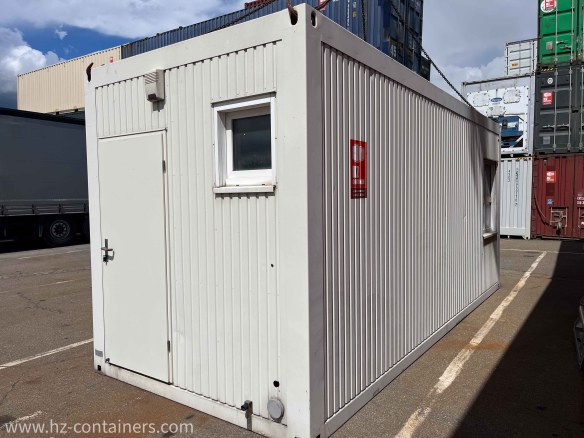

Other container news...
Can You Modify a 40ft High Cube Container?
The short answer is yes — you absolutely can modify a 40ft high cube container, and it is one of the most popular container types for modification projects worldwide. But the real question is not whether you can modify one; it is how to do it correctly, safely, legally, and within budget. This guide answers every dimension of that question, drawing on engineering principles, real-world pricing data, and the collective experience of thousands of modified container projects.
Key Takeaway: A 40ft high cube container offers 320 square feet of floor space with an extra foot of ceiling height compared to a standard container — making it the ideal canvas for offices, workshops, homes, retail spaces, and industrial applications. The extra height is particularly valuable when you add insulation and still want comfortable headroom.

Cargo worthy container
If you have ever shopped for a used shipping container, you have almost certainly encountered the term cargo worthy — often abbreviated as CW or CWO (Cargo Worthy Only). It is one of the most important classifications in the container industry, yet it is also one of the most misunderstood. A cargo worthy container is not a container that looks new. It is not necessarily a container that has a valid CSC plate. And it is definitely not the same as a wind and watertight container. This guide explains what cargo worthy really means — from its technical definition and historical origins to the precise structural criteria, inspection process, cost implications, and common misconceptions that trip up even experienced buyers.

Shipping container home
A shipping container home is a residential dwelling constructed from one or more steel intermodal containers — the same standardized metal boxes that transport goods across oceans, railways, and highways. These containers, engineered from corrosion-resistant Corten steel and designed to withstand brutal maritime conditions, are repurposed into fully habitable living spaces through insulation, structural modifications, and the installation of all standard residential utilities. A shipping container home can range from a minimalist 160-square-foot studio built from a single 20-foot container to a sprawling multi-level compound combining dozens of 40-foot high-cube units.
Core Definition: A shipping container home is a code-compliant, habitable structure built from one or more steel intermodal shipping containers that have been insulated, structurally reinforced where modified, and fitted with windows, doors, plumbing, electrical systems, and interior finishes to function as a permanent or semi-permanent residence.
Corner casting steel vs aluminum
Every shipping container in the world — all 40 million of them — rests on eight critical components. Corner castings are the load-bearing blocks at each corner of an ISO shipping container, and they are the universal interface between the container and every crane, twistlock, spreader, and chassis on the planet. When you lift a container, stack it nine high on a ship, or lock it to a truck trailer, every ton of force flows through these fittings.