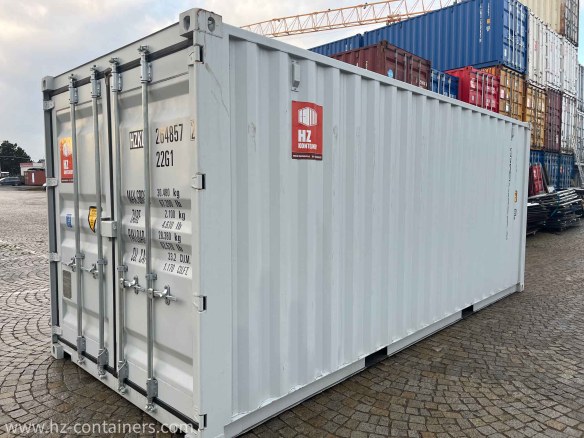
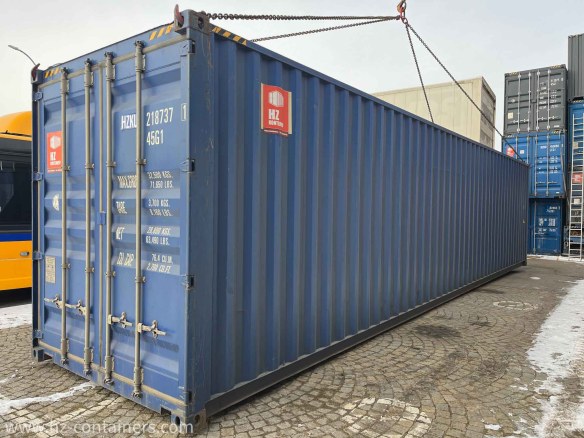
OVERALL HEIGHT WILL EXCEED 13’6″ ON A STANDARD CHASSIS
What does this warning mean?
The designation “Shipping Container – CAUTION – OVERALL HEIGHT WILL EXCEED 13’6″ ON A STANDARD CHASSIS” represents a key warning that is placed on certain types of intermodal transport containers. In English, this is the phrase “Shipping Container – CAUTION – OVERALL HEIGHT WILL EXCEED 13’6″ (4,115 m) ON A STANDARD CHASSIS”. This is a legally required and logistically essential piece of information for everyone involved in the transport of goods, particularly in road transport in the USA.
This warning is most commonly associated with so-called High Cube containers (HC), which are 30 cm taller than standard containers. When this container is loaded onto a standard trailer chassis, its total height exceeds the federally established limit of 13 feet 6 inches (4,115 m). Failure to heed this warning can lead to serious accidents, damage to infrastructure and goods, and endanger public safety.
Why is this warning essential?
- Safety: Exceeding height limits can cause collisions with bridges and overpasses (so-called “bridge strikes”), resulting in millions of dollars in damage and loss of life.
- Legal liability: Transporting oversized cargo without permission is illegal in the USA (and other countries), with transporters facing high fines and liability for damages.
- Logistics: The warning determines the choice of proper equipment (low-profile chassis), route planning, and obtaining special permits if necessary.
Analysis of the warning designation: Meaning of individual parts
To fully understand the meaning of this warning, it is necessary to analyze each of its components, which has its specific meaning in logistics and transport.
“Shipping Container”
- Definition: These are standardized steel boxes designed for intermodal transport – that is, easy transfer between maritime, rail, and road transport without unloading goods.
- Standardization: All dimensions, strength, and construction of containers are determined by the international standard ISO 668, which enables global compatibility.
- Construction: Most commonly made of Corten steel, which is resistant to corrosion and extreme conditions, the container must withstand stacking in multiple layers on a ship, vibrations on rails, and shocks on the road.
- Use: Shipping containers are the backbone of global trade – they enable efficient, safe, and fast transport of goods around the world.

“CAUTION”
- Meaning: Clear designation of an impending danger or potential risk. In the context of transport, it is a mandatory safety signal that requires increased attention and adoption of specific measures.
- Standards: The designation must be sufficiently visible, often supplemented with reflective elements and prominent lettering, to be noticeable when maneuvering in ports and on the road.
“OVERALL HEIGHT”
- Definition: The total height of a loaded vehicle measured from the road surface to the highest point of the cargo (i.e., the container).
- Calculation formula: Total height = chassis height + container height
- Significance: A key parameter for road transport – exceeding the permitted height means the need for special permission and determination of a special route.
“WILL EXCEED 13’6″” (Will exceed 13 feet 6 inches / 4,115 m)
- Normative limit: 13’6″ is the maximum permitted height of vehicles on the federal highway network in the USA (National Network). In Europe, the typical limit is 4.0 m.
- Consequences of exceeding:
- Legal: Without special permission, transporting oversized cargo is illegal.
- Technical: Higher risk of collision with low bridges, tunnels, and overhead lines.
- Economic: Need for route planning, higher transport and insurance costs.
“ON A STANDARD CHASSIS”
- What is a standard chassis?
- A steel frame structure with wheels and brakes, specially dimensioned for transporting containers.
- Typical platform height of chassis: 1,220–1,470 mm (48–58 inches).
- Reason for warning:
- High Cube container (HC) is 30 cm taller than a standard container. When placed on a standard chassis, the total height exceeds the legal limit.
- The driver and dispatcher must be informed that a low-profile chassis must be used or a permit must be obtained.
High Cube containers: Detailed view
What is a High Cube container?
- Definition: A container with a height of 9 feet 6 inches (2,896 mm), which is 1 foot (30 cm) taller than a standard container (8’6″ / 2,591 mm).
- Advantage: An increase in internal volume of approximately 12–13%, ideal for light, bulky goods or goods exceeding standard height.
- Main uses: Transport of electronics, machinery, furniture, agricultural products, and also for construction and architectural conversions (modular homes, offices).
| Parameter | 40′ High Cube | 45′ High Cube |
|---|---|---|
| External length | 12,192 mm | 13,556 mm |
| External width | 2,438 mm | 2,438 mm |
| External height | 2,896 mm | 2,896 mm |
| Internal length | 12,040 mm | 13,556 mm |
| Internal width | 2,345 mm | 2,345 mm |
| Internal height | 2,690 mm | 2,690 mm |
| Volume | 76.4 m³ | 86 m³ |
| Tare (empty) | 3,900–4,820 kg | 4,820 kg |
| Useful load | up to 28,560 kg | up to 27,860 kg |
| Floor | Wood | Wood |
| Certification | ISO, CSC | ISO, CSC |
Uses of High Cube containers
- Light, bulky cargo: Ideal for goods with low density and large volume (e.g., polystyrene, textiles, consumer electronics).
- Construction and architectural projects: High ceilings allow for better insulation and greater comfort in modular buildings.
- Transport of machinery and equipment: Allows safe transport of larger equipment that would not fit in a standard container.
Significance of ISO 668 standard in container transport
- What is ISO 668? It is an international standard that:
- Determines the exact external dimensions and minimum internal dimensions of containers.
- Establishes parameters for fastening, strength (stackability up to 9 containers on top of each other) and safety requirements.
- Ensures compatibility – each container complying with this standard can be safely transported on any ISO-compatible chassis, train, or ship.
- Historical context: Standardization enabled a revolution in global logistics, reduced costs, and increased transport safety.
- Height specifications: The standard distinguishes two main height categories: 2,591 mm (8’6″ – standard) and 2,896 mm (9’6″ – high cube).
Practical implications for transporters and freight forwarders
Selection of proper transport equipment
- Low-profile or “drop-deck” chassis: Allow transporting a high cube container below the 13’6″ limit. Special types of chassis are commonly available from larger transporters.
- Gooseneck chassis: A lowered section at the front allows the container to sit lower over the rear axle of the tractor, reducing the total height by up to 15 cm.
Route planning and permitting
- Permits for oversized cargo: If low-profile chassis is not available, special permission must be obtained for transport in each state and a route must be planned without low bridges.
- Route survey: Need to verify each section of the route for height restrictions (especially in urban and historic areas).
Risks and consequences of ignoring the warning
- Fines and penalties: Significant fines for each violation of permitted parameters, in the USA up to tens of thousands of USD.
- Infrastructure damage: Liability for damage to bridges, tunnels, or electrical lines.
- Cargo destruction: An accident often means total loss of not only the container but also the transported goods.
- Insurance: High insurance premiums or loss of insurance coverage due to negligence.
Modern trends and digitalization
- GPS and planning: Modern navigation allows you to enter vehicle height and automatically plans a route without low bridges.
- Sensors: New chassis can be equipped with sensors that automatically report cargo height to the dispatcher before departure.
- Automation: In the future, fully automated systems for detecting and preventing transport of oversized cargo can be expected.
Frequently Asked Questions (FAQ)
What is the exact total height of a 40′ High Cube container on a standard chassis?
Usually between 4.11 m and 4.36 m (13’6″ to 14’4″) depending on the height of the specific chassis. On a chassis 1,220 mm (48″) high, the container is exactly at 13’6″. On a higher chassis, the limit is exceeded.
Why is the limit 13’6″ (4,115 m) in the USA?
This is the federal maximum height for road vehicles on the highway network. In Europe, the typical limit is 4.0 m.
Does this warning apply outside the USA?
Yes, the principle is global. Each country has its own limit (in the EU most commonly 4.0 m), which must be respected.
Do Flat Rack and Open Top containers have the same problem?
No, here the height of the transported unit is determined by the cargo itself, and therefore it is always planned as oversized cargo with a permit.
Does the warning concern the length of the container?
No, exclusively the height. The warning applies to all high cube containers – both 20′ and 40′, if they exceed the permitted transport height on the given chassis.
The warning CAUTION – OVERALL HEIGHT WILL EXCEED 13’6″ ON A STANDARD CHASSIS is a fundamental element of safety and logistics in international transport. It warns of the risk of exceeding the maximum permitted height when transporting high cube containers on a standard chassis. Proper understanding of this issue is key for every transporter, freight forwarder, and driver – it protects not only their business but also public safety and infrastructure.
 Czech Republic, Hradec Králové
  FREE SHIPPING