Dimensions of Transport Containers
Dimensions of transport containers represent clearly defined and globally standardized specifications that determine the external and internal size, volume and carrying capacity of container units. These units form the basis for efficient operation of global logistics, maritime transport and storage. Standards are established primarily by the International Organization for Standardization (ISO; for example ISO 668, ISO 1496, ISO 6346) and are of fundamental importance for ensuring compatibility between all parts of the transport chain, from port terminals through railways and road transport to warehouses.
Thanks to this, it is possible to easily transfer containers between different modes of transport, safely stack and handle them anywhere in the world. Proper knowledge of container dimensions is key not only for logistics professionals, freight forwarders and carriers, but also for developers, architects, construction companies or investors in container buildings (container homes) or modular warehouse systems.
Why is standardization of dimensions essential?
Standardization of dimensions is a basic prerequisite for efficient transport:
- Intermodal transport without transshipment: Containers complying with ISO can be moved from ship to train, from train to truck and further to warehouse or to the end customer without changing the contents.
- Unified handling equipment: Port cranes, forklifts, spreaders and other equipment are designed specifically for ISO container dimensions. This enables safe stacking (up to 8–10 layers on ships) and fast handling.
- Cost and schedule predictability: Shippers, carriers and recipients can precisely calculate costs, capacity and time schedules. Standardization minimizes the risk of incompatibility.
- Support for container market development: The ability to buy, rent or exchange containers anywhere in the world, which increases flexibility and reduces capital costs for companies.
Key metrics of container dimensions
When planning transport, storage or construction, it is absolutely essential to distinguish between three basic types of dimensions:
External Dimensions
This information is key for logistics planning, design of ramps, vehicles, warehouses and buildings. It specifies the total dimensions L×W×H (length × width × height) in meters or millimeters.
| Container Type | Length (mm) | Width (mm) | Height (mm) |
|---|---|---|---|
| 20′ Standard | 6 058 | 2 438 | 2 591 |
| 40′ Standard | 12 192 | 2 438 | 2 591 |
| 40′ High Cube (HC) | 12 192 | 2 438 | 2 896 |
| 45′ High Cube (HC) | 13 716 | 2 438 | 2 896 |
Note: For specialized containers (reefer, flat rack, open top, tanktainer), external dimensions are usually maintained for compatibility, even though they differ significantly in construction.
Internal Dimensions
Affected by wall thickness, floor and construction. Key for planning cargo volume, goods storage and structural modifications.
| Container Type | Internal Length (mm) | Internal Width (mm) | Internal Height (mm) | Volume (m³) |
|---|---|---|---|---|
| 20′ Standard | 5 898 | 2 350 | 2 390 | 33.1 |
| 40′ Standard | 12 032 | 2 350 | 2 390 | 67.6 |
| 40′ High Cube (HC) | 12 032 | 2 350 | 2 695 | 76.2 |
| 45′ High Cube (HC) | 13 556 | 2 352 | 2 697 | 86.0 |
Door Opening Dimensions
One of the most frequently overlooked, yet absolutely essential values. Door opening dimensions determine the maximum possible size of an object that can be loaded into or unloaded from a container in one piece.
| Container Type | Door Width (mm) | Door Height (mm) |
|---|---|---|
| 20’/40′ Standard | 2 340 | 2 280 |
| 40′ High Cube (HC) | 2 340 | 2 585 |
| 45′ High Cube (HC) | 2 340 | 2 585 |
Practical tip: If you are transporting bulky or indivisible goods (e.g., machinery, furniture in one piece), always verify not only the internal dimensions, but especially the door opening dimensions!
Overview of the most common container types and their parameters
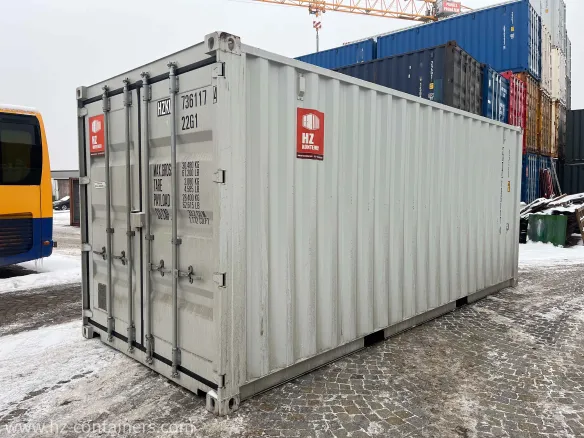
20-foot Standard Container (20′ Standard Dry Container)
- External dimensions: 6 058 x 2 438 x 2 591 mm
- Internal dimensions: 5 898 x 2 350 x 2 390 mm
- Door opening: 2 340 x 2 280 mm
- Volume: 33.1 m³
- Tare (empty weight): ~2 150–2 230 kg
- Maximum carrying capacity (payload): ~28 250–28 330 kg
- Max. total weight (gross weight): 30 480 kg
- EUR pallet capacity (120×80 cm): approx. 11 pcs in one layer
- Use: Heavy, dense cargo (machinery, raw materials, building materials, etc.)
40-foot Standard Container (40′ Standard Dry Container)
- External dimensions: 12 192 x 2 438 x 2 591 mm
- Internal dimensions: 12 032 x 2 350 x 2 390 mm
- Door opening: 2 340 x 2 280 mm
- Volume: 67.6 m³
- Tare: ~3 640–3 720 kg
- Maximum carrying capacity: ~26 760–26 840 kg
- Total weight: 30 480 kg
- EUR pallet capacity: approx. 23–24 pcs
- Use: Bulky but relatively light cargo (furniture, electronics, consumer goods)

40-foot High Cube Container (40′ High Cube Dry Container)
- External dimensions: 12 192 x 2 438 x 2 896 mm
- Internal dimensions: 12 032 x 2 350 x 2 695 mm
- Door opening: 2 340 x 2 585 mm
- Volume: 76.2 m³
- Tare: ~3 700–3 900 kg
- Maximum carrying capacity: ~26 760–28 800 kg
- Total weight: 30 480–32 500 kg (depending on manufacturer)
- EUR pallet capacity: up to 24 pcs
- Use: Light, bulky cargo, tall pallets, ideal for conversion to residential containers due to increased ceiling height.
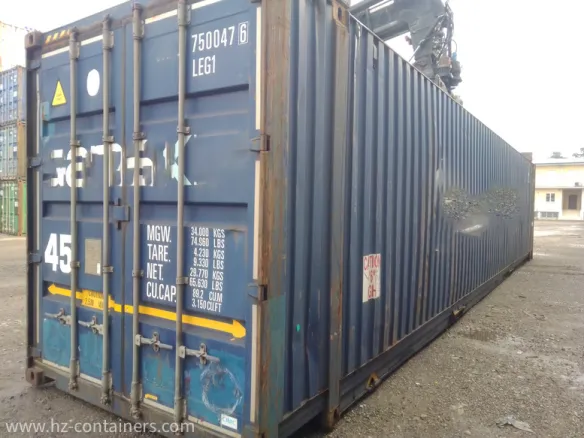
45-foot High Cube Container (45′ High Cube Dry Container)
- External dimensions: 13 716 x 2 438 x 2 896 mm
- Internal dimensions: 13 556 x 2 352 x 2 697 mm
- Door opening: 2 340 x 2 585 mm
- Volume: 86.0 m³
- Tare: ~4 650–4 700 kg
- Maximum carrying capacity: ~25 780–27 850 kg
- Total weight: 30 480–32 500 kg
- Use: Oversized and bulky goods, frequently used in the USA and on some European routes.
10-foot Container (10′ Dry Container)
- External dimensions: 2 991 x 2 438 x 2 591 mm
- Internal dimensions: approx. 2 831 x 2 350 x 2 390 mm
- Volume: approx. 15.6 m³
- Use: Storage on construction sites, mobile warehouses, less common in international transport.
Specialized container types
Open Top Container
- Description: Has no fixed roof, which is replaced by a tarpaulin. Allows loading from above using a crane.
- Dimensions: External dimensions identical to standard containers
- Use: Tall machinery, bulky pieces, bulk materials.
Flat Rack Container
- Description: Has only front walls and a fixed floor, sides and roof are missing.
- Use: Oversized/heavy cargo (cars, construction machinery, pipes). Collapsible walls for better stackability.
- Carrying capacity: Significantly higher than standard containers (often up to 40 000 kg and more).
Reefer Container (Refrigerated Container)
- Description: Insulated container with integrated cooling unit, maintains temperature in the range of approximately -30 °C to +30 °C.
- Use: Food, pharmaceuticals, chemicals.
- Specifics: Significantly smaller internal space due to insulation and cooling unit.
Tanktainer (Tank Container)
- Description: Steel frame of ISO dimensions, in which a tank for liquids, gases or powdered materials is placed.
- Dimensions: External dimensions identical to 20′ container.
- Volume: Commonly 21–26 m³.
Weight parameters of containers
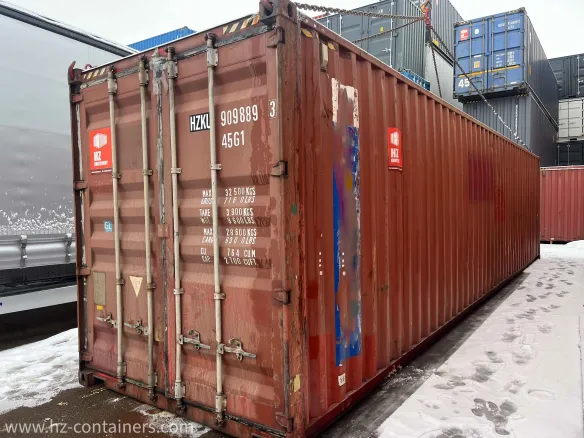
Each container must have three essential data points listed on the doors:
- Tare (Tare Weight): Weight of empty container (20′ approx. 2 150–2 300 kg, 40′ approx. 3 700–4 000 kg).
- Carrying capacity (Payload): Maximum weight of cargo permitted to be loaded (20′ up to 28 330 kg, 40′ up to 28 800 kg).
- Total weight (Gross Weight): Sum of tare and carrying capacity (commonly 30 480 kg for 20’/40′, for some HC up to 32 500 kg).
Important: Do not exceed permitted values! Overloading means risk during handling, transport and can result in fines or other complications.
Overview table of dimensions and weights
| Container Type | External Dimensions L×W×H (mm) | Internal Dimensions L×W×H (mm) | Door Opening W×H (mm) | Volume (m³) | Tare (kg) | Payload (kg) | Gross (kg) | EUR Pallets |
|---|---|---|---|---|---|---|---|---|
| 20′ Standard | 6058x2438x2591 | 5898x2350x2390 | 2340×2280 | 33.1 | 2150 | 28330 | 30480 | 11 |
| 40′ Standard | 12192x2438x2591 | 12032x2350x2390 | 2340×2280 | 67.6 | 3640 | 26840 | 30480 | 23–24 |
| 40′ High Cube | 12192x2438x2896 | 12032x2350x2695 | 2340×2585 | 76.2 | 3700 | 28800 | 32500 | 24 |
| 45′ High Cube | 13716x2438x2896 | 13556x2352x2697 | 2340×2585 | 86.0 | 4650 | 27850 | 32500 | 27–29 |
| 10′ Standard | 2991x2438x2591 | 2831x2350x2390 | 2338×2280 | 15.6 | 1300 | 8950 | 10250 | 5 |
FAQ: Most frequently asked questions about container dimensions
What does High Cube mean?
High Cube is an elevated variant of a standard container. Compared to the standard height of 2 591 mm (8’6″), HC has a height of 2 896 mm (9’6″), which provides approximately 13% greater volume.
What is TEU?
TEU (Twenty-foot Equivalent Unit) is an international unit corresponding to one 20-foot container. A 40-foot container = 2 TEU.
Can containers be stacked?
Yes, containers are designed for stacking. Corner elements (corner castings) are designed to transfer high pressures. Ships commonly stack 8–10 layers, in ports and warehouses more often 4–5.
How many pallets fit in a container?
- 20′ container: approx. 11 EUR pallets (120×80 cm) in one layer, or 9–10 standard pallets (120×100 cm).
- 40′ container: approx. 23–24 EUR pallets, or 20–21 standard pallets.

 Brno, Czech Republic
  FREE SHIPPING