
40ft High Cube shipping containers: dimensions, prices, uses, and everything you need to know
40ft high cube shipping container is more than just half a meter taller wall bolted onto a standard container. It represents a deliberate evolution in intermodal logistics—an evolution that changed the way the world ships bulky cargo, redefined steel boxes as architecture, and recalculated shipping costs. Whether you are a logistics manager evaluating FCL options, a builder planning a container home, or a business owner who appreciates a storage solution, understanding this type of container down to the smallest details pays off.
This guide covers every key dimension: the history of the high cube design, precise measurements down to the millimeter, weight and payload specifications, a full price overview by condition grade, real applications, modification pathways, and the misconceptions that cost buyers money every day.
What is a 40ft High Cube Shipping Container?
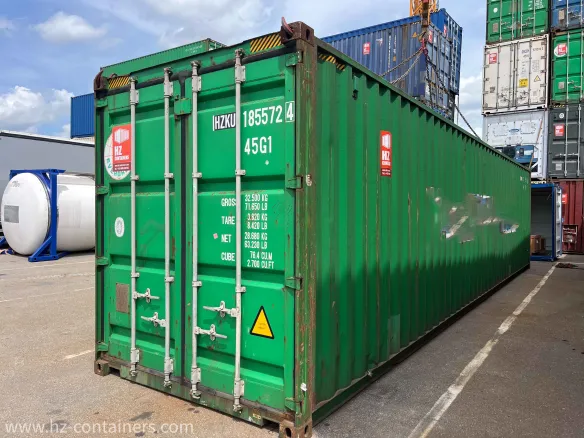
40ft high cube shipping container—often shortened to 40HC, 40HQ, or simply “high cube”—is an ISO-standard intermodal cargo container with an exterior height of 9 feet 6 inches (2.89 meters), exactly one foot taller than the standard 40ft general purpose (GP) container. In the ISO 6346 classification system, this container type carries the code 45G1, where the first digit (“4”) designates 40-foot length and the second digit (“5”) signals the high cube height class.
Key ISO identifier: A 40ft high cube dry container has the code 45G1. A standard 40ft GP has the code 42G1. When you see these codes stamped on a container’s door, you instantly know its height class—no tape measure needed.
The high cube design increases internal volume by approximately 10 to 13 percent compared to a standard 40ft container. This translates to roughly 76 cubic meters (2,694 cubic feet) of usable space versus 67.7 m³ (2,389 cubic feet) in a standard GP—a difference large enough to fit an entire additional row of stacked pallets or machinery that would otherwise require a flat rack container or open-top unit.

Where Did the High Cube Container Come From?
The story of the high cube container cannot be told without understanding the gooseneck tunnel chassis—a structural innovation that made the entire concept feasible.
When Malcolm McLean’s first container ship, SS Ideal-X, sailed in 1956 from Newark to Houston, standardization was still years away. ISO adopted the first container standards in the late 1960s, cementing the 8-foot width and establishing 20-foot (TEU) and 40-foot (FEU) lengths as the global norm. Standard height settled at 8 feet 6 inches (2.59 meters).
But cargo does not always cooperate with clearance limits. By the 1980s, shippers of light, voluminous goods—furniture, textiles, insulation materials, empty plastic packaging—were hitting the cubic ceiling of standard boxes long before approaching weight limits. Demand for taller containers grew. The problem was that simply raising the roof of a 40ft box created a height problem on standard chassis: the container would sit too high for many overpasses and port handling equipment.
The solution was the gooseneck tunnel chassis—a recessed channel built into the floor at the front of the container. This recess allows the container to sit lower on a specially designed gooseneck chassis, effectively lowering the front of the box. The result: half a meter more internal height with minimal increase in overall transport height. Every 40ft high cube container in operation today uses this gooseneck recess, making it a defining structural feature of the design.
High cube containers entered mainstream operation in the 1990s and proliferated around 2000 as global trade shifted toward goods with higher volume and lower weight. Today they represent a significant share of the global dry container fleet and are standard equipment for virtually all major shipping companies, including Maersk, MSC, CMA CGM, Hapag-Lloyd, and COSCO.
What Are the Dimensions of a 40ft High Cube Container?
Precision matters when you are calculating loading plans, pallet configurations, or structural modifications. Here are the definitive dimensions of a 40ft high cube container, drawn from ISO standards and verified against major carrier specifications.
External Dimensions
| Measurement | Imperial | Metric |
|---|---|---|
| External length | 40′ 0″ | 12.192 m |
| External width | 8′ 0″ | 2.438 m |
| External height | 9′ 6″ | 2.896 m |
Internal Dimensions
| Measurement | Imperial | Metric |
|---|---|---|
| Internal length | 39′ 5″ – 39′ 6″ | 12.025 – 12.032 m |
| Internal width | 7′ 8″ – 7′ 9″ | 2.350 – 2.352 m |
| Internal height | 8′ 10″ – 8′ 10¼″ | 2.695 – 2.700 m |
| Door opening width | 7′ 8″ – 7′ 8⅛″ | 2.340 – 2.343 m |
| Door opening height | 8′ 5″ – 8′ 6″ | 2.577 – 2.597 m |
| Usable volume | ~2,694 ft³ | ~76.0 – 76.4 m³ |
Critical loading note: The door opening height is always less than the internal ceiling height—typically by 3 to 5 inches. If your cargo requires the full internal clearance of 8′ 10″, you must verify it will physically pass through the door frame. This is one of the most common oversights in loading planning.
How Do These Dimensions Affect Loading?
The internal width of approximately 7′ 8″ (2.35 m) is the same as a standard container—the extra high cube space is entirely vertical. This has specific implications for pallet loading:
- Euro pallets (1.2 m × 0.8 m): A 40ft high cube holds up to 25 Euro pallets in a single-layer floor configuration. Two rows fit side by side—one row loaded lengthwise and one crosswise.
- Standard US pallets (40″ × 48″ / 1.016 m × 1.219 m): You can stack up to 21 pallets in one layer, arranged in aligned rows.
- Stacked loading: With the extra vertical space, many shippers can stack pallets two or even three high, effectively doubling or tripling the pallet count depending on cargo height and weight distribution.
The additional 12 inches of internal height also eliminates the need to tilt or angle tall items during loading—a practical benefit for machinery, tall pieces of furniture, and multi-tier stacks of packaging.
How Does a 40ft High Cube Compare to a Standard 40ft Container?
Choosing between a 40ft standard (GP) and a 40ft high cube (HC) is one of the most important decisions in container logistics. It is not simply a matter of “more space is better.”
Side-by-Side Dimension Comparison
| Specification | 40ft Standard (GP) | 40ft High Cube (HC) | Difference |
|---|---|---|---|
| External height | 8′ 6″ (2.591 m) | 9′ 6″ (2.896 m) | +12″ (+305 mm) |
| Internal height | 7′ 10″ (2.390 m) | 8′ 10″ (2.695 m) | +12″ (+305 mm) |
| Door height | 7′ 6″ (2.280 m) | 8′ 6″ (2.585 m) | +12″ (+305 mm) |
| Usable volume | 2,389 ft³ (67.7 m³) | 2,694 ft³ (76.4 m³) | +305 ft³ (+8.7 m³) |
| Tare weight (avg.) | ~8,268 lbs (3,750 kg) | ~8,750 – 9,000 lbs (3,970 – 4,080 kg) | +500 – 730 lbs |
| Maximum payload (typical) | ~58,996 lbs (26,760 kg) | ~61,200 – 63,230 lbs (27,760 – 28,680 kg) | Similar or slightly higher |
| ISO code | 42G1 | 45G1 | — |
| Gooseneck tunnel | No | Yes | Structural difference |
When Should You Choose a Standard 40ft Container Instead of High Cube?
A standard 40ft container remains the better choice when:
- Your cargo is weight-dense. If you are shipping tiles, stone, metal parts, liquid bottles, or construction materials, you will hit the maximum gross weight limit long before you fill the cubic capacity. The extra half meter of height in a high cube will sit empty and you will pay a premium for unused space.
- Availability of ports and chassis is a concern. In some smaller ports or secondary trade routes, standard 40ft containers are easier to obtain than high cube. Booking high cube during tight supply can lead to container relocations or substitutions that disrupt loading plans.
- Unit price is the primary decision factor. High cube containers typically carry a slight surcharge on both purchase price and ocean shipping rates. If volume is not a constraint, this surcharge offers no return.
When Should You Choose High Cube?
High cube becomes the right choice when:
- Your cargo volume is between 70 and 75 cubic meters and total weight stays below roughly 28 tons.
- You are shipping light, voluminous goods—furniture, insulation, textiles, empty packaging, exhibition materials, foam products.
- Your cargo includes items taller than 7′ 6″ that would not fit through the doors of a standard container.
- You want to stack pallets higher, reducing the number of containers in your booking.
Common Mistakes When Choosing Between Standard and High Cube
- Assuming more space always saves money. If your cargo is heavy and dense, the extra cubic capacity of high cube is wasted. You pay for volume you literally cannot use because the weight limit stops you first.
- Overlooking door height vs. internal height. The internal ceiling of a high cube is 8′ 10″, but the door opening is only 8′ 6″. Cargo near full internal height may not fit through the doors without tilting or special handling.
- Ignoring the gooseneck chassis requirement. High cube containers require gooseneck chassis for road transport. In some markets, standard chassis are more readily available and securing a gooseneck chassis for high cube can add costs or delays.
How Much Weight Can a 40ft High Cube Container Hold?
Weight specifications for a 40ft high cube container are governed by ISO standards and the structural type plate affixed to each unit. These numbers vary slightly between manufacturers and carrier fleets, but the following ranges represent industry consensus:
Weight Specifications
| Weight metric | Imperial (lbs) | Metric (kg) |
|---|---|---|
| Tare weight | 8,600 – 9,260 lbs | 3,900 – 4,200 kg |
| Maximum gross weight (MGW) | 67,200 lbs | 30,480 kg |
| Maximum payload (cargo weight) | 57,940 – 61,200 lbs | 26,280 – 27,760 kg |
Maximum Gross Weight (MGW) of 30,480 kg (67,200 lbs) is the absolute ceiling stamped on the container’s CSC (Container Safety Convention) safety approval plate. Payload is calculated by subtracting tare weight from MGW.
What Affects Real-World Payload Limits?
The theoretical maximum payload exists on paper. In practice, usable payload is almost always lower due to:
- Road weight regulations. In the United States, the federal gross vehicle weight limit for a tractor-trailer combination is 80,000 lbs. With a typical tractor weighing 17,000–20,000 lbs and a chassis weighing 8,000–10,000 lbs, the remaining capacity for a loaded container may be limited to 43,000–50,000 lbs—well below the container’s own MGW. In other words, road regulations, not container structure, often determine the practical payload ceiling.
- Carrier and terminal restrictions. Individual shipping lines and port terminals may impose lower weight limits based on crane capacity, stack weight limits on vessel decks, or regional regulations. Always consult your forwarder.
- Load distribution. Uneven weight distribution can create point loads that exceed the floor’s rated strength values, even when the total weight is within limits. The floor of a 40ft high cube is typically rated for evenly distributed loads; concentrated heavy machinery may require steel plates or spacer pads to distribute the load.
How Much Does a 40ft High Cube Shipping Container Cost?
Container prices are dynamic—they respond to global steel prices, trade imbalances, seasonal demand, and regional availability. This means the following price ranges represent the U.S. market in mid-2026:
Price by Condition Grade
| Condition | Description | Price range (USD) |
|---|---|---|
| New / One-Trip | Manufactured overseas, used for one cargo voyage to the U.S. Minimal wear, perfect condition. Often still in factory paint. | $4,500 – $8,000 |
| Cargo-Worthy (CW) | 5–15 years old. Structurally sound, watertight, certified for international shipping. Visible cosmetic wear, but fully functional. | $2,800 – $5,500 |
| Wind and Water Tight (WWT) | Typically 10–20 years old. Doors and seals intact. Keeps weather out but is not certified for cargo shipping. Ideal for storage. | $2,000 – $4,000 |
| As-Is | Sold without any watertightness guarantee. May have rust, dents, or minor structural issues. Best for projects requiring extensive modification. | $1,200 – $2,800 |
What Affects Price Beyond the Container Itself?
The purchase price of a container is only one line item. Total acquisition costs include:
- Delivery fees. Transporting a 40ft high cube container 50–200 miles from a depot typically costs $500–$1,000. Long-distance or remote location deliveries can run $2,000–$5,000.
- Location. Proximity to a major port (Los Angeles/Long Beach, New York/New Jersey, Houston, Savannah) means lower container prices and delivery costs. Rural or inland locations pay a premium.
- Seasonal demand. Spring and early summer see surges in construction and moving season demand. Prices can rise 10–20% during peak months.
- Custom modifications. Forklift pockets, additional ventilation openings, lock boxes, or custom paint—all add incremental costs.
Rental alternative: Monthly rental of a 40ft high cube storage container in the U.S. typically ranges from $120 to $250 per month, making rental the better choice for short-term needs (under 18–24 months). For longer horizons, purchasing is almost always more economical.
What Are Container Grades and Why Do They Matter?
Buyers encounter three primary condition grades when purchasing a 40ft high cube container. Understanding each grade prevents you from paying too much for what you do not need—or buying something unsuitable for your purpose.
Cargo-Worthy (CW)
A cargo-worthy container passes a certified inspection confirming it is structurally sound, watertight, and suitable for cargo transport on ships, trains, and trucks. The inspection checks the CSC plate, door seals, floor, corner posts, roof panels, and understructure. CW containers carry a valid CSC certification and are the minimum grade required for international freight transport.
- Best for: Cargo transport, intermodal shipping, export operations.
- Age range: Typically 5 to 15 years.
- Appearance: Expect scuffs, surface rust, faded paint, and dented panels—all cosmetic. Structure must remain intact.
Wind and Water Tight (WWT)
A wind and water tight container is not certified for cargo shipping but is guaranteed to keep the elements out. Doors seal properly, the roof does not leak, and the floor is intact. WWT containers have either expired CSC certification or were never recertified, but remain fully functional as ground-level storage.
- Best for: On-site storage, tool sheds on construction sites, retail inventory overflow.
- Age range: Typically 10 to 20 years.
- Appearance: Visible wear including rust spots, dents, and cosmetic damage. Must remain structurally weather-resistant.
AS-IS
An as-is container is sold in whatever condition it is currently in—no guarantees, no certifications, no promises regarding watertightness. As-is units often have significant rust, door alignment issues, or minor structural concerns.
- Best for: Project containers destined for extensive modification, welding, cutting, and conversion into homes, offices, or art installations.
- Price advantage: Lowest entry price, often 40–60% cheaper than a new unit.
- Risk: Requires thorough in-person inspection before purchase. A leaking roof or rusted corner castings can turn a bargain into a problem.
What Can You Use a 40ft High Cube Container For?
Applications for a 40ft high cube container extend far beyond what its original designers envisioned. The extra half meter of internal height makes it the preferred container type for virtually any conversion project where clearance matters.
Traditional Shipping and Logistics
In its primary role, the 40ft high cube ships dry cargo—furniture, clothing, electronics, machinery, paper goods, and consumer packaged goods—across ocean, rail, and road. It is the default choice for FCL (Full Container Load) shipments with volume constraints. When your cargo fills 70–76 cubic meters and stays under the weight limit, high cube maximizes container utilization and minimizes cost per cubic meter shipped.
Storage Solutions
The 40ft high cube is the benchmark for on-site storage. Its 2,694 cubic feet of internal space holds the contents of a 2–3 bedroom apartment, the equipment of an entire construction crew, or months of retail inventory. The tall interior enables racking systems that double or triple usable storage density. Businesses in e-commerce, construction, event management, and agriculture routinely purchase or rent high cube units as permanent yard storage.
Container Homes and Architecture
The architectural movement around shipping containers owes much of its momentum to the high cube. A standard 8′ 6″ container, once insulated and finished—with flooring, ceiling panels, and lighting—leaves an internal ceiling of around 7′ 4″ to 7′ 6″. This can feel claustrophobic in a living space.
High cube, by contrast, starts with an internal ceiling of 8′ 10″. After 4–6 inches of floor insulation and 2–4 inches of ceiling treatment, it still exceeds 8 feet—comparable to many conventional homes or better. This extra space enables:
- Loft spaces and mezzanines
- Overhead HVAC ductwork without sacrificing clearance
- Tall windows and sliding glass doors with full-height frames
- A genuinely residential feel that standard-height containers struggle to achieve
Notable projects include the WFH House by Aarcgency in Denmark, Casa Incubo in Costa Rica (built from eight 40ft high cube containers), and countless single-container tiny homes across North America and Australia.
Commercial and Retail Spaces
Pop-up shops, food kiosks, bike rental stations, and mobile showrooms increasingly operate from high cube containers. The added height improves ventilation, accommodates professional lighting setups, and creates a more inviting customer environment. Container parks—collections of converted containers functioning as retail markets—have emerged in Las Vegas, London, Berlin, and Tokyo.
Industrial Modifications
On military bases, mining sites, and remote industrial installations, 40ft high cube containers are converted into air-conditioned equipment shelters, mobile laboratories, generator housings, and secured tool storage. The steel construction withstands extreme environments, and the extra height of high cube accommodates tall racking systems and overhead cable trays that would not fit in a standard container.
How Are 40ft High Cube Containers Modified?
Modifying a 40ft high cube container transforms the steel box into a purposeful space. The process follows a logical, engineering-driven sequence:
Step 1: Planning and Design
Every modification begins with a detailed plan. Engineers or experienced fabricators assess which cuts the container can withstand without disrupting the load path. Corner castings, corner posts, top and bottom rails form the structural skeleton of the container—cuts into these elements require compensatory steel reinforcement (usually welded square tubing or C-channels). Door openings, window openings, and large side cutouts must be framed with steel lintels to redistribute the load.
Step 2: Structural Modification
Using plasma cutters, grinders, and welding equipment, fabricators cut openings for doors, windows, roller shutters, and passages. A common configuration for a container office is:
- One personnel door (36″ steel door) cut into the long side wall
- Two to four windows (36″ × 36″ or 48″ × 36″) framed and trimmed
- Optional HVAC pass-through in the wall
For container homes, entire side walls can be removed and replaced with glass facades or sliding door systems. These large-scale cuts require substantial steel reinforcement and should only be performed by experienced professionals.
Step 3: Insulation and Interior Finishing
The steel shell of a container is thermally brutal—it conducts heat in summer and cold in winter with equal efficiency. Common insulation approaches include:
- Spray foam insulation: Applied directly to interior walls and ceiling. Excellent R-value per inch (~R-6 to R-7 per inch for closed cell). Creates a vapor barrier when sealed.
- Rigid foam board: XPS or polyiso panels fitted between steel furring strips. Easier for DIYers, but requires careful sealing at joints.
- Blanket / mineral wool insulation: Framed cavities filled with mineral wool or fiberglass. Cost-effective, but consumes more interior space.
After insulation, interior walls are typically finished with plywood, drywall, or steel cladding panels. Floors range from epoxy-coated marine plywood to vinyl planks or polished concrete coatings.
Step 4: Installation
Electrical wiring runs through channels mounted on interior walls or embedded in wall cavities. Plumbing for sinks, showers, and toilets requires floor penetrations and careful waterproofing. Mini-split HVAC systems are the most common climate control solution for modified containers due to their compact size and efficiency.
Door Configurations Worth Knowing
In addition to the standard double doors at one end, high cube containers can be ordered or modified with:
| Door type | Best for | Notes |
|---|---|---|
| Standard double doors | General use, shipping, storage | Both doors open 270°, secured by locking rods |
| Side-opening door | Retail, office, easy access | Personnel door cut into the long side wall |
| Roller shutter | Storage, frequent forklift access | Steel roller, typically 8′–10′ wide |
| Side-opening container | Full side access for wide cargo | Entire side opens, used for oversized cargo |
| Double end doors | Drive-through access, tunnel storage | Doors at both 40ft ends |
Regulatory Compliance and Permits
Modified containers used as living spaces or commercial buildings must comply with local building codes. This often requires:
- Engineer approval of modifications
- Electrical and plumbing permits and inspections
- Zoning approval for the container’s placement and use
- Foundation anchoring (piers, concrete slab, or screw piles) in high-wind or seismic zones
Skipping the permitting process is one of the costliest mistakes DIY container builders make. Unauthorized construction can result in fines, mandatory removal, or inability to insure the property.
What Are Common Misconceptions About 40ft High Cube Containers?
“More Space Always Means Better Value”
This is the most persistent misconception in container purchasing. If your cargo weighs 28 tons and occupies only 60 cubic meters, the extra 16 cubic meters of high cube is dead space. You pay a premium—both in container price and shipping rates—for cubic capacity you will never use because weight limits are the binding constraint. For dense cargo, a standard 40ft is not a compromise; it is the correct economic choice.
“High Cube Containers Hold More Weight”
The maximum gross weight of a high cube (30,480 kg) is the same as a standard 40ft container. The tare weight of a high cube is actually higher—by approximately 500–730 lbs—because the taller side panels and corner posts require more steel. A 40ft standard container often has a slightly higher net payload capacity than a comparable high cube. High cube carries more volume, not more weight.
“Any Container Can Be Converted Into a Home”
A container that spent 15 years shipping industrial chemicals across the Pacific may have absorbed toxic residues into its floor—especially if the original marine plywood was treated with pesticides (common in older containers to meet quarantine requirements). Building a home inside such a unit without replacing the floor and thoroughly testing for contaminants is dangerous. Responsible container home builders either buy one-trip containers with known history or completely remove and replace the original flooring.
“High Cube and Standard Containers Are Interchangeable”
They are not. High cube requires a gooseneck chassis for road transport. If a trucker arrives with a standard chassis, the high cube will not sit properly, creating a dangerous transport configuration. Warehouses must also verify that door openings, loading ramps, and overhead clearances are tall enough for a 9′ 6″ box.
What Is the Future of High Cube Containers?
The 40ft high cube container is poised for further growth, driven by trends that favor its specific advantages:
Sustainability and Green Building
As the circular economy gains strength, repurposing decommissioned shipping containers into permanent structures diverts thousands of kilograms of steel from recycling furnaces. A single 40ft high cube contains approximately 3,800 kg of steel. Its reuse as a building module avoids the energy-intensive remelting process and creates a structure with a dramatically lower carbon footprint than a comparable wood or concrete building.
Smart Container Technology
A new generation of high cube containers arrives with integrated IoT sensors—GPS tracking, door-open alerts, internal temperature and humidity monitors, and impact sensors. For pharmaceutical logistics, high-end electronics shipments, and cold chain applications where the extra internal height accommodates taller racking configurations, smart high cube containers provide complete visibility that traditional containers cannot achieve.
Market Trends and Demand Outlook
The global container fleet continues to tilt toward high cube. Major shipping lines are increasingly ordering 40ft high cube instead of standard 40ft for their dry cargo fleets, reflecting the market reality that a growing share of global trade is constrained by volume, not weight. The secondary (used) market will see expanding supply as these units exit ocean service, which will likely exert downward pressure on used high cube prices over the next decade.
Simultaneously, the container architecture movement shows no signs of slowing. Building codes in jurisdictions from California to the Netherlands are evolving to explicitly address container construction, reducing the regulatory friction that once made container homes difficult to permit. High cube—with its residential ceiling height—will remain the container of choice for this sector.
Frequently Asked Questions
What is the Difference Between a 40ft High Cube Container and a 45ft High Cube Container?
A 40ft high cube measures 40 feet of external length, while a 45ft high cube extends to 45 feet. The 45-foot version offers approximately 85 cubic meters of capacity (versus 76 m³ for the 40-foot) and holds up to 27 Euro pallets. 45-foot containers are, however, less common on many shipping routes and can be harder to obtain and more expensive to ship. The 40ft high cube remains the ideal compromise between capacity, availability, and cost for most applications.
Can a 40ft High Cube Container Be Stacked?
Yes. The corner castings of a 40ft high cube container are rated for stacking—typically up to 9 high (approximately 216 tons of stacking load on the bottom container’s corner posts) when fully loaded. The gooseneck tunnel does not affect stacking capability. For ground storage or architectural use, containers can be stacked 2–3 high with proper twist-lock connections and engineered foundation solutions.
How Many TEU Is a 40ft High Cube Container?
A 40ft high cube container equals 2 TEU (Twenty-Foot Equivalent Units). The TEU measurement system is based on a 20ft container as the standard unit, so any 40ft container—standard or high cube—counts as 2 TEU. The high cube designation refers to height, not length, and does not affect the TEU calculation.
What Is the Clear Door Height on a 40ft High Cube?
The door opening height on a 40ft high cube container is approximately 8′ 5″ to 8′ 6″ (2.577 to 2.597 meters). This is significantly higher than the standard container door height of 7′ 6″ (2.280 meters). The internal ceiling height, however, is 8′ 10″, meaning there is a 4–5 inch overhang in the upper portion of the door frame. Cargo near full internal height must be tilted or lowered to pass through the door lintel.
Do High Cube Containers Cost More to Ship Than Standard Containers?
Ocean shipping rates for high cube containers are typically 5–15% higher than for standard 40ft containers on the same route, reflecting the increased volume, slightly higher tare weight, and specialized handling requirements (gooseneck chassis, stack height considerations on vessel decks). The cost per cubic meter shipped, however, is often lower because high cube carries 10–13% more volume for a marginal increase in shipping rate.
Can I Buy a 40ft High Cube Container Directly from a Shipping Line?
Most major shipping lines (Maersk, MSC, Hapag-Lloyd, etc.) sell decommissioned containers through authorized depots and dealer networks, not directly to end buyers. Purchasing through a reputable container dealer gives you access to inspected, graded inventory with logistical delivery included in the price. Always verify that the dealer provides the container’s CSC plate information and condition grade in writing before purchasing.
What Is a Gooseneck Tunnel and Does Every High Cube Have One?
A gooseneck tunnel is a recessed channel in the floor at the front of the container (opposite the doors), measuring approximately 4 feet wide and extending about 10–12 feet into the container floor. It allows the container to sit lower on a gooseneck chassis, keeping the overall transport height within road height limits despite the container’s extra half meter of height. Every ISO-standard 40ft high cube dry container includes this feature—it is integral to the design specification.
 Czech Republic, Klatovy
 FREE SHIPPING

Other container news...

Obligation to Check Tightness When Selling a Reefer Container
Who is responsible for the refrigerant leak check when selling a refrigerated container? Find out what obligations the seller has at the time of handover and why they must provide a PTI report along with the technical data plate. Learn which regulatory requirements and F-gas record-keeping duties become the sole responsibility of the new owner.

New sea shipping containers
If you are currently considering purchasing a new shipping container, you are not alone. While just twenty years ago containers were used almost exclusively for maritime transport, today they have found their way into construction, storage, business, and even housing. This growing popularity brings with it a host of questions: Which type should you choose? How much does it cost? How do you recognize quality? How can you avoid falling victim to scammers?
New shipping containers
If you are currently considering purchasing a new shipping container, you are not alone. While just twenty years ago containers were used almost exclusively for maritime transport, today they have found their way into construction, storage, business, and even housing. This growing popularity brings with it a host of questions: Which type should you choose? How much does it cost? How do you recognize quality? How can you avoid falling victim to scammers?

6m shipping container
Are you thinking about buying a 6-meter shipping container but aren’t sure what to look for? You are not alone—this 20-foot container is the best-selling size on the Czech market, and the differences between various types, conditions, and prices can be significant. In this guide, you will find everything you need to know: from exact dimensions and a comparison of categories (such as “one-way,” refurbished, and “Cargo Worthy”) to current prices and shipping advice.