
What is a Hasp Lock on a Container? (Lock Box) – Definition and Purpose
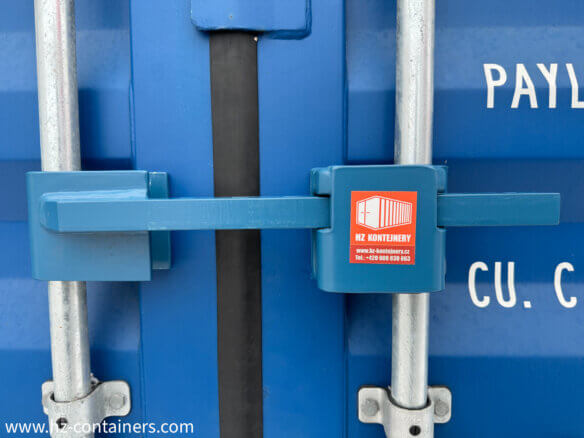
Hasp lock on a container (English: lock box, sometimes also security box) is a robust security device that brings fundamental improvement to the level of protection of doors of transport and storage containers. It is not the lock itself, but a massive steel housing that is permanently installed on the container doors. Its main function is to protect the shackle (eye) of a padlock from attack by common tools such as bolt cutters, hacksaws or angle grinders.
It is important that the lock box does not allow direct access to the lock shackle – this fundamentally extends the time needed to overcome the security and increases the probability of detecting the perpetrator. In practice, the lock box is one of the most effective and cost-accessible elements for increasing container security, whether it stands on a construction site, in a port, in a warehouse area or on private land.
Detailed Anatomy of a Hasp Lock
Main Components and Technical Design
Based on analysis of product data from leading manufacturers and sellers, the hasp lock (lock box) can be divided into the following main parts:
| Component | Purpose and Construction |
|---|---|
| Steel body (housing) | Box-shaped protective cover made of solid steel (thickness 3–6 mm), often with surface treatment (powder coating, galvanizing). Protects the padlock from access and cutting attempts. |
| Hasp | Movable part (usually welded), covers the fixed part, when closed ensures alignment of openings for the lock. |
| Eye (staple) | Stationary part with opening for the lock shackle, firmly connected to the door or frame. |
| Mounting hardware | Set of bolts (min. class 5, often security bolts for higher resistance) or welds. |
| Washers and nuts | Increase joint strength, prevent loosening, self-locking nuts are recommended. |
| Surface treatment | Powder coating – for anti-corrosion and aesthetic protection, galvanizing or galvanization – for increased resistance to weather effects. |
Dimensions:
- A typical lock box measures approximately 18–20 cm in length, 12–14 cm in height and 4–6 cm in depth, the internal space is designed for large padlocks with a covered shackle.
- The weight of a quality lock box ranges around 3–4 kg, for heavier models up to 6–7 kg.
Design variants:
- Weld-on – permanent, highly secure solution, recommended for long-term use.
- Bolt-on – faster installation, possibility of disassembly and relocation; suitable especially for rented containers or when welding is not possible.
Materials and Their Importance for Security
- Hardened structural steel: The basic building block of the lock box is always steel with high compressive and tensile strength. Hardening (quenching) increases resistance to cutting, drilling and deformation.
- Anti-corrosion surface treatment: Powder coating or hot-dip galvanizing significantly extend lifespan even in aggressive outdoor environments (seaside, chemical plants, etc.).
- Stainless steel (in some models): Higher purchase price, but maximum resistance to corrosion and weather effects.
How Does the Lock Box Work in Practice?
The principle is ingeniously simple and at the same time extremely effective:
- A lock box is installed on the container doors (welded or bolted).
- After closing the doors, the padlock is guided through the opening in the hasp and eye – the shackle is completely hidden inside the steel body.
- External access to the shackle is practically impossible – it cannot be grasped with bolt cutters, nor can it be directly cut with common tools.
- Attempts at prying are made difficult by the shape and massiveness of the cover (some models even have reinforcing “guard plates” against prying).
Visual deterrent: The massive lock box is a clear signal to potential perpetrators that the container is thoroughly protected and penetration would be risky, noisy and time-consuming.
Key Security Benefits of the Lock Box
- Maximum protection against tools: Hides the lock shackle from bolt cutters, prevents the use of hacksaws, pry bars or angle grinders.
- Resistance to weather effects: Certified models have surface treatment resistant to rain, snow, sun and wind. Powder coating is the standard for quality versions.
- Long-term lifespan: A quality lock box lasts for decades without significant maintenance; only occasional lubrication of the lock and checking of bolts is important.
- Versatility of use: Not just containers, but also garages, warehouses, mobile units, workshops, gates.
- Low operating costs: Unlike electronic security, it does not require power, service or license renewal.
- Increased container value at sale/rental: The lock box is a desired security element that increases the attractiveness and price of the container for customers.
Lock Box Installation Step by Step
A. Weld-on Installation
Suitable for: Permanent protection, containers with high-value contents, long-term placement.
Procedure:
- Thoroughly clean the welding surfaces (remove paint, corrosion).
- Position the lock box so that it aligns precisely with the door leaves and openings.
- Hold and secure with spot welds.
- Check functionality (insert the lock).
- Perform continuous welding around the entire perimeter.
- After cooling, grind the welds, treat with primer and final paint/anti-corrosion treatment.
Tip: Welding should only be performed by an experienced welder – poor welds can reduce the security and lifespan of the lock.
B. Bolt-on Installation
Suitable for: Rented containers, containers without welding capability, quick installation.
Procedure:
- Apply the lock box, mark the drilling locations (only into the door panel and frame).
- Use a drill suitable for steel (recommended min. 8 mm).
- Insert security bolts (with round head, prevents unscrewing from outside).
- From the inside use large washers and self-locking nuts.
- Tighten carefully, after a week of operation check the tightness again.
Note: Some manufacturers supply mounting kits directly with the lock box including bolts, washers and security nuts.
Selecting the Right Lock Box and Padlock
How to Recognize a Quality Lock Box?
- Material: Hard (hardened) steel, minimum thickness 4 mm (better 5–6 mm).
- Surface treatment: Powder coating or galvanizing, or stainless steel.
- Internal dimensions: Must accommodate a quality padlock with a covered shackle.
- Type of installation: Prefer the welded version if welding is possible on site; otherwise bolt-on.
- Compatibility: Best are universal models that fit most ISO containers (20′, 40′, 45′, 53′).
Which Padlock to Choose?
Recommendations from lock box manufacturers and security experts:
- Type: Disc (hockey puck) or locks with covered shackle (shrouded shackle).
- Shackle material: Hardened steel or boron alloy.
- Certification: CEN 4–6, or ANSI Grade 5–6.
- Weather resistance: Stainless steel, sealing, dustproof keyhole cover.
- Number of pins: Min. 5, ideally 6 or more, security insert.
- Dimensions: The shackle must fit precisely into the lock box so it cannot be pried out.
Example lock:
- Padlock designed directly for lock boxes, massive body, stainless steel surface treatment, three unique keys, covered shackle.
Comparison of Container Lock Types
| Type of Lock | Advantages | Disadvantages | Recommended Use |
|---|---|---|---|
| Padlock without lock box | Low price, simplicity | Very vulnerable shackle, low resistance to attacks | Where there is no high risk of theft |
| Lock box + padlock | Maximum shackle protection, visual deterrent, permanent installation | Need for installation, dependence on the quality of the chosen padlock | Standard for stationary containers |
| Crossbar lock | Secures both door bars, portable, high resistance | Higher price, bulkiness, need to apply/remove | Transport, temporary security |
| Internal lock | Invisible from outside, cannot be easily attacked | Complex installation, does not deter | Long-term storage of valuables |
| Electronic lock | Access control capability, records, smart functions | Higher price, dependence on power, possibility of electronic attack | Commercial, frequently used containers |
Lock Box as Part of Comprehensive Security
- Recommended combination: Certified lock box + disc padlock + physical inspection of the area around the container.
- Additional security measures:
- Crossbar locks for increased resistance.
- Internal bolts and locks (hidden security mechanisms).
- Alarms, motion sensors, GPS tracking.
- Lit, fenced, monitored areas.
Frequently Asked Questions (FAQ)
What is a lock box on a container?
- A steel housing designed to protect a padlock from attack.
Is a lock box really resistant to bolt cutters?
- Yes, the lock shackle is completely hidden, bolt cutters will not reach it.
Can I install a lock box myself?
- The bolt-on version yes (the kit contains everything needed), have the welded installation done only by a professional.
What is the ideal padlock?
- Disc, with covered shackle, made of hardened steel or boron alloy, with high security certification.
Will a lock box increase the value of a container at sale?
- Yes, containers with lock boxes are more attractive and more marketable.
Glossary of Terms
- Shackle: The arched part of a padlock that closes into the eye of the hasp.
- Hardened steel: Specially quenched steel with high resistance to cutting and deformation.
- Bolt cutters: Massive hand tool designed to cut chains, locks and bars.
- CEN (Central European Norm): European standard for testing lock security (EN 12320), scale 1–6.
- Powder coating: Surface treatment where paint is applied in powder form and cured in an oven.
 Czech Republic
  WITHOUT SHIPPING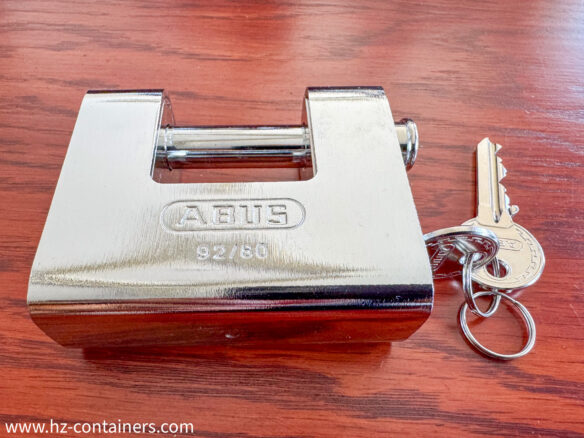


Other container news...
Shipping container 12m (40 ft)
A 12m shipping container is an investment that, if properly selected and cared for, will pay off in decades of trouble-free use. Whether you plan to use it as a warehouse, workshop, garage or the basis for a residential module — the key is careful selection of the condition, a thorough inspection before purchase and high-quality preparation of the base for placement. Take the time to compare offers, check the seller’s references and do not hesitate to personally inspect the container before buying. A properly selected 40-foot container will serve you reliably for many years.
Construction container
A construction container is an investment in safety, order and comfort — whether it is protecting tools from thieves or providing a dignified environment for workers. There are three key decisions: type (storage, residential, sanitary, rubble), form of acquisition (rent vs. purchase) and legislative provision (occupation, building code).
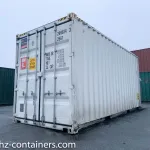
Used shipping container marketplace – prices, condition, transport and how to avoid scams
Buying a shipping container from a second-hand store doesn’t have to be risky if you know what to look for. Always check the seller, compare prices including VAT and shipping, and if possible, arrange a personal inspection. A suspiciously low price is the most common warning sign – a quality used shipping container at a fair price is worth much more than the cheapest option, which can cost you extra money and nerves.
Rental of shipping containers
Do you need a quick and reliable solution for storing materials, tools or goods, but you don’t want to invest hundreds of thousands in buying your own container? Renting shipping containers is one of the most effective solutions for companies and individuals today – whether you are dealing with seasonal storage, arranging facilities on a construction site, or looking for temporary space when moving. This guide will give you a complete overview: from prices and types of containers to rental conditions and a comparison of verified providers. After reading it, you will know exactly which container to choose, how much you will pay for it and what to look out for when renting.