
Shipping containers Duisburg Germany
Duisburg — a city at the confluence of the Rhine and the Ruhr — has transformed over the past two decades from a coal crossroads into one of the most important container hubs in Europe. Whether you are considering purchasing a shipping container for storage, transport, or even modular construction, you are in the right place where one of the widest selections of used and new containers on the European continent is concentrated. This guide will walk you through everything you need to know — from the history of the duisport harbor, through the types and quality grades of containers, to practical instructions on how to transport a container to the Czech Republic.
What is duisport and why is Duisburg the center of container transport in Europe?
Duisburg is not just any ordinary river port. Duisport, as the port is officially called today, is the largest inland port in the world. It covers an area of approximately 1.8 million m² and handles over 4 million TEU (twenty-foot equivalent units) annually. For comparison: this number ranks it among the twenty busiest container nodes on the planet — despite the fact that it lies 230 kilometers from the sea.
History of the Port of Duisburg: from the coal island to a logistics giant
The port in Duisburg began to take shape as early as the 18th century and for over 300 years was synonymous with the transshipment of coal. One of the transshipment areas between the port basins was even aptly called the “coal island” (Kohleninsel). At the turn of the millennium, the annual volume of coal transshipment reached approximately 20 million tons.
However, the decarbonization of the European economy dealt a hard blow to the coal business. By 2021, the port handled less than 2 million tons of coal — a decline of 90% over twenty years. Operations on the coal island were officially terminated in 2020 and the remaining supplies were moved to the peripheral parts of the area.
But that is not where the story of Duisburg ends — quite the opposite. From the ashes of the coal era, one of the most ambitious logistics projects of the present is being born.
Key moment: The former “coal island” is being transformed into the Duisburg Gateway Terminal (DGT) — the largest container terminal in the European inland, which will moreover be operated completely climate-neutrally.
Duisburg Gateway Terminal: an inland giant powered by hydrogen
The Duisburg Gateway Terminal represents an investment in the hundreds of millions of euros. The terminal, whose construction peaked in 2024, features six gantry cranes, twelve rail tracks, and extensive mooring positions for river vessels. Its trimodal connection — water, rail, and road — makes it an ideal transshipment point for containers flowing from seaports (Rotterdam, Antwerp, Hamburg) to Central and Eastern Europe.
What does DGT build its uniqueness on? On hydrogen technologies. The handling equipment and the heating of administrative buildings use green hydrogen, making the terminal the first climate-neutral facility of its kind in the world. This is not just a marketing slogan — it is a structural response to EU regulation and a signal of where the entire sector is heading.
Why is Duisburg strategic for the Czech Republic?
The distance from Prague to Duisburg by road is approximately 650–700 km, which corresponds to about 7–8 hours of truck driving. This is comparable to the distance to Hamburg, which is the traditional gateway to maritime transport for Czech importers. However, Duisburg offers two key advantages:
- Rail connection — Duisburg is connected to the trans-European rail network, and regular freight trains connect the Ruhr area with terminals in the Czech Republic.
- Concentration of container depots — In Duisburg and the wider Ruhr area, dozens of dealers in used containers operate, creating a competitive environment and pushing prices down.
| Factor | Duisburg | Hamburg | Rotterdam |
|---|---|---|---|
| Distance from Prague (km) | ~670 | ~650 | ~900 |
| Annual volume (TEU) | ~4.1 million | ~8.5 million | ~14.3 million |
| Availability of used containers | Very high | High | High |
| Rail connection to the Czech Republic | Excellent | Excellent | Good |
| Container price level | Competitive | Medium | Higher |
What types of shipping containers can be purchased in Duisburg?
The market for shipping containers in Duisburg is extremely diverse. While Czech depots typically offer several dozen pieces, the Duisburg transshipment points have hundreds to thousands of containers available at any given moment. This means not only a wider selection, but also the possibility of finding specific types that are hard to obtain in the Czech Republic.
Standard containers: 20′, 40′ and 40′ High Cube
The cornerstone of the offer consists of standard steel containers (Dry Van / General Purpose) meeting ISO 668 and CSC standards.
| Type of container | External length | External width | External height | Internal volume | Max. load capacity |
|---|---|---|---|---|---|
| 20′ DV (Dry Van) | 6,058 mm | 2,438 mm | 2,591 mm | ~33 m³ | ~28,000 kg |
| 40′ DV (Dry Van) | 12,192 mm | 2,438 mm | 2,591 mm | ~67 m³ | ~26,500 kg |
| 40′ HC (High Cube) | 12,192 mm | 2,438 mm | 2,896 mm | ~76 m³ | ~26,500 kg |
| 40′ HC PW (Pallet Wide) | 12,192 mm | 2,500 mm | 2,896 mm | ~80 m³ | ~26,000 kg |
The most sought-after format for storage and construction projects is the 40′ High Cube — thanks to its height of 2.9 meters, it provides a comfortable ceiling even for taller persons, and its volume of 76 m³ offers enough space for most applications. For transporting goods on euro pallets (EUR pallets 1,200 × 800 mm), the Pallet Wide version is ideal, as its extended width of 2,500 mm allows pallets to be placed side by side without losing space.
Special containers available in Duisburg
Duisburg, as a transshipment point of global importance, also offers special types that a regular Czech dealer may not have in stock:
- Open Top — a container with a removable tarpaulin roof for top-loading by crane. Suitable for oversized cargo or bulk materials.
- Flat Rack — folding end walls and a solid floor without sides and roof. Ideal for heavy machinery, vehicles, or structural elements.
- Double Door — a container with double-wing doors at both ends. Allows pass-through and flexibility during loading.
- Side Door — standard end doors supplemented with a side entrance. Popular for storage and workshop modifications.
- Reefer (refrigerated) — an insulated container with an integrated cooling unit for the transport and storage of temperature-sensitive goods.
What are the quality grades of shipping containers and how to navigate them?
Quality grades are the alpha and omega of purchasing. Two visually similar containers can differ in price by up to 200% — and the difference lies precisely in their classification. In German depots, you will encounter the following hierarchy.
| Quality grade | Typical aging | Condition | Service life (estimate) | Price (40′ HC, indicative) | Suitable use |
|---|---|---|---|---|---|
| AS IS 1–3 | 15–25 years | Heavily worn, dents, corrosion, leaks | 2–5 years | 33,000–45,000 CZK | Cheap storage of tools, bulk materials |
| AS IS 4–7 | 12–18 years | Medium wear, minor leaks, functional doors | 5–8 years | 40,000–55,000 CZK | Storage, workshop, garden house |
| AS IS 8–10 | 10–15 years | Minimal corrosion, watertight, clean | 8–12 years | 50,000–65,000 CZK | Better storage, hobby workshop |
| Cargo Worthy | 5–12 years | Fully functional, with valid CSC certification | 10–15 years | 55,000–75,000 CZK | Cargo transport + storage |
| One Way (single trip) | 1–3 years | Almost new, minimal signs of use | 15–20+ years | 65,000–85,000 CZK | Demanding storage, modular buildings |
| New (New / IICL) | 0–1 year | Perfect, factory condition | 20–30+ years | 85,000–120,000 CZK | Modular housing, offices, representative purposes |
Beware of confusion: The designation “AS IS” means that the container is sold in the condition in which it stands — without guarantees, without repairs. The numerical scale 1–10 (used especially by Czech dealers such as HZ Containers) helps to distinguish the state of preservation even within the AS IS category.
What does CSC certification mean and why does it matter?
CSC (International Convention for Safe Containers) is an international agreement requiring that every container used in international transport has a valid safety plate. The CSC plate (a metal plate on the container doors) indicates the date of manufacture, the date of the last inspection, and the maximum load capacity. For storage purposes, CSC certification is not necessary — but if you plan to transport the container by sea, it is a requirement.
How does the purchase of a shipping container in Duisburg proceed step by step?
Where to look for sellers
In Duisburg and the surrounding area, there are several types of sellers:
- Specialized sellers with Czech support (HZ Containers) — they offer containers located in Duisburg directly on the Czech website with prices in Czech crowns.
How to transport a shipping container from Duisburg to the Czech Republic?
Transporting a container from Duisburg to the Czech Republic can be done in two main ways: by truck (the most common) or by rail (advantageous for larger volumes).
Truck transport
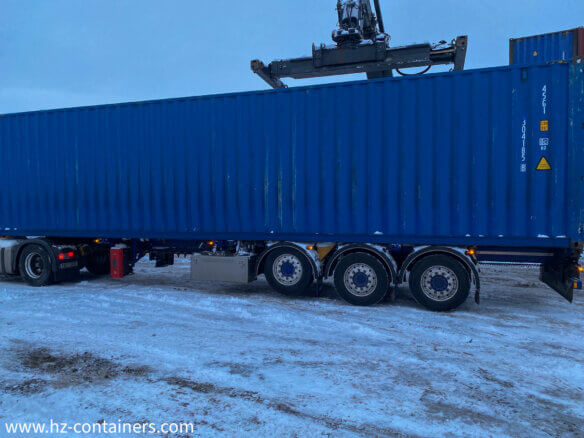
The container is transported on a special container trailer or flatbed with twist-lock attachments. The distance Duisburg → Prague is approximately 670 km (via Dresden and the D8 motorway). The cost of truck transport is calculated either as a flat rate per trip, or per kilometer driven:
- Flat rate: 18,000–25,000 CZK per one trip (excluding VAT), depending on current fuel and toll prices.
- Per kilometer: 26–35 CZK/km including tolls (excluding VAT), i.e. approximately 17,000–23,000 CZK for the Duisburg–Prague route.
Practical tip: Request round-trip transport. If the carrier finds cargo for the return journey as well, the price can drop by up to 30%.
Indicative transport time: 1–2 working days from loading in Duisburg to unloading in the Czech Republic.
Rail transport
The advantage is a lower price per unit when transporting multiple containers. The disadvantage is the need to arrange transport from the destination terminal to the final location (“last mile” by truck). For an individual buying one container, rail is usually disadvantageous.
Customs aspects
Germany and the Czech Republic are both EU members. When purchasing a container, you do not pay customs duty and the movement of goods within the Union is free. The only thing you need to handle is VAT (reverse charge for B2B, see above) and road tolls, which are paid by the carrier.
Frequently Asked Questions (FAQ)
How long does it take to transport a container from Duisburg to the Czech Republic?
Truck transport from Duisburg to Prague takes 1–2 working days. Rail transport (by container train) can take 3–5 days depending on the timetable. The total time from ordering to delivery is typically 5–10 working days.
How do I recognize a quality shipping container?
You can recognize a quality container by: (1) tight and smoothly opening doors, (2) an intact floor without soft spots, (3) the absence of deep corrosion — especially in the corners and on the roof, (4) a valid CSC plate (if you plan to transport it), and (5) overall cleanliness and the absence of odors from chemicals or mold.
What are the alternatives to Duisburg for buying containers in Germany?
In addition to Duisburg, other significant container nodes in Germany include Hamburg (the largest German seaport), Bremen/Bremerhaven (the second largest port), and Nuremberg (an inland port). Each location has its specifics — Hamburg offers an even larger selection, but is further from the Czech Republic. Nuremberg, on the other hand, is closer (approximately 350 km from Prague), but with a smaller selection.
What does “AS IS” mean and is it a good choice?
“AS IS” means the sale in the condition in which the container stands — without guarantees, without repairs, without promises. It is a lottery that pays off if: (a) you see the container in person, (b) you only need cheap storage where appearance and minor leaks do not matter, and (c) you are prepared for the possibility of repairs (welding, floor replacement). For housing or representative purposes, choose rather Cargo Worthy or One Way.
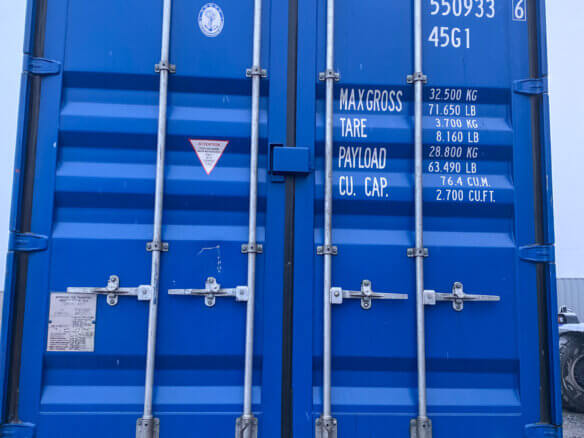
 Duisburg, Germany
  WITHOUT SHIPPING

Other container news...

High Cube container specifications
A high cube container — also referred to as an HC container, HQ container, or high-cube — is an intermodal shipping container that stands one foot taller than the standard ISO container. While a standard general-purpose container measures 8 feet 6 inches (2.59 m) in external height, a high cube container extends to 9 feet 6 inches (2.89 m). This extra 12 inches of vertical clearance translates into approximately 10–15% more cubic capacity without altering the container’s footprint — the same length and width are maintained, meaning the container occupies the same floor space on a vessel, chassis, or storage yard.
Shipping container parts
A shipping container looks like a simple steel box from the outside, but it is an assembly of dozens of precisely engineered shipping container parts — each governed by international standards, each designed to survive decades of ocean transit, crane lifts, and stacking loads that would crush an ordinary structure. Whether you are buying a used container, planning a container home, troubleshooting a repair, or simply building your logistics vocabulary, understanding every individual component is the difference between making an informed decision and an expensive mistake.

40 Foot Container Dimensions
If you have ever booked ocean freight, planned a warehouse layout, or designed a modular building project, you have asked the same question: what are the exact 40 foot container dimensions — and what do they mean for what you can actually load? The numbers are standardized worldwide, but the practical implications of those numbers are surprisingly nuanced. A 40-foot container is not simply 40 feet of usable space, and its weight limits are not what most people assume. This guide covers every measurement, every weight rating, and every loading consideration you need to make informed decisions about the world’s most common shipping container.
Quick Answer: A standard ISO 40-foot shipping container measures 12.19 m (40 ft) long × 2.44 m (8 ft) wide × 2.59 m (8 ft 6 in) high externally and provides approximately 67.7 m³ (2,390 ft³) of usable internal volume. The maximum gross weight is 30,480 kg (67,200 lbs), with a typical payload capacity of approximately 26,700–26,800 kg (58,900–59,000 lbs).

Cargo worthy container
If you have ever shopped for a used shipping container, you have almost certainly encountered the term cargo worthy — often abbreviated as CW or CWO (Cargo Worthy Only). It is one of the most important classifications in the container industry, yet it is also one of the most misunderstood. A cargo worthy container is not a container that looks new. It is not necessarily a container that has a valid CSC plate. And it is definitely not the same as a wind and watertight container. This guide explains what cargo worthy really means — from its technical definition and historical origins to the precise structural criteria, inspection process, cost implications, and common misconceptions that trip up even experienced buyers.