
Container chassis – types, construction, standards and safety features
What is a container chassis? Comprehensive guide for 2025
In the global logistics chain, container chassis – often referred to as skeletal semi‑trailers or simply “chassis” – are a crucial and indispensable link of intermodal transport. Without these specialized semi‑trailers, the movement of standardized cargo containers between ships, rail and road transport would not be possible. Chassis serve as a bridge between different modes of transport and enable efficient, fast and safe transport of goods to the destination.
Why are chassis so important?
- They ensure compatibility and safe attachment of containers according to international ISO standards.
- They enable efficient loading and unloading at ports, warehouses and rail terminals.
- They minimise downtime and optimise logistics costs thanks to standardised interfaces.
Definition and Main Purpose of a Container Chassis
A container chassis is a specialised skeletal semi‑trailer constructed from high‑strength steel without its own loading platform. It is used exclusively for the transport of intermodal containers (20’, 40’, 45’, 48’, 53’) that are placed on it and secured with twist‑locks – rotating locks positioned precisely at the corner ISO fittings of the container.
Key construction features:
- Steel frame: Minimalist but extremely strong, designed for even load distribution.
- Axles and wheels: The number of axles determines maximum payload and stability.
- Braking, lighting and electrical system: According to legislation and safety regulations.
- Landing legs: Mechanical or hydraulic, allowing independent standing.
- Twist‑locks: Standardised for safe attachment of all ISO containers.
Basic technical parameters (according to manufacturers and standards):
| Parameter | Range / Value |
|---|---|
| Chassis length | 20’, 40’, 45’, 48’, 53’ |
| Height above ground | 1 220–1 470 mm (48–58”) |
| Payload (by type) | 20–40 t (up to 70 t for special models) |
| Frame material | High‑strength steel (often with corrosion‑protective coating) |
| Number of axles | 2–3 (occasionally more) |
| Braking system | ABS/EBS, air brakes |
| Lighting | LED technology, approved ECE/SAE standards |
| Securing elements | Twist‑locks, pins, cross‑members |
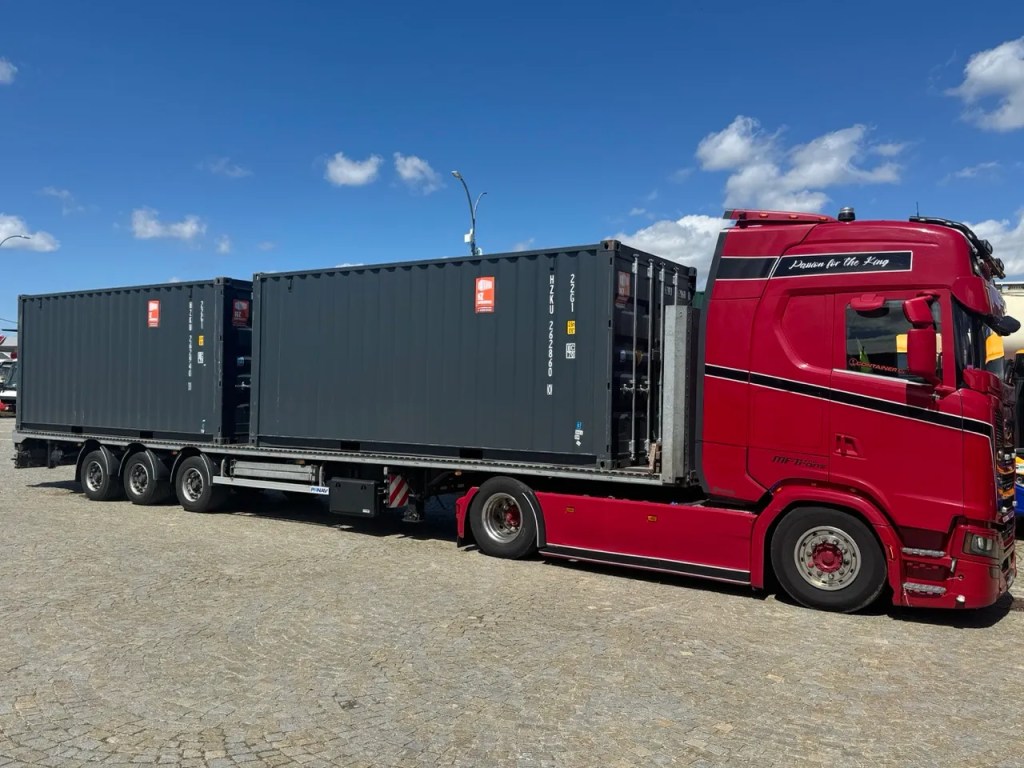
Key Components and Their Functions
1. Chassis Frame
- Made from high‑strength steel using modern technologies (laser cutting, robotic welding).
- Frame design is critical for load distribution and fatigue resistance.
- Gooseneck chassis has a lowered front (“gooseneck”) for transporting high‑cube containers at legal height.
2. Axles, Wheels, Suspension
- Standard chassis have 2 axles (for 20’/40’ containers); heavy or special units may have 3–4 axles.
- Tires: “super single” or dual configurations depending on load and regional regulations.
- Suspension: leaf‑spring or air; air suspension improves comfort and reduces cargo damage.
3. Securing Mechanisms (Twist‑locks, Pins, Flanges)
- Twist‑lock: 90° steel rotating locks that engage the container’s corner fittings.
- Additional securing items: pins, cross‑bars, stops according to chassis type and regional requirements.
4. Braking System
- Air (pneumatic) brakes with optional ABS or EBS.
- In Europe, a dual‑circuit system is required by ECE R13.
- Modern models include wear sensors and diagnostics.
5. Landing Legs
- Mechanical or hydraulic, sized for the static load of a fully loaded chassis.
- Operated manually or automatically on modern types.
6. Lighting and Electrical System
- Fully LED – lower consumption, long lifespan.
- Required lights: outline, brake, direction, fog and reflective markings.
7. Additional Technologies
- GPS tracking for position and condition monitoring (useful for large fleets).
- Tire pressure sensors, weight sensors, telematics for brake and axle status.
Overview of Main Types of Container Chassis
| Chassis type | Purpose, advantages, main use | Image / visualisation |
|---|---|---|
| Standard | 20’/40’ containers, simple maintenance, universal | Standard chassis |
| Extendable | Adjustable length (20–53’), flexibility, fewer types in fleet | Extendable chassis |
| Gooseneck | Front “gooseneck” allows high‑cube containers | Gooseneck chassis |
| Combo (combined) | Supports multiple sizes, reduces downtime and costs | Combo chassis |
| Tank | ISO tanks – liquids, gases, increased stability and safety | Tank chassis |
| Low‑bed | For high and heavy loads, lower centre of gravity, higher stability | Low‑bed chassis |
| Tilting | Hydraulic mechanism for dumping bulk materials | (specialised products) |
| Slider | Sliding axle for load distribution according to legislation (USA) | (see Thaco Trailers) |
Each type has its own construction specifics, emphasizing safety, compatibility and efficiency in different logistics scenarios.
Standards, Legislation and Safety
International standards (ISO)
- ISO 668: Standards for dimensions and corner fittings of containers.
- ISO 1161: Defines dimensions and strength of corner fittings.
- Chassis must comply with these standards for safe locking and handling.
National and regional legislation
- Maximum length, width and height: According to EU directives and national rules (e.g., Czech Republic – max length 16.5 m, width 2.55 m, height 4.0 m).
- Maximum axle load: Usually 10–12 t per axle.
- Safety equipment: Required side and rear underrun guards, reflective strips, approved lighting.
Safety features and inspections (per OSHA and EU)
- Twist‑locks must be fully functional, regularly inspected and not damaged.
- Brakes, lighting, tire pressure and frame condition must be checked regularly.
- In the USA, chassis must meet OSHA 1917.71 – requirement to use pins, flanges or other securing devices to prevent container slip.
- Mandatory periodic inspections and maintenance (EU at least every 12 months, USA often more frequently).
Modern safety technologies
- ABS/EBS braking systems, advanced diagnostic systems.
- GPS and telematics – online monitoring of position, load, chassis condition.
- Wear sensors for tires, brake pads, axle pressure.
Operational Aspects, Maintenance and Fleet Management
Efficient loading / unloading
- Use of portal cranes, reach stackers, manipulators – focus on minimising downtime.
- For bulk goods, tilting chassis with hydraulics are used.
Chassis pools (shared chassis fleets)
- In ports and logistics centres, “pools” – shared chassis for multiple carriers – are common.
- Benefits: better utilisation, lower investment, higher availability.
- Risks: possible shortage during peak periods, need for coordinated maintenance.
Maintenance and common failures
- Frame degradation (corrosion, cracks), lock wear, brake and light damage.
- Recommended regular maintenance: at least every 12 months (EU legal requirement), pre‑trip checks before each journey.
- Most frequent faults: jammed twist‑locks, air leaks in brakes, non‑functional lighting.
- In port areas, increased risk of frame corrosion – surface treatment (hot‑dip galvanising, coatings) is advised.
Practical Advice and Frequently Asked Questions (FAQ)
How to recognise a quality chassis?
- Require a frame made of high‑strength steel (minimum S355, often with protective coating).
- Verify that the locks meet ISO standards and are regularly serviced.
- Modern chassis have LED lighting, ABS/EBS, and optionally sensors and telematics.
Can a 20’ container be transported on a 40’ chassis?
- Yes, if the chassis has centre locks for the 20’ position. A combo or extendable chassis is a better choice for improved stability.
How much does a container chassis cost?
- New basic chassis: €8 000–€15 000 (depending on type, manufacturer, equipment).
- Special (tank, extendable, gooseneck): €15 000–€35 000.
- Used chassis: €2 000–€8 000 depending on condition.
What is the service life of a container chassis?
- 10–20 years with regular maintenance; in humid environments the life may be shorter.
- Manufacturers recommend a major overhaul of the frame and locks after approximately 8–12 years.
 Czech Republic, Hodonín
  FREE SHIPPING
Other container news...

Obligation to Check Tightness When Selling a Reefer Container
Who is responsible for the refrigerant leak check when selling a refrigerated container? Find out what obligations the seller has at the time of handover and why they must provide a PTI report along with the technical data plate. Learn which regulatory requirements and F-gas record-keeping duties become the sole responsibility of the new owner.

New shipping containers
If you are currently considering purchasing a new shipping container, you are not alone. While just twenty years ago containers were used almost exclusively for maritime transport, today they have found their way into construction, storage, business, and even housing. This growing popularity brings with it a host of questions: Which type should you choose? How much does it cost? How do you recognize quality? How can you avoid falling victim to scammers?
New sea shipping containers
If you are currently considering purchasing a new shipping container, you are not alone. While just twenty years ago containers were used almost exclusively for maritime transport, today they have found their way into construction, storage, business, and even housing. This growing popularity brings with it a host of questions: Which type should you choose? How much does it cost? How do you recognize quality? How can you avoid falling victim to scammers?

6m shipping container
Are you thinking about buying a 6-meter shipping container but aren’t sure what to look for? You are not alone—this 20-foot container is the best-selling size on the Czech market, and the differences between various types, conditions, and prices can be significant. In this guide, you will find everything you need to know: from exact dimensions and a comparison of categories (such as “one-way,” refurbished, and “Cargo Worthy”) to current prices and shipping advice.