
Patented ConFoot legs
Patented ConFoot Container Legs are innovative mechanical supports that allow simple and safe handling of shipping containers without heavy equipment such as cranes or forklifts. These legs were developed in Finland and, thanks to a patented design and the use of high‑quality Finnish steel, enable a single worker to lift or load a container onto a truck trailer in a few minutes.
Solution principle
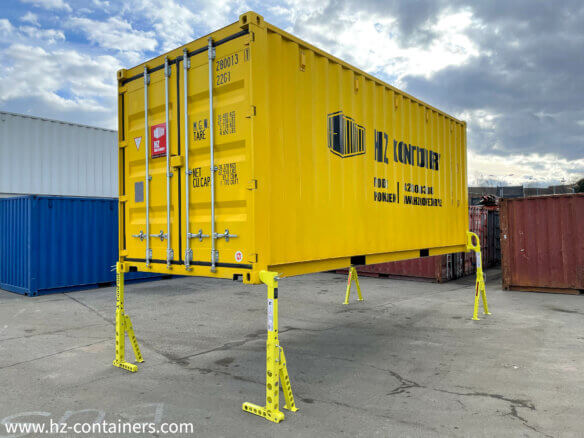
ConFoot legs attach to the corner casting elements of an ISO container. They safely support a container with a load of up to 34 t, even where no machinery is available. This makes containers usable as mobile warehouses, easy to move between locations, or to leave standing in remote sites without infrastructure.

Key Features and Innovations
| Feature | Details |
|---|---|
| Operated by one person | Installation and dismantling can be done by a single worker in 5 minutes. |
| Low weight | A standard leg weighs only 24 kg, allowing easy manual handling and storage. |
| High load capacity | A set of 4 legs carries up to 34 t; lower‑capacity models (20 t or 30 t) are available for special applications. |
| Height adjustability | Support height is easily adjustable – from 1 043 mm to 1 448 mm, some models up to 1.5 m. |
| Modular storage | Folding design; legs can be transported directly inside a container or on a trailer. |
| Material | Special alloy of six high‑strength Finnish steel types; service life 10–30 years. |
| Safety | CE certification, compliance with European safety standards (e.g., EN 283, Directive 2006/42/EC). |
| Patented design | Protected by patents in the EU and other countries. |
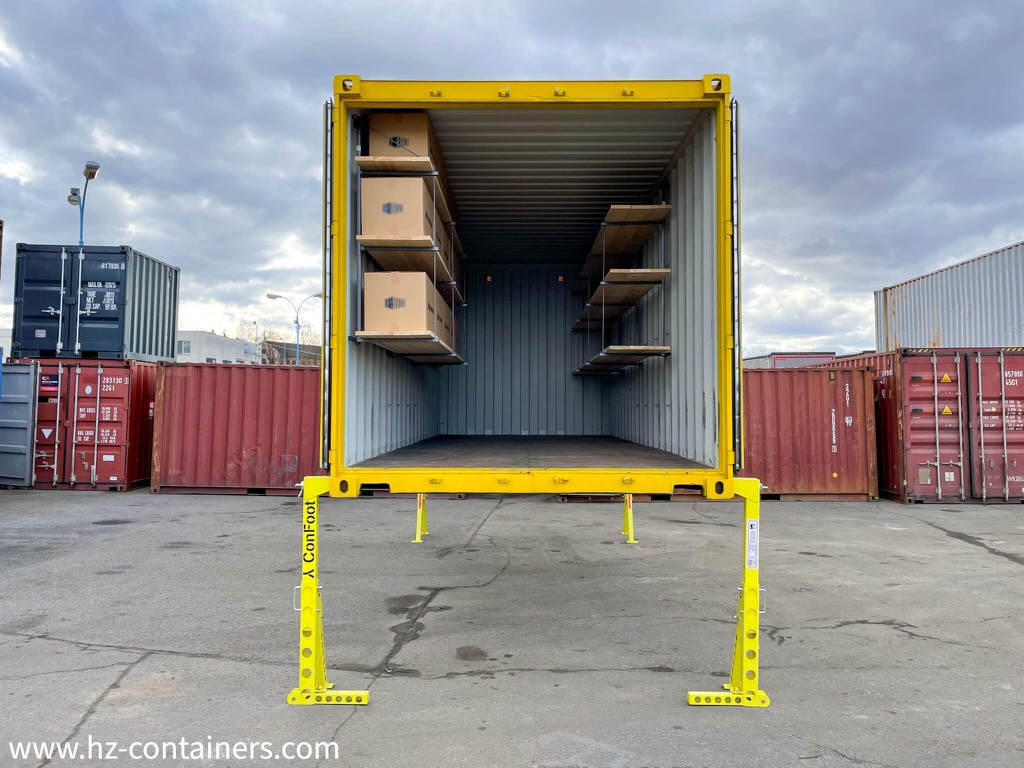
How It Works: How a Container Is Unloaded
The handling process with ConFoot legs is as follows:
- Vehicle preparation – Truck with container and air suspension drives to the site.
- Trailer lift – Driver raises the trailer to its highest position using the suspension.
- Leg installation – Worker inserts the four legs into the container’s corner openings and secures them.
- Unlocking twist‑locks – The container separates from the trailer.
- Trailer lowering – The trailer is lowered; the container’s weight transfers to the ConFoot legs.
- Trailer departure – Driver drives away, leaving the container safely standing on the legs.
The whole procedure takes 5–10 minutes and requires no machinery or additional workers. Reloading onto the trailer is performed in reverse order.
Model Overview and Detailed Specifications
| Model | Load capacity (set) | Height setting | Weight (per leg) | Intended use / specifics | Price (excl. VAT) |
|---|---|---|---|---|---|
| ConFoot CF | 34 t | 1 043–1 448 mm | 24 kg | Standard containers | €3 500 |
| ConFoot CFP | 30 t | 1 043–1 448 mm | 24 kg | Loading ramps, door opening up to 270° | €3 500 |
| ConFoot CFU 20 | 20 t | up to 1.5 m | 46 kg | Hydraulic lift, no air suspension needed | €6 300 |
| ConFoot CFU 30 | 30 t | up to 1.5 m | 46 kg | Height‑adjustable, advanced model | €7 500 |
| ConFoot CFL | 30 t | 1 043–1 448 mm | 24 kg | For frame containers (swap bodies) | €3 500 |
Prices are valid for 2024 according to the official website. Prices may vary. Current offers are available on the ConFoot website.
Model comparison
- Standard CF – Most common choice, suitable for the majority of ISO containers.
- CFP – Designed for containers placed on a ramp, allowing full door opening.
- CFU 20/30 – Hydraulic lifting – ideal where the vehicle lacks air suspension or the container must be fully lowered to the ground.
- CFL – For specific frame containers, e.g., tankers.
Detailed Installation – Step by Step
- Stop and secure the vehicle – Requires a flat, firm surface.
- Raise the trailer suspension – Height set according to container type and leg model.
- Fit ConFoot legs – Insert into corner openings, secure with a pin or magnetic mechanism (model‑dependent).
- Release twist‑locks – Container detaches.
- Slowly lower the trailer – Weight transfers to the legs; check stability.
- Complete lowering – Trailer is free, driver can safely depart.
- Reload in reverse order when needed.
Safety tips:
- Always work on an even, solid base (asphalt, concrete, compacted gravel).
- Do not install on soft ground, steep slopes, or icy surfaces.
- Inspect corner castings for damage or deformation before use.

Main Benefits and Advantages
Efficiency and time saving
- Immediate container placement lets drivers continue without waiting.
- No need to arrange a crane or additional handling staff.
- Stored containers are available exactly where needed.
Reduced operating costs
- Elimination of heavy‑equipment expenses: Savings on crane and forklift rentals and labor time.
- Optimised vehicle and driver utilisation: More trips, fewer standby trucks.
- Lower wage costs: Only one worker required instead of several.
Increased safety
- Always complies with European safety regulations.
- CE certified, tested according to EN 283.
- High safety margins for static and dynamic loads.
Flexibility and mobility
- Temporary storage anywhere – construction sites, festivals, fields, remote areas.
- Quick relocation, easy transfer between locations.
- Usable where no infrastructure exists.
Environmental aspect
- Reduced CO₂ emissions thanks to less heavy‑equipment usage and more efficient routing.
- Lower equipment wear, reduced fuel consumption.
Real‑World Use Cases and References
Logistics and transport
- Kuehne + Nagel – Faster vehicle turnaround, reduced unloading wait times.
- Smaller forwarding companies – Ability to leave a container at the customer’s site and depart immediately.
- Ports – Simplified intra‑terminal logistics, better handling of multiple trucks simultaneously.
Construction and industry
- Mobile warehouses on site for tools, materials, and facilities.
- Manufacturing plants – Container positioned at a ramp, unloaded without blocking the truck.
Retail
- IKEA and other chains – Smooth unloading of goods without strict truck arrival schedules.
Agriculture
- Seasonal storage of harvests, fertilizers, feed – protection from moisture and pests, easy road transport to fields.
Defense and humanitarian missions
- Finnish Army – Rapid deployment of storage capacity in the field.
- Humanitarian organisations – Temporary warehouses, field hospitals, mobile shelters in crisis zones.
Technical and Safety Standards
- Material: Special blend of six Finnish steel grades.
- Static tests: According to SFS‑EN 1993‑1‑1, EN 283.
- Dynamic tests: Simulated field loads, vibrations, impacts.
- Regulations: Machinery Directive 2006/42/EC, CE certification.
- Service life: Expected 10–30 years, depending on usage conditions.
- Maintenance: Minimal – visual inspection before each use, occasional lubrication of joints and securing mechanisms.
Comparison with Alternatives
| Solution | Investment | Operating cost | Personnel required | Speed | Flexibility | Safety | Emissions |
|---|---|---|---|---|---|---|---|
| ConFoot | Low | Minimal | 1 | 5–10 min | High | High | Low |
| Crane | High | High | 3–5 | 30+ min | Low | Medium | High |
| Forklift | Medium | Medium | 2–3 | 20+ min | Medium | Medium | Medium |
| Container mover | Very high | Very high | 2–3 | 10–30 min | Low | High | High |
Summary: ConFoot provides the most flexible, fastest, and cost‑effective handling solution for small and large companies without the need for expensive machinery or large crews.
Legislative Aspects
- CE certification: ConFoot legs are approved for use throughout the EU.
- Standard compliance: Fully meets occupational safety and heavy‑load handling requirements.
- Recommended procedure: Installation only by trained personnel, regular inspection of legs and container corner castings.
Maintenance, Service, and Service Life
- Maintenance: Minimal – check securing elements, lubricate pins, remove debris.
- Service life: 10–30 years, depending on intensity and conditions of use.
- Spare parts: Available from all ConFoot distributors.
Customer Experiences and Reviews
“ConFoot dramatically sped up our logistics; the driver no longer has to wait for warehouse staff and can continue immediately. The time and cost savings are crucial for us.” – Freight forwarder, Germany
“On the construction site we use containers on ConFoot legs as mobile warehouses. When we change phases, we simply unload and move them without waiting for a crane.” – Construction company, Czech Republic
“We use ConFoot in humanitarian missions. It helps us quickly set up storage in crisis areas.” – Logistics coordinator, humanitarian organization

 Czech Republic
  WITHOUT SHIPPING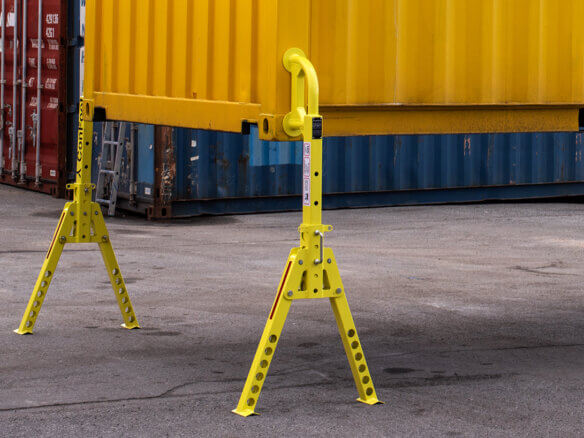

Other container news...

20 Foot shipping container cost
If you are researching the cost of a 20 foot shipping container, you have likely already encountered wildly different prices — from $999 listings online to quotes exceeding $5,500. That range is not a sign of inconsistency. It reflects real differences in container condition, location, delivery logistics, and the seller you are dealing with.
Side Opening container
A side opening container is an ISO-compliant intermodal shipping container engineered with full-length bi-fold doors along one of its long side walls, in addition to the standard cargo doors at one end. Unlike conventional containers that restrict access to a single set of rear doors, a side opening container — also widely called an open side container, open-sided shipping container, or side door container — provides unobstructed lateral access across the entire 20-foot or 40-foot length of the unit. This design transforms the container from a narrow tunnel into a wide-open space that forklifts can enter from the side, multiple workers can load simultaneously, and oversized cargo that would never fit through standard end doors can be placed without struggle.
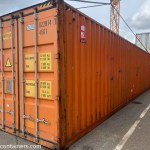
40 Foot High Cube container cost
A 40 foot high cube container — often abbreviated as 40ft HC, 40′ HC, or 40-foot high cube — is one of the most common shipping container sizes sold on the secondary market. But if you are researching what a 40 foot high cube container costs, you have almost certainly noticed that prices are all over the map. One seller quotes $1,500. Another quotes $7,000. Both could be legitimate.
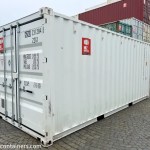
20 Foot container cost
If you have ever searched for a shipping container, you have almost certainly asked one question first: how much does a 20 foot container cost? The answer is not a single number. It is a range that spans from under $1,000 for a weathered, as-is unit to over $5,000 for a pristine, one-trip container — and that is before delivery, site preparation, or modifications enter the picture.