
Shipping Container on Legs ConFoot
Shipping container on legs ConFoot is not a standalone type of container, but represents a unique system for handling standard ISO containers. The foundation is a set of four portable support legs ConFoot, which are temporarily installed into corner anchor elements (corner castings) of the container. This Finnish patented system enables safe and efficient unloading or pickup of containers from a trailer or chassis without the need for expensive and bulky heavy handling equipment, such as cranes, reach stackers (reach stackers) or side loaders (sidelifters).
Main advantages of the ConFoot system:
- Full mobility: Allows container placement practically anywhere on a hardened surface.
- Speed and efficiency: The entire unloading or pickup operation takes only 5–10 minutes and can be handled by a single person.
- Universal use: Compatible with 10′, 20′, 30′, 40′ and 45′ containers, including tank containers and special frame containers.
- Safety: The system is certified according to EN 283 and complies with Directive 2006/42/ES.
ConFoot thus dramatically changes the traditional approach to container handling and enables greater logistical flexibility even in companies without heavy mechanization.
Operating Principle: How Does the ConFoot System Work?
ConFoot utilizes the common properties of modern trailers with air suspension and a patented support leg system. The process can be summarized in these steps:
Step by Step – How to Unload a Container Using ConFoot Legs
| Step | Description |
|---|---|
| 1. Site and Vehicle Preparation | A truck with a container arrives at a stable, hardened location (concrete, asphalt, compacted gravel). The vehicle is secured against movement. |
| 2. Raising the Trailer | The driver raises the trailer to the highest position using air suspension. |
| 3. Installing the Legs | Four ConFoot legs are individually inserted into the lower corner anchor holes of the ISO container. The legs are lightweight (24 kg), equipped with a magnet for attachment to the container wall. The arms are spread into an inverted “V” shape and secured with safety pins. |
| 4. Unlocking the Container | Twist-locks (locking pins) on the chassis are released. |
| 5. Lowering the Trailer | Air is slowly released from the bellows, the trailer descends and the container weight is transferred to the ConFoot legs. |
| 6. Vehicle Departure | The truck departs, the container safely stands on ConFoot legs. |
The entire process can be performed in reverse order when loading the container back onto the vehicle. Everything is designed for safe handling by a single person.
Video tutorials and guides: The official YouTube channel ConFoot contains instructional videos and practical demonstrations of use in the field.
Technical Specification and Construction
ConFoot legs are the result of precise Finnish engineering with emphasis on maximum safety, durability and ease of operation.
Materials and Construction
- Material: High-strength Finnish steel (special alloy of up to six types of steel for optimal weight-to-load ratio).
- Weight: 24 kg for standard models (CF, CFP, CFL), 46 kg for hydraulic models (CFU).
- Load capacity: 34 tons (CF, CFL), 30 tons (CFP, CFU 30), 20 tons (CFU 20), 45 tons (CFU 45).
- Telescopic construction: Leg height adjustable in the range 1,043–1,448 mm (up to 1,500 mm for the CFU model).
- Magnetic stabilization: A magnet attaches the upper part of the leg to the container wall, facilitating installation and preventing unintended movement.
- Patented folding design: In the extended state, the arms form a stable inverted “V”.
- Surface treatment: Corrosion protection for long life in any weather conditions.
Safety and Certification
- EN 283 Certification: Resistance to static and dynamic loads.
- CE Mark: Full compliance with Directive 2006/42/ES for machinery.
- Safety locks: Mechanical locks and pins for stability assurance.
Compatibility
- Containers: ISO standard (10′, 20′, 30′, 40′, 45′), including tank and frame containers.
- Surface: Hardened, level and load-bearing surface (concrete, asphalt, gravel).
ConFoot Leg Models and Their Specific Uses
ConFoot offers several model series that cover various usage scenarios:
| Model | Load Capacity (set of 4 pcs) | Weight (1 pc) | Height Range | Purpose and Key Features |
|---|---|---|---|---|
| CF | 34,000 kg | 24 kg | 1,043–1,448 mm | Standard model for universal use |
| CFP | 30,000 kg | 24 kg | 1,043–1,448 mm | Special “L” shape for ramp positioning |
| CFU 20 | 20,000 kg | 46 kg | up to 1,500 mm | Hydraulic lifting, height from ground |
| CFU 30 | 30,000 kg | 46 kg | up to 1,500 mm | Hydraulic, advanced height control |
| CFU 45 | 45,000 kg | 46 kg | up to 1,500 mm | Hydraulic, advanced height control |
| CFL | 34,000 kg | 24 kg | 1,043–1,448 mm | For frame/tank containers |
Model selection depends on specific use:

- Standard CF: For warehouses, logistics, construction, agriculture.
- CFP: Ideal for distribution centers where container doors need to open up to 270° at the ramp.
- CFU: Enables active lifting/lowering of containers to the ground – suitable for locations without additional handling equipment, or where precise floor level is required.
- CFL: Optimized for tank and frame containers.
Price Range (excluding VAT, approximate)
- CF/CFP/CFL (set of 4 pcs): approx. 3,700 EUR
- CFU 20: approx. 6,500 EUR
At selected distributors (e.g. HZ Containers) short-term rental is also possible in the Czech Republic and Slovakia.
Main Advantages and Benefits of the ConFoot System
Implementation of the ConFoot system brings significant benefits across the logistics chain:
Key Advantages
- Cost savings: No need for cranes, reach stackers or sidelifters – dramatically lower acquisition and operating costs.
- Accelerated transport: “Drop & hook” operations save driver time, vehicle is not blocked waiting for unloading.
- Flexibility: Possibility of placing containers on any hardened surface, including remote construction sites, agricultural areas, festival grounds or locations with minimal infrastructure.
- Safety: Elimination of heavy equipment movement among people, minimization of cargo or container damage risk.
- Cargo protection: Container standing on legs is protected from moisture, pests and flooding, air circulation improves.
- Easy operation: Everything can be handled by one person, independently of external operators.
- Certified quality: European standards and long-term testing guarantee safety even at full load.
Comparison with Traditional Handling Methods
For an objective assessment of ConFoot system advantages, it is useful to compare it with common container handling methods:
| Method | Required Equipment | Number of People | Time (min) | Direct Costs | Safety | Flexibility |
|---|---|---|---|---|---|---|
| ConFoot legs | Just a set of legs | 1 | 5–10 | Low | High | High |
| Mobile crane | Crane, rigging equipment | 2+ | 30+ | High | Medium | Low |
| Sidelifter | Special trailer | 1–2 | 15–30 | High | High | Medium |
| Reach stacker | Heavy forklift | 2+ | 10–20 | High | High | Low |
| Large forklift | Forklift with adapter | 2+ | 15–30 | Medium | Low | Low |
From the comparison it is clear that ConFoot is unbeatable in speed, costs, operation and deployment capability in hard-to-reach locations.
Practical Use in Various Industries
Main Areas of Use
- Logistics and transport: Accelerated vehicle turnover, reduced waiting time, higher fleet efficiency.
- Construction: Mobile warehouses, changing rooms, offices directly on the construction site. Easy relocation according to construction progress.
- Agriculture: Seasonal warehouses without the need to invest in permanent structures.
- Retail and e-commerce: Temporary warehouses during seasonal peaks directly at the store or warehouse.
- Events and festivals: Temporary infrastructure, technical facilities, storage spaces.
- Military and humanitarian missions: Rapid deployment of hospitals, warehouses, accommodation in crisis areas.
- Industry and manufacturing: Temporary storage of semi-finished products, flexible logistics routes.
Examples from Practice
- Retail chains: During Christmas, increase storage capacity without structural modifications.
- Highway construction: Movable warehouse of construction materials according to work progress.
- Festivals: Quick setup of catering or technical support facilities.
Relationship to Broader Logistics Processes
Physical vs. Documentary Logistics
The use of ConFoot legs significantly accelerates physical container handling, but the logistics process also includes administrative steps. It is necessary to ensure that container unloading/loading takes place in synchronization with the transfer of shipping documents (Original Bill of Lading, Telex Release), which are essential for lawful cargo acceptance.
Compatibility with Special Containers
- Refrigerated containers (reefers): ConFoot legs will easily support even heavy reefers. However, when they are stored for longer periods, external power supply for the cooling unit must be provided.
- Tank and frame containers: Special CFL model optimized for proper support of these structures.
- Special containers: If they have standard ISO corner elements, ConFoot use is possible.
Recommended Conditions of Use
- Surface: Solid, level, load-bearing (concrete, asphalt, well-compacted gravel).
- Slope: Maximum a few percent; with greater slope there is risk of instability.
- Storage period: The system is designed even for long-term storage (days to weeks), with the CFL model even longer.
- Weather: Corrosion protection allows year-round use.

 Czech Republic
  WITHOUT SHIPPING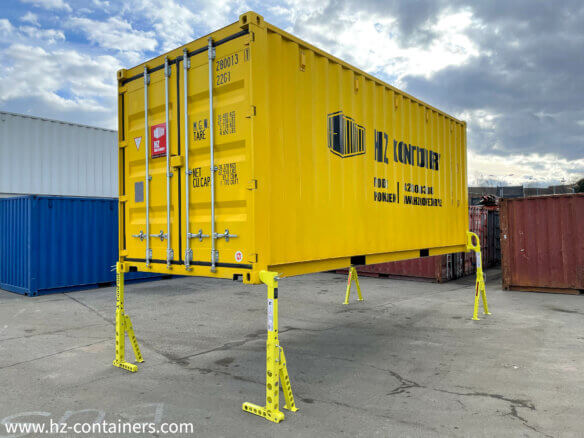


Other container news...

What Is a Shipping Container? The Ultimate Definitive Guide
A shipping container is a standardized, reusable steel box engineered to transport goods safely across multiple modes of transportation — ship, rail, and truck — without ever unloading the cargo inside. Also known as an ISO container, intermodal container, freight container, cargo container, sea van, dry box, or conex box, the shipping container is the invisible backbone of the global economy. More than 90% of everything you buy — from the smartphone in your pocket to the coffee in your cup — spent at least part of its journey inside one of these rectangular steel boxes.
Used Shipping Container: Grades, Costs, Inspection & More
A used shipping container delivers the same structural steel integrity as a new unit at 30–50% lower cost. For most storage, farming, job-site, and budget conversion applications, the right used container — properly graded and inspected — provides equal functional value with meaningfully lower upfront investment. This guide covers every decision you’ll face: grades, pricing, inspection, delivery, lifespan, and the mistakes that cost buyers thousands.

40ft Open Side Container
A 40ft open side container is a specialized ISO shipping container in which one full 40-foot long wall is replaced with bi-fold or multi-panel doors that swing open to provide unobstructed access along the entire side of the unit. Unlike a standard shipping container — where the only way in is through the 7-foot-8-inch-wide double doors at one end — an open side container lets you reach every pallet, every piece of equipment, and every inch of stored cargo from the side, without ever having to dig through layers of inventory. The standard end doors remain intact, giving you two fundamentally different access modes in a single unit.

20 Foot shipping container
A 20 foot shipping container is the single most important unit of measurement in global trade. It is the backbone of intermodal logistics, the standard by which every container ship, port terminal, and freight rate is measured, and — increasingly — a building block for homes, offices, and creative architecture. Despite its ubiquity, most people who encounter a 20 foot shipping container know surprisingly little about what defines it, how it came to be, and what it can actually do.