
How to Properly Choose a Shipping Container?
Purchase of a shipping container, whether for storage, transport, conversion to residential or commercial objects, requires knowledge of technical parameters, standards, typology and container conditions. In the Czech Republic the container market is diverse, offering a wide range of sizes, conditions and types depending on the intended use. Containers are subject to international standards (ISO, CSC) that define their dimensions, load capacity, safety requirements and inspection methods. This glossary of terms is intended for anyone who wants to select the right shipping container based on verified parameters and with an emphasis on long‑term investment reliability.
Overview of Key Terms and Extended Information
ACEP (Approved Continuous Examination Program)
Definition:
ACEP is a continuous (ongoing) container inspection system approved by the International Convention for the Safety of Containers (CSC). Fleet operators (especially large shipping companies) commit to regular inspections of all containers not only at scheduled intervals but also after any significant event (e.g., damage, repair, change of ownership).
Technical details and legislation:
- Every container enrolled in ACEP must have a unique ACEP number on the CSC plate.
- Operators must keep precise records and documentation of all inspections.
- ACEP is recognized worldwide, including EU countries, and is considered equivalent to Periodic Inspections (PES).
- In the Czech Republic compliance with ACEP is mandatory for cross‑border and international transport.
Practical significance for the buyer:
If you buy a container with ACEP records, it is usually a unit that has been carefully managed and regularly inspected. For pure storage purposes ACEP is not required, but it is a sign of higher quality and traceability of origin.
As‑Is Container ( “as‑is” Container)

Definition:
This is the lowest condition category of a shipping container. The container is sold in its current state, without any guarantees of watertightness, functionality or structural integrity.
Technical details:
- Most commonly decommissioned units with damage that may include extensive corrosion, wall holes, ruined floor, non‑functional doors, frame deformation.
- The service life of these containers is significantly shorter; they are often intended for scrapping into steel or for construction/hobby projects requiring extensive renovation.
Recommendation:
Purchase only if you have experience with container repairs, access to spare parts and a budget for refurbishment. Suitable for recycling, fence or garage construction, or workshop structures where poor aesthetic or technical condition is acceptable.
Cargo Worthy (CW) Container
Definition:
“Cargo Worthy” designates a container capable of safe maritime transport – it has passed inspection by a certified inspector and meets all structural strength requirements of ISO 1496 and CSC.

Technical details:
- Valid or renewable CSC plate (technical certificate).
- Minor cosmetic defects (surface rust, dents) do not affect functionality.
- Watertight test (“light test”) is standard.
- Floor must be free of serious damage and suitable for cargo.
- Elements such as door locks, seals and ventilation must be fully functional.
Recommendation:
Ideal for cargo transport, long‑term storage of valuable materials, or as a base for residential and office conversions.
CSC Plate
Definition:
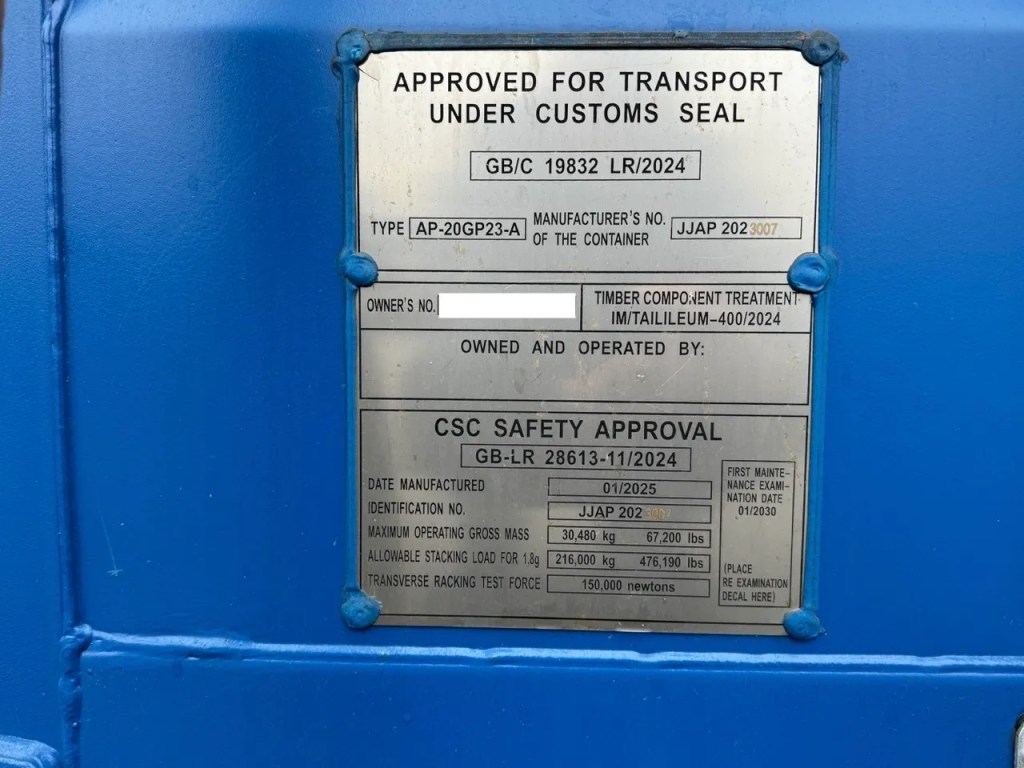
A metal plate (usually stainless steel) attached to the outside of the container doors. It is mandatory for all containers used in international transport.
Contains:
- Manufacturing data (year, manufacturer, serial number)
- Maximum Gross Weight (MGW)
- Maximum stacking load value
- Floor data (material and treatments)
- Date of next inspection or ACEP number
Practical significance:
Without a valid CSC plate a container is not allowed for sea transport. For storage purposes a valid plate indicates a well‑maintained unit.
Gooseneck Tunnel
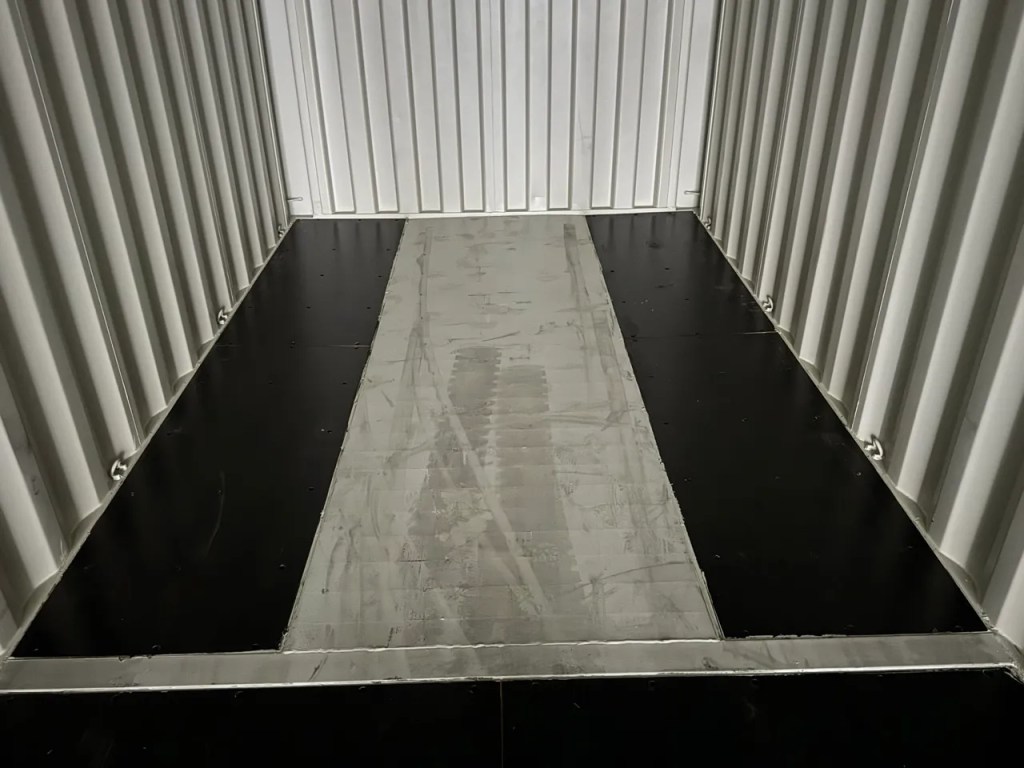
Definition:
A recessed section in the floor of 40‑foot and longer containers, adapted for transport on a special “gooseneck chassis”.
Technical details:
- Reduces the overall height of the train.
- Not a defect or floor damage.
- Allows safe road transport of the container in accordance with European maximum height regulations.
Practical significance:
No major relevance for storage or construction, but may be required for certain trailer types during transport.
High Cube (HC) Container
Definition:

A container that is 1 foot (30 cm) taller than the standard (8 ft 6 in vs. 9 ft 6 in).
Technical details:
- Most common in 40‑foot length; 20‑foot HC variants also exist.
- Internal height ≈ 2.70 m.
- Usable volume up to 76 m³ (for 40′ HC).
Uses and advantages:
- Ideal for storing tall items, conversions to living spaces (more room for insulation and services).
- Greater volume with only a minimal price increase compared with a standard container.
IICL (Institute of International Container Lessors)

Definition:
International association of the largest container leasing companies. IICL standards (e.g., IICL‑5, IICL‑6) are the strictest norms for repairs and condition of used containers.
Technical details:
- Minimal number of cosmetic defects.
- Emphasis on structural integrity, watertightness and aesthetics.
- IICL containers are often comparable to “as‑new” condition but at a lower price than One‑Trip.
Practical use:
For transporting sensitive goods, high‑profile conversions, or customers seeking maximum lifespan with minimal maintenance.

Container Inspection
Types:
- Professional inspection according to CSC/IICL: Required for cargo transport and import/export.
- Personal inspection: Recommended before acceptance and when buying for storage.
Detailed checklist:
- Visual inspection of the frame (main beams, corner posts)
- Floor inspection (signs of rot, delamination, chemical contamination)
- Watertight test (darkening the interior, looking for light leaks)
- Door and seal functionality (easy opening, flexible seals)
- Wall and roof inspection (holes, dents, corrosion)
- For refrigerated containers, additional check of refrigeration technology
Practical advice:
Never take possession of a container without inspection, preferably with an expert or using a detailed checklist.
One‑Trip Container
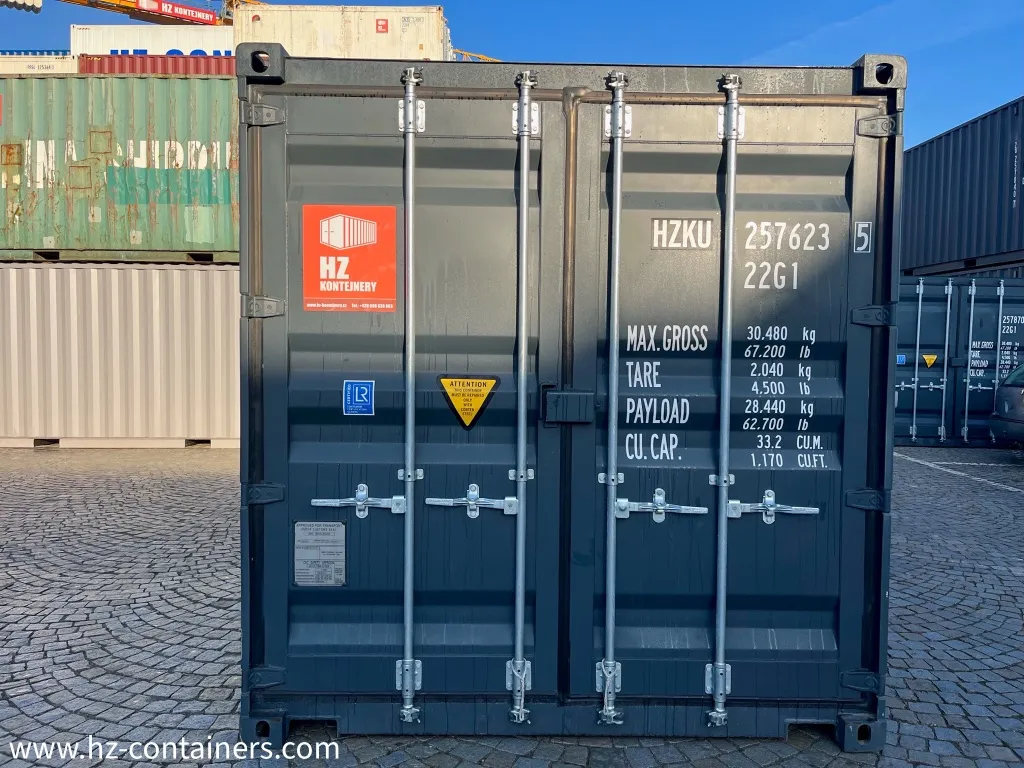
Definition:
A container that has been used for only one transport from the factory (usually from China to Europe/USA).
Technical details:
- “As‑new” condition, no structural faults, minimal handling marks (cosmetic scratches).
- Perfect floor, clean interior, maximum service life.
Uses:
Luxury conversions, showrooms, mobile units, long‑term storage of valuable items – an investment with the lowest future maintenance costs.
Corrosion and Rust
Types:
- Surface rust: Orange‑brown coating, removable by grinding and painting.
- Structural rust: Delamination of layers, deep corrosion, risk of loss of structural strength (professional repair required).
Recommendation:
Always prefer containers with minimal structural corrosion. Surface defects can be easily repaired.
Purchasing a Shipping Container – Procedure and Recommendations
Steps:
- Define the purpose (storage, transport, conversion)
- Choose the appropriate size and type (20′, 40′, High Cube, specialized)
- Select the condition (One‑Trip, IICL, CW, WWT, As‑Is)
- Verify seller references and history
- Request an on‑site inspection or detailed photo/video inspection
- Arrange transport (check stacking possibilities, access routes)
- Perform an inspection before taking possession
Legislative note:
Using a container as a building (garage, house, warehouse) may require a building permit, project documentation and structural calculations in the Czech Republic.
Container Floor

Composition:
- Steel cross‑beams
- 28 mm thick plywood (often tropical wood, “marine grade”)
- Treatment with pesticides and antifungicides (information on CSC plate)
Specifics:
- Chemical treatments can release harmful substances when sanded or refinished – for residential use always apply a barrier coating or consider floor replacement.
Container Dimensions (ISO standards)
| Container Type | Length (mm) | Width (mm) | Height (mm) | Internal Length (mm) | Internal Width (mm) | Internal Height (mm) | Volume (m³) |
|---|---|---|---|---|---|---|---|
| 20′ Standard | 6 058 | 2 438 | 2 591 | 5 898 | 2 352 | 2 393 | approx. 33 |
| 40′ Standard | 12 192 | 2 438 | 2 591 | 12 032 | 2 352 | 2 393 | approx. 67 |
| 40′ High Cube (HC) | 12 192 | 2 438 | 2 896 | 12 032 | 2 352 | 2 698 | approx. 76 |
Special types have additional modifications (see below).
Types of Shipping Containers
- Dry Van / General Purpose: Closed container for ordinary cargo.
- High Cube: Taller variant for bulkier loads.
- Open Top: Removable canvas roof, for oversized or bulk cargo loaded from the top.
- Flat Rack: No side walls or roof, only end walls – for machinery, vehicles, oversized equipment.
- Reefer ( refrigerated ): Built‑in cooling unit, insulated.
- Tank Container: For liquids or gases.
- Double Door, Side Door: Doors on both ends or on the side for easier handling.
Wind and Watertight (WWT) Container
Definition:
A category that guarantees wind resistance and watertightness of the container, without a guarantee for transport.
Technical details:
- Functional door seals, no breaches in walls/roof.
- More cosmetic defects, repairs, surface rust.
- Not suitable for stacking fully loaded containers or sea transport.
Use:
Most cost‑effective for dry land storage, construction projects, temporary garages, workshops.
Container Condition (Grade/Condition)
| Category | Description | Suitable for | Note |
|---|---|---|---|
| One‑Trip | New, transported only once | Luxury projects, long‑term use | Highest price, minimal maintenance |
| IICL | Excellent used | Demanding customers, representative purposes | According to the strictest standards |
| Cargo Worthy | Structurally sound | Transport, storage, conversions | Excellent price/performance ratio |
| Wind & Watertight (WWT) | Watertight, not suitable for transport | Storage, construction | Most common for storage |
| As‑Is | Damaged with no guarantees | Repairs, scrapping | Cheapest, highest risk |

 Koper, Slovenia
  WITHOUT SHIPPING


Other container news...

40ft High Cube container price
If you are researching the 40ft high cube container price, you have probably already noticed that the numbers vary wildly — anywhere from $1,200 to over $7,000. That range is not a mistake. It reflects a market where condition, geography, and timing collide to produce dramatically different outcomes for buyers. One person in Houston pays $1,800 for a wind-and-watertight unit delivered to their door, while another in Denver pays $5,500 for the same grade. This guide exists to close that information gap. By the time you finish reading, you will know exactly what drives these prices, what you should realistically budget, and how to avoid the traps that cause buyers to overpay.

High Cube container specifications
A high cube container — also referred to as an HC container, HQ container, or high-cube — is an intermodal shipping container that stands one foot taller than the standard ISO container. While a standard general-purpose container measures 8 feet 6 inches (2.59 m) in external height, a high cube container extends to 9 feet 6 inches (2.89 m). This extra 12 inches of vertical clearance translates into approximately 10–15% more cubic capacity without altering the container’s footprint — the same length and width are maintained, meaning the container occupies the same floor space on a vessel, chassis, or storage yard.

Shipping containers for sale
A shipping container is a standardized steel box built to ISO specifications for intermodal freight transport and storage. Whether you need one for secure on-site storage, a construction project, a home conversion, or international cargo shipping, understanding the market — prices, grades, sizes, delivery logistics, and inspection criteria — is the difference between a smart investment and an expensive mistake. This guide covers everything you need to know before buying shipping containers for sale in 2026.

What Is a Shipping Container? The Ultimate Definitive Guide
A shipping container is a standardized, reusable steel box engineered to transport goods safely across multiple modes of transportation — ship, rail, and truck — without ever unloading the cargo inside. Also known as an ISO container, intermodal container, freight container, cargo container, sea van, dry box, or conex box, the shipping container is the invisible backbone of the global economy. More than 90% of everything you buy — from the smartphone in your pocket to the coffee in your cup — spent at least part of its journey inside one of these rectangular steel boxes.