
Specifications of 40-foot High Cube container
40-foot high cube container — often abbreviated as 40ft HC, 40′ HQ or 40HC — is one of the most used intermodal shipping containers in global logistics. It shares the same length and width as a standard 40-foot container, but is exactly one foot taller: 9 feet 6 inches (2.896 meters) externally versus the standard 8 feet 6 inches (2.591 meters). This extra foot of height translates to approximately 12.5% more internal cubic volume, making the 40-foot high cube container the preferred choice for light, voluminous or oversized cargo.
This guide provides all the specifications of a 40-foot high cube container you need — internal and external dimensions down to the millimeter, weight parameters, door opening dimensions, pallet capacity, ISO codes, construction features, pricing, and a complete comparison with the standard 40-foot container. Whether you are a shipper, importer, container buyer, or architect planning a container conversion, the data here is drawn from specifications published by major shipping lines, leasing companies, and ISO standards that govern the global container fleet.
Key Summary: A 40-foot high cube container offers approximately 76.4 cubic meters (2,694 cubic feet) of internal volume compared to approximately 67.7 cubic meters for a standard 40-foot container. The extra foot of height is the only dimensional difference — but its impact on cargo capacity, loading flexibility, and cost per unit shipped is substantial.
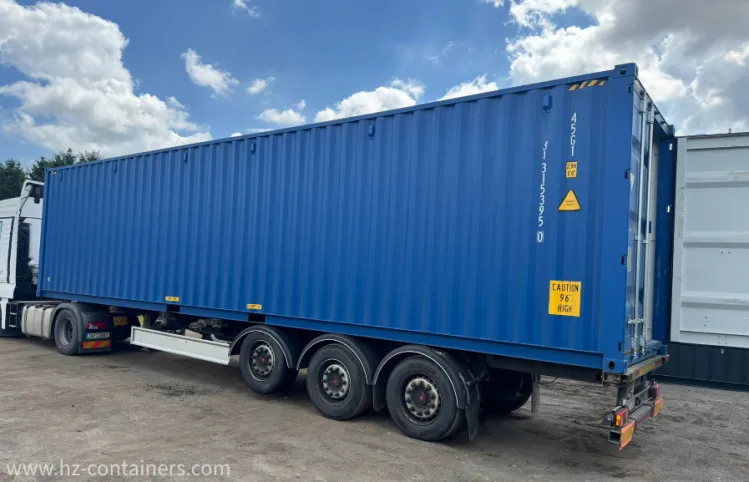
What is a 40-foot high cube container?
Definition and ISO Classification
A 40-foot high cube container is a fully enclosed, rectangular steel box designed for intermodal freight transport — meaning it can be moved by ship, rail, and truck without unloading and reloading the cargo inside. It conforms to ISO 668, the international standard that defines external dimensions, corner fitting positions, and structural requirements for Series 1 containers used in global trade.
The defining characteristic of the high cube container is its external height of 9 feet 6 inches (2,896 mm), compared to the standard ISO container height of 8 feet 6 inches (2,591 mm). This extra height is the only dimensional difference from the standard 40-foot container — length and width are identical.
ISO Code: The standard ISO type-size code for a 40-foot high cube container for general dry cargo is 45G0. The designation “45” means a 40-foot length with a height of 9 feet 6 inches and “G0” means a general-purpose container without ventilation. Some classifications also use 42G1, but 45G0 is the most common designation on container markings.
These containers are made predominantly of CORTEN steel — a high-strength, low-alloy weathering steel that forms a stable, protective rust patina when exposed to the elements. This patina paradoxically makes the steel highly resistant to corrosion, which is why shipping containers typically last 15 to 20 years exposed to saltwater on the decks of ocean vessels. The floor is typically marine-grade plywood, usually 28 mm thick, treated against moisture, fungal rot, and insects, mounted on a steel frame with cross members.
History and Evolution of High Cube Containers
The 40-foot high cube container did not emerge by accident. It is the product of decades of evolution in containerization that began with Malcolm McLean’s first container voyage in 1956 and the subsequent ISO standardization of container dimensions in the late 1960s.
The original ISO 668 standard, published in 1968, set container heights at 8 feet and 8 feet 6 inches. These dimensions were chosen to fit the loading clearance profiles of North American rail tunnels and European road bridges. But by the 1980s, shipping lines were facing a persistent problem: shippers of light, voluminous goods — furniture, textiles, insulation materials, empty plastic containers — were “cubing out” their containers long before they “weighing out”. The container was physically full to the ceiling yet still well below its maximum weight limit. Economically speaking, shippers were paying for weight capacity they couldn’t use because they ran out of physical space first.
The industry responded by introducing containers with an extra foot of internal height. Originally called “high cube” or “hi-cube” containers, these 9-foot-6-inch boxes offered a simple, elegant solution: approximately 12% more internal volume with virtually no increase in handling difficulty or port infrastructure requirements.
Gooseneck Tunnel Innovation: A key structural feature that made high cube containers practical on roads was the gooseneck tunnel — a tunnel-like recess running across the underside at the front end of 40-foot containers. This recess allows the container floor to sit lower on a specialized gooseneck chassis, so the container slides down between the trailer wheels instead of riding entirely above them. Without this innovation, a 9′6″ container on a standard chassis would exceed height limits on many highways. The tunnel elegantly solves this problem and is standard on nearly all modern 40-foot high cube containers.
| Era | Development | Impact |
|---|---|---|
| 1956 | Malcolm McLean’s first container voyage | Birth of containerization |
| 1968 | ISO 668 published — standard heights of 8′ and 8′6″ | Global dimensional standardization |
| 70s | Rapid adoption of 20-foot and 40-foot standard containers | Global shipping revolution |
| 80s | Problem of “cubing out” recognized for light cargo | Growing demand for taller containers |
| Late 80s | First high cube containers with 9′6″ height introduced | 12% more volume for voluminous, light cargo |
| 90s | Gooseneck tunnel becomes standard | High cube containers become road-legal with drop-deck chassis |
| 2000–present | High cube containers dominate new container orders | Most 40-foot containers now manufactured as high cube |
Today, the 40-foot high cube container represents a substantial and growing share of the global container fleet. Many major shipping lines now order new 40-foot containers almost exclusively in the high cube configuration, reflecting shippers’ demand for incremental capacity at marginal additional cost.
What are the exact external dimensions of a 40-foot high cube container?
The external dimensions of a 40-foot high cube container are standardized under ISO 668 to ensure compatibility with container ships, gantry cranes, rail cars, and truck chassis anywhere in the world. A crane operator in Shanghai uses the same corner fitting spacing as an operator in Rotterdam — this universality is the foundation of the global intermodal transport system.
External Dimensions
| Dimension | Metric | Imperial (feet and inches) |
|---|---|---|
| External length | 12,192 mm | 40′ 0″ |
| External width | 2,438 mm | 8′ 0″ |
| External height | 2,896 mm | 9′ 6″ |
The external length of 12,192 mm is the defining ISO dimension for a 40-foot container — corner fittings are precisely positioned according to this length and all container handling equipment, from ship cell guides to chassis locks, is built to match it. The external width of 2,438 mm is the universal ISO container width, shared by 20-foot, 40-foot, and 45-foot containers.
The external height of 2,896 mm is the only dimensional difference between the high cube container and the standard 40-foot container, which measures 2,591 mm (8′ 6″) externally. Those 305 mm (12 inches) of additional height create the volumetric advantage of the high cube container.
How external dimensions enable intermodal transport
The precise standardization of external dimensions means that a 40-foot high cube container loaded at a factory in Vietnam can be trucked to the port, lifted by a gantry crane onto a container ship, unloaded in Los Angeles, transferred to a railcar, and finally delivered by truck to a warehouse in Chicago — all without opening the container doors. Every piece of equipment in this chain is designed to handle exactly these external dimensions. Corner fittings — reinforced steel blocks at each of the container’s eight corners with oval apertures — are the universal interface between the container and all handling equipment.
What are the internal dimensions of a 40-foot high cube container?
Internal dimensions vary slightly between manufacturers and the age of the container, but fall within a narrow and well-established range. The data below represents the most commonly cited specifications from major shipping lines including Hapag-Lloyd, OOCL, Maersk, and ONE.
Internal Dimensions
| Dimension | Metric (typical) | Metric (range) | Imperial (typical) | Imperial (range) |
|---|---|---|---|---|
| Internal length | 12,032 mm | 11,998–12,032 mm | 39′ 6″ | 39′ 4″–39′ 6″ |
| Internal width | 2,352 mm | 2,312–2,352 mm | 7′ 9″ | 7′ 7″–7′ 9″ |
| Internal height | 2,700 mm | 2,665–2,700 mm | 8′ 10″ | 8′ 9″–8′ 10″ |
The internal height of approximately 2,700 mm (8′ 10″) is the most important dimension for cargo planning. It is approximately 305 mm (12 inches) more than the internal height of a standard 40-foot container, which typically measures 2,393 mm (7′ 10″). The difference is the result of the one-foot increase in external height, minus the thickness of the roof structure and floor.
The internal width of 2,352 mm (7′ 9″) is critical for pallet loading. Two standard Euro pallets (1,200 mm × 800 mm) can be placed side by side with the long dimension across the container width, while two standard American pallets (48″ × 40″) can be placed side by side with the 40-inch dimension across the width.
Door Opening Dimensions
The cargo doors at the rear of the container are the primary access point for loading and unloading. The door opening dimensions are slightly smaller than the internal dimensions due to the steel construction of the door frame:
| Dimension | Metric | Imperial |
|---|---|---|
| Door opening width | 2,340 mm | 7′ 8″ |
| Door opening height | 2,585–2,597 mm | 8′ 5″–8′ 6″ |
The door opening height is typically about 100–115 mm (4–4.5 inches) less than the internal height due to the door header and sill. This is a critical consideration for cargo approaching the container’s height limits — even if an item fits inside the container, it must also pass through the door opening during loading. Always verify both the internal height and door opening height before booking a shipment for oversized cargo.
How much does a 40-foot high cube container weigh?
Weight specifications are just as important as dimensions because road weight limits, crane capacities, and ship stowage plans all depend on accurate knowledge of the loaded container weight. Three key weight terms are:
- Tare Weight (Tare): The weight of the empty container itself, including all permanently attached fittings.
- Maximum Gross Weight (MGW): The maximum allowable total weight of the container including its cargo — also called maximum payload or maximum gross weight.
- Maximum Payload: The maximum weight of cargo that can be loaded into the container, calculated as MGW minus the tare weight.
Weight Specifications
| Specification | Metric (typical) | Metric (range) | Imperial (typical) | Imperial (range) |
|---|---|---|---|---|
| Tare Weight | 3,940 kg | 3,800–4,200 kg | 8,687 lbs | 8,380–9,260 lbs |
| Maximum Gross Weight | 30,480 kg | 30,480–32,500 kg | 67,200 lbs | 67,200–71,650 lbs |
| Maximum Payload | 28,560 kg | 26,300–28,620 kg | 62,975 lbs | 58,000–63,100 lbs |
Because a 40-foot high cube container has slightly taller corner posts, additional steel in the roof rails, and a marginally heavier frame construction than a standard 40-foot container, its tare weight is typically 300 to 400 kilograms (660–880 lbs) heavier than that of a standard 40-foot container. This means the maximum payload is slightly lower — but for most shippers, the extra volume far outweighs the small weight penalty.
Important: Road weight regulations in individual countries and states often impose limits stricter than the ISO maximum gross weight. In the United States, the federal vehicle gross weight limit is 80,000 lbs (36,287 kg) for tractor-trailer combinations. A fully loaded 40-foot container weighing 67,200 lbs, combined with chassis weight (~10,000 lbs) and tractor weight (~17,000–20,000 lbs), can approach the federal limit. Always verify road weight rules for the specific route, including state axle weight limits.
The SOLAS (Safety of Life at Sea) Verified Gross Mass (VGM) requirement, in effect since 2016, mandates that shippers provide the verified gross weight of each packed container before it is loaded onto a vessel. This makes accurate weight knowledge not just a planning consideration but a legal requirement for ocean shipping.
How much cargo can a 40-foot high cube container hold?
Cubic Capacity
A 40-foot high cube container offers approximately 76.4 cubic meters (2,694–2,700 cubic feet) of internal cargo space. This is approximately 12.5% more volume than the approximately 67.7 cubic meters in a standard 40-foot container. Across an entire shipment of multiple containers, this means a shipper using high cube containers typically needs nine containers where a shipper using standard-height boxes would need ten — a significant cost saving.
Useful rule of thumb: if your cargo has a density of less than approximately 350 kg per cubic meter, you will likely “cube out” (fill the container’s physical space) before you “weigh out” (reach the weight limit). In these cases, the high cube container is almost always the more economical choice. Examples of such cargo include furniture, foam products, insulation, textiles, empty plastic containers, and agricultural products like hay bales.
Pallet Capacity — Euro vs. American Pallets
How many pallets fit in a 40-foot high cube container depends on the pallet type and loading configuration:
| Pallet Type | Pallet Dimensions | Maximum Number of Pallets (on floor) | Loading Pattern |
|---|---|---|---|
| Euro Pallet (EUR) | 1,200 mm × 800 mm | 25 | 11 pallets lengthwise + 14 pallets crosswise |
| Standard American Pallet (GMA) | 48″ × 40″ (1,219 mm × 1,016 mm) | 20–21 | Two rows of 10, or 10 + 11, depending on orientation |
| ISO Pallet | 1,200 mm × 1,000 mm | 20 | Two rows of 10 |
Euro pallets achieve the highest density because their 800 mm width allows two different orientations within the container’s 2,350 mm internal width. Stacking pallets in two layers — which the high cube container’s extra foot of height makes much more practical than in a standard container — can double the total pallet count to 50 Euro pallets or 40–42 American pallets, provided the cargo weight does not exceed the container’s payload limit.
Gooseneck Tunnel and Its Impact on Floor Loading
The gooseneck tunnel has a practical consequence for loading: the floor of a 40-foot high cube container is not uniformly flat across its entire length. Near the front end of the container (opposite the doors), the floor drops by approximately 120 mm (4.7 inches) over roughly the first meter of container length. This recess, which accommodates the gooseneck of the chassis when the container is on a truck, creates a slight unevenness in the floor.
For most palletized cargo this is not a problem — pallets bridge the recess without difficulty. But for machinery, equipment, or any cargo requiring a perfectly level surface, the tunnel zone should be avoided or leveled with shims. Loaders should be aware of this feature and plan cargo placement accordingly.
How does a 40-foot high cube container differ from a standard 40-foot container?
The only defining difference between a 40-foot high cube container and a standard 40-foot container is height. All other dimensions — length and width — are identical. But this one change has a cascading effect on differences in volume, weight, loading flexibility, and cost efficiency.
Complete Side-by-Side Comparison
| Specification | 40-foot Standard Container | 40-foot High Cube Container | Difference |
|---|---|---|---|
| External height | 8′ 6″ (2,591 mm) | 9′ 6″ (2,896 mm) | +1′ 0″ (+305 mm) |
| Internal height | 7′ 10″ (2,393 mm) | 8′ 10″ (2,700 mm) | +1′ 0″ (+307 mm) |
| Door opening height | 7′ 5″ (2,261 mm) | 8′ 5″ (2,585 mm) | +1′ 0″ (+324 mm) |
| External length | 40′ 0″ (12,192 mm) | 40′ 0″ (12,192 mm) | None |
| External width | 8′ 0″ (2,438 mm) | 8′ 0″ (2,438 mm) | None |
| Internal length | 39′ 5″ (12,032 mm) | 39′ 5″ (12,032 mm) | None |
| Internal width | 7′ 8″ (2,352 mm) | 7′ 9″ (2,352 mm) | None |
| Cubic Capacity | ~67.7 m³ (2,390 ft³) | ~76.4 m³ (2,694 ft³) | +8.7 m³ (+304 ft³) |
| Tare Weight | ~3,600 kg (7,940 lbs) | ~3,940 kg (8,687 lbs) | +340 kg (+747 lbs) |
| Maximum Payload | ~28,880 kg (63,670 lbs) | ~28,560 kg (62,975 lbs) | −320 kg (−705 lbs) |
| ISO Code | 42G0 | 45G0 | — |
When to Choose a Standard 40-foot Container
A standard 40-foot container is the better choice when:
- Your cargo is dense and heavy — you “weigh out” before you “cube out”
- The slightly higher tare weight of the high cube container would reduce your payload below requirements
- Your cargo fits comfortably within the standard internal height of 7′ 10″
- Road height restrictions on the destination route make the high cube container impractical
When to Choose a 40-foot High Cube Container
A 40-foot high cube container is the better choice when:
- Your cargo is light and voluminous — you “cube out” before you “weigh out”
- Your cargo items are tall or require vertical stacking clearance
- You are shipping on pallets that need to be stacked in two layers
- The per-unit shipping cost savings from using fewer containers outweighs the small weight penalty
- The container will be converted for storage, workspace, or conversion where standing height is desirable
Common Misconception: Many people assume that shipping a high cube container costs significantly more. In reality, ocean freight rates for a 40-foot high cube container on major trade routes are often identical to rates for a standard 40-foot container. The price difference, if any, is typically marginal. The economic benefit of fitting more cargo per container usually far outweighs any small price premium.
What are the construction features of a 40-foot high cube container?
CORTEN Steel, Corner Fittings, and Frame Construction
A 40-foot high cube container is an engineering achievement of structural efficiency. The frame consists of:
- Four corner posts — vertical columns at each corner, made of the thickest steel in the container construction. These bear the entire stacking load when containers are stacked up to nine high on a ship.
- Top and bottom side rails — longitudinal steel beams running the entire length of the container. The top rails include lashing rings and provide roof support.
- Front and rear header rails — horizontal beams above the front wall and door opening.
- Corner fittings — standard ISO corner fittings with oval apertures at all eight corners. These are the universal connection points for twist locks, crane spreaders, and stacking cones.
- Cross members — steel beams running laterally beneath the floor at approximately 300 mm intervals, supporting the plywood floor and distributing cargo weight.
- Roof panels — corrugated CORTEN steel sheets, typically 2 mm thick, welded to the top rails and roof bows.
The entire structure is built from CORTEN steel (also known as weathering steel), a high-strength, low-alloy steel that forms a stable, self-protecting rust patina when exposed to the atmosphere. Unlike ordinary steel, which continues to corrode, the CORTEN patina acts as a barrier that dramatically slows further corrosion. This is why containers can spend decades in marine environments without structural failure.
Lashing Rings and Cargo Securing Points
Cargo securing is a critical safety aspect, and a 40-foot high cube container is equipped with multiple lashing points:
- Top rail lashing rings: Located along the top side rails, typically at regular intervals. A 40-foot container usually has approximately 10 lashing rings on each side rail at the top rail.
- Bottom rail lashing rings: Located along the bottom side rails, providing low anchor points for cargo straps and tie-downs.
- Corner post lashing rings: Additional rings on the corner posts, often rated for the highest loads.
- Lashing ring capacity: Each lashing ring is typically rated for loads up to 1,000 kg (2,200 lbs), although exact ratings depend on the manufacturer and age of the container. Rings should be loaded in the direction of the lashing force, not at extreme angles.
- Front-end tunnel rail: The bottom cross member at the front end often includes additional lashing points.
Securing Principle: Lashings should be arranged so that the cargo cannot move in any direction — forward, backward, sideways, or up. The lashing angle should ideally be between 30° and 60° from horizontal. For heavy cargo, more lashings should divide the load between several lashing points, rather than concentrating force on a single ring.
Floor Construction and Weight Distribution
The floor of a 40-foot high cube container is made of marine-grade plywood panels, typically 28 mm thick, bolted or screwed to the steel cross members. The plywood is treated with anti-fungal and anti-insect preservatives and is designed to withstand:
- Forklift traffic with loaded weights (provided the forklift axle load does not exceed the floor load point limit)
- Heavy, concentrated loads when properly distributed using shims
- Years of exposure to fluctuating moisture and temperature conditions
The floor load capacity is highest when the weight is distributed across multiple cross members. Point loads — such as the wheels of a heavy forklift or a heavy machine base — should always be distributed using timber dunnage or steel plates.
What are 40-foot high cube containers used for?
Applications in Shipping and Logistics
In their primary role as shipping containers, 40-foot high cube containers are used for all types of general cargo (dry cargo), but are particularly suited for:
- Light, voluminous cargo: Furniture, textiles, clothing, footwear, toys, plastic products, foam products, and insulation materials
- Oversized cargo: Items that exceed the internal height of a standard container but fit within the high cube container’s 2,700 mm internal height
- Palletized goods on tall pallets: Goods stacked on taller-than-standard pallets that would not clear the door opening of a standard container
- Double-stacked pallets: When two pallets are stacked vertically, the high cube container’s extra foot provides the necessary clearance
- Full container load (FCL) shipments: Where the shipper controls the entire container and benefits from maximizing cubic utilization
Storage, Conversion, and Alternative Uses
Once a 40-foot high cube container leaves ocean service, it often finds a second life in a wide range of applications:
- On-site storage: Secure, weather-resistant storage of building materials, equipment, documents, or supplies
- Container homes and offices: The high cube container’s internal height of approximately 2,700 mm (8′ 10″) makes it much more comfortable for human habitation than a standard container with 2,393 mm. After adding insulation, flooring, and ceiling, the remaining clear height is still sufficient for standing.
- Pop-up retail and hospitality: Converted into cafes, bars, retail kiosks, and market stalls
- Workshops and studios: Generous dimensions provide ample space for work tables, equipment, and movement
- Emergency and humanitarian shelters: Rapidly deployable, secure, and durable temporary accommodation or medical facilities
- Art galleries and exhibition spaces: The clean, industrial aesthetic and modular nature make containers popular for temporary installations
How much does a 40-foot high cube container cost?
Container prices vary significantly based on condition, location, and market demand. The table below provides representative price ranges for 2026 in the American market:
Price Ranges by Condition Category
| Condition Category | Description | Typical Price Range (USD) |
|---|---|---|
| New / One Trip | Recently manufactured, one cargo trip from factory to destination. Minimal wear, like-new condition. | $2,950–$3,500 |
| Cargo Worthy (CW) | Structurally sound, wind and water tight, CSC certified for ocean shipping. May have cosmetic wear. | $1,800–$2,500 |
| Wind and Water Tight (WWT) | Doors seal, roof does not leak, structurally intact. May not have current CSC certification. Suitable for storage. | $1,500–$2,100 |
| As Is | Sold in current condition, may have leaks, rust, or door issues. Suitable for projects where repairs are planned. | $800–$1,500 |
Prices vary significantly by location. Coastal markets with major ports (Los Angeles/Long Beach, New York/New Jersey, Houston, Savannah) typically offer lower prices due to greater container availability. Inland locations and areas far from ports have higher prices due to transportation costs.
Buying Tip: Before purchasing a used container, always inspect it in person or request detailed photographs. Check door seals, the roof for indentations or rust-through, the floor for soft spots or delamination, and corner fittings for damage. A container that is “wind and water tight” should be verified by entering the container on a sunny day with the doors closed — any light spots indicate openings through which water will penetrate.
Frequently Asked Questions
What is a 40-foot high cube container?
A 40-foot high cube container is an ISO-standard intermodal shipping container that measures 40 feet in length, 8 feet in width, and 9 feet 6 inches in height externally. It is one foot taller than a standard 40-foot container and provides approximately 12.5% more internal cubic capacity (76.4 m³ vs. 67.7 m³). It is used for shipping light, voluminous, or oversized cargo and is also widely converted for storage, housing, and commercial conversions.
What is the difference between a 40-foot high cube container and a standard 40-foot container?
The only dimensional difference is height. A standard 40-foot container measures 8′ 6″ (2,591 mm) externally in height, while the high cube container measures 9′ 6″ (2,896 mm). Inside, the high cube container provides approximately 8′ 10″ (2,700 mm) of usable height compared to 7′ 10″ (2,393 mm) in the standard container. This extra foot increases internal volume by approximately 12.5% and adds approximately 300–400 kg to the tare weight.
How much cargo can a 40-foot high cube container hold?
A 40-foot high cube container has an internal volume of approximately 76.4 cubic meters (2,694 cubic feet) and a maximum payload of approximately 28,560 kg (62,975 lbs). The actual amount of cargo that fits depends on cargo density and packaging method. For palletized cargo, it holds up to 25 Euro pallets or 20–21 standard American pallets in a single layer, or double that if pallets are stacked in two layers (subject to weight limits).
How many pallets fit in a 40-foot high cube container?
Capacity depends on pallet type: 25 Euro pallets (1,200 mm × 800 mm), 20–21 standard American pallets (48″ × 40″), or 20 ISO pallets (1,200 mm × 1,000 mm) in a single layer. Double-stacking pallets can double these figures, provided cargo weight does not exceed the container’s maximum payload.
What is the tare weight of a 40-foot high cube container?
The tare weight (empty weight) of a 40-foot high cube container typically ranges between 3,800 and 4,200 kg (8,380–9,260 lbs), with 3,940 kg (8,687 lbs) being the most commonly cited figure. It is approximately 300–400 kg heavier than a standard 40-foot container due to the additional steel in the taller corner posts and roof rails.
What is the ISO code for a 40-foot high cube container?
The standard ISO 6346 type-size code for a 40-foot high cube container for general dry cargo is 45G0. The designation “45” means a 40-foot container with 9′ 6″ height and “G0” means a general-purpose container without ventilation and without a gooseneck tunnel at the front. Some classifications also use 42G1, but 45G0 is the most widespread designation.
What are the door opening dimensions of a 40-foot high cube container?
The door opening of a 40-foot high cube container measures approximately 2,340 mm (7′ 8″) in width and 2,585–2,597 mm (8′ 5″–8′ 6″) in height. The door opening height is approximately 100–115 mm (4–4.5 inches) less than the internal height due to the door header and sill, so cargo approaching the maximum internal height must be able to pass through the door opening.
How much does a 40-foot high cube container cost?
As of 2026, prices in the American market range from approximately $800–$1,500 for an “as is” container, $1,500–$2,100 for a wind and water tight unit, $1,800–$2,500 for a cargo worthy container, and $2,950–$3,500 for a new or one-trip container. Prices are higher in inland locations and lower near major ports.
What is the gooseneck tunnel and why is it important?
The gooseneck tunnel is a tunnel-like recess on the underside of the front end of a 40-foot container. It allows the container to sit lower on a specialized gooseneck chassis, so the overall vehicle height remains within road height limits despite the container’s 9′ 6″ height. It also creates a slight unevenness in the container floor near the front end that cargo loaders should take into account.
What are 40-foot high cube containers used for?
In shipping, they are used for light, voluminous, or oversized dry cargo — furniture, textiles, electronics, plastic products, insulation, and tall machinery. After their shipping life ends, they are commonly converted into on-site storage units, container homes, offices, workshops, pop-up retail spaces, emergency shelters, and art galleries. The extra clear height makes them much more suitable for human habitation than standard containers.

 Czech Republic, Třebíč
  FREE SHIPPING

