
Shipping containers Trenčín Slovakia
Shipping containers have long served not only for transporting goods across oceans. In Trenčín and its surroundings, they have also become a common solution for storage, business, and even living. This guide will provide you with all the information you need to select, purchase, and properly use a shipping container — whether you are a company, sole proprietor, or private individual.
What is a shipping container and where does it come from?
Definition of a shipping container
A shipping container (also called an ISO container, sea container, or transport container) is a standardized steel transport unit that meets the standards of the International Organization for Standardization — primarily ISO 668 and ISO 1496. Thanks to precisely defined dimensions, corner fittings (so-called corner castings), and strength parameters, it can be safely stacked, transferred between ship, train, and truck, and transported around the world without the need to reload the cargo.
Definition according to ISO 668: A shipping container is a transport unit sufficiently strong for repeated use, specially designed to facilitate the transport of goods by one or more modes of transport without intermediate handling of the contents.
What is a shipping container made of?
A shipping container is built to withstand extreme conditions — salty sea air, impacts during transshipment, pressure during stacking of up to 9 containers on top of each other, and temperature fluctuations from -40 °C to +70 °C. The construction consists of:
- Corten steel (COR-TEN A/B): Self-patinating steel with high resistance to atmospheric corrosion. The surface rust layer creates a protective patina that prevents further corrosion penetration into the depth. Corten steel has approximately 4× higher corrosion resistance than standard structural steel.
- Corner castings: Eight steel castings in the corners of the container with precisely defined dimensions and openings for twist-lock fasteners. They are the load-bearing element of the entire structure — they transfer weight during stacking and serve for attachment during transport.
- Plywood floor: Usually 28 mm thick, made of tropical hardwoods (e.g., Apitong or Keruing), impregnated against pests and moisture. Some newer containers use bamboo or plastic flooring.
- Side walls and roof: Corrugated steel sheet 1.6 – 2.0 mm thick. The corrugation is not just a design element — it significantly increases strength and rigidity.
- Door seal: EPDM (ethylene-propylene-diene rubber) seal resistant to UV radiation, water, and temperature changes. For containers with “watertight” classification, the seal must withstand water pressure during a water jet test.
What types of shipping containers exist and which is suitable for you?
The choice of the right type of shipping container depends on what you plan to use it for. The basic division distinguishes containers for general purpose and special purpose.
Overview of basic types
| Container type | Designation | Common dimensions (L × W × H) | Max. load capacity | Typical use |
|---|---|---|---|---|
| Dry Van (DV/DC) — standard | 20′ DC, 40′ DC | 6.06 × 2.44 × 2.59 m / 12.19 × 2.44 × 2.59 m | 22 – 28 tons | Storage of tools, materials, seasonal items, transport of common goods |
| High Cube (HC) — increased height | 20′ HC, 40′ HC, 45′ HC | 12.19 × 2.44 × 2.90 m (40′ HC) | 26 – 30 tons | Storage of bulkier goods, conversion to workshop, garage, or office |
| Open Top (OT) — with opening roof | 20′ OT, 40′ OT | 6.06 × 2.44 × 2.59 m | 22 – 26 tons | Top loading by crane — machines, oversized cargo, bulk materials |
| Flat Rack (FR) — platform | 20′ FR, 40′ FR | 6.06 × 2.44 m (without sides) | 30 – 45 tons | Heavy machinery, vehicles, construction prefabricates, ships |
| Refrigerated / Freezer container (Reefer) | 20′ RF, 40′ RF HC | 6.06 × 2.44 × 2.59 m / 12.19 × 2.44 × 2.90 m | 22 – 27 tons | Food, medicines, chemicals requiring controlled temperature (-35 °C to +30 °C) |
| Tank container | 20′ tank | Frame: 6.06 × 2.44 × 2.59 m, tank volume: 14 000 – 26 000 l | 26 – 36 tons | Liquids, gases, chemicals, food oils |
Standard containers: 20′ DC, 40′ DC, 40′ HC
The most commonly used types are 20′ DC (the so-called “six-meter”), 40′ DC (the “twelve-meter” — 12 meters), and 40′ HC (the “high” — 12 meters, height 2.90 m). For most storage needs in Trenčín, a 20′ container is sufficient. It offers usable space of approximately 28 m³ and a floor area of about 13.9 m², which is roughly equivalent to a smaller garage.
The 40′ HC container is ideal if you need more space — the usable volume reaches 76 m³, which is almost 2.5 times more compared to the 20′ DC.
Special containers: Open Top, Flat Rack, refrigerated, tank
Special containers appear less frequently on the Slovak market, but for specific projects, they are irreplaceable. The Open Top container has a tarpaulin instead of a solid roof — allowing top loading by crane. The Flat Rack container is essentially only a floor with end walls — sides and roof are missing, allowing the transport of oversized cargo. Refrigerated/Freezer containers require an electrical connection (3-phase, 380–460 V) and are 30–60 % more expensive than standard containers.
Alternative uses: offices, residential containers, garages
Shipping containers are increasingly being converted into construction cabins, office containers, residential containers, and garages. For such use, it is necessary to address:
- insulation (mineral wool, PUR foam, EPS — thickness 50–100 mm),
- electrical, water, and sewerage installations,
- windows and doors (cutting openings and fitting frames),
- interior cladding (plasterboard, OSB boards, plywood),
- heating and air conditioning.
Residential containers are subject to building law — more in a separate chapter below.
What are the dimensions, load capacity, and technical parameters of shipping containers?
Detailed dimensions and weights
Understanding the technical parameters is essential when selecting a shipping container — they affect not only what you can store in it, but also the method of transport, the need for a crane, or the preparation of the base.
| Parameter | 20′ DC (6 m) | 40′ DC (12 m) | 40′ HC (12 m high) | 20′ HC (6 m high) |
|---|---|---|---|---|
| External dimensions (L × W × H) | 6 058 × 2 438 × 2 591 mm | 12 192 × 2 438 × 2 591 mm | 12 192 × 2 438 × 2 896 mm | 6 058 × 2 438 × 2 896 mm |
| Internal dimensions (L × W × H) | 5 898 × 2 352 × 2 393 mm | 12 032 × 2 352 × 2 393 mm | 12 032 × 2 352 × 2 698 mm | 5 898 × 2 352 × 2 698 mm |
| Door width | 2 340 mm | 2 340 mm | 2 340 mm | 2 340 mm |
| Internal volume | 33.2 m³ | 67.7 m³ | 76.3 m³ | 37.4 m³ |
| Floor area | 13.9 m² | 28.3 m² | 28.3 m² | 13.9 m² |
| Maximum gross weight (MGW) | 30 480 kg | 30 480 kg | 34 000 kg | 30 480 kg |
| Tare weight | 2 200 – 2 400 kg | 3 700 – 4 000 kg | 3 800 – 4 200 kg | 2 400 – 2 700 kg |
| Maximum payload | 28 000 kg | 26 500 kg | 29 800 kg | 27 800 kg |
| Maximum stacking (fully loaded) | 9 pcs | 6 pcs | 6 pcs | 9 pcs |
Practical tip: If you plan to only store the container on the ground, you don’t need to worry too much about floor load capacity — it standardly supports a forklift with a load capacity of 7 tons. However, if you plan to transport it, verify the total weight of the loaded container against the carrier’s limit.
What does container marking mean?
Every shipping container has a unique identification marking, which consists of:
- Owner code (3 letters, e.g., HZK) — assigned by the BIC (Bureau International des Containers),
- Equipment category (1 letter, e.g., U = container for goods transport),
- Serial number (6 digits),
- Check digit (1 digit, calculated according to ISO 6346),
- CSC plate (Convention for Safe Containers) — confirms that the container meets safety standards. On the plate, you will also find the date of manufacture and the date of the last inspection.
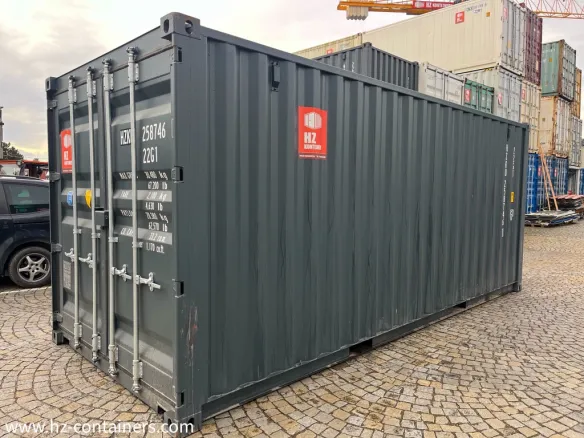
Example: HZKU 258 746-1 — HZK = owner (HZ Containers), U = container for goods, 258746 = serial number, 1 = check digit.
The qualitative classification IICL (Institute of International Container Lessors) defines container condition levels:
- IICL 6 / Cargo Worthy: Fully suitable for sea transport, without rust-through, with watertight seal and functional doors.
- One-Way: Manufactured in Asia, used for one trip — practically new, but without CSC validity (a new CSC can be arranged).
- AS IS: Sold “as is” — may have rust-through, leaks. Suitable for static storage, not for transport.
How to choose the right shipping container?
Define the purpose: storage, transport, or conversion?
The first and most important question: What will you use the shipping container for?
- Storage: Most people in Trenčín buy containers precisely for storage — tools, seasonal tires, building materials, garden equipment, archival documents. For storage, a used container of the AS IS category is sufficient, provided it is statically sound and does not leak. Make sure the doors open and close well — this is key in everyday use.
- Transport: If you plan to transport the container by road, rail, or sea, you absolutely need a container with a valid CSC certification (IICL 6, Cargo Worthy, or One-Way with a new CSC). Without a valid CSC, the container will not pass even a road inspection.
- Conversion: When converting to a workshop, office, or residential space, we recommend a One-Way container — it is practically new, clean, odorless, and does not require extensive repairs. A used container saves money on purchase, but repair costs (rust grinding, new paint, floor replacement) can cancel out the difference.
New versus used container — advantages and risks
| Criterion | New / One-Way container | Used container (IICL 6) | Used container (AS IS) |
|---|---|---|---|
| Price (20′ DC) | 2 500 – 3 500 € | 1 800 – 2 800 € | 1 200 – 1 800 € |
| Appearance | Flawless paint, no rust | Minor scratches, slight wear | Visible rust, dents, worn paint |
| Door seal | 100 % watertight | Watertight, with slight wear | May be leaking, requires replacement |
| Floor | Undamaged, no odor | Slight wear, possible odor | Possible damage, stains, mold |
| CSC validity | Yes (after arrangement) | Yes (limited validity) | No |
| Ideal use | Conversion, living, representative spaces | Storage, transport, workshop | Only static storage on own land |
What to watch out for — checklist
When buying a container, check:
- Roof — walk on it. It should not sag or have holes. A rotten roof is the most common hidden defect and the most expensive repair.
- Doors — open and close both leaves. They must move smoothly, without creaking or sticking. Check the hinges and seal around the entire perimeter.
- Floor — look for dark spots, signs of mold, and rot. Particularly dangerous are chemical stains (possible contamination).
- Corners and corner castings — check that they are not cracked or deformed. Their repair is complicated and expensive.
- Ventilation — every container has ventilation openings (usually 2–4 on each side). Make sure they are passable — they prevent condensation inside.
- Odor — go inside and close the doors for 2 minutes. An unpleasant odor may signal mold, chemicals, or decomposition of organic material.
What are the prices of shipping containers in 2025/2026?
Indicative price list by type and condition
Prices of shipping containers on the Slovak market in 2025–2026 are in the following ranges (excluding VAT):
| Container type | AS IS (used, without CSC) | Cargo Worthy / IICL 6 | One-Way (new, from Asia) |
|---|---|---|---|
| 20′ DC (6 m) | 1 200 – 1 600 € | 1 800 – 2 800 € | 2 500 – 3 500 € |
| 20′ HC (6 m high) | 1 500 – 2 000 € | 2 300 – 3 000 € | 2 900 – 3 900 € |
| 40′ DC (12 m) | 1 800 – 2 300 € | 2 500 – 3 500 € | 3 000 – 4 500 € |
| 40′ HC (12 m high) | 2 000 – 2 500 € | 2 800 – 3 800 € | 3 300 – 5 000 € |
| 20′ Refrigerated | — | 4 000 – 6 000 € | 7 000 – 10 000 € |
| 20′ Open Top | — | 2 500 – 3 500 € | 4 000 – 5 500 € |
Note: Prices are indicative and may vary depending on current supply, season (spring and autumn = higher demand).
What affects the price?
- Container age: The typical lifespan of a shipping container in active transport is 10–15 years. A 20-year-old container can be significantly cheaper, but with hidden defects.
- Condition and classification: The difference between AS IS and IICL 6 can be 500–1 000 € for the same type.
- Container type: The HC version is always 10–20 % more expensive than the DC. Special containers (reefer, open top) cost two to three times as much.
- Seasonality: In spring and autumn, prices rise by 5–15 % due to higher demand from construction and agriculture.
Hidden costs
In addition to the price of the container itself, count on these items:
- Transport: 100–400 € (depending on distance and site accessibility). A hydraulic carrier (so-called “hook loader”) is cheaper than a crane.
- Handling: If the access road does not allow the carrier to enter, you need a crane — price 100–300 € depending on reach.
- Base preparation: Gravel bed (200–500 €), concrete footings (50–100 €/pcs).
- Permits: Most storage containers on private land do not need a permit, but always check with the building authority.
How does the purchase of a shipping container proceed step by step?
Step 1: Define the need and select the type
Write down what exactly you will store in the container, how often you will go to it, and whether you plan to ever move it. The choice of type, size, and quality class follows from this. For example, to store a motorcycle and garden equipment, a 20′ DC is sufficient; to store furniture from a three-room apartment, you will need at least a 40′ HC.
Step 2: Quality verification
- current photos of the specific container (not illustrative),
- age and country of origin,
- type of classification and CSC validity,
- complete calculation.
Step 3: Order, payment, and delivery terms
The standard delivery time is 3–14 days from payment — depending on the depot location. Most sellers require 100 % payment in advance, some allow a 50 % deposit. Always request an invoice with a breakdown of items (container separately, transport, VAT).
Step 4: Site preparation and unloading
The place for the container must be:
- Level and reinforced — gravel bed, concrete footings, or asphalt surface. The container must not stand directly on the ground — it needs ventilation from below.
- Accessible for a truck — minimum access road width is 3 meters, load capacity must handle up to 40 tons (fully loaded carrier with container).
- Outside protective zones — engineering networks, watercourses, etc.
Unloading is most often carried out by a hydraulic carrier — the container is placed directly at the prepared site. The entire process takes 15–30 minutes. Make sure there are no obstructing branches, power lines, or other obstacles at height in the vicinity.
Step 5: Maintenance and care of the container
After placing the container:
- Check that the doors fit properly and the seal is not damaged during transport.
- Once a year, check the roof and treat any rusty spots with anti-corrosion paint.
- Keep the area around the container clean — leaves and dirt can retain moisture and accelerate corrosion of the lower part.
- Ensure natural ventilation — do not block ventilation openings.
How to prepare the base and foundations for a shipping container?
A proper base is the foundation of a long container life. If the container stands directly on the ground, moisture rises into the floor, causing plywood rot and accelerating corrosion.
Types of base
| Base type | Price (indicative) | Suitability | Note |
|---|---|---|---|
| Gravel bed (20–30 cm) | 200 – 400 € | Excellent | Drains water, allows ventilation from below. Must be compacted with a vibratory plate. |
| Concrete footings (6 pcs — at corners and center) | 50 – 150 € (material) | Good | Simple and cheap option. Proper placement is important. |
| Road panels | 300 – 600 € | Excellent | Reusable, high load capacity. |
| Concrete slab (15–20 cm) | 800 – 1 500 € | Best | Permanent solution. Requires excavation, formwork, and reinforcement. |
| Asphalt surface | Already existing | Good | Sufficient if level and drained. |
| Directly on the ground | 0 € | Unsuitable | Causes floor rot and corrosion. We do not recommend it even short-term. |
Drainage and ventilation
The container must be positioned so that air can circulate under it. The minimum height between the ground and the bottom of the container should be 10–15 cm. The surroundings should have a slight slope (at least 1–2 %) away from the container, so water does not accumulate under it. If the land is in a wet area, consider a drainage system.
How long does a shipping container last and how to maintain it?
The lifespan of a shipping container depends on several factors, but with proper care, it can serve for decades.
Factors affecting lifespan
- Environment: A container exposed to sea air corrodes 3–5× faster than a container in a dry inland environment.
- Original lifespan in sea transport: 10–15 years in active transport, after which the container “retires from service” — these are precisely the containers that end up for sale.
- Static use: If the container stands in one place as a storage, its lifespan extends to 25–40+ years. Corten steel practically needs no maintenance in a dry environment.
Maintenance tips
- Check the roof once a year. Even a small sag can retain water and accelerate corrosion.
- Treat rusty spots with a wire brush and apply anti-corrosion paint.
- Treat the door seal with silicone spray — extending its lifespan and maintaining its elasticity.
- Keep ventilation openings passable — they prevent condensation and mold formation inside.
- If you notice a musty odor, leave the container fully open for several days and consider installing passive ventilation grilles.
What are the most common mistakes and myths about shipping containers?
“A cheap container is always a bargain”
The cheapest container on the market (AS IS for 1 200 €) can end up costing you more than a One-Way for 2 900 € — when you factor in roof repair (500–1 000 €), floor replacement (400–800 €), new seal (150–300 €), and anti-corrosion paint (200–500 €). When converting to a residential space, a cheap container is almost always a false saving.
“The container is completely waterproof”
Even a new container is only “watertight,” not “waterproof.” In heavy rain with strong wind, water can penetrate through ventilation openings or door seams. Moreover, moisture condensation inside is a natural phenomenon — that is why ventilation is important. We do not recommend storing textiles, documents, or electronics in a container without additional moisture protection.
“I can transport it on a regular car trailer”
No. An empty 20′ container weighs 2 200 – 2 400 kg — that is more than any regular car trailer can handle (the maximum weight of a trailer for a category B driver’s license is 3 500 kg of total set). Moreover, the container has no attachment points for straps — it requires twist-locks compatible with corner castings. Transporting a container requires a specialized truck (hydraulic container carrier) or a low-bed trailer with twist-locks pulled by a tractor.
“I don’t need any permits”
Most storage containers indeed do not need a permit. But watch out for exceptions: if the container is located in a heritage zone (which also applies to some parts of Trenčín), if it is closer than 2 meters from the property boundary, or if you have restrictions in the zoning plan — always check.
Frequently asked questions
How much does an empty shipping container weigh?
An empty 20′ DC container weighs approximately 2 200 – 2 400 kg (tare weight). A 40′ DC container weighs 3 700 – 4 000 kg and a 40′ HC container approximately 3 800 – 4 200 kg. The exact value can be found on the CSC plate of each container.
What does the abbreviation IICL mean?
IICL (Institute of International Container Lessors) is an international institute of container lessors that sets quality and inspection standards. A container of the IICL 6 classification meets the highest standard for used containers — it is fully suitable for sea transport.
What is the difference between a DC and HC container?
DC (Dry Container) has a standard height of 2 591 mm (external). HC (High Cube) is 30 cm higher — 2 896 mm (external). The internal height of an HC container is approximately 2 698 mm, allowing comfortable movement even for taller persons and providing more storage space.
Can a shipping container be used without a floor?
No — the floor is an integrated part of the container construction and contributes to its strength. If the floor is damaged, it must be repaired or replaced. Never use a container with a removed or significantly damaged floor.
How to secure a container against theft?
A standard container has lockable door rods with holes for a padlock. We recommend using a special container lock (so-called container lock), which is cut-resistant and has a protective cover against prying. Additionally, an alarm or GPS tracker can be installed.
Can I paint the container a different color?
Yes. Corten steel can be painted with common anti-corrosion paints. Before painting, it is necessary to degrease the surface, brush off any rust, and apply a primer. RAL colors are most commonly used (e.g., RAL 7016 — anthracite, RAL 6005 — green, RAL 5010 — blue).
What electrical connection does a refrigerated container need?
Refrigerated containers (reefer) require a 3-phase connection 380–460 V / 50 Hz, with a minimum fuse of 32 A. Consumption depends on the set temperature and external conditions, but ranges between 5–15 kW. It is not possible to operate them on a standard household 230 V socket.
Can a shipping container be moved using a forklift?
Yes, but only an empty 20′ container using a forklift with a load capacity of at least 10 tons and forks of a minimum length of 1.2 meters. The container has openings in the lower part (forklift pockets) designed precisely for this purpose. A 40′ container cannot be moved by a forklift — a crane or hydraulic carrier is used.
Do I need insurance for a shipping container?
A container used for storage can be insured under property insurance or separate movable property insurance. Standard household insurance usually does not apply to a container standing on the land — we recommend consulting with the insurer. Separate container insurance costs approximately 50–150 € per year depending on value.
Is it possible to join multiple containers together?
Yes, multiple containers can be joined side by side and on top of each other using connecting elements (container couplings, bridges) and twist-locks. Side walls can be cut out and replaced with load-bearing lintels. However, for multi-story constructions, a structural assessment and building permit are essential.
 Slovakia, Trenčín
  FREE SHIPPING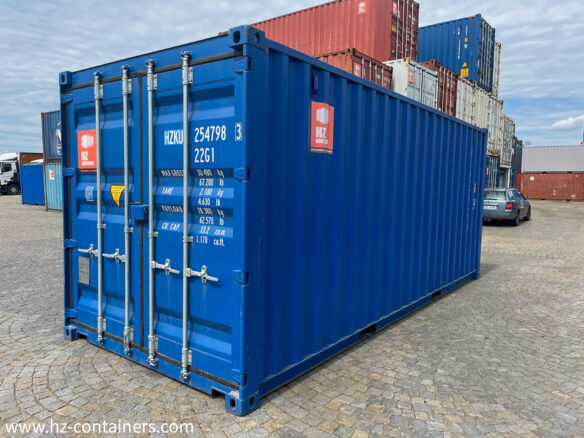

Other container news...

20 Foot shipping container cost
If you are researching the cost of a 20 foot shipping container, you have likely already encountered wildly different prices — from $999 listings online to quotes exceeding $5,500. That range is not a sign of inconsistency. It reflects real differences in container condition, location, delivery logistics, and the seller you are dealing with.
Side Opening container
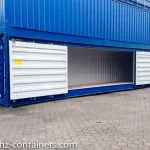
A side opening container is an ISO-compliant intermodal shipping container engineered with full-length bi-fold doors along one of its long side walls, in addition to the standard cargo doors at one end. Unlike conventional containers that restrict access to a single set of rear doors, a side opening container — also widely called an open side container, open-sided shipping container, or side door container — provides unobstructed lateral access across the entire 20-foot or 40-foot length of the unit. This design transforms the container from a narrow tunnel into a wide-open space that forklifts can enter from the side, multiple workers can load simultaneously, and oversized cargo that would never fit through standard end doors can be placed without struggle.
40 Foot High Cube container cost
A 40 foot high cube container — often abbreviated as 40ft HC, 40′ HC, or 40-foot high cube — is one of the most common shipping container sizes sold on the secondary market. But if you are researching what a 40 foot high cube container costs, you have almost certainly noticed that prices are all over the map. One seller quotes $1,500. Another quotes $7,000. Both could be legitimate.
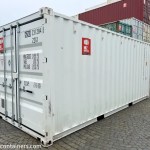
20 Foot container cost
If you have ever searched for a shipping container, you have almost certainly asked one question first: how much does a 20 foot container cost? The answer is not a single number. It is a range that spans from under $1,000 for a weathered, as-is unit to over $5,000 for a pristine, one-trip container — and that is before delivery, site preparation, or modifications enter the picture.