
Refrigerated Container for Rent
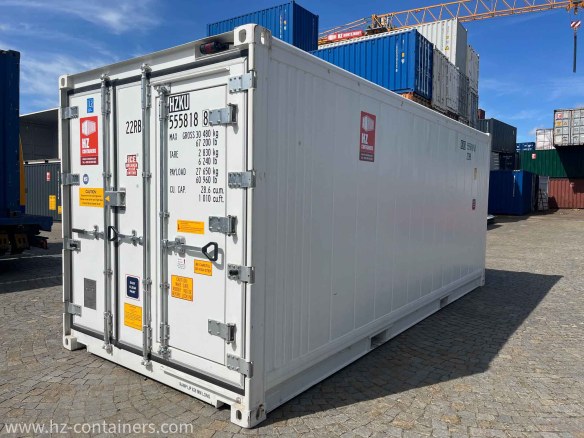
The service “Refrigerated container for rent” from HZ KONTEJNERY s.r.o. presents a specialized solution for companies and individuals that need temporary, flexible, and mobile storage of food, pharmaceuticals, or other goods requiring strict temperature control. The rented containers are equipped with modern cooling and freezing units capable of maintaining precisely set temperatures across a wide range. HZ KONTEJNERY s.r.o. provides a complete service – from selecting the right type of container, through transport and installation, to technical support and regular servicing.
Temperature range and variants:
Typical refrigerated containers handle temperatures from –25 °C to +25 °C, advanced models from –40 °C up to +45 °C, special pharmaceutical units (e.g., ArcticStore) even up to –75 °C and +85 °C. This enables storage of both ordinary food and highly sensitive medicines or samples.
Key advantages of renting through HZ CONTAINERS
- Rental flexibility (from weekend to years, one‑off or recurring events)
- Fast availability, transport across the Czech Republic, delivery possible within 24 hours
- Regular service, condition monitoring and the option to replace the container in case of failure
- Stackability for space savings, suitable for outdoor and indoor use
- Modern and eco‑friendly technologies (low consumption, eco‑friendly refrigerants, optional solar power)
In‑Depth Analysis: Components and Technical Parameters
Refrigerated (freezer) container – construction, technology, safety
Construction:
- Material: Steel or aluminium, insulated with polyurethane foam (up to 120 mm thick)
- Standard dimensions:
- 20 ft (6058 mm × 2438 mm × 2591 mm), internal size approx. 5450 mm × 2294 mm × 2220 mm
- 40 ft (12192 mm × 2438 mm × 2591 mm), High Cube (HC) variant height 2896 mm
- Weight: Tare 2 350–4 500 kg (depending on size), payload up to 29 000 kg
Cooling unit (compressor):
- Manufacturers: Carrier, Thermo King, Daikin, StarCool, recently also Microlink 3 (efficient, eco‑friendly)
- Temperature range: Standard –25 °C to +25 °C, ArcticStore models –40 °C / +45 °C, specialized pharmaceutical down to –75 °C
- Functions: Cooling and heating, automatic defrost, alarms, remote monitoring (SMS, online app)
- Power consumption: 6–10 kWh (normal operation), advanced models up to 55 % more efficient (e.g., ArcticStore Horizon with solar panels)
- Electrical connection: 400 V / 3‑phase / 50 Hz, typical socket 32 A CEE, fused
Floor and access:
- T‑profile floor – ensures air circulation and even cooling
- Reinforced doors with multi‑point sealing, often “cut‑out” doors for easy entry
- ISO fittings for crane or forklift handling, stackable up to 9 containers high
Safety and hygiene:
- Interior surfaces are washable and mold‑resistant, certified for food contact
- CSC label – confirms technical suitability for international transport
- Fault signaling and safety fuses (including emergency interior opening)
Rental model and its benefits
- Short‑term vs. long‑term rental:
The client chooses the period according to need (e.g., weekend event, monthly renovation, seasonal storage) - All‑inclusive service:
Rental price often includes transport, installation, operator training and regular service - Tax advantages:
Rental is an expense item, improves cash flow and does not burden the balance sheet - Scalability:
When demand grows, additional containers can be added quickly, or capacity can be reduced just as fast - Eco innovations:
New models with eco‑friendly refrigerants, solar panels or air‑heat recovery significantly reduce carbon footprint
Comparison: Refrigerated Container (Reefer) vs. Stationary Walk‑In Cooler
| Feature | Refrigerated container (rental) | Walk‑in cooler |
|---|---|---|
| Purpose | Transport and stationary storage, robust | Primarily stationary, frequent staff access |
| Temperature range | –40 °C to +45 °C | Usually 0 °C to +10 °C (sometimes down to –20 °C) |
| Dimensions | 10 ft, 20 ft, 40 ft, High Cube, stackable | Various, often smaller, modular |
| Mobility | Heavy (up to 4 500 kg), requires crane | Easier handling, lighter |
| Installation | Requires reinforced floor, 400 V/32 A | Often 230 V sufficient, can be placed almost anywhere |
| Noise level | High, industrial compressor | Lower, suitable near people |
| Durability | Extreme, suitable for sea transport | Suitable for interior and exterior |
| Energy efficiency | Higher consumption, optimized for extremes | Lower consumption, optimized for normal operation |
| Security | Steel construction, lockable | Laminate, often less resistant to break‑in |
Service specifics at HZ KONTEJNERY s.r.o.
Portfolio and added services
- Types and sizes:
20 ft (approx. 10 euro‑pallets), 40 ft/40 ft HC (approx. 22 euro‑pallets), also 10 ft variants for smaller events - Custom offer:
Quote tailored to rental length, installation site, transport requirements, accessories (ramps, racks, etc.) - Technical background:
All containers undergo regular inspections, hold a valid CSC label and are equipped with modern units with monitoring - Logistics:
Own fleet with hydraulic crane, option for express delivery, installation assistance and optional ConFoot legs - Consultancy and customer service:
Experts advise on the right type, help with site preparation and power connection
Modern trends and innovations in refrigerated containers
- Energy efficiency:
New models (e.g., ArcticStore Horizon) achieve up to 55 % lower consumption thanks to improved insulation and solar panels - Remote monitoring:
Online temperature, alarm and unit status tracking via mobile app or web portal - Eco‑friendliness:
Use of eco‑friendly refrigerants (e.g., R452A, CO₂), minimised leaks and carbon footprint - Modularity:
Quick reconfiguration, ability to combine multiple containers into larger units - Safety:
Emergency interior opening, LED lighting, locks against unauthorized entry - Certification:
Compliance with Czech and EU hygiene regulations, certifications for the pharmaceutical industry
Typical use cases and real‑world examples
- Food industry: storage of meat, fish, dairy, confectionery, fruit, vegetables, semi‑finished products
- Catering and events: festivals, sport and cultural events, catering services, breweries, bakeries
- Pharmacy and healthcare: medicines, vaccines, blood derivatives, laboratory samples and cultures
- Agriculture: storage of seedlings, harvested crops, seeds, plants
- Industry and logistics: temporary storage during renovations, accidents, power outages, demand peaks
- Special applications: backup freezer capacity for hospitals, chemical storage, temperature‑sensitive artworks
Legislation, safety, certifications (Czech Republic / EU)
- Legal requirements:
Food and medicinal storage is subject to strict hygiene and safety standards (Czech Act 137/2004 Sb., EU Regulation 852/2004, GDP/GLP for pharmaceuticals) - Container certifications:
CSC label for international transport, food‑contact certifications (HACCP, ISO 22000) - Inspections and service:
Regular checks of electrical systems, compressors and seals, mandatory temperature logging (for food and medicines) - Safety measures:
Emergency opening, lighting, locking, fault signaling, protection against unauthorized entry
Frequently Asked Questions (FAQ)
What is the minimum rental period for a refrigerated container?
Usually 2–3 days (weekend event); most providers allow custom arrangements.
Can I change the temperature during the rental?
Yes, most units allow smooth temperature adjustments and switching between cooling and freezing modes.
What do I need to provide on site?
A flat, reinforced surface, sufficient space for crane handling, and a 400 V / 32 A power connection.
How is defrosting and maintenance handled?
Units have automatic defrost cycles; regular service is provided by the supplier.
How secure is the cargo inside the container?
The container is lockable, equipped with an alarm and robust doors. In case of power loss, backup power can be arranged.

 Czech Republic, Třebíč
  WITHOUT SHIPPING

Other container news...

Shipping container types
Roughly 80% of everything you own traveled to you inside a steel box. Shipping containers—also called cargo containers, ISO containers, or “conex” boxes—are the backbone of global trade, carrying about 90% of the world’s non-bulk cargo across oceans, rails, and highways. Yet a “shipping container” is not one single object. It is a family of specialized steel boxes, each engineered for a specific kind of cargo: some vent, some freeze, some open from the top, and some have no walls at all.

40 foot container storage uses
The 40 foot container has moved far beyond its original job of hauling cargo across the ocean. Today, the phrase “40 foot container storage uses” describes an enormous and still-growing field: everything from an extra garage behind a house to a full retail storefront, a mobile office, an indoor farm, or a temporary shelter. Because the 40 foot container is the most common size in global shipping, it is also the most abundant, the most affordable, and the most widely converted for storage and building purposes.

How tall is a 20-Foot shipping container?
A 20-foot shipping container stands 8 feet 6 inches (8′ 6″) tall on the outside, or 2.59 meters. Inside, the usable height is slightly less — roughly 7 feet 9–5/8 inches (2.39 m) — because the floor, roof panels, and corner castings consume several inches of the total height.
That is the short answer. But “how tall” hides important nuance: the number changes depending on whether you are measuring a standard unit or a high cube unit, whether you are measuring the exterior or the interior, and whether you actually need to fit something through the door opening, which is the shortest vertical dimension on the entire box.

Shipping container wheel movement kits
A shipping container wheel movement kit is a bolt-on (or twist-lock) hardware system that lets a single person attach wheels to the corner castings of a 20 ft or 40 ft shipping container and reposition it — often without a crane, forklift, or flatbed truck. Instead of hiring a heavy-haul trucker every time you want to nudge a container a few feet on your property, the right wheel kit turns a 4,000–10,000 lb steel box into something a pickup truck, skid steer, or a couple of strong backs with a come-along can move.