
Shipping container wheel movement kits
A shipping container wheel movement kit is a bolt-on (or twist-lock) hardware system that lets a single person attach wheels to the corner castings of a 20 ft or 40 ft shipping container and reposition it — often without a crane, forklift, or flatbed truck. Instead of hiring a heavy-haul trucker every time you want to nudge a container a few feet on your property, the right wheel kit turns a 4,000–10,000 lb steel box into something a pickup truck, skid steer, or a couple of strong backs with a come-along can move.
These kits sit at the center of a growing niche: the container home movement, on-site storage repositioning, and mobile job-site offices. But they are also one of the most misunderstood products in the container-accessory market. People buy the wrong lug pattern, assume the container can be towed down a public road, or discover too late that “wheel kit” means three completely different categories of hardware. This guide lays out exactly what a container wheel movement kit is, how the different types compare, how to install one safely, and what these kits can and cannot legally do.
What Exactly Is a Shipping Container Wheel Movement Kit?
At its core, a container wheel movement kit is an axle-and-wheel assembly engineered to interface with the corner castings of an ISO shipping container. Every standard shipping container has eight hollow steel corner fittings — four on top, four on the bottom — each with standardized oblong apertures. These castings were originally designed for twist-lock couplings and crane lifting, but their uniform dimensions are precisely what make wheel kits possible: a manufacturer can fabricate a hub adapter, axle, or caster plate that keys into those apertures and locks in place.
The defining components of almost every kit include:
- Hub adapters or mounting brackets — the interface piece that seats into (or straps around) the corner casting.
- Spindles or axles — the rotating shaft that carries the wheel load.
- Wheels and tires — sometimes included, sometimes sold separately.
- A jack or lifting mechanism — some kits include a lifter, while others assume you own a bottle jack.
- Ratchet straps or ISO pins — the fastening method that holds the kit to the container.
Not every “shipping container wheel kit” contains all of these. That is the single biggest source of buyer confusion. The term is an umbrella that covers at least three distinct product families, and their use cases barely overlap.
What Are the Different Types of Container Wheel Kits?
Understanding the three categories is the key to buying the right product. Here they are side by side.
| Type | How it mounts | How it moves | Best for | Typical load rating |
|---|---|---|---|---|
| Axle/hub wheel kit | Bolt-on or twist-lock hub into the rear corner castings | Towed by a pickup, tractor, or skid steer via a tow bar | Repositioning empty or lightly loaded containers across a site | 8,000–16,000 lb per axle |
| Caster dolly kit | Swivel casters bolted to the four corner castings | Pushed by hand or moved with a forklift/tug | Fine positioning inside warehouses and workshops | 4,400–5,500 lb per caster |
| End wheel kit | Slide-in pins into the bottom ISO pockets on one end | Container rolls on one end while a forklift lifts the other | Loading/unloading from trailers, straight-line rolling | ~5,500 lb dynamic per wheel |
Axle and Hub Kits
The axle/hub kit is what most people picture when they hear “container wheel movement kit.” Two spindle-and-hub assemblies bolt onto the rear bottom corner castings, wheels bolt onto the hub using a standard trailer lug pattern (commonly 6×5.5″, 8×6.5″, or 5×5.5″), and a tow bar attaches to the front corner castings. You lift the front with the tow bar (or a jack mounted to the truck’s hitch) and tow the whole container like a trailer — at walking speed, on private property only.
The appeal is leverage. A single person with a ¾-ton or 1-ton pickup can move a 40 ft container that would otherwise require a crane. Brands sell the components separately so you can match the hub pattern to a set of trailer wheels you may already own.
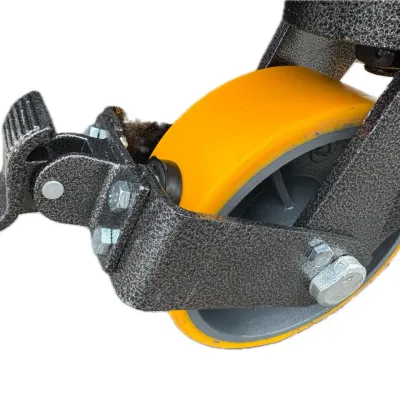
Caster Dolly Kits
Caster dollies take the opposite approach. Instead of two fixed axles on one end, you install a swiveling caster at each of the four bottom corners. The container becomes a giant cart. Casters are ideal for tight, warehouse-scale maneuvering where you need to spin a container or slide it laterally, but they are limited to smooth, hard surfaces — concrete or asphalt — because small caster wheels sink and jam in soft ground.
End Wheel Kits
End wheels (such as ContainGo’s patented design) are the most specialized. Two wheels slide onto ISO attachment pins at the rear end wall of the container, so the back edge of the container rolls instead of scraping the ground. A light-duty forklift lifts the front, and the container glides off or onto a flatbed. This is a gentler, quieter alternative to dragging the rear of a container across pavement during delivery.
How Does a Container Wheel Kit Physically Move a 40 ft Container?
The physics is deceptively simple, which is part of the magic. A shipping container’s weight is carried entirely through its corner castings — the same four bottom corners that crane spreaders and twist-locks grip. When you mount wheels at two of those corners, you are loading the container exactly where it is designed to be loaded.
Once wheels are on the rear corners, the container behaves like a very large lever. The tow bar or forklift lifts the front, transferring the front weight onto the vehicle and the rear weight onto the wheels. Because steel wheels on pneumatic tires have low rolling resistance, a truck that can produce a few thousand pounds of drawbar pull can roll a container that weighs several times that. The same principle lets one person push a 200 lb piano cart with relative ease — the wheels carry the weight, and you only overcome friction and inertia.
What makes this different from a trailer is that the wheels are not mounted to a suspension-equipped axle frame. There is no spring, no brake system, and nothing rated for highway speed.
Critical limitation: Every serious manufacturer labels container wheel kits “off-road use only” or “not intended for transportation on public roads.” These kits are repositioning tools, not a means to haul a container down the highway.
How Do You Install a Shipping Container Wheel Movement Kit?
Installation follows a broadly similar sequence across axle and hub kits, though exact steps vary by brand.
- Empty and level the container. Move nothing but an empty container. Loaded units exceed the kit’s safe working load and can rupture tires or shear fasteners.
- Chock the container. Block both ends so it cannot roll during the lift.
- Jack one end. Use a bottle jack rated 20 tons or higher, placed under a corner casting or reinforced floor crossmember — never under the thin floor skin. Lift 6–8 inches.
- Mount the hub adapters. Seat each adapter into the rear bottom corner casting and secure it (bolts for bolt-on kits, twist-lock or ratchet straps for no-drill kits).
- Install wheels and tires. Torque the lug nuts to the manufacturer’s specification in a star pattern. Inflate tires fully (some kits require 80 psi or more) before any load is applied.
- Attach the tow bar up front. Connect it to the 2-5/16″ hitch ball on your truck or the quick-attach plate on your skid steer.
- Lower and test. Lower the jack, confirm the kit is seated, then roll a few feet at walking pace before committing to a longer move.
The no-drill designs matter more than they might appear. A kit that twists into the corner casting and straps secure leaves the container structurally intact — a real concern for anyone who later wants to resell the container or maintain its wind- and water-tight rating for a tiny-home build.
What Lug Pattern and Weight Ratings Do You Need?
Lug pattern is the specification that causes the most ordering errors. Because hub kits are designed to reuse standard trailer wheels, the buyer has to know the exact bolt circle of the wheels they intend to run.
| Lug pattern | Number of lugs | Typical capacity | Common source of matching wheels |
|---|---|---|---|
| 5 × 5.5″ | 5 | Light duty | Older Jeep/Ford truck wheels, small trailers |
| 6 × 5.5″ | 6 | Heavy duty | Chevy/GMC 6-lug truck and trailer wheels |
| 8 × 6.5″ | 8 | 8,000 lb | Heavy trailer wheels |
| 8 × 6.5″ (HD) | 8 | 16,000 lb | Heavy-duty trailer wheels |
The capacity you need is driven by the size of the container. A standard 20 ft dry container has a tare (empty) weight of roughly 4,850 lb, while a 40 ft high-cube container tares around 8,750 lb — and a 40 ft can exceed 9,000 lb. Because weight during a move can shift dynamically (especially over a bump or a slight slope), the kit’s rating should comfortably exceed the container’s empty weight rather than just meeting it.
Most manufacturers state capacity as a pair of wheel assemblies or a full axle. Read carefully: a kit described as “16,000 lb” is usually describing the combined axle rating, not per-wheel.
How Much Does a Container Wheel Movement Kit Cost?
Prices span a wide range because the term covers everything from a bare pair of hub adapters to a complete tow-and-roll system with wheels, tires, straps, and a lifter.
| Configuration | What’s included | Typical price (USD) |
|---|---|---|
| Simple hub kit | 2 mounted hub assemblies, no wheels/tires | $600 – $750 |
| Kit with wheels and tires | Hubs, wheels, tires, ratchet straps | $825 – $1,400 |
| Tow bar (separate) | Bolt-on front tow bar | $1,300 – $1,400 |
| Caster dolly (single) | One 2-ton ISO caster | $300 – $400 |
| Budget import kit | Wheels, tires, straps, jacks, generic mounting | $250 – $800 |
The budget import kits are genuinely popular, and reviews are mixed for a specific reason. Buyers consistently praise the value — “you get tires, wheels, axles, straps, and lifting points for much less than the competition” — while flagging that the mounting hardware often requires you to reach inside the corner casting to tighten a nut, a pinch-point hazard that no reputable twist-lock design has. The savings are real; so is the trade-off in mounting safety and ease of repeat use.
What Are the Safety Rules and Legal Limits?
The most important thing to internalize is this: a container on a wheel kit is not road-legal. These are repositioning aids for private property, job sites, farms, and warehouses. Using one to tow a container on a public street is both illegal in most jurisdictions and mechanically reckless, since a kit has no brakes, no suspension, no lights, and no DOT certification.
Safety practices that every manufacturer and installer agrees on:
- Move empty containers only. Loaded containers can double the load and overwhelm the kit.
- Keep speed to walking pace or less. Momentum is the enemy; a rolling container is hard to stop.
- Stay off slopes. Even a gentle grade can make an un-braked container run away.
- Chock before and after every move. Wheel chocks or wooden wedges are the only “brakes” you have.
- Verify ground firmness. Soft or muddy ground lets jacks and wheels sink and tip the load.
- Use rated lifting points. Jack only under corner castings or reinforced crossmembers.
The safety margin in the ratings is real but should not be treated as headroom to exceed. A 5,500 lb per-wheel dynamic rating is not permission to roll a 10,000 lb loaded container on two wheels.
What Are the Most Common Misconceptions?
Several myths circulate in forums and YouTube comments, and they cause real, expensive mistakes.
“I can tow a container on the highway with this.” No. These kits are explicitly not street-legal, and doing so is dangerous. Highway moves require a proper tilt-bed trailer or container chassis with brakes and lights.
“A wheel kit lets one person move any container.” Only empty ones, and only on reasonably firm, level ground. The “one person” claim assumes the assist of a pickup truck, tractor, or skid steer for anything beyond the shortest repositioning.
“All kits are no-drill.” Not true. Some bolt through holes, and some budget kits require you to reach inside the corner casting to secure a nut. Read the mounting method before buying.
“Higher lug count always means higher capacity.” Not necessarily. The 8×6.5″ pattern is offered in both 8,000 lb and 16,000 lb versions; the steel grade, spindle diameter, and weld quality determine capacity, not just the number of lugs.
“Wheels and tires are always included.” Often they are not. “Simple kits” frequently ship the hub assemblies only, expecting you to supply trailer wheels.
How Do You Choose the Right Kit for Your Situation?
The right product depends almost entirely on how and where you need to move the container.
- Repositioning outdoors on a farm or rural lot, with a pickup or tractor available → an axle/hub kit with a tow bar, matched to truck or trailer wheels you own.
- Fine positioning inside a warehouse or on smooth concrete, needing lateral and rotational moves → a four-caster dolly system.
- Loading and unloading from flatbeds during delivery, or rolling a container in a straight production line → end wheels.
- Frequent moves of multiple containers with an existing skid steer → a hub kit plus a skid-steer quick-attach mover.
Budget also drives the decision. If you will move a container once or twice, a budget kit can pay for itself instantly compared to hiring a crane or tilt-bed twice. If you run a business that repositions containers regularly, the time saved by a proper twist-lock, no-drill system with your own wheels and a dedicated tow bar justifies the higher upfront cost.
What Does the Future Hold for Container Mobility?
Two trends are shaping this niche. First, the container home and modular building boom is creating more customers who own a container on their own land and want to reposition it themselves rather than pay for crane time. Second, manufacturers are converging on twist-lock and strap-secured, no-drill mounting as the standard, exactly because these buyers care about preserving the structural integrity and resale value of an expensive container.
Expect more kit bundling — the “starter kit” that ships hubs, wheels, tires, straps, and a lifter in a single SKU is becoming the norm rather than the exception. And as safety reviews expose the pinch-point hazards of cheap mounting hardware, the market is likely to standardize on the twist-lock mechanism that has served the marine and port industry for decades.
Frequently Asked Questions
What is a shipping container wheel movement kit?
It is a bolt-on or twist-lock axle-and-wheel assembly that mounts to the corner castings of a shipping container so the container can be rolled and repositioned without a crane or flatbed. Kits typically include hub adapters, spindles, and sometimes wheels, tires, straps, and a lifter.
How do you move a shipping container without a crane?
The two most common crane-free methods are (1) a wheel movement kit with a tow bar pulled by a pickup or tractor, and (2) steel pipe rollers placed under a bottle-jacked container and pulled with a come-along winch. Both are limited to short, slow moves on private property.
What lug pattern do shipping container wheels use?
The most common patterns are 6×5.5″ (standard heavy duty) and 8×6.5″ (offered in both 8,000 lb and 16,000 lb versions), with 5×5.5″ for lighter duty. You should match the hub pattern to a set of standard trailer wheels you already own.
Can you move a loaded shipping container on wheels?
No. Wheel kits are rated for empty or very lightly loaded containers only. A loaded container can double or triple the intended load, overwhelming the tires, spindles, and fasteners and creating a dangerous, hard-to-stop rolling mass.
Are shipping container wheel kits street legal?
No. They are repositioning tools rated “off-road use only” and are neither DOT-certified nor equipped with brakes, suspension, or lights. Highway transport requires a proper container chassis or tilt-bed trailer.
How much weight can a shipping container wheel kit carry?
Depending on the kit, a pair of axle assemblies is typically rated between 8,000 lb and 16,000 lb combined, and individual casters or end wheels are rated around 4,400–5,500 lb dynamic. Always choose a rating that comfortably exceeds the empty container’s tare weight.
How long does it take to install a container wheel kit?
For a no-drill, twist-lock or strap-secured kit, installation typically takes 15–30 minutes with a bottle jack and basic hand tools. Bolt-on systems take somewhat longer, and budget kits that require reaching inside the corner casting can be slower and more hazardous.
Can one person really move a shipping container with a wheel kit?
Yes — but only with the assist of a pickup truck, tractor, or skid steer to provide the pulling force, and only for an empty container on firm, level ground. The “one person” claim refers to not needing a crew or a crane, not to pushing it by hand.

 Czech Republic
 WITHOUT SHIPPING


Other container news...

Shipping container types
Roughly 80% of everything you own traveled to you inside a steel box. Shipping containers—also called cargo containers, ISO containers, or “conex” boxes—are the backbone of global trade, carrying about 90% of the world’s non-bulk cargo across oceans, rails, and highways. Yet a “shipping container” is not one single object. It is a family of specialized steel boxes, each engineered for a specific kind of cargo: some vent, some freeze, some open from the top, and some have no walls at all.

Where Can I Buy a 40ft High Cube Container?
A 40ft high cube container represents one of the most versatile and cost-effective storage and shipping solutions available today. Whether you are expanding warehouse capacity, starting a container home project, or need secure on-site storage for a construction site, knowing where to buy one — and what to expect — can save you thousands of dollars and weeks of frustration. This guide walks you through every aspect of purchasing a 40ft high cube container, from understanding what it actually is to comparing sellers, navigating delivery logistics, and handling permits.

How much does a 40 foot shipping container cost?
A 40 foot shipping container is the single most common large-format steel container in the world. Whether you are adding on-site storage, moving freight overseas, or converting a unit into a home or workshop, the first question almost everyone asks is the same: how much does a 40 foot shipping container cost?
The short answer is that a 40 foot shipping container price in the United States typically lands between $1,500 and $7,000 depending on condition, height, location, and delivery. Used, wind-and-watertight 40ft units often start near $1,500–$2,700, while a brand-new one-trip 40ft high cube can exceed $4,000–$6,500. The gap between those two ends of the range is wide because a “shipping container” is not one product—it is a graded commodity whose value shifts with its physical condition, its market, and even the distance from your site to a major port.

How to move a shipping container
Moving a shipping container is rarely as simple as “put it on a truck and drive.” A standard steel container weighs over two tons even when empty, spans 20 to 40 feet (or more), and has no wheels, no hitch, and no built-in way to attach to standard equipment. Whether you are repositioning a storage container across a jobsite, delivering one to a rural property, or relocating a loaded unit across the country, the method you choose determines your cost, your timeline, and whether the move succeeds at all.