
40 foot container storage uses
The 40 foot container has moved far beyond its original job of hauling cargo across the ocean. Today, the phrase “40 foot container storage uses” describes an enormous and still-growing field: everything from an extra garage behind a house to a full retail storefront, a mobile office, an indoor farm, or a temporary shelter. Because the 40 foot container is the most common size in global shipping, it is also the most abundant, the most affordable, and the most widely converted for storage and building purposes.
This guide explains what a 40 foot container actually is, how much it holds, what it costs, and — most importantly — the many ways people use one. You will also find concrete dimensions, capacity figures, comparison tables, organization techniques, and answers to the most frequently asked questions, so you can decide whether a 40 foot container is the right solution for your storage or conversion project.
What Is a 40 Foot Shipping Container and Where Did It Come From?
A 40 foot shipping container is a standardized, stackable steel box built to transport goods by ship, rail, and truck without unloading the cargo in between. Its dimensions, fittings, and strength are governed by an international standard, which is exactly what makes it so useful for storage and building once its shipping days are over.

The ISO Standard and the Meaning of “TEU”
The modern shipping container is defined by ISO 668, the international standard that sets container dimensions and corner-casting locations. This standardization is what allows a container loaded in Shanghai to be lifted by the same crane in Rotterdam and to lock onto the same chassis in Chicago. The 40 foot container is defined as two TEU, or “twenty-foot equivalent units,” because it is exactly twice the length of the baseline 20 foot container. When you read that a port handled “2 million TEU,” that volume could be expressed as one million 40 foot containers, or any mix of 20 foot and 40 foot units.
Because the 40 foot unit is the workhorse of ocean freight, it is produced in enormous numbers and retired or resold in large quantities every year. That supply is the foundation of the secondary market for 40 foot container storage uses.
A Brief History of the 40 Foot Container
Containerized shipping is usually credited to the American trucking entrepreneur Malcolm McLean, who in 1956 shipped the first modern intermodal containers aboard a converted tanker. The early boxes were 33 feet and 35 feet long, but the industry quickly converged on the dimensions we use today. By the late 1960s and early 1970s, the ISO standard settled on the 20 foot and 40 foot lengths, with 8 feet of width and 8 feet 6 inches of height. The 40 foot length won out for most ocean routes because it doubled the capacity of a single 20 foot box while still fitting on the same truck chassis with only minor adjustment.
Once containers began retiring from maritime service in large numbers, builders and property owners recognized that a steel box built to survive saltwater, storms, and heavy stacking also made a remarkably strong, weather-resistant, and secure storage building. That realization turned the 40 foot container into a staple of construction sites, farms, and eventually modern container architecture.
Standard Versus High Cube: Two Heights to Know
When people talk about a 40 foot container, they usually mean one of two heights. The standard 40 foot container stands 8 feet 6 inches tall on the outside. The 40 foot high cube adds a full extra foot, rising to 9 feet 6 inches, which provides noticeably more interior headroom and volume. The table below summarizes the key differences.
| Specification | 40 ft Standard | 40 ft High Cube |
|---|---|---|
| External length | 40 ft (12.19 m) | 40 ft (12.19 m) |
| External width | 8 ft (2.44 m) | 8 ft (2.44 m) |
| External height | 8 ft 6 in (2.59 m) | 9 ft 6 in (2.90 m) |
| Interior length | ~39 ft 5 in (12.03 m) | ~39 ft 5 in (12.03 m) |
| Interior width | ~7 ft 8 in (2.35 m) | ~7 ft 8 in (2.35 m) |
| Interior height | ~7 ft 10 in (2.39 m) | ~8 ft 10 in (2.70 m) |
| Interior volume | ~2,390 cu ft (67.7 m³) | ~2,694 cu ft (76.4 m³) |
| Door opening | ~7 ft 8 in wide | ~7 ft 8 in wide |
The extra height of a high cube is rarely essential for basic storage of boxes and pallets, but it matters a great deal if you plan to insulate the floor and ceiling, install lighting and HVAC, add shelving that reaches the top, or convert the space into a livable room. The taller interior also feels far less cramped.
What Are the Dimensions and Capacity of a 40 Foot Container?
Understanding the real, usable dimensions of a 40 foot container is the first step in deciding what it can hold. The numbers on a spec sheet are always slightly larger than the space you can actually use, because the walls and corner posts take up room.
Interior and Exterior Measurements
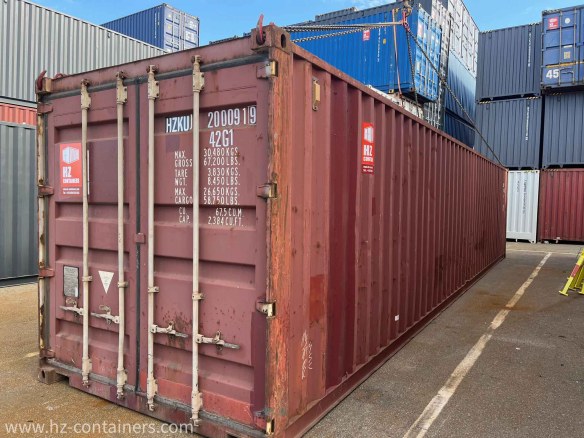
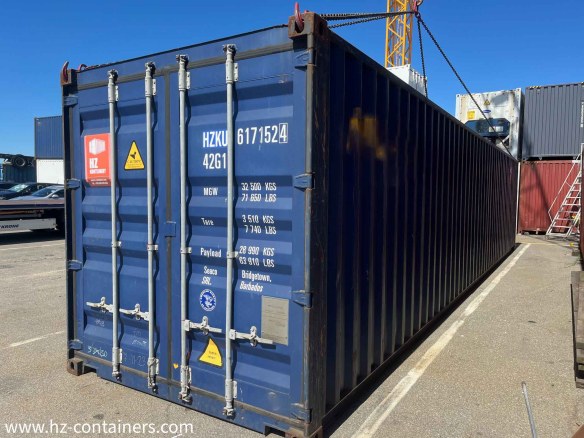
A standard 40 foot container measures 40 feet long, 8 feet wide, and 8 feet 6 inches high on the outside. On the inside, it is roughly 39 feet 5 inches long, 7 feet 8 inches wide, and 7 feet 10 inches high. That interior translates to roughly 305 square feet of floor space and about 2,390 cubic feet (67.7 cubic meters) of volume. The door opening is approximately 7 feet 8 inches wide and 7 feet 6 inches high, so anything you intend to store or install must clear that aperture.
How Much Can a 40 Foot Container Hold?
Capacity is usually described in two ways: volume (how much space) and payload (how much weight). In volume terms, a 40 foot container holds about 2,390 cubic feet — a little more than double the roughly 1,170 cubic feet of a 20 foot container. In practical terms, a 40 foot container can accommodate the household goods of a two- to three-bedroom home or apartment, or a three- to four-bedroom family home depending on how much furniture is involved.
In weight terms, a 40 foot container is engineered for a maximum gross weight of about 67,200 pounds (30,480 kg). Subtracting the empty weight of the container itself — roughly 8,000 pounds (3,750 kg) — leaves a rated payload of roughly 59,000 to 61,000 pounds (about 26,700 to 28,000 kg). In the real world, however, road and permit limits frequently cap what you can legally move on a truck well below that number, so heavy loads are usually split or transported by specialized equipment.
| Capacity Reference | Approximate Amount |
|---|---|
| Standard pallets (48″ × 40″, unstacked) | 22 pallets |
| Euro pallets (1200 × 800 mm, unstacked) | 27 pallets |
| Household goods | 2–3 bedroom apartment (up to a 3–4 bedroom home) |
| Moving boxes | 100–200 boxes, depending on size |
| Mattresses | up to 400 |
| 55-gallon drums | 80–160, depending on container type |
| Vehicle + household goods | one car plus a 1–2 bedroom apartment’s contents |
These figures are estimates, not guarantees. Real capacity depends on how items are packed, whether you use shelving, and whether you need to leave an aisle for access. A 40 foot container is only a 320-square-foot liability if you cannot reach what is stored in the middle, so planning the layout matters as much as the raw numbers.
What Are the Most Common 40 Foot Container Storage Uses?
The most frequent 40 foot container storage uses fall into two broad groups: personal and residential storage, and commercial or industrial storage. In both cases, the appeal is the same — secure, weather-resistant, ground-level space that costs less than building a permanent structure.
Residential and Personal Storage
For homeowners, a 40 foot container is essentially an oversized, lockable garage or shed that can be delivered to the driveway or a cleared corner of the property. Common residential uses include:
- A vehicle garage. A 40 foot container can hold most cars and pickups, plus motorcycles, ATVs, or a small boat. Its 7 foot 8 inch door width comfortably clears a standard car with room to open the driver’s door.
- Equipment and tool storage. Lawnmowers, snow blowers, tractors, weed trimmers, generators, ladders, and seasonal tools all fit with room to spare.
- Household overflow. Furniture during a renovation, holiday decorations, sporting gear, and boxes of belongings that no longer fit in the home.
- Seasonal storage. Boats, jet skis, patio furniture, and outdoor toys that sit idle for half the year.
Because a 40 foot container sits at ground level, you can walk or roll heavy items straight in without ramps or stairs — a major advantage over an upstairs storage loft or a distant storage facility.
Commercial and Business Storage
Businesses are among the heaviest users of 40 foot container storage uses, because the unit doubles as cheap, secure warehousing that can sit right next to the shop, site, or warehouse. Typical commercial applications include:
- Inventory and retail stock. Seasonal or holiday businesses can surge capacity without leasing permanent square footage.
- Construction and contractor storage. Tools, scaffolding, building materials, and site equipment stay dry, organized, and lockable on the job site.
- Warehousing overflow. A 40 foot container absorbs excess pallets and slow-moving stock without expanding the main facility.
- Document and archive storage. Waterproof steel construction protects records, files, and archives from weather and pests.
- Agricultural storage. Feed, seed, fertilizer, and equipment can be stored close to fields and barns.
The key commercial advantage is location: a container placed on your own property eliminates the round trips to a rented storage unit and keeps inventory immediately at hand.
What Are the Creative and Alternative Uses of a 40 Foot Container?
Beyond plain storage, the 40 foot container has become a building block in its own right. Its steel frame is strong enough to be cut, welded, stacked, and insulated, which opens a wide range of conversions.
Conversions: Office, Retail, Restaurant, and Housing
With insulation, electrical wiring, windows, and a proper door, a 40 foot container transforms into a functional room at a fraction of the cost of conventional construction. Popular conversions include:
- Container offices. A single 40 foot container provides enough floor space for several workstations, making it a fast, relocatable office for growing businesses or remote job sites.
- Retail and pop-up shops. Brands and small businesses use 40 foot containers as moveable storefronts, bike-rental kiosks, and market stalls. A cut-out door and an awning turn the box into a transaction counter.
- Restaurants, cafes, and bistros. Food businesses appreciate that a container can be purchased outright, avoiding the rent increases and strict parking rules that burden food trucks.
- Tiny homes and accessory dwelling units. One or more containers can be joined to form a compact home, guest quarters, or an office-in-the-backyard (ADU).
- Emergency and temporary housing. Rapidly deployable and structurally strong, containers have been used as temporary shelters after disasters and as workforce housing in remote locations.
Specialty Uses: Grow Rooms, Workshops, and Events
The sealed, controlled interior of a 40 foot container also suits several niche applications:
- Indoor farms and grow rooms. With climate control and lighting, a container becomes a sealed growing environment that protects plants from weather, pests, and vandalism and can produce year-round.
- Workshops and maker spaces. The sturdy floor and long interior suit woodworking, metalworking, and equipment repair, with room for benches along both walls.
- Event restrooms and facilities. Fairs, festivals, and construction sites use converted 40 foot containers as mobile bathroom blocks with plumbing and fixtures.
- Industrial modification space. Containers can be insulated and fitted with anchors, openings, and mounts to house sensitive test or field equipment at a customer’s location.
The only real limit is engineering and imagination — but also, practically, local zoning rules and the laws of physics.
How Does a 40 Foot Container Compare to a 20 Foot Container?
Choosing between the two standard lengths is the most common decision buyers face. The 20 foot container is half the size, roughly half the cost, and much easier to place in a tight residential yard. The 40 foot container doubles the storage but demands more room for delivery and turning.
| Feature | 20 ft Container | 40 ft Container |
|---|---|---|
| Interior volume | ~1,170 cu ft (33.2 m³) | ~2,390 cu ft (67.7 m³) |
| Floor space | ~150 sq ft | ~305 sq ft |
| Standard pallets (unstacked) | 10–11 | 22 |
| Household equivalent | 1-bedroom apartment / studio | 2–3 bedroom home |
| Typical purchase price (used) | $1,500–$3,000 | $2,500–$4,500 |
| Delivery clearance needed | ~60 ft straight | ~100 ft straight |
| Ease of placement | Easier, fits small yards | Needs longer, wider site |
When a 20 Foot Container Is the Better Choice
A 20 foot container is usually the right call when you have a small or awkward site, when a delivery truck cannot navigate a long straight approach, or when you simply do not need the extra volume. It is also easier to resell and reposition. The 40 foot container wins when you need to store a vehicle, large equipment, bulky materials, or the contents of an entire home, and when you have the space to place it. For many businesses, the 40 foot unit’s lower cost per square foot makes it the better long-term value even if it is not fully packed.
What Does a 40 Foot Storage Container Cost?
Cost is one of the biggest reasons people choose a 40 foot container over building a permanent structure or renting a climate-controlled storage unit. Prices vary by location, condition, and whether you rent or buy, but the figures below give a reliable ballpark.
Rent Versus Buy Versus a Traditional Storage Unit
Renting a 40 foot storage container typically costs between $100 and $250 per month, depending on your region and whether delivery and pickup are included. Buying a used 40 foot container commonly runs from about $2,500 to $4,500, while a one-trip (nearly new) or high cube unit can reach $5,000 to $6,000 or more. By comparison, a traditional self-storage unit large enough to hold comparable volume often costs more per month and requires a separate trip to a facility.
| Option | Typical Cost | Best For |
|---|---|---|
| Rent 40 ft container | $100–$250/month | Short-term projects, seasonal needs |
| Buy used 40 ft container | $2,500–$4,500 | Long-term storage, permanent placement |
| Buy high cube / one-trip | $4,500–$6,000+ | Conversions, livable space |
| Traditional storage unit | $150–$400+/month | Small loads, climate control |
Industry estimates commonly place container storage 30% to 50% below the cost of an equivalent traditional storage unit over time, because you avoid monthly facility rent and can place the container exactly where you need it. The trade-off is that most containers are not climate controlled, so temperature and humidity swings must be managed for sensitive items.
Additional Costs to Budget For
The sticker price is not the whole story. Delivery fees, site preparation (gravel pad or concrete), a lockbox and high-security padlock, shelving, ventilation, and possibly a permit all add to the total. If you plan to convert the container, budget separately for insulation, electrical work, flooring, and windows, which can easily exceed the cost of the box itself.
How Do You Organize a 40 Foot Storage Container for Maximum Efficiency?
A 40 foot container is a 305-square-foot tunnel, and its depth is both a strength and a weakness. The goal of organization is not to cram in as much as possible but to keep every item reachable without moving a wall of pallets first.
Layout and Shelving Strategy
The single most effective upgrade is going vertical. Industrial shelving along both side walls turns unused air space into organized storage and keeps the floor aisle clear. A common planning rule is to keep the most frequently accessed items within the first third of the container (nearest the doors), mid-frequency items in the middle, and rarely used items at the far end — sometimes called the 60/30/10 rule.
- Place heavy, stable items on the floor and lighter items on shelves.
- Use uniform boxes and bins so stacks stay stable.
- Label every box on multiple sides and keep a master inventory list near the door.
- Leave a clear central aisle wide enough to walk or roll a hand truck through.
- Store a vehicle or large equipment first, then build shelving around it.
Moisture, Ventilation, and Security
Steel containers are watertight but not automatically dry. When warm air meets cold steel walls, condensation forms, which can rust tools, warp paper, and grow mildew. Adding passive vents near the top and bottom promotes airflow and sharply reduces condensation. For sensitive items, use pallets or dunnage to keep goods off the floor, and consider desiccant or a small dehumidifier in humid climates.
Security is the other half of protection. The container’s own steel body is a strong first line of defense, but the padlock is the weakest point. Use a hardened, shrouded lockbox bolted or welded over the hasp, and a high-security padlock that is difficult to cut. For high-value contents, consider a secondary interior lock or an alarm.
What Are the Pros and Cons of a 40 Foot Storage Container?
Like any storage solution, a 40 foot container has clear strengths and real limitations. Weighing them honestly will save you from an expensive mistake.
| Pros | Cons |
|---|---|
| Secure, lockable steel construction | Not climate controlled (heat and condensation) |
| Weather-resistant and pest-resistant | Requires ~100 ft of straight delivery clearance |
| Lower cost per square foot than storage units | Needs a flat, prepared site and possibly a permit |
| Portable and relocatable | Long “tunnel” interior makes deep access harder |
| Delivered and usable immediately | Used units may show dents, rust, or worn floors |
| Doubles as a building shell for conversions | Zoning rules may restrict placement on residential land |
Common Misconceptions
Several beliefs about 40 foot containers persist despite being misleading. First, containers are not automatically dry inside; condensation is a real issue unless you add ventilation. Second, the rated payload of nearly 60,000 pounds does not mean you can legally move that weight on a standard truck — road and permit limits often apply first. Third, a container is not a free pass to build anywhere; many municipalities require permits or restrict container placement in residential zones. Finally, “one-trip” does not mean flawless — it simply means the unit made a single loaded voyage, so it is newer but not necessarily perfect.
What Does the Future Hold for 40 Foot Shipping Containers?
The 40 foot container’s future is tied to both global trade and a growing movement to reuse rather than scrap the steel. When containers age out of maritime service, they are increasingly repurposed rather than melted down, because reuse preserves the energy already embedded in their steel. This has fueled container architecture, from single-unit offices to multi-story apartment and retail complexes assembled from stacked boxes.
At the same time, container availability and pricing fluctuate with global trade cycles, and the supply of used units is not infinite. As modular and prefabricated construction grows, the 40 foot container is likely to remain a favored building block — strong, standardized, and abundant — even as designers find ever more inventive ways to cut, stack, and insulate it.
Frequently Asked Questions
What can you use a 40 foot shipping container for?
A 40 foot shipping container can be used for vehicle and equipment storage, household overflow, business inventory and warehousing, construction material storage, and agricultural storage. It can also be converted into an office, retail shop, restaurant, workshop, indoor grow room, tiny home, or temporary shelter.
How much can a 40 foot container hold?
A standard 40 foot container holds about 2,390 cubic feet (67.7 cubic meters) of volume and roughly 305 square feet of floor space. It accommodates about 22 standard pallets or 27 Euro pallets unstacked, the household goods of a two- to three-bedroom home, or up to 400 mattresses.
What are the dimensions of a 40 foot container?
A standard 40 foot container measures 40 feet long, 8 feet wide, and 8 feet 6 inches high on the outside. Inside, it is roughly 39 feet 5 inches long, 7 feet 8 inches wide, and 7 feet 10 inches high, with a door opening of about 7 feet 8 inches wide.
How much does a 40 foot storage container cost?
Renting a 40 foot storage container typically costs $100 to $250 per month. Buying a used unit usually runs $2,500 to $4,500, while a high cube or one-trip container can reach $4,500 to $6,000 or more, before delivery, site preparation, and accessories.
What is the difference between a standard and a high cube 40 foot container?
The high cube adds one foot of height, standing 9 feet 6 inches tall on the outside instead of 8 feet 6 inches. This raises interior height from about 7 feet 10 inches to 8 feet 10 inches and increases volume from about 2,390 cubic feet to 2,694 cubic feet.
Is a 40 foot container good for storage?
Yes. A 40 foot container is good for storage because it is secure, weather-resistant, pest-resistant, portable, and less expensive per square foot than a traditional storage unit. Its main drawbacks are a lack of climate control and the need for a large, flat delivery site.
How do you organize a 40 foot storage container?
Organize a 40 foot container by adding industrial shelving along both walls to use vertical space, keeping frequently used items nearest the doors, placing heavy items low, labeling boxes on all sides, maintaining a central aisle, and keeping a master inventory list near the entrance.
Can a car fit in a 40 foot container?
Yes, most cars and pickups fit easily in a 40 foot container, with room remaining for the household goods of a one- to two-bedroom apartment. The roughly 7 foot 8 inch door width is wide enough for a standard vehicle, and the interior length exceeds 39 feet.

 Bilbao, Spain
 WITHOUT SHIPPING

Other container news...

Shipping container types
Roughly 80% of everything you own traveled to you inside a steel box. Shipping containers—also called cargo containers, ISO containers, or “conex” boxes—are the backbone of global trade, carrying about 90% of the world’s non-bulk cargo across oceans, rails, and highways. Yet a “shipping container” is not one single object. It is a family of specialized steel boxes, each engineered for a specific kind of cargo: some vent, some freeze, some open from the top, and some have no walls at all.

How tall is a 20-Foot shipping container?
A 20-foot shipping container stands 8 feet 6 inches (8′ 6″) tall on the outside, or 2.59 meters. Inside, the usable height is slightly less — roughly 7 feet 9–5/8 inches (2.39 m) — because the floor, roof panels, and corner castings consume several inches of the total height.
That is the short answer. But “how tall” hides important nuance: the number changes depending on whether you are measuring a standard unit or a high cube unit, whether you are measuring the exterior or the interior, and whether you actually need to fit something through the door opening, which is the shortest vertical dimension on the entire box.

Shipping container wheel movement kits
A shipping container wheel movement kit is a bolt-on (or twist-lock) hardware system that lets a single person attach wheels to the corner castings of a 20 ft or 40 ft shipping container and reposition it — often without a crane, forklift, or flatbed truck. Instead of hiring a heavy-haul trucker every time you want to nudge a container a few feet on your property, the right wheel kit turns a 4,000–10,000 lb steel box into something a pickup truck, skid steer, or a couple of strong backs with a come-along can move.

How much does it cost to rent a 40ft High Cube container?
The honest answer to how much it costs to rent a 40ft high cube container is that the headline monthly rate is only part of the real bill. Across the United States in 2026, the base rental rate for a 40ft high cube container typically lands between $150 and $300 per month, with most providers clustering around $175 to $250 per month. But delivery fees, pickup charges, term discounts, and the physical condition of the unit can push your true all-in cost meaningfully higher — or, when you negotiate well, pull it down toward the low end of the range.