
How to Fold a Shipping Container Without a Crane – ConFoot Legs
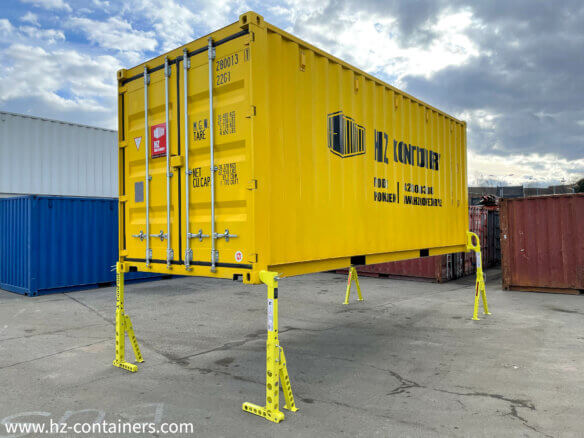
ConFoot System is a unique, patented device for professional handling of ISO shipping containers without the use of a crane, reach stacker, side loader, or heavy handling equipment. It is a set of four mechanical support legs that are clamped into standardized corner elements (ISO corner castings) of the container and allow its safe stacking and loading using only the air suspension function of the cargo vehicle.
Key Features of the ConFoot System:
- Mobility and Compactness: Each leg weighs only 24 kg and the entire system can be easily operated by a single person.
- Patented Mechanism: Unique folding design with high stability.
- Compatibility: Designed for all standard ISO 20′ and 40′ containers according to ISO 668 standard.
- Efficiency: Enables decoupling delivery and unloading, which significantly increases throughput and fleet efficiency.
- No Heavy Equipment Required: Eliminates the need to order cranes, complex logistics planning, and driver waiting times.
This innovative system is used in logistics, construction, military, humanitarian missions, and retail, where it brings a revolution to work organization and operational safety.
Technological Analysis: What Are ConFoot Legs Made Of and How Do They Work?
Materials and Construction
| Element of System | Material / Technology | Advantage |
|---|---|---|
| Main Load-Bearing Part | High-Strength Finnish Steel (up to 6 different grades) | High Load Capacity, Low Weight, Long Service Life |
| Telescopic Mechanism | Steel, Precise Locking Pins | Height Adjustability from approximately 1,043 to 1,448 mm |
| Magnetic Stabilization | Strong Neodymium Magnet in Leg Head | Easy Handling, Secure Attachment to Container Wall |
| Surface Treatment | Anti-Corrosion Coating per EN ISO 12944 | Weather and Salt Resistance, Extended Service Life |
| Safety Pins and Locks | Hardened Steel | Prevention of Accidental Folding, Protection Against Failure |
Design: Each leg folds into a compact “V” shape and offers a patented folding mechanism that minimizes the risk of tipping or container damage.
Operating Principle – Step by Step
- Attachment: Legs are inserted into the bottom corner elements of the container (ISO 1161).
- Lifting the Chassis: Using air suspension, the chassis height is increased by up to 15 cm.
- Installation and Securing: Legs are unfolded, extended telescopically, and secured with safety pins.
- Weight Transfer: By gradually releasing air from the bellows, the container weight is transferred from the chassis to the legs.
- Vehicle Departure: After complete chassis relief, the vehicle can safely drive out from under the container.
Safety and Certification
- EN 283: The system is tested according to this European standard for static and dynamic loads.
- CE Mark: Complies with Machinery Directive 2006/42/ES.
- Additional Safety Features: Robust pins, integrated locks, and surface treatment against corrosion per EN ISO 12944.
- Service Life: With proper maintenance and adherence to instructions, exceeds 10 years of intensive use.
Product Overview: ConFoot Models and Their Specifications
| Model | Load Capacity (set of 4 pcs) | Weight (1 leg) | Adjustable Height | Specific Use |
|---|---|---|---|---|
| CF | 34,000 kg | 24 kg | 1,043–1,448 mm | Standard model for stacking common ISO containers |
| CFP | 30,000 kg | 24 kg | 1,043–1,448 mm | Special “L” shape for unloading at ramps, full door opening (up to 270°) |
| CFU 20 | 20,000 kg | 46 kg | up to 1,500 mm | Enables active lifting/lowering of container to ground level |
| CFU 30 | 30,000 kg | 46 kg | up to 1,500 mm | For higher load capacity and height adjustability requirements |
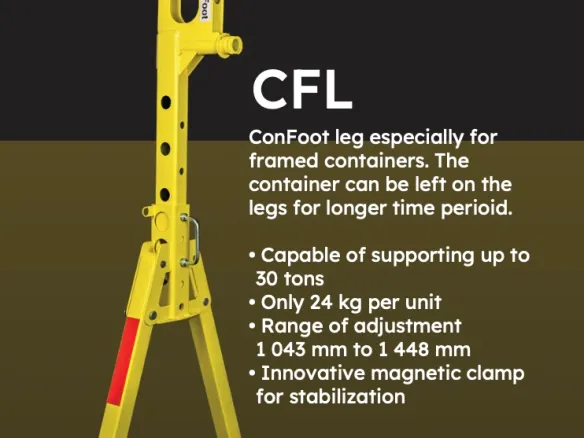
| CFL | 34,000 kg | 24 kg | 1,043–1,448 mm | For special frames, cisterns, tanktainers |
Note: For use on loading ramps, a combination of CFP and CF models within one set is recommended.
Unloading Process: Detailed Step-by-Step Guide

Required Equipment:
- 4 pcs of ConFoot legs of the appropriate type
- Vehicle with ISO chassis and air suspension
- Personal protective equipment (gloves, footwear)
- Optionally, wedges for wheel securing
Procedure:
- Surface Inspection – compacted, level, load-bearing surface (concrete/asphalt/gravel).
- Vehicle Securing – parking brake, wedges.
- Chassis Lifting – maximum air suspension position.
- Unlocking Twist-Locks – container release.
- Leg Installation:
- Push pin into corner element,
- Rotate leg and secure with magnet,
- Unfold into “V” and secure with pins,
- Extend telescopic part and secure with lock.
- Chassis Lowering and Weight Transfer – slow air release, monitor leg loading.
- Vehicle Departure – drive out from under the container, container remains safely in place.
Loading is the reverse process: Drive under container, lift chassis, remove legs, secure with twist-locks.
Comparison with Alternative Handling Methods
Professional Alternatives
| Method | Advantages | Disadvantages |
|---|---|---|
| Mobile Crane | High Load Capacity, Versatility | More Expensive, Requires Ordering, High Costs, Space Requirements |
| Side Loader (Sidelifter) | Fast, Efficient, Safe | Limited Availability, High Purchase Price, Specialized Personnel |
| Reach Stacker | Suitable for Terminals, High Throughput | High Operating Costs, Bulky Equipment |
| Forklift | Cheaper for Lighter Containers | Requires Special Models, Risk of Container Damage |
Improvised and Low-Cost Methods
- Levers, Logs, Rollers, Winches: Highly Risky, No Certification, Instability, Risk of Injury and Container/Cargo Damage.
- Time and Physical Demands: ConFoot can be safely operated by one person in 10 minutes.
ConFoot: Certified, tested, and safe solution for all common applications.

Key Advantages: Why Choose ConFoot Legs?
- Cost Savings: Elimination of cranes, lower operating expenses, reduced equipment wear.
- Time Savings: Container stacking/loading in 5–10 minutes, without waiting for specialized personnel.
- Maximum Flexibility: Ability to stack containers anywhere on a compacted surface, even in remote locations.
- Enhanced Safety: Handling without working at heights, robust securing and testing per EN 283.
- Cargo Protection: Container on legs = protection against moisture, pests, flooding, possibility of ventilation.
- Long Service Life: High-strength materials, robust construction, anti-corrosion treatment, service life 10+ years.
Practical Use Cases
- Logistics and Transport: “Drop & hook” operations, efficient fleet utilization.
- Construction: Temporary warehouses, changing rooms, offices, workshops without foundation requirements.
- Agriculture: Seasonal crop, feed, and equipment storage.
- Military and Humanitarian Missions: Rapid establishment of bases, hospitals, warehouses in the field.
- Event Management: Festivals, sports events, temporary stands, storage facilities.
- Retail and Distribution: Container delivery directly to ramp – accelerated unloading.
Safety, Maintenance, and Service Life
Safety Principles
- Firm, Level Surface: Never use on soft/uneven ground.
- Regular Inspection: Check leg condition, pins, and locks before each use.
- Balanced Loading: Even weight distribution within the container.
- Wind Conditions: Do not use in winds exceeding 22.5 m/s (approximately 80 km/h).
- Safety Zone: Exclusion of unauthorized persons in the surrounding area.
Maintenance
- Cleaning: Remove dirt, salt, mud.
- Lubrication: Lubricate all moving parts at least once a year with appropriate grease.
- Storage: In dry conditions, away from aggressive chemicals and weather exposure.
Service Life
- More than 10 years with adherence to maintenance and safety principles, full return on investment.
Technical Documentation
Technical documentation is available in PDF format, including diagrams, certificates, manuals, and drawings.
Related Terms
- ISO Container: Standardized shipping container per ISO 668.
- Corner Casting: Reinforced steel part per ISO 1161, key for handling and stacking.
- Twist-Lock: Locking mechanism for container fixation to chassis.
- Air Suspension: Allows change in vehicle chassis height.
- Decoupling Delivery and Unloading: Separation of transport and unloading, increases logistics efficiency.
- CE Mark: Declaration of compliance with European standards.
- EN 283: Standard for static and dynamic testing of interchangeable superstructures.
 Czech Republic
  WITHOUT SHIPPING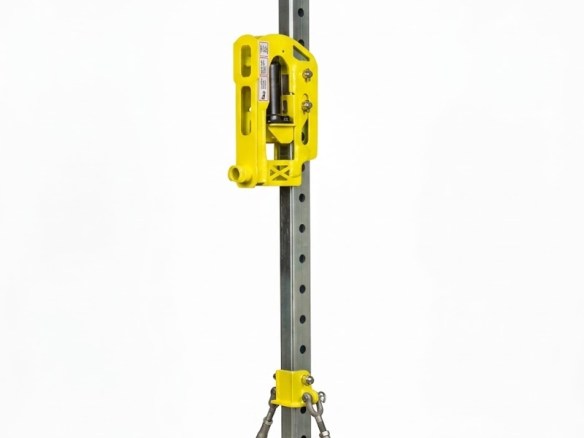

Other container news...

Contamination of the inner walls of a shipping container: Why this is a normal operating condition and not a reason for a complaint
Dark streaks, scuffs, and marks on the interior walls of a shipping container are a completely normal occurrence during use. They arise naturally during the loading and unloading of goods via handling equipment and have no impact on the container’s watertightness or structural integrity. Find out why these aesthetic marks are not grounds for a complaint and how they can be easily touched up if necessary.

Obligation to Check Tightness When Selling a Reefer Container
Who is responsible for the refrigerant leak check when selling a refrigerated container? Find out what obligations the seller has at the time of handover and why they must provide a PTI report along with the technical data plate. Learn which regulatory requirements and F-gas record-keeping duties become the sole responsibility of the new owner.

New shipping containers
If you are currently considering purchasing a new shipping container, you are not alone. While just twenty years ago containers were used almost exclusively for maritime transport, today they have found their way into construction, storage, business, and even housing. This growing popularity brings with it a host of questions: Which type should you choose? How much does it cost? How do you recognize quality? How can you avoid falling victim to scammers?
New sea shipping containers
If you are currently considering purchasing a new shipping container, you are not alone. While just twenty years ago containers were used almost exclusively for maritime transport, today they have found their way into construction, storage, business, and even housing. This growing popularity brings with it a host of questions: Which type should you choose? How much does it cost? How do you recognize quality? How can you avoid falling victim to scammers?