
ConFoot legs for handling the container
Introduction to ConFoot Legs
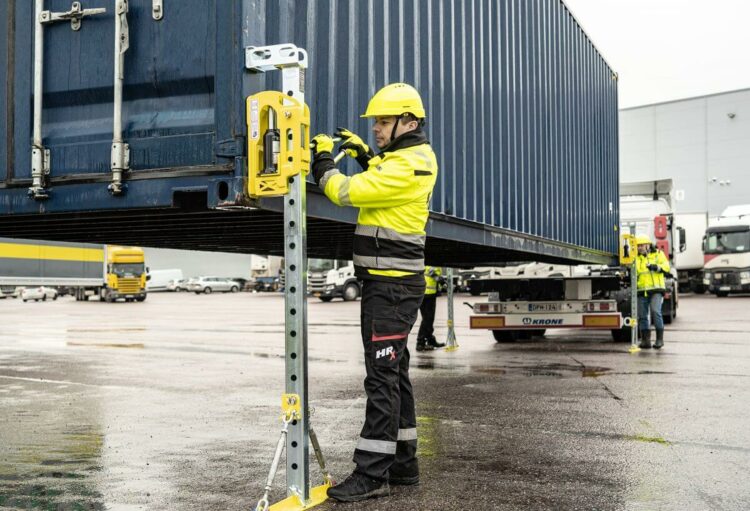
ConFoot legs for container handling represent a revolutionary solution for efficient and safe handling of shipping containers. These patented legs allow for easy folding and repositioning of containers without the need for heavy machinery, significantly simplifying logistics operations. With ConFoot legs, you can place the container exactly where you need it, quickly and conveniently.
How ConFoot Legs Work
ConFoot legs are mounted directly on the container and allow it to be lifted to the desired height. The process is simple and quick:
- Prepare the Trailer: A truck with an air suspension arrives at the site.
- Mount the Legs: The trailer is raised to the maximum using air, then the ConFoot legs are easily mounted.
- Release the Bolts: Release the securing bolts holding the container on the trailer.
- Lower the Trailer: The trailer is lowered, and the container remains standing on the ConFoot legs.
- Truck Departure: The truck can leave, and the container stays safely in place.
Benefits of Using ConFoot Legs
Using ConFoot legs offers a range of benefits:
- Efficiency: Enables quick and easy container folding without the need for a crane or other heavy equipment.
- Safety: Stable and robust construction ensures safe placement of the container.
- Mobility: Legs are easy to transport and install, increasing flexibility in various logistics situations.
- Time and Cost Savings: Reduces the need to rent expensive equipment and speeds up container handling processes.
ConFoot Model Specifications
There are several ConFoot leg models designed for different needs, which we have regularly in stock at our warehouse in Třebíč:
- ConFoot CF14ST10: Standard model suitable for most common containers.
-
Main Advantages of the ConFoot CF14ST10 Leg Set:
- Standard version with a load capacity of up to 34 tons!
- Ability to open container doors up to 180°
- Innovative magnetic coupling to support stability
- Height range from 1043 to 1448 mm
- Weight of one support only 24 kg
- Operable by just one person
- Patented design
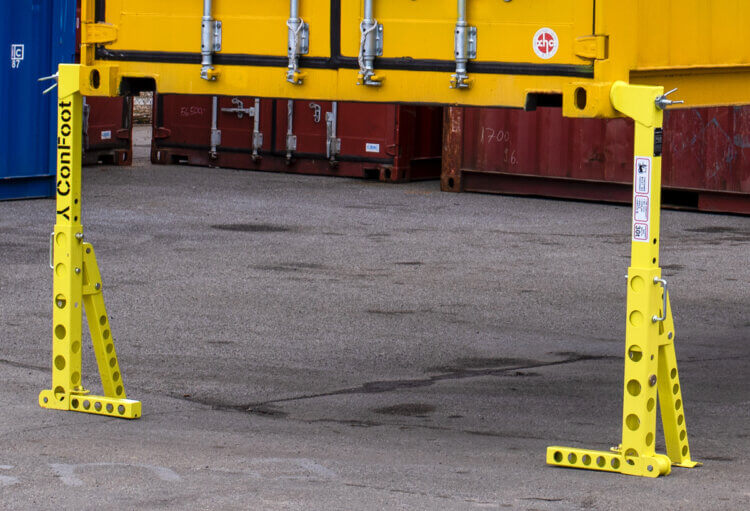 The set includes:
- 4 CF-leg supports, model 14ST10 (standard version)
The set contains a total of 4 pieces. We have the goods in stock!
-
- ConFoot CFP15ST11: Special model designed for placing containers at ramps, ideal for unloading operations.
-
Main Advantages of the ConFoot CFP15ST11 Leg Set:
- Can be placed perpendicular to the ramp
- Easy to use on unloading ramps
- Allows full opening of container doors
- Height range from 1043 to 1448 mm
- Weight of one support only 24 kg
- Operable by just one person
- Total load capacity of up to 34 tons!
The set includes:
- CFP-leg, model 15ST11 (designed for ramp placement)
- 2 CFP supports
- 2 CF supports
-
- ConFoot CFP with hydraulics: The main advantage of the hydraulic set is that you do not need handling equipment to fold and load the container onto the trailer
-
Main Advantages of the ConFoot CFP Hydraulic Set:
– Allows lifting the container from the trailer and lowering it to the ground– Container can be lifted from the ground– Utilizes hydraulic jacks– Container can remain on the supports indefinitely– Total load capacity of up to 20 tons!The hydraulic set includes:
– 4 CFP-leg supports with hydraulicsThe set contains a total of 4 pieces. We have the goods in stock!
-
- ConFoot CFP15ST13: Model primarily intended for 45′ shipping containers.
For more information, videos, and more, visit our website www.confoot.czPrice is listed without shipping!
Examples of ConFoot Legs Usage
ConFoot legs find wide application in various sectors:
- Logistics and Transport: Simplify the loading and unloading process of containers at various locations without the need for stationary equipment.
- Construction and Industry: Allow easy relocation of containers on construction sites or within industrial facilities.
- Storage and Distribution: Aid in handling containers in warehouses and distribution centers, increasing work efficiency.
ConFoot legs represent an innovative and practical solution for handling shipping containers. Thanks to their easy installation, robust construction, and wide range of uses, they simplify and enhance logistics operations in various industries. If you are looking for a way to simplify container handling and reduce costs, ConFoot legs are the right choice.
How Do ConFoot Legs Assist in International Goods Transport?
ConFoot legs represent an innovative and practical solution for simplifying and streamlining container handling in international goods transport. Their easy installation, versatility, increased safety, and ecological benefits make them an invaluable tool for modern logistics companies. They enable companies to achieve significant cost savings and improve overall management of transport processes.
Innovation in Container Handling
In the modern world of international goods transport, containers play a key role. However, handling them often requires heavy machinery and specialized equipment. This is where ConFoot legs come into play, offering a revolutionary solution for easier container handling. These innovative supports allow for quick relocation and increased efficiency in loading and unloading containers.
Easy Installation and Handling
ConFoot legs feature simple installation that can be done by one person in just a few minutes. Simply attach them to the corners of the container and secure. The container can then be easily lifted using a standard forklift or other handling equipment. This process significantly reduces the need for heavy machinery and simplifies the entire logistics chain.
Flexibility and Versatility
One of the greatest advantages of ConFoot legs is their versatility. They are compatible with various types of containers, including standard shipping containers, refrigerated containers, and other special types. This makes them usable in a wide range of transport scenarios, from sea transport to road transport and storage.
Increased Safety and Cost Reduction
Using ConFoot legs also brings significant improvements in safety during container handling. Their stable and secure placement reduces the risk of accidents and damage to goods. Additionally, they eliminate the need for expensive and demanding cranes and other heavy equipment, positively impacting the reduction of overall transport costs.
Eco-friendly and Sustainable Solution
ConFoot legs are made from durable materials that ensure long life and minimal maintenance. Their use also reduces fuel consumption and greenhouse gas emissions as they enable more efficient container handling without the need for heavy machinery. This contributes to a more sustainable and environmentally friendly method of goods transport.
Improvement in Logistics and Inventory Management
With ConFoot legs, logistics companies can better plan and manage their inventory. Quick and easy handling of containers allows for more efficient loading and unloading of goods, reducing overall transport time and increasing productivity. This leads to better use of storage space and optimization of the entire logistics process.
Other container news...

New shipping containers
If you are currently considering purchasing a new shipping container, you are not alone. While just twenty years ago containers were used almost exclusively for maritime transport, today they have found their way into construction, storage, business, and even housing. This growing popularity brings with it a host of questions: Which type should you choose? How much does it cost? How do you recognize quality? How can you avoid falling victim to scammers?

6m shipping container
Are you thinking about buying a 6-meter shipping container but aren’t sure what to look for? You are not alone—this 20-foot container is the best-selling size on the Czech market, and the differences between various types, conditions, and prices can be significant. In this guide, you will find everything you need to know: from exact dimensions and a comparison of categories (such as “one-way,” refurbished, and “Cargo Worthy”) to current prices and shipping advice.
Corner casting steel vs aluminum
Every shipping container in the world — all 40 million of them — rests on eight critical components. Corner castings are the load-bearing blocks at each corner of an ISO shipping container, and they are the universal interface between the container and every crane, twistlock, spreader, and chassis on the planet. When you lift a container, stack it nine high on a ship, or lock it to a truck trailer, every ton of force flows through these fittings.

Construction cabin – selection, tips, dimensions and prices
Every construction project – whether a family house, a development project or a reconstruction – starts with the infrastructure. No construction manager, craftsman or investor who needs an on-site office, a changing room for workers or a safe storage for tools can do without a quality construction cell. But navigating the offer is not easy: residential containers, sanitary cells, storage modules, rental, purchase, refurbished pieces… This guide will give you answers to all the essential questions in one place.