
Advantages of 4 Fold Shipping Containers
4 Fold Container (also known as 4FOLD foldable container) represents a revolutionary innovation in global logistics and cargo transportation. It is a fully certified, standardized 40-foot High Cube (HC) maritime container whose unique feature is the ability to fold it to one-quarter of its original height. This technology was developed by the Dutch company Holland Container Innovations (HCI) and protected by a series of worldwide patents. After folding, four such containers can be connected into one bundle with dimensions and handling points identical to a standard 40′ container.
Main Technical Parameters:
| Parameter | Value |
|---|---|
| Type | 40′ High Cube (HC) |
| Material | High-strength steel (Corten) |
| Weight of empty container | approx. 4,100 kg |
| Height in folded state | approx. 650 mm (0.65 m) |
| Payload capacity | up to 30,480 kg |
| Certification | ISO, CSC, UIC, AAR |
| Number of patent families | 10+ |
The folding technology fundamentally solves one of the biggest problems in global transportation – inefficient transport of empty containers. By enabling the transport of four empty containers in the place of one, the 4 Fold container brings significant economic, environmental, and operational advantages for the entire supply chain.
History and Development: From Idea to Reality
The concept of foldable containers was not entirely new, but it was Holland Container Innovations (HCI) that succeeded in developing a fully functional, certified, and commercially viable product. The first prototypes were created at the Technical University of Delft around 2000 as a student project led by one of HCI’s founders, Simon Bosschieter. The company was founded in 2008 and was followed by several years of development and testing – it was necessary to prove that the folding version would be equally strong, safe, and watertight as a standard ISO container.
Key Certifications and Approvals
- ISO (International Organization for Standardization): Dimensional and handling compatibility with standard containers.
- CSC (Convention for Safe Containers): Structural strength and safety for stacking and transportation.
- UIC (International Union of Railways): Approval for rail transport in the EU.
- AAR (Association of American Railroads): Approval for rail transport in the USA.
Other approving authorities include, for example, Korean Register (KR), American Bureau of Shipping (ABS), DEKRA, and Lloyd’s Register (LR).
The Problem That 4 Fold Solves: Empty Container Inefficiency
Key Facts and Statistics
- Up to 20% of containers transported by sea are empty.
- Up to 40% of containers in road and rail transport are empty.
- 25 billion EUR annually spent by shipping companies on repositioning empty containers.
- More than 200 million tons of CO₂ annually generated precisely due to empty container transport – which is comparable to emissions from the entire European transport infrastructure.
- More than 30 million m² of storage space is occupied by empty containers.
This imbalance burdens ports, increases costs, and has a significant environmental impact.
How 4 Fold Works: Mechanism and Handling
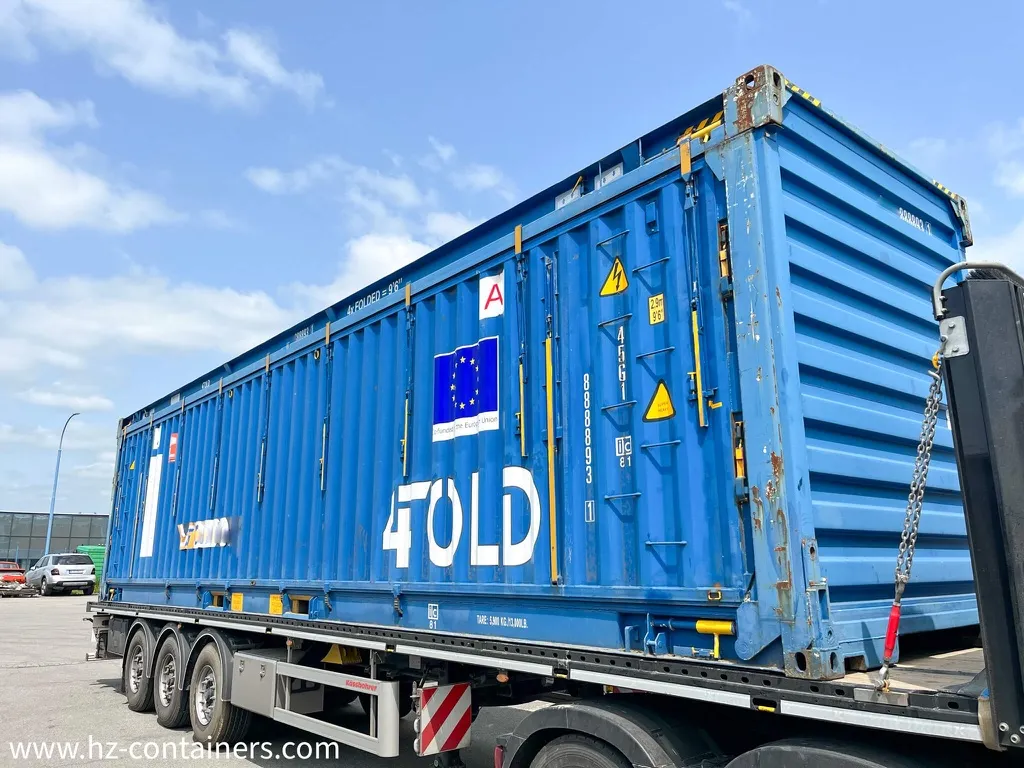
Container Folding and Unfolding Process
- Folding time: approx. 10 minutes, 2 workers
- No special equipment required – standard equipment is sufficient (crane, spreader, forklift)
- Step by step:
- Folding side walls: Side panels fold inward onto the floor.
- Lifting the roof: The roof (connected to the front walls) is lifted up.
- Folding front walls: The front and door wall are placed on the already folded side walls.
- Locking the roof: The roof is lowered and secured on the folded walls.
4 in 1 Concept
- Four folded containers are stacked and connected into one bundle with dimensions of a standard 40-foot container.
- Handling points (corner castings) are preserved – full compatibility with terminal equipment.
- The bundle can be transported, stored, and handled as one standard container.
Robustness and Lifespan
- Made from high-strength steel, tested for resistance to sea salt, vibrations, and repeated folding.
- Lifespan and payload capacity comparable to standard ISO containers (15–20 years).
Main Advantages of 4 Fold Containers
Economic Advantages
- Up to 75% savings in costs for repositioning empty containers (4 for the price of 1).
- Lower storage and handling fees – payment is made for the bundle, not for individual units.
- Faster handling = lower operating costs.
- More efficient use of capacity in ports, depots, and transport.
Environmental Advantages
- Up to 37% reduction in CO₂ emissions associated with empty container transport.
- Fewer trips mean lower emissions of NOx, PM10, and noise in the vicinity of logistics hubs.
- Reduction of the ecological footprint of the entire logistics sector, contributes to meeting ESG and climate goals.
Operational Advantages
- Reduction of congestion in ports and depots – fewer movements, fewer bottlenecks.
- Greater flexibility in responding to demand for empty containers in export regions.
- Capacity optimization on ships, trains, and trucks – more space for full containers.
- Increased safety and standardization of handling processes.
Technical Specification and Construction
| Parameter | Value |
|---|---|
| Type | 40′ High Cube (HC) |
| Material | High-strength steel |
| Weight of empty container | approx. 4,100 kg |
| Height in folded state | approx. 650 mm |
| Payload capacity | up to 30,480 kg |
| Lifespan | 15–20 years |
| Certification | ISO, CSC, UIC, AAR |
| Number of patents | 10+ |
Construction: All major components (corner elements, locking mechanisms, hinges) meet international standards for strength and safety.
Examples of Use and Practical Deployment
- Shipping companies: 4FOLD containers are deployed by more than 15 major shipping companies worldwide.
- Geographic expansion: More than 60 ports and depots worldwide (Europe, Asia, North America).
- Typical routes: Asia–Europe export corridors, Asia–North America, green corridors (Shanghai – Vancouver – Chicago – New York – Europe – Shanghai).
- Logistics centers: Terminals where speed of turnover and efficient use of space are key.
Automation and Future Development
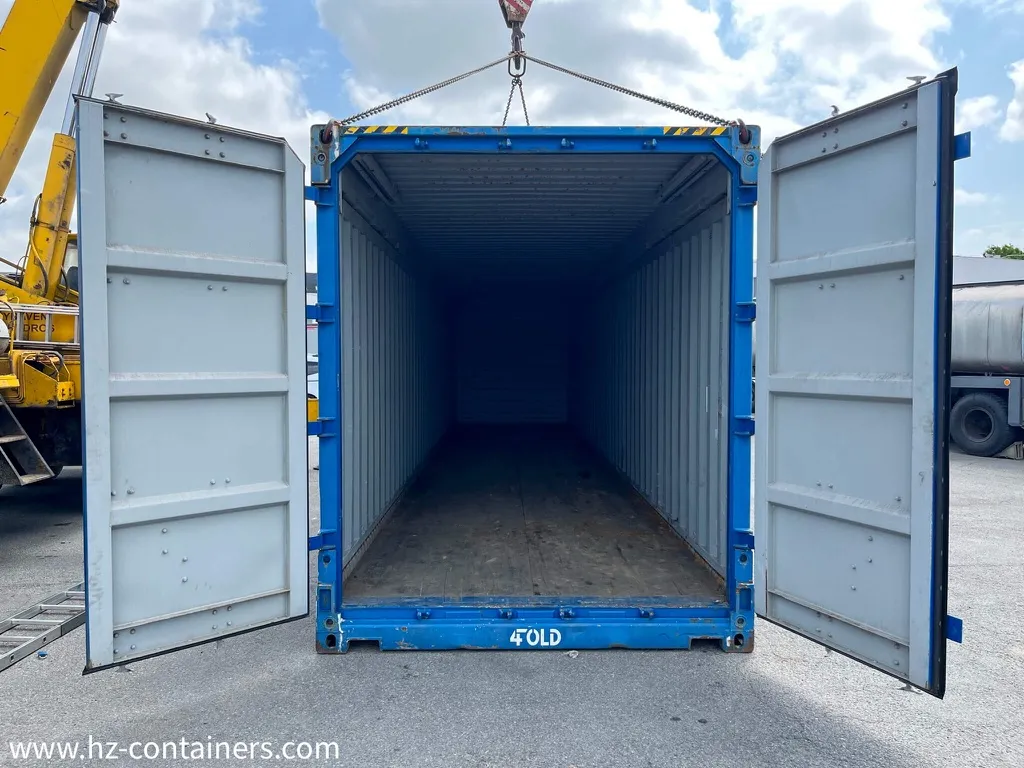
- Automated folding equipment: Development of semi-automatic and fully automated lines for folding/unfolding (for further efficiency increases).
- New dimensions: Development of folding versions for 45′ (Europe) and 53′ (USA) containers.
- Digitalization: Tracking of container movement and condition using IoT, RFID, and advanced logistics systems.
- Green corridors: Active cooperation in creating routes where foldable containers will be systematically deployed to maximize savings and environmental benefits.
Frequently Asked Questions (FAQ)
Is the 4 Fold container as strong and safe as a standard one?
Yes, all key certifications and tests confirm the same structural strength, payload capacity, and watertightness as standard ISO containers.
Is handling complicated?
No, the bundle of four folded containers has the same dimensions and handling points as a standard 40′ HC container. It can be handled with standard equipment.
What is the return on investment?
The higher purchase price is quickly recovered through savings on repositioning, handling, and storage. On imbalanced routes, ROI is very fast.
Where are the containers used?
In leading world ports, depots, and on railways across continents.
What is the lifespan of a foldable container?
The same as a standard ISO container – with proper maintenance, 15–20 years.

 Czech Republic, Třebíč
  FREE SHIPPING


Other container news...

New sea shipping containers
If you are currently considering purchasing a new shipping container, you are not alone. While just twenty years ago containers were used almost exclusively for maritime transport, today they have found their way into construction, storage, business, and even housing. This growing popularity brings with it a host of questions: Which type should you choose? How much does it cost? How do you recognize quality? How can you avoid falling victim to scammers?
New shipping containers
If you are currently considering purchasing a new shipping container, you are not alone. While just twenty years ago containers were used almost exclusively for maritime transport, today they have found their way into construction, storage, business, and even housing. This growing popularity brings with it a host of questions: Which type should you choose? How much does it cost? How do you recognize quality? How can you avoid falling victim to scammers?

6m shipping container
Are you thinking about buying a 6-meter shipping container but aren’t sure what to look for? You are not alone—this 20-foot container is the best-selling size on the Czech market, and the differences between various types, conditions, and prices can be significant. In this guide, you will find everything you need to know: from exact dimensions and a comparison of categories (such as “one-way,” refurbished, and “Cargo Worthy”) to current prices and shipping advice.
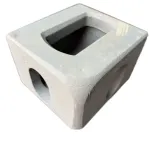
Corner casting steel vs aluminum
Every shipping container in the world — all 40 million of them — rests on eight critical components. Corner castings are the load-bearing blocks at each corner of an ISO shipping container, and they are the universal interface between the container and every crane, twistlock, spreader, and chassis on the planet. When you lift a container, stack it nine high on a ship, or lock it to a truck trailer, every ton of force flows through these fittings.