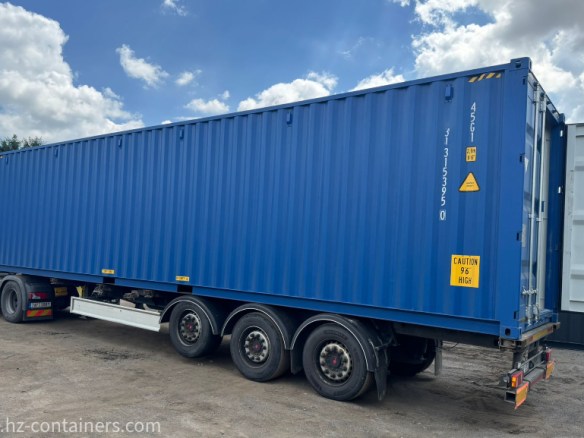
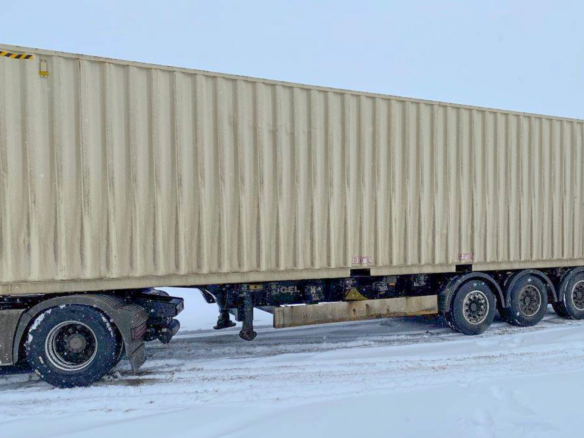
What Is a 40 Foot High Cube Shipping Container?
A 40 foot high cube shipping container is an intermodal freight container that measures 40 feet long, 8 feet wide, and 9 feet 6 inches tall — exactly one foot taller than the standard 40-foot container, which stands at 8 feet 6 inches. That extra 12 inches of height transforms the container’s usable volume from roughly 2,350 cubic feet to approximately 2,694 cubic feet — a gain of nearly 15% more storage capacity in the same footprint.
In the world of global logistics, this container type has quietly become the dominant 40-foot unit. As of 2025, over 55% of the global 40-foot container fleet consists of high cube units, and the segment continues to grow at an estimated 7.2% compound annual rate. Whether you are shipping freight, buying storage for a construction site, or planning a container home conversion, understanding exactly what a 40 foot high cube container is — and is not — can save you thousands of dollars and countless logistical headaches.
What Is a 40 Foot High Cube Shipping Container?
Definition and Core Concept
A high cube container (often abbreviated HC, HQ, or 40’HC) is a dry freight container built to the same length and width specifications as a standard 40-foot container, but with an external height of 9 feet 6 inches (2.89 meters) instead of the standard 8 feet 6 inches (2.59 meters). Internally, this translates to roughly 8 feet 10 inches (2.70 meters) of clearance — room enough for taller cargo, higher pallet stacks, or, in the case of container architecture, room for insulation, flooring, and ductwork without making the space feel cramped.
Key Distinction: “High cube” refers exclusively to the container’s height. The length (40 feet) and width (8 feet) are unchanged from the ISO standard 40-foot footprint. The term “cube” derives from the container’s cubic capacity — high cube units simply offer more cubes of volume.
High cube containers are almost always dry van containers — meaning they are fully enclosed, non-refrigerated steel boxes with corrugated walls, a solid roof, and double cargo doors at one end. They fall under the ISO 668 Series 1 classification for freight containers, identified by the size type code that includes the 9’6″ height designation.
Where Did the Term “High Cube” Come From?
The story of the high cube container begins not with height, but with a competitive push for efficiency. Standard shipping containers had been locked at 8 feet and 8 feet 6 inches in height since ISO 668 was first published in 1968, formalizing the dimensions Malcolm McLean’s original 1956 container innovation had set in motion. For two decades, the industry worked within those constraints.
Then, in 1986, American President Lines (APL) introduced the first 45-foot container — and crucially, it stood 9 feet 6 inches tall. APL was targeting domestic U.S. intermodal routes where highway and rail clearances could accommodate the extra height. The added capacity was immediately attractive: shippers could fit roughly 10–15% more cargo volume on the same chassis or railcar, reducing per-unit shipping costs.
The 9’6″ height proved so successful that carriers began applying it to 40-foot units as well. By the early 1990s, 40-foot high cube containers were entering the global fleet in significant numbers. ISO 668 was revised to formally recognize the 9’6″ height classification, and the “high cube” designation entered the lexicon of every freight forwarder, logistics coordinator, and container trader.
Today, the high cube format has effectively become the default for new 40-foot container manufacturing. Most major shipping lines — Maersk, MSC, CMA CGM, Hapag-Lloyd, COSCO — now order 40-foot high cube containers as their standard dry van unit.

The Role of ISO 668 in Standardizing High Cube Containers
ISO 668 is the international standard that governs the classification, external dimensions, and maximum gross weight ratings of Series 1 freight containers. First published in 1968 and revised multiple times (most recently in 2020 as ISO 668:2020), the standard ensures that a container loaded in Shanghai can be seamlessly transferred to a truck in Los Angeles, a train in Chicago, and a barge in Rotterdam — all without dimensional incompatibilities.
The standard establishes specific size codes. A 40-foot high cube dry container carries the ISO size type code 42G1 (or similar, depending on specific features), with the “2” in the second position denoting the 9’6″ height. A standard-height 40-foot container is coded 42G0, with the “0” indicating 8’6″.
Why does this matter? Because the ISO standard is what allows automated handling equipment at ports — spreaders, cranes, chassis — to interface with every container identically. The external corner castings, the spacing of the forklift pockets, the gooseneck tunnel on the underside: all are fixed by ISO 668 so that a 40-foot high cube container can be handled by the same equipment as a standard unit. The only variable is the extra foot of steel at the top.
What Are the Exact Dimensions of a 40ft High Cube Container?
External Dimensions
All 40-foot containers share the same footprint. The difference between a standard and a high cube is entirely vertical.
| Dimension | Standard 40ft (Imperial) | Standard 40ft (Metric) | 40ft High Cube (Imperial) | 40ft High Cube (Metric) |
|---|---|---|---|---|
| External Length | 40′ 0″ | 12.19 m | 40′ 0″ | 12.19 m |
| External Width | 8′ 0″ | 2.44 m | 8′ 0″ | 2.44 m |
| External Height | 8′ 6″ | 2.59 m | 9′ 6″ | 2.89 m |
The external length and width are locked to ISO standards. The external height of 9’6″ is what makes it a high cube.
Internal Dimensions and Usable Space
Inside the corrugated steel walls, the numbers shift. Corrugation depth, door hardware, and front-end wall thickness all eat into the external envelope. Here is how the internal dimensions compare:
| Measurement | Standard 40ft | 40ft High Cube | Difference | % Increase |
|---|---|---|---|---|
| Internal Length | ~39′ 5″ (12.03 m) | ~39′ 5″ (12.03 m) | None | 0% |
| Internal Width | ~7′ 8″ (2.35 m) | ~7′ 8″ (2.35 m) | None | 0% |
| Internal Height | ~7′ 10″ (2.39 m) | ~8′ 10″ (2.70 m) | ~12 in (0.31 m) | ~12.8% |
| Internal Volume | ~2,350 cu ft (67.5 m³) | ~2,694 cu ft (76.4 m³) | ~344 cu ft (8.9 m³) | ~14.6% |
Note that actual internal dimensions can vary slightly between manufacturers. CIMC, Singamas, CXIC, and other major container builders may differ by a few millimeters in their internal clearances — but the exterior dimensions are non-negotiable per ISO 668.
Door Opening Dimensions
The cargo doors on a 40-foot high cube container are taller than those on a standard container, which is critical for loading and unloading tall items:
| Door Opening | Standard 40ft | 40ft High Cube |
|---|---|---|
| Door Width | ~7′ 8″ (2.34 m) | ~7′ 8″ (2.34 m) |
| Door Height | ~7′ 5″ (2.26 m) | ~8′ 5″ (2.57–2.60 m) |
The door height is always slightly less than the internal height because of the door header — the structural beam that runs across the top of the door opening. Even so, an 8-foot-5-inch door opening means you can drive a standard forklift with a raised load through the doors — something that required careful maneuvering with the standard-height 7’5″ opening.
How Much Can a 40ft High Cube Container Hold?
Cubic Capacity
The defining advantage of a high cube container is its volumetric capacity. At approximately 2,694 cubic feet (76.4 cubic meters) of internal volume, a 40ft high cube offers roughly 344 extra cubic feet compared to a standard 40ft container’s 2,350 cubic feet (67.5 m³).
Put in practical terms: that extra volume equals roughly three standard American refrigerators, or enough space to stack an additional layer of 16 standard pallets of boxed goods (assuming 8-inch box heights). For light but bulky cargo — furniture, insulation materials, plastic components, empty packaging — high cube containers let shippers fill the box before hitting the weight limit.
Weight Specifications
Despite having more steel in their taller walls, high cube containers share the same maximum gross weight rating as standard 40-foot containers under ISO standards. This means the extra steel translates to slightly less net payload capacity:
| Specification | Imperial | Metric | Notes |
|---|---|---|---|
| Max Gross Weight | ~67,200 lbs | ~30,480 kg | ISO maximum; same as standard 40ft |
| Tare Weight (empty) | ~8,550–9,260 lbs | ~3,880–4,200 kg | Slightly heavier than standard 40ft (~8,200 lbs) |
| Net Payload | ~57,900–58,650 lbs | ~26,300–26,600 kg | Slightly less than standard (~59,000 lbs) |
The tare weight of a 40ft high cube is typically 200–400 pounds heavier than a standard 40-foot container because of the additional steel in the taller corner posts, side panels, and door frame. This means the net payload is marginally lower — a difference that rarely matters for volume-constrained cargo but matters a great deal for dense commodities like steel coils, bagged cement, or heavy machinery.
Pallet Capacity and Loading Configurations
How many pallets you can fit depends on the pallet type and loading pattern. The 40ft high cube’s internal dimensions allow multiple common configurations:
| Pallet Type | Dimensions (approx.) | Maximum Quantity | Loading Notes |
|---|---|---|---|
| Euro Pallet (EUR) | 1,200 × 800 mm | Up to 25 | One row lengthwise, one row widthwise; snug fit |
| Standard US Pallet (GMA) | 48″ × 40″ (1.22 × 1.02 m) | Up to 20–21 | Two rows of 10 side-by-side |
| Industrial UK Pallet | 1,200 × 1,000 mm | Up to 20 | Two rows of 10 |
| ISO Pallet | 1,219 × 1,016 mm | Up to 20 | Two rows of 10 |
What makes high cube containers especially valuable for palletized freight is the additional vertical space. Where a standard container might allow stacking pallets two-high, a high cube can often accommodate three-high stacking, effectively increasing the total number of pallets per container — provided the cargo weight does not exceed payload limits.
How Does a 40ft High Cube Compare to a Standard 40ft Container?
Height: The Defining Difference
At its simplest, a high cube container is a standard 40-foot container with an extra foot of height. Both share the same length, same width, same corner casting geometry, and compatibility with the same handling equipment. The only physical difference is 12 additional inches of vertical steel.
That foot matters in three specific ways:
- Cargo height clearance: You can load items up to roughly 8’10” internally instead of 7’10”.
- Ceiling height in conversions: For container homes and offices, 8’10” gives you room for insulation, ductwork, and finished ceilings while maintaining comfortable headroom.
- Stacking clearance in warehouses: If you store containers and stack goods inside, the extra height allows an additional full layer of many product types.
Volume and Capacity Differences
The 14.6% increase in internal volume is the high cube’s primary selling point. For low-density cargo — think furniture, textiles, plastic goods, empty containers, insulation — this means you can fully utilize the container’s volume before hitting weight limits. A standard 40-foot container loading these cargo types would “cube out” (run out of space) before it “weighs out” (hits the payload limit), leaving unused weight capacity. The high cube mitigates this inefficiency.
Weight Tradeoffs
The tradeoff is simple: you gain ~344 cubic feet of volume and lose ~200–400 pounds of net payload. For most cargo types, this is an excellent trade. The only time it becomes a disadvantage is when shipping extremely dense commodities — metal ingots, stone, liquids in drums, bagged cement — where every pound of payload capacity counts and the extra foot of height goes unused.
When to Choose High Cube Over Standard
| Scenario | Best Choice | Reason |
|---|---|---|
| Shipping bulky, lightweight goods (furniture, plastic parts, textiles) | High Cube | Extra volume prevents cubing out before weighing out |
| Shipping dense, heavy cargo (steel, stone, liquid-filled drums) | Standard 40ft | Lower tare weight = more payload; extra height unused |
| Container home or office conversion | High Cube | Extra foot allows insulation + finished ceiling at comfortable height |
| Construction site storage for tools and materials | High Cube | Extra headroom for shelving and ease of movement |
| Budget-constrained storage, low-height items only | Standard 40ft | Lower purchase price, sufficient height |
| Intermodal transport with tight bridge/tunnel clearances | Standard 40ft | Some routes have 8’6″ height restrictions on certain roads |
| E-commerce fulfillment and general freight | High Cube | 55%+ fleet share means better availability in many ports |
What Are the Common Uses and Applications of a 40ft High Cube Container?
Shipping and Freight Transport
The 40-foot high cube container is the backbone of modern ocean freight. Walk through any major port — Shanghai, Rotterdam, Los Angeles/Long Beach — and the stacked rows of containers are predominantly high cube 40-footers. They carry everything from consumer electronics and apparel to industrial components and food products.
In intermodal transport, the high cube moves seamlessly from ship to rail to truck. The ISO-standard corner castings mean the same spreader that lifts it off a vessel can place it onto a railcar or chassis. The extra height does impose some routing constraints — certain older rail tunnels and low highway overpasses cannot clear 9’6″ on a standard chassis — but these restrictions are well-mapped and logistics planners account for them routinely.
Storage Solutions
Beyond shipping, the 40-foot high cube container has become a ubiquitous storage solution across industries:
- Construction sites: Secure tool and material storage that arrives on a truck and is ready to use immediately.
- Retail and warehousing: Overflow inventory storage during peak seasons, positioned in parking lots or loading bays.
- Agriculture: Weatherproof storage for feed, equipment, and harvested products.
- Events and festivals: Secure back-of-house storage for equipment, merchandise, and supplies.
The extra foot of height in a high cube makes shelving and stacking far more practical than in a standard-height container, where tall workers may find themselves constantly ducking.
Container Home and Building Conversions
The 40-foot high cube container has become the preferred unit for architectural conversions — and the extra foot of height is the reason. A standard 8’6″ container, once you add a subfloor, ceiling insulation, and some form of finished interior ceiling, leaves you with roughly 7 feet of interior height. That is technically habitable but feels low and cramped.
A high cube, by contrast, starts with 8’10” internally. Subtract 4–6 inches for a raised floor, 4–6 inches for a ceiling assembly with insulation, and you are left with a comfortable 7’10” to 8’2″ of finished ceiling height — comparable to a conventional house. This single dimension is why high cubes command a premium in the architectural and tiny home market.
A single 40-foot high cube provides roughly 320 square feet of floor space — enough for a studio apartment, a compact one-bedroom, or a spacious office. Multiple units can be combined side-by-side or stacked to create larger structures. Real-world examples include multi-unit apartment complexes in Amsterdam, student housing in Copenhagen, and luxury vacation homes in the California desert — all built from 40-foot high cube containers.
Specialty and Creative Applications
The durability and modularity of high cube containers have spawned a wide range of creative uses:
- Pop-up retail stores and food and beverage kiosks
- Mobile medical clinics and testing laboratories
- Swimming pools — the container is lined and filled, creating an instant above-ground pool
- Vertical farms — stacked containers with hydroponic systems for urban agriculture
- Emergency housing and disaster relief shelters
- Art galleries and exhibition spaces that can be transported between venues
What Are the Different Conditions and Grades of 40ft High Cube Containers?
When buying or renting a 40-foot high cube container, condition is everything. The industry uses several broadly recognized grades:
New / One-Trip Containers
A one-trip (or “one-way”) container has been manufactured overseas, loaded with cargo exactly once for its journey to the destination country, and then sold. These units have minimal wear — typically just some scuffing from the single voyage. The paint is near-pristine, the door seals are brand new, the floor is unmarked. One-trip containers carry a premium price but offer the closest thing to factory condition without the environmental cost of manufacturing a container solely for domestic use.
Cargo Worthy (CW) Used Containers
A Cargo Worthy container holds a valid CSC (Convention for Safe Containers) safety plate, meaning it has been inspected and approved for international shipping. These units may show cosmetic rust, dents, or paint fading, but the structural integrity is sound, the doors seal properly, and the floor is solid. Cargo Worthy containers represent the sweet spot for buyers who need reliable, shippable containers at a mid-range price.
Wind & Watertight (WWT) Used Containers
Wind and Watertight is the most common grade for storage-only containers. These units may have visible dents, surface rust, patched areas, and faded paint, but the critical functions remain intact: doors open and close, gaskets seal against rain, and the floor can bear weight. WWT containers are typically 10–15 years old and are no longer certified for international shipping (their CSC plate may be expired), but they are perfectly functional for ground-level storage at a significantly lower price point.
IICL-5 and Premium Used
The Institute of International Container Lessors (IICL) maintains strict inspection standards. An IICL-5 container has been inspected and repaired to meet these standards, which are more demanding than basic Cargo Worthy criteria. These containers are typically younger, better-looking, and command a price between new and standard used units. They are popular with buyers who want a clean appearance alongside structural reliability.
| Grade | Description | Typical Price Range (2026, US) | Best For |
|---|---|---|---|
| New / One-Trip | Single cargo voyage, near-pristine | $4,500–$7,000 | High-end conversions, image-conscious retail |
| IICL-5 / Premium Used | Inspected to strict lessor standards | $3,500–$5,000 | Commercial storage, clean builds |
| Cargo Worthy (CW) | CSC-certified, structurally sound, cosmetic wear | $2,500–$4,000 | Reliable storage, occasional shipping |
| Wind & Watertight (WWT) | Sealed against elements, visible wear | $1,400–$2,500 | Budget storage, basic site use |
| As-Is | Sold in current condition, may have issues | $800–$1,500 | DIY repairs, non-critical uses |
How Much Does a 40 Foot High Cube Container Cost?
New Container Pricing
A new or one-trip 40-foot high cube container in the U.S. market typically costs between $4,500 and $7,000, with pricing heavily influenced by geographic location and delivery distance. Coastal states with major ports (California, Texas, New Jersey, Georgia) tend to have lower base prices due to higher container supply. Inland states like Nebraska or Montana pay a premium because containers must be trucked hundreds of additional miles.
Used Container Pricing by Condition
Used 40-foot high cube container pricing breaks down as follows:
- Cargo Worthy: $2,500–$4,000, with examples as low as $2,650 in port-proximate locations
- Wind & Watertight: $1,400–$2,500, with occasional deals below $1,400 for older units
- As-Is: $800–$1,500, for buyers willing to accept leaks, rust-through, or door issues
These are base container prices. Delivery is typically quoted separately and can range from $200 for local delivery up to $2,000+ for long-distance hauls or deliveries requiring special permits (high cube containers on a standard tilt-bed trailer exceed the legal height limit in some states, requiring lowboy trailers or route permits).
Factors That Affect Price
- Geographic location: Distance from the nearest port or container depot drives delivery costs disproportionately
- Steel prices: Container prices correlate with global scrap steel and Corten steel prices
- Supply and demand: Post-pandemic container shortages (2021–2022) saw prices double; the market has since normalized but remains sensitive to trade disruptions
- Age: Containers built before 2010 typically sell for less, though Corten steel construction means well-maintained units last 20+ years
- Modifications: Pre-cut doors, windows, vents, or paint add cost but save time for conversion projects
- Color: Tan, beige, and gray are common; specialty colors or uniform fleets cost more
What Are the Most Common Misconceptions About High Cube Containers?
“High Cube Containers Hold More Weight”
This is perhaps the single most common misunderstanding. A 40-foot high cube container does not have a higher maximum gross weight than a standard 40-foot container. Both are rated at approximately 30,480 kg (67,200 lbs) under ISO standards. The high cube has more volume — but because its tare weight is slightly higher (more steel in the taller walls and frame), its net payload is actually slightly lower by about 200–400 pounds. For most cargo, this is a rounding error. But if you are shipping dense goods at the margin of the weight limit, every pound counts — and the standard container edges ahead.
“All 40ft Containers Are the Same Height”
First-time container buyers frequently assume that “40-foot” defines the entire container. It does not. Length and height are independent dimensions. A 40-foot container can be standard height (8’6″), high cube (9’6″), or even — in rare cases — a “low cube.” Always check the height specification before purchasing or booking freight, especially if your goods or loading equipment depend on a specific clearance.
“High Cube Containers Cost Significantly More to Ship”
Ocean freight rates for containers are typically calculated on a per-container or per-TEU (twenty-foot equivalent unit) basis, not on container height. A 40-foot high cube and a 40-foot standard container generally command the same ocean freight rate on the same route. The cost difference emerges in inland transportation: a high cube on a standard chassis may exceed 13’6″ total height, which is the legal limit for U.S. highways without special permits. Some carriers charge a surcharge or require a lowboy trailer for high cube moves, adding $100–$300 to domestic trucking costs — but the ocean portion is typically neutral.
“You Can Always Stack High Cubes as High as Standard Containers”
In theory, yes — high cube containers have the same corner casting geometry and stacking strength. In practice, some older container vessels have cell guides (the vertical rails in a ship’s hold that containers slide into) designed for 8’6″ containers. Loading a 9’6″ high cube into these cells is impossible. Modern vessels are designed to accommodate both, but it is a constraint worth knowing if you charter older tonnage. On land, stacking high cubes requires the same inter-box connectors (twist locks) as standard containers — no special equipment — but the taller stack may introduce wind-load and stability considerations at the top of the stack.
What Does the Future Hold for 40ft High Cube Containers?
Market Trends and Fleet Growth
The high cube format is steadily becoming the default 40-foot container. With over 55% of the global 40-foot fleet already in high cube configuration and a projected 7.2% CAGR through 2027, it is reasonable to expect that within a decade, standard-height 40-foot containers will be the exception rather than the norm in many trade lanes. The economic logic is straightforward: for most cargo, the extra volume costs almost nothing in operational terms while delivering 15% more space.
Smart Container Technology
The next generation of high cube containers is increasingly “smart.” IoT-enabled devices — GPS trackers, door-open sensors, temperature and humidity monitors, shock detectors — are being integrated into container fleets. These systems allow shippers to track cargo in real time, receive alerts if a container deviates from its route, and monitor conditions for sensitive goods. The extra interior height of a high cube provides more flexibility for mounting these devices without encroaching on cargo space.
Sustainability and Second-Life Applications
A shipping container’s first life at sea typically lasts 10–15 years. After that, it enters a second life — storage, conversion, or recycling. The 40-foot high cube container has become the darling of the sustainable architecture movement precisely because its proportions approximate those of habitable human spaces. As the global fleet ages and containers are retired from ocean service, the supply of used high cubes for architectural reuse will only increase. Meanwhile, the steel in a container is fully recyclable — when a container finally reaches end of life, roughly 3,900 kg of Corten steel can be melted down and repurposed.
Frequently Asked Questions
How much taller is a high cube container than a standard container?
A high cube container is exactly one foot (12 inches, or approximately 305 mm) taller than a standard container. Standard containers stand 8 feet 6 inches (2.59 meters) tall externally, while high cube containers stand 9 feet 6 inches (2.89 meters) tall. Internally, the difference is roughly the same: about 12 inches of additional vertical clearance.
Can a 40 foot high cube container be used for a shipping container home?
Yes — and the high cube is strongly preferred over a standard-height container for home conversions. The internal height of approximately 8 feet 10 inches (2.70 meters) provides enough clearance to add floor insulation, a subfloor, ceiling insulation, and a finished ceiling while maintaining comfortable headroom of roughly 7 feet 10 inches to 8 feet. A standard 8’6″ container, by contrast, leaves only about 7 feet of finished ceiling height, which feels constricted in a living space.
How many standard pallets fit in a 40ft high cube container?
Up to 20–21 standard US GMA pallets (48″ × 40″) can fit on the floor of a 40-foot high cube container, arranged in two side-by-side rows of 10. Euro pallets (1,200 × 800 mm) can fit up to 25, arranged in a combination of lengthwise and widthwise rows. The high cube’s extra height enables stacking pallets — two or even three pallets high in some configurations — dramatically increasing total cargo capacity provided the weight limit is not exceeded.
What is the internal cubic capacity of a 40ft high cube container?
The internal volume of a 40-foot high cube container is approximately 2,694 cubic feet (76.4 cubic meters). This compares to approximately 2,350 cubic feet (67.5 cubic meters) for a standard 40-foot container — a difference of roughly 344 cubic feet, or about 14.6% more usable volume.
How much does a 40ft high cube container weigh when empty?
The tare weight (empty weight) of a 40-foot high cube container ranges from approximately 8,550 to 9,260 pounds (3,880 to 4,200 kilograms), depending on the manufacturer, age, and specific construction details. This is roughly 200–400 pounds heavier than a standard 40-foot container due to the additional steel in the taller corner posts, side walls, and door frame.
What is the maximum cargo weight for a 40-foot high cube container?
The maximum gross weight (container plus cargo) is approximately 67,200 pounds (30,480 kilograms) under ISO standards. Subtracting the tare weight of roughly 8,550–9,260 pounds leaves a net payload capacity of approximately 57,900 to 58,650 pounds (26,300 to 26,600 kilograms). This payload capacity is slightly lower than a standard 40-foot container because the high cube is heavier when empty.
How much does a 40 foot high cube container cost?
As of 2026, a used 40-foot high cube container ranges from approximately $1,400 to $4,000 depending on condition (Wind & Watertight at the low end, Cargo Worthy at the upper end of the used range). A new or one-trip container costs between $4,500 and $7,000. Delivery fees are additional and vary by distance. Prices fluctuate with global steel markets and regional supply-demand dynamics.
What does “HC” or “HQ” mean on a shipping container?
“HC” stands for “High Cube” and “HQ” stands for “High Cube” as well (the “Q” is sometimes used as an abbreviation in certain markets and documentation systems). Both acronyms refer to the same thing: a container with an external height of 9 feet 6 inches (2.89 meters) rather than the standard 8 feet 6 inches. You will see “40’HC” or “40HQ” painted on containers and used in freight documentation.
Are high cube containers more expensive to transport by ocean freight?
Ocean freight rates are typically the same for a 40-foot high cube as for a 40-foot standard container on the same route — carriers charge by the container unit, not by container height. The cost difference, if any, arises in inland trucking: a high cube on a standard chassis may exceed the 13’6″ legal road height in some jurisdictions, requiring a lowboy trailer and potentially adding $100–$300 to domestic delivery costs, depending on the route.
When were high cube containers introduced?
The first containers with a 9’6″ height were introduced by American President Lines (APL) in 1986 as part of the initial 45-foot container design for domestic U.S. intermodal routes. The format proved so successful that 40-foot high cube containers entered widespread production in the early 1990s. ISO 668 was subsequently revised to formally recognize the 9’6″ height classification. Today, high cube containers represent the majority of the global 40-foot container fleet.
What is the door opening size on a 40ft high cube container?
The cargo door opening on a 40-foot high cube container is approximately 7 feet 8 inches wide by 8 feet 5 inches tall (2.34 meters × 2.57–2.60 meters). The door height is slightly less than the internal height of 8 feet 10 inches because of the structural header beam above the door opening. The door width is the same as a standard container.
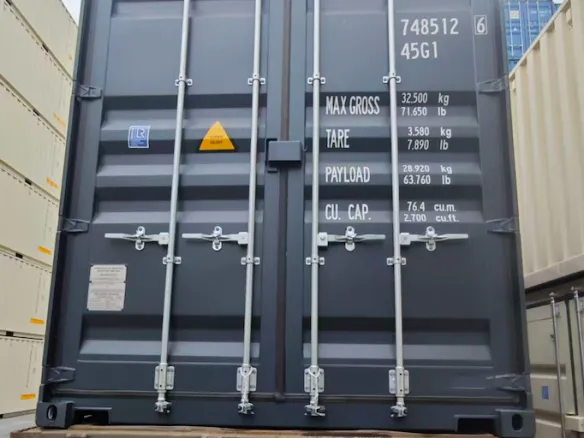
 Houston, USA
  WITHOUT SHIPPING