Neuss – Germany container port and depot
Neuss is Germany’s third largest inland port and one of the most important logistics hubs on the Rhine. Every year, more than 24 million tons of goods and over 1.2 million TEU of containers pass through here. HZ Containers offers the opportunity to purchase retired shipping containers that you can take away immediately. No intermediaries, no waiting for shipping, no hidden transshipment fees. Simply come and take your container straight home.
Neuss – One of the Largest Inland Ports in Europe
History and Significance of the Port of Neuss
The Port of Neuss has almost 190 years of history behind it. It was founded in 1835 by expanding an original arm of the Rhine, and since then it has become the engine of economic development for the entire region. In 2003, it merged with the Düsseldorf port, creating Germany’s third largest inland port – right after Duisburg and Cologne.
Today, the port is operated by RheinCargo, which provides a complete logistics chain across six terminals between Neuss, Düsseldorf, and Cologne. In Neuss itself, there are five port basins equipped with fifteen cranes. On average, 50 ships are handled here daily, replacing up to 5,000 truck journeys. The port is connected to the European waterway network via the Rhine – heading north to Rotterdam and Antwerp, and heading south deep into the interior.
What Retired Shipping Containers We Offer
Standard Storage Containers 10, 20 and 40 Feet
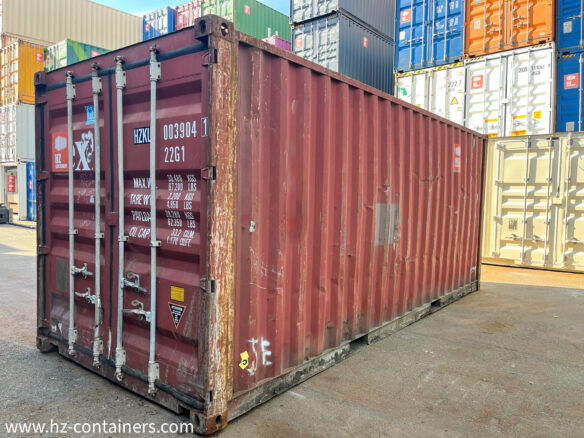
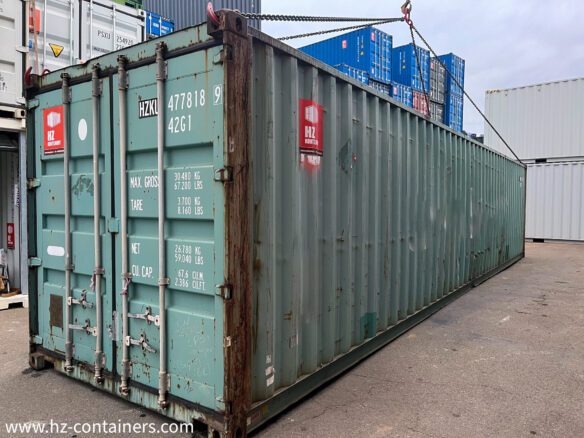
The most sought-after category is standard closed containers. These steel boxes with wooden floors and double-wing doors are used for storing tools, materials, seasonal equipment, or as a base for conversion into workshops, garages, or mobile offices.
The most common 20-foot container (6 m long) offers approximately 33 m³ of storage space and can hold up to 28 tons of cargo. The larger 40-foot container (12 m) offers double the volume and is ideal for larger-scale storage or major construction projects. In addition, we also have smaller 10-foot containers in stock, suitable for tight spaces or as a mobile stand.
Special Containers – Refrigerated, Open Top, Flat Rack, High Cube
In addition to standard types, we also offer special containers from the Neuss depot:
| Container Type | Dimensions (L × W × H) | Typical Use |
|---|---|---|
| 20′ Standard | 6.06 × 2.44 × 2.59 m | Universal storage, workshop |
| 40′ Standard | 12.19 × 2.44 × 2.59 m | High-capacity warehouse, construction cabin |
| 40′ High Cube | 12.19 × 2.44 × 2.89 m | Storage with higher ceiling, conversion into living space |
| 20′ Open Top | 6.06 × 2.44 × 2.59 m | Bulk materials, top loading |
| 20′ Flat Rack | 6.06 × 2.44 × 2.59 m | Heavy machinery, oversized goods |
| 40′ Reefer (refrigerated) | 12.19 × 2.44 × 2.59 m | Insulated storage, transport of sensitive goods |
Refrigerated containers (reefer) are equipped with insulation and an integrated cooling unit. Even if the unit may no longer be functional, the insulation itself makes them an excellent solution for storing temperature-sensitive goods – food, chemicals, or furniture, for example. The temperature inside a well-insulated reefer fluctuates much less than in a standard box. High Cube containers have a 30 cm higher ceiling (2.89 m instead of the standard 2.59 m). This seemingly small change significantly improves comfort when converting into living space, an office, or a workshop. Open Top containers lack a fixed roof – instead, they use a removable tarpaulin. This allows them to be loaded from above by crane. Flat Rack containers have only a solid floor and front walls; the sides are open or foldable. They are used for oversized machinery, pipes, wooden logs, and other goods that don’t fit in a closed box.
Quality of Retired Containers – What to Look for When Choosing
Quality Categories – AS IS, IICL, Cargo Worthy
The world of retired shipping containers uses several standard quality categories. Understanding them will help you choose a container that exactly matches your needs.
- AS IS – the container is sold in the condition in which it arrived. It may show signs of wear – dents, surface rust, damaged seals. The price is the lowest. It is suitable for undemanding storage where appearance doesn’t matter.
- IICL – international standard for containers suitable for further maritime transport. The container has passed inspection and repairs according to precisely defined criteria. It is in very good condition, with functional doors and an intact roof.
- Cargo Worthy (CW) – the container is fit for cargo transport. It meets the requirements for safe transport, has a valid CSC certification, and is watertight. This is the most sought-after category for the majority of customers.
CSC Certification
CSC (Convention for Safe Containers) is an international agreement that sets safety standards for transport containers. Every certified container carries a metal plate on the door with information about the manufacturer, date of manufacture, maximum load capacity, and the last inspection. Check the validity of the CSC plate – without it, the container cannot be legally transported on a flatbed or ship.
How Container Pickup Works at the Neuss Depot
Where the Depot is Located and How to Get There
The port is connected to three main highway routes. The A57 motorway connects Neuss with Cologne (south) and the Dutch city of Nijmegen (north). The A46 motorway leads west to Mönchengladbach and further to the Belgian border. The A52 motorway connects Neuss with Düsseldorf and Essen. The port area itself is well signposted, and the depot is accessible for trucks of all sizes.
What Type of Transport You Need to Take Away a Container
You arrange transport yourself for the container from the Neuss depot. The type of vehicle depends on the size of the container:
- 10-foot and 20-foot container – a truck with a hydraulic arm (e.g., Mercedes Atego, MAN TGL) or a flatbed with a load capacity of at least 3.5 tons for an empty 20-foot container (weight approx. 2.2 t) is sufficient.
- 40-foot container – a flatbed or truck is required. An empty 40-foot container weighs approximately 3.8 tons.
We handle the loading at the depot – we will load the container onto your prepared vehicle. The loading time is usually within 30 minutes of your arrival.
Overview of approximate distances and travel times from selected Czech cities to Neuss:
| Departure City | Distance (km) | Travel Time |
|---|---|---|
| Prague | ~750 km | 8 hours |
| Brno | ~850 km | 9 hours |
| Plzeň | ~600 km | 6.5 hours |
| Ostrava | ~950 km | 10 hours |
| Ústí nad Labem | ~680 km | 7 hours |
Why Buy a Retired Shipping Container Instead of a New One
Price Comparison – New vs. Retired Container
A retired shipping container typically costs 40–60% of the price of a new one. While a new container comes from a factory in China, travels by ship to Europe, and its price includes manufacturing costs and shipping, a retired container has already completed its transport service. Its value has decreased, but its functionality remains.
For non-commercial use – garden storage, a construction cabin, a workshop – a retired container is completely sufficient. A 20-foot container in the Cargo Worthy category will serve you for decades, while its price is a fraction of the cost of a comparably sized sheet metal hall or garage. In addition, it can be moved at any time – it doesn’t create a permanent structure for which you would need a building permit.
Comparison of approximate price levels by quality and age:
| Category | Condition | Approximate Price Level | Suitable Use |
|---|---|---|---|
| AS IS | Visible wear | 40–50% of new price | Undemanding storage, construction cabin |
| IICL | After inspection and repairs | 60–70% of new price | Company warehouses, more demanding use |
| Cargo Worthy | Fully functional, watertight | 70–80% of new price | Storage and transport, long-term investment |
| New container | Factory condition, 0 voyages | 100% | Representative purposes, residential use |
Environmental Aspect of Buying a Retired Container
Every retired shipping container we sell means one recycled steel box that doesn’t have to end up as scrap. Manufacturing a new 20-foot container consumes approximately 2,200 kg of steel and produces roughly 4,000 kg of CO₂. By extending the life of an existing container by another 10–20 years, you actively save these emissions.
The steel frame of a container is designed for maritime transport – it withstands storms, salt spray, and extreme loads. Even after years at sea, its structural integrity is usually excellent. A retired container is thus one of the best examples of functional reuse in practice.
Frequently Asked Questions
What Type of Transport Do I Need to Pick Up a Container?
For a 20-foot container, a truck with a hydraulic arm or a flatbed with a load capacity of at least 3.5 tons is sufficient. For a 40-foot and High Cube container, we recommend a flatbed or truck with an appropriate load capacity (min. 5 tons).
Are the Containers at the Neuss Depot Certified?
The majority of containers in our offer have valid CSC certification and meet the Cargo Worthy standard. For each unit, we state the quality category and the status of the CSC plate, so you know exactly what you are buying.
How Long Does Order Processing Take?
After payment and order confirmation, the container is usually ready for pickup within 5–7 working days. In case of urgent requirements, please contact us.
Can a Container from Neuss Be Transported to the Czech Republic?
You arrange transport yourself. Neuss is approximately 600 km from the Czech border (Rozvadov crossing), and the truck journey takes about 7 hours. From Prague, count on approximately 750 km and 8 hours of driving.
Do You Also Offer Container Rental from the Neuss Depot?
No. HZ Containers specializes exclusively in the sale of new and retired shipping containers. We do not offer rentals.
What If I Need a Container with Atypical Dimensions?
In addition to standard 20-foot and 40-foot containers, we sometimes have less common sizes in our offer – 10-foot, 30-foot, or 45-foot High Cube containers. For current availability, contact us with your specific requirement.

 Mannheim, Germany
 WITHOUT SHIPPING