
Which refrigerants are used in transport containers?
Welcome to the comprehensive glossary that thoroughly answers the question: “Which refrigerants are used in transport containers?” This article presents the most elaborate source on the Czech internet, focused on technical, ecological and legislative aspects of refrigerants in maritime logistics. With rapidly changing regulations and pressure on ecology, the choice of the right refrigerant is crucial not only for efficient operation but also for responsible business on a global scale.
Basic concepts and technologies
Refrigerant
Definition and principle:
A refrigerant is a chemical substance (or mixture of substances) that circulates in a closed cooling circuit. Its role is to transport heat: it absorbs heat at low pressure and temperature in the evaporator and releases it in the condenser to the surrounding environment. The refrigerant continuously changes from liquid to gas phase and back in the system.
Technical requirements for refrigerants:
- Suitable boiling and condensation temperature range (must work efficiently under container conditions)
- Chemical and thermal stability
- Non‑reactivity with circuit materials (aluminium, copper, steel)
- Non‑toxicity, non‑flammability (or controlled flammability according to ISO 817)
- Low global warming potential (GWP) and zero ozone depletion potential (ODP)
Refrigeration Systems
Components of a standard refrigeration unit for containers:
| Component | Function |
|---|---|
| Compressor | Compresses the gaseous refrigerant, raising its pressure and temperature. |
| Condenser | Releases heat to the surroundings, changing the refrigerant from gas to liquid. |
| Expansion valve | Reduces the pressure of the liquid refrigerant, cooling it sharply. |
| Evaporator | Refrigerant absorbs heat from the cargo space, turning into gas and thus cooling the cargo. |
Modern technologies:
- Advanced control: Units such as TK Magnum PLUS and Daikin LXE use intelligent software to optimise operation, reduce energy consumption and minimise emissions.
- Flexibility: The newest units are often “multi‑refrigerant ready” – they can be adapted to different refrigerants according to legislation and customer needs.
Reefer container
Characteristics:
- Insulated walls, floor and ceiling (polyurethane foam, vacuum panels)
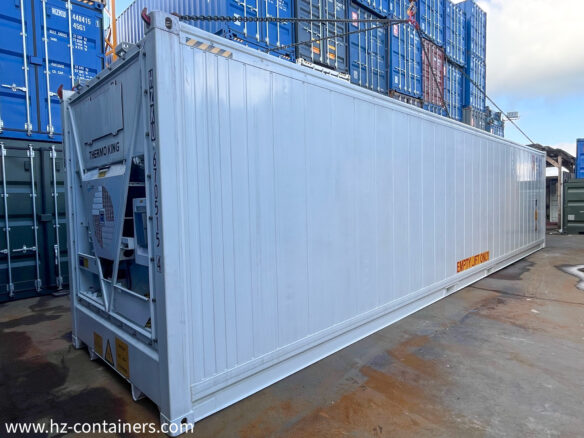
- Integrated refrigeration unit on the front wall
- Operating temperature range: –30 °C to +30 °C (some systems extreme – down to –65 °C with CO₂)
- Uses: food, pharmaceuticals, chemicals, biotechnology, fresh flowers, electronics
- Monitoring: Remote temperature monitoring (IoT, GSM/GPS modules), alarm on deviation
Primary and secondary refrigerants
| Refrigerant type | Description | Typical use in containers |
|---|---|---|
| Primary | Directly circulates in the cooling circuit, changing between liquid and gas | Yes |
| Secondary | Transfers cooling from the exchanger further (water/glycol mixture, brine), cooled by the primary medium | No (except in special solutions) |
Key environmental metrics
Global Warming Potential (GWP)
- GWP indicates how many times more a substance contributes to global warming compared with CO₂ (CO₂ = 1).
- Values: R134a (GWP 1430), R404A (GWP 3922), R452A (GWP 2140), R513A (GWP 631), R1234yf (GWP 4), CO₂/R744 (GWP 1)
- Regulation: From 2025 the EU limits GWP to 150 for new autonomous refrigeration systems!
Ozone Depletion Potential (ODP)
- Reference substance R‑11 (ODP 1)
- Modern refrigerants (HFC, HFO, CO₂) have ODP = 0
- CFC and HCFC refrigerants (R12, R22) are completely banned
Total Equivalent Warming Impact (TEWI)
- TEWI = direct emissions (refrigerant leaks × GWP) + indirect emissions (CO₂ emissions from electricity generation)
- Emphasis on system energy efficiency and leak minimisation
- Decisive metric for environmental assessment in tenders and certifications (e.g., BREEAM, LEED)
Classification and detailed description of refrigerant types
Historical refrigerants (retired or banned)
| Type | Designation | Properties / disadvantages | Status in 2025 |
|---|---|---|---|
| CFC | R‑12 | High GWP and ODP | Globally banned |
| HCFC | R‑22 | Reduced ODP, still high GWP | Phase‑out, banned |
HFC (hydrofluorocarbons) – transitional generation
| Refrigerant | Typical use | GWP | Temperature range | Note |
|---|---|---|---|---|
| R134a | Standard containers, cars | 1430 | –25 to +25 °C | Reliable, efficient, being phased out |
| R404A | Freezer containers | 3922 | –30 to +35 °C | High GWP, banned in new units (EU, 2025) |
Modern blends – transitional solutions
| Refrigerant | Replacement for | GWP | Advantages | Scope of use |
|---|---|---|---|---|
| R452A | R404A | 2140 | Lower GWP, similar performance | New freezer containers |
| R513A | R134a | 631 | Lower GWP, retrofit‑friendly | Refrigerated containers |
- Significant GWP reduction (30–70 %) while maintaining operational properties
- Direct retrofitting of existing systems is possible
HFO (hydrofluoroolefins) – fourth generation, revolutionary solutions
| Refrigerant | GWP | ODP | Advantages | Limitations / notes |
|---|---|---|---|---|
| R1234yf | 4 | 0 | Practically no warming impact, chemical stability | Lower cooling performance than R134a |
| R1234ze | 7 | 0 | High efficiency, safety class A2L | Flammability requires special measures |
- Properties: Decompose quickly in the atmosphere, do not damage ozone, meet the strictest EU norms and global GWP limits.
- Applications: Industry (e.g., Maersk Star Cool), automotive, stationary cooling; in containers still limited but the trend is strong.
- Safety: Some HFOs are mildly flammable (A2L according to ISO 817), requiring design adaptations and safety training.
Natural refrigerants – long‑term ecological solutions
| Refrigerant | Chemical label | GWP | ODP | Advantages | Disadvantages / technical requirements |
|---|---|---|---|---|---|
| CO₂ | R744 | 1 | 0 | Non‑flammable, non‑toxic, extremely cheap | Higher system pressure (up to 100 bar), higher electricity consumption in tropical climates |
| Ammonia | R717 | 0 | 0 | High efficiency, low GWP | Toxic, corrosive, not used in standard containers |
| Propane | R290 | 3 | 0 | Very efficient, ecological | Highly flammable, requires special safety measures |
- CO₂ (R744): Suitable for deep‑temperature applications (‑65 °C), vaccines, biotechnology; requires robust systems and special compressors.
- Propane (R290): Still rare in containers because of safety, but interest is growing in some regions due to low GWP.
Comparative table of refrigerants (technical and environmental parameters)
| Refrigerant | GWP | ODP | Temperature range | Operating pressure | Energy efficiency | Safety class | Outlook 2025+ |
|---|---|---|---|---|---|---|---|
| R134a | 1430 | 0 | –25/+25 °C | Medium | Good | A1 (non‑flammable) | Decline |
| R404A | 3922 | 0 | –30/+35 °C | High | Excellent | A1 | Ban |
| R452A | 2140 | 0 | –30/+35 °C | High | Good | A1 | Transitional |
| R513A | 631 | 0 | –25/+25 °C | Medium | Good | A1 | Transitional |
| R1234yf | 4 | 0 | –20/+20 °C | Medium | Slightly lower performance | A2L (flammable) | Growth |
| CO₂ | 1 | 0 | –65/+45 °C | Very high | Climate‑dependent | A1 | Long‑term trend |
Legislation, regulations and trends
Montreal Protocol (1987)
- Banned production and consumption of CFC and HCFC substances because of ozone layer damage.
- Triggered massive innovation in refrigerants.
Kigali Amendment (2016)
- Introduced global limits on HFC refrigerants because of their extremely high GWP.
- Pushes the market toward HFO and natural refrigerants.
EU F‑gases Regulation (2024/573)
- From 2025 the maximum GWP is 150 for new autonomous refrigeration systems (i.e., most container units).
- Quotas on HFC refrigerants, dramatic price increases, preference for ecological alternatives.
- Strict leak control, mandatory record‑keeping, certified service technicians.
Market trends 2025 and beyond
- R404A is disappearing completely; service only for existing equipment until stock is exhausted.
- R452A and R513A act as transitional solutions, with rapid uptake of HFO and CO₂/R744.
- Manufacturers (Carrier, Thermo King, Daikin, Star Cool) are launching “triple refrigerant ready” units.
- Expansion of remote monitoring, IoT, predictive maintenance to minimise leaks and optimise consumption.
Practical aspects of operation and maintenance
Maintenance and service of refrigeration units
- Annual inspection: Check tightness, pressure tests, electronics and insulation panels.
- Leak detection: Modern units (e.g., Daikin LXE) have integrated refrigerant leak detectors and alarms.
- Refrigerant selection during service: Always follow the data plate, respecting compatibility with the compressor and expansion valve.
- Safety: Work with HFO and natural refrigerants only by trained personnel, with emphasis on fire safety for A2L.
Energy efficiency
- Compressor speed control (inverter): Reduces consumption by up to 20 %.
- Optimised evaporator defrosting: Minimises losses and extends lifespan.
- Insulation: Choice of type (PUR, PIR, vacuum panels) influences both energy use and refrigerant leaks.
Future of refrigerants in transport containers
- Ultra‑low GWP: All developments head toward refrigerants with GWP < 10 (HFO, CO₂).
- Digitalisation: Remote control, predictive maintenance, automation to minimise leaks and optimise operation.
- New materials: Development of more durable seals, anti‑corrosion alloys that extend service life in extreme conditions.
- Flexibility: New units are designed for easy refrigerant change during their lifespan (retrofit‑ready).
- Safety: Innovations in leak detection and fire protection, especially for A2L refrigerants (HFO, propane).
 Czech Republic, Třebíč
  FREE SHIPPING


Other container news...

Obligation to Check Tightness When Selling a Reefer Container
Who is responsible for the refrigerant leak check when selling a refrigerated container? Find out what obligations the seller has at the time of handover and why they must provide a PTI report along with the technical data plate. Learn which regulatory requirements and F-gas record-keeping duties become the sole responsibility of the new owner.

New shipping containers
If you are currently considering purchasing a new shipping container, you are not alone. While just twenty years ago containers were used almost exclusively for maritime transport, today they have found their way into construction, storage, business, and even housing. This growing popularity brings with it a host of questions: Which type should you choose? How much does it cost? How do you recognize quality? How can you avoid falling victim to scammers?
New sea shipping containers
If you are currently considering purchasing a new shipping container, you are not alone. While just twenty years ago containers were used almost exclusively for maritime transport, today they have found their way into construction, storage, business, and even housing. This growing popularity brings with it a host of questions: Which type should you choose? How much does it cost? How do you recognize quality? How can you avoid falling victim to scammers?

6m shipping container
Are you thinking about buying a 6-meter shipping container but aren’t sure what to look for? You are not alone—this 20-foot container is the best-selling size on the Czech market, and the differences between various types, conditions, and prices can be significant. In this guide, you will find everything you need to know: from exact dimensions and a comparison of categories (such as “one-way,” refurbished, and “Cargo Worthy”) to current prices and shipping advice.