
Shipping containers Berlin Germany
Shipping containers Berlin, Germany represent an increasingly attractive alternative to buying on the domestic market for Czech entrepreneurs, tradesmen, and private buyers. Berlin is not only the capital of the largest European economy, but also a natural logistics hub with excellent accessibility from the Czech Republic and connections to the North German ports, led by Hamburg. It is precisely this combination that creates a highly competitive market, where you can purchase shipping, maritime, and storage containers of all types, sizes, and conditions at prices that often surpass the Czech offer. In this article, you will find everything you need to know – from an overview of Berlin dealers, through types and container certifications, to a practical guide on how to transport a shipping container from Berlin to your home.
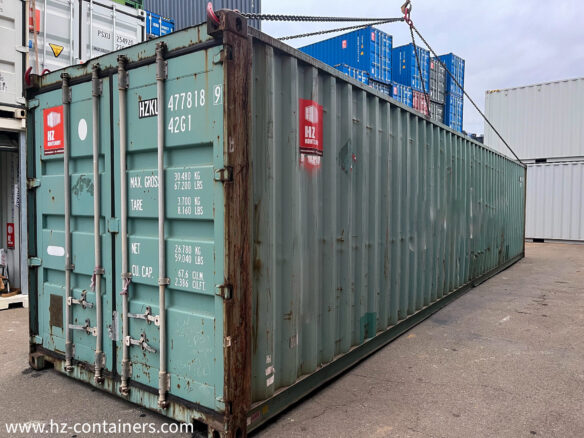
Shipping container (also called maritime container, ISO container, Seecontainer) is a standardized steel transport unit made of Corten steel, meeting the international ISO 668 and ISO 1496 standards. It is used for intermodal transport of goods by sea, rail, and road, and increasingly also as a basis for storage, workshops, offices, or modular buildings.
What are shipping containers and why buy them in Berlin?
Definition of a shipping container and its global significance
A shipping container is much more than just a “large tin box.” It is an ingeniously designed product of industrial standardization that launched a revolution in global trade. When in 1956 the American entrepreneur Malcom McLean had the tanker Ideal X converted and loaded 58 standardized steel boxes onto it, he laid the foundations for a system that today transports over 90% of all global goods. Containerization dramatically reduced transshipment costs, practically eliminated theft in ports, and above all enabled the seamless transfer of cargo between ship, train, and truck without the need to unpack and reload goods.
Every shipping container is made of Corten steel (also known as weather-resistant steel), which forms a stable protective layer of rust on its surface – this stops further corrosion instead of accelerating it. It is precisely thanks to this material that a container can withstand extreme conditions on the open sea and serve for decades. Structurally, it is equipped with corner castings, which allow safe gripping by a crane, stacking up to nine layers, and secure connection to the transport vehicle.
ISO container is a shipping container that meets the standards of the International Organization for Standardization – specifically ISO 668 (dimensions), ISO 1496 (technical specifications), and ISO 1161 (corner castings). Only such a container can be legally used in international transport.
Why Berlin is a strategic location for purchasing a container
In the context of shipping containers, Berlin is a remarkable destination. Although it is not a seaport itself, its geographical location makes it an ideal distribution hub for all of eastern Germany and the surrounding Central European regions. Here are the main reasons why Berlin:
- Proximity to the port of Hamburg – Hamburg is the third-largest European container port with an annual throughput of over 8 million TEU. Berlin is approximately 290 km from there, which means low costs for the initial distribution of containers from the port to Berlin depots.
- Dense network of container depots – At least seven specialized dealers and several other brokers operate in Berlin and its surroundings. Competition between them pushes prices down and forces them to improve services.
- Lower VAT in Germany – While in the Czech Republic the basic VAT rate is 21%, in Germany it is 19%. When buying a container for 3,000 EUR, this means a saving of 60 EUR (approx. 1,500 CZK) on tax alone.
- Higher container turnover – The German market processes a multiple larger volume of containers than the Czech market. This means a wider selection of types, conditions, and price ranges. While in the Czech Republic you will encounter a limited offer of one or two types, in Berlin you can choose from standard, High Cube, Double Door, Side Door, Flat Rack, Open Top, Hard Top, and refrigerated variants.
- Transport accessibility from the Czech Republic – The journey from Prague to Berlin is approximately 350 km (about 3.5 hours of driving), from Ústí nad Labem even less. This means that self-transport of a container is a realistic option.
Comparison of shipping container purchases: Berlin vs. Czech Republic
| Factor | Berlin, Germany | Czech Republic |
|---|---|---|
| Price of used 20′ container | From 850 € (~21,400 CZK) | From 38,000–44,000 CZK |
| Price of new 20′ container | From 2,100 € (~52,900 CZK) | From 69,900 CZK |
| Price of used 40′ HC | From 2,000 € (~50,400 CZK) | From 57,000–65,000 CZK |
| VAT | 19% | 21% |
| Range of offer | High (7+ dealers, many types) | Medium (several main dealers) |
| Transport to CZ | 400–1,200 € (10,000–30,000 CZK) | From 2,500–15,000 CZK (depending on distance) |
| Language barrier | German / English | Czech |
| Possibility of personal inspection | Yes (distance 250–400 km) | Yes (easier accessibility) |
As the table shows, the lower purchase prices in Berlin can offset even the higher transport costs – especially if you buy multiple pieces or a more expensive type of container. For one cheap used 20′ container, buying in Germany is only marginally worthwhile; for two or more pieces or new containers, however, the saving is very significant.
What types of shipping containers can be bought in Berlin?
The Berlin market offers practically all established types of ISO containers. Let’s introduce them in detail.
Basic types by size
| Container type | External dimensions (L × W × H) | Internal dimensions (L × W × H) | Volume | Empty weight | Max. payload |
|---|---|---|---|---|---|
| 10′ container | 2,991 × 2,438 × 2,591 mm | 2,830 × 2,350 × 2,390 mm | ~15.9 m³ | ~1,300 kg | ~8,700 kg |
| 20′ DV (Dry Van) | 6,058 × 2,438 × 2,591 mm | 5,900 × 2,350 × 2,390 mm | ~33.2 m³ | ~2,200 kg | ~28,200 kg |
| 20′ HC (High Cube) | 6,058 × 2,438 × 2,896 mm | 5,900 × 2,350 × 2,700 mm | ~37.4 m³ | ~2,350 kg | ~28,000 kg |
| 40′ DV (Dry Van) | 12,192 × 2,438 × 2,591 mm | 12,030 × 2,350 × 2,390 mm | ~67.6 m³ | ~3,700 kg | ~26,700 kg |
| 40′ HC (High Cube) | 12,192 × 2,438 × 2,896 mm | 12,030 × 2,350 × 2,700 mm | ~76.3 m³ | ~3,900 kg | ~26,500 kg |
| 45′ HC PW | 13,716 × 2,438 × 2,896 mm | 13,550 × 2,350 × 2,700 mm | ~86.1 m³ | ~4,400 kg | ~28,100 kg |
High Cube (HC) designates a container that is one foot (30.5 cm) higher than a standard Dry Van (DV). This seemingly small difference means an increase in volume of approximately 13%, which is essential for storing bulkier but lighter materials.
The best-selling size in Berlin – as everywhere else – is the 20′ container. It is universal, easy to transport with a regular truck with a hydraulic arm, and its price is the most affordable. For larger storage or construction projects, however, it is often more advantageous to opt for a 40′ HC, because the price per square meter of floor area is significantly lower for it.
Special types of containers
In addition to classic “dry” containers (Dry Van), Berlin dealers also offer specialized variants:
- Double Door (DD) – A container with double-leaf doors at both ends. Allows pass-through loading and unloading, ideal for storage requiring access from both sides.
- Side Door (SD) – A container with side doors. Suitable for situations where the front side is blocked.
- Flat Rack – A container without fixed walls and roof, intended for oversized or heavy cargo (machines, vehicles, construction material).
- Open Top (OT) – A container with a removable tarpaulin roof. Allows loading from above using a crane.
- Hard Top – Similar to Open Top, but with a solid removable steel roof.
- Reefer (refrigerated container) – A container with an integrated cooling unit, capable of maintaining a temperature from −30 °C to +30 °C. Used for transport and storage of food, medicines, and other temperature-sensitive goods.
What are the conditions and certifications of shipping containers?
Container condition categories
The condition of a container is, alongside size and type, the most important factor affecting the price. In the Berlin market, you will encounter these categories:
| Condition | Definition | Advantages | Disadvantages | Typical price 20′ (Berlin) |
|---|---|---|---|---|
| New (Werksneu) | Factory new, never used | Flawless appearance, maximum service life | Highest price | From 2,100 € |
| One Way | Used for a single sea voyage, year of manufacture 2023–2025 | Almost new appearance, significantly cheaper than new | Minimal cosmetic defects | From 1,500 € |
| Cargo Worthy (CW) | Fully functional, with valid CSC certification for transport | Good price/performance ratio, watertight | Visible signs of use, dents | From 850 € |
| ASIS (As Is) | Sold “as it stands”, without warranty | Lowest price | May have leaks, damaged floor, missing certification | From 500–700 € |
For most Czech customers who plan to use the container for storage, a workshop, or conversion, the Cargo Worthy category is the ideal choice. The container is watertight, functional, and has a valid CSC certification – thus meeting everything essential for safe use. However, if appearance matters (for example, for representative purposes), it is worth paying extra for a One Way container.
CSC certification and ISO standards
Every shipping container involved in international transport must be equipped with a CSC plate (CSC Safety Approval Plate). It is a metal plate riveted to the left door of the container (when viewed from the outside), which contains:
- Country of approval and approval number
- Date of manufacture
- Maximum gross weight (MGW – Maximum Gross Weight)
- Permitted stacking weight
- Empty container weight (Tare Weight)
- Maximum cargo weight (Payload / Max Load)
CSC certification is issued by authorized inspection companies (such as Bureau Veritas, Lloyd’s Register, DNV-GL) and is valid for the period stated on the plate – typically 30 months from the date of the last inspection. After the validity expires, the container can be recertified, which most larger dealers in Berlin offer as an additional service.
Practical tip for Czech buyers: During a personal inspection or on sent photographs, always check the legibility of the CSC plate and the date of the last inspection. Without a valid CSC certification, you cannot legally transport the container by rail or by sea – and even with road transport, you may encounter complications.
The marking system corresponds to the ISO 6346 standard. Each container bears a unique alphanumeric code composed of:
- Owner code (3 capital letters, e.g. HZK for HZ Containers)
- Category identifier (1 letter, most often U for maritime containers)
- Serial number (6 digits)
- Check digit (1 digit, calculated from the previous characters)
How much does a shipping container cost in Berlin and what are the main price factors?
Indicative price list by type and condition (2025/2026)
| Container type | ASIS (used, without warranty) | Cargo Worthy (used, certified) | One Way (almost new) | New |
|---|---|---|---|---|
| 10′ DV | – | From 900 € | – | – |
| 20′ DV | 500–700 € | 850–1,650 € | 1,500–2,300 € | 2,100–6,000 € |
| 20′ HC | – | 1,400–1,900 € | 2,000–2,800 € | 2,700–9,500 € |
| 40′ DV | 800–1,100 € | 1,100–2,800 € | 2,500–3,500 € | 2,500–7,500 € |
| 40′ HC | 1,000–1,500 € | 2,000–3,500 € | 2,800–4,500 € | 2,950–6,820 € |
| 40′ HC Reefer (refrigerated) | – | 5,000 € (used) | – | 10,000 € |
Note: Prices are indicative (excluding VAT) and are based on publicly available offers from Berlin dealers as of June 2026. The actual price depends on the specific unit, season, and the buyer’s negotiating skills.
What affects the price of a container
The price of a shipping container in Berlin is not fixed – it fluctuates depending on several key factors:
- Seasonality – In spring and summer (March–August), demand traditionally rises because companies and individuals buy containers for the construction season. Prices in this period are usually 5–15% higher than in winter. Conversely, November to February is the period when the best prices can be achieved.
- Availability at the port of Hamburg – Global shipping is cyclical. When empty containers accumulate in Hamburg (which typically happens after the end of the pre-Christmas transport peak), prices fall. Conversely, during crises (such as the COVID-19 pandemic, the Suez Canal blockade), prices rocket upward.
- Number of pieces purchased – When buying two or more containers, most dealers can negotiate a volume discount in the range of 5–15%, and the fixed transport costs are also spread out.
- Condition of the floor – The wooden floor is the most vulnerable part of a container. A container with a new or flawless floor retains a higher price. A damaged, moldy, or chemically contaminated floor dramatically reduces the price – but also means the need for investment in repair.
- EUR/CZK exchange rate – For a Czech buyer, this factor is essential. At an exchange rate of 25 CZK/EUR vs. 24 CZK/EUR, the difference on a container for 3,000 EUR amounts to 3,000 CZK in total.
The actual transport of a shipping container by road requires special equipment. The container is loaded using a hydraulic arm (the so-called “Hakenlift”) or a crane. Most Berlin dealers have their own loading equipment and are able to safely place the container on the transport lowloader with a hydraulic arm.
Important for Czech customers: Within the European Union, you do not pay any customs duty – Germany and the Czech Republic are members of a single customs area. When transporting across the border, you only need an invoice (Rechnung) and, in the case of a newer container, proof of origin.
What to arrange before the delivery of the container
Before the container arrives at your address, check the following:
- Reinforced and level base – The container must stand on a firm, level surface. A concrete slab, paving, or compacted gravel is ideal. Soft terrain will cause the container to sink and subsequent problems with the doors.
- Access road – A truck with a container needs at least 3.5 m of width and 4.5 m of height of free space (watch out for tree branches, power lines). The hydraulic arm needs an additional 3–4 m of lateral space for handling.
- Placement of corner pads – The container should not stand directly on the ground. Place concrete blocks or railway sleepers between the floor of the container and the terrain – this ensures ventilation under the floor and prevents rotting.
- Possible building permits – In some municipalities, the placement of a shipping container may be considered a construction requiring notification. Check local regulations.
How to buy a shipping container in Berlin step by step?
Practical purchasing procedure
Buying a shipping container in Berlin can be summarized in six logical steps:
Step 1: Define the purpose and budget. Even before you start making inquiries, be clear about exactly what you need the container for. Storing garden equipment? Then a 10′ or 20′ used container in Cargo Worthy condition for approx. 850–1,200 € will suffice. A workshop or office? Then consider a 40′ HC, where you will appreciate the height and space. Set your budget including transport – it can make up 20–40% of total costs.
Step 2: Compare offers and verify the specific unit. Don’t choose just by price. Request detailed photographs – the whole from the front, from behind, from the side, detail of the roof, floor, door seals, and especially the CSC plate. Compare the age, condition of the floor, and overall condition.
Step 3: Arrange transport. Decide whether to use truck transport (convenient, but more expensive) or your own transport.
Step 4: Take over the container. During handover, check that the delivered unit matches the photographs and specification. Check the functionality of the doors, tightness, and legibility of the CSC plate. Any discrepancies should be complained about immediately – ideally in writing (by e-mail) with photo documentation.
What to watch out for
- Hidden roof corrosion – The roof is the most stressed part of the container. Rusty spots on the inner ceiling signal perforation, which will lead to leaking.
- Contaminated floor – Some used containers have transported chemicals. If the floor smells or is stained, it is better to withdraw from the purchase.
- Language barrier during complaints – Complaints in German are more demanding. Find out in advance whether the dealer also communicates in English.
- Invalid CSC certification – Without a valid CSC plate, the container is legally unusable for transport. Always check the expiration date.
What is the future of the shipping container market in Germany?
The shipping container market is undergoing dynamic development that directly affects Berlin. The main trends include:
- Growing demand for modular buildings – Containers are increasingly used as a basis for offices, apartments, restaurants, and entire residential complexes. Berlin is one of the European leaders in this respect – in urban districts such as Friedrichshain or Neukölln, entire container communities are emerging.
- Pressure for sustainability – A used shipping container is a prime example of upcycling – instead of ending up in steelworks, it gains a second life as a warehouse, workshop, or living space. This narrative resonates strongly in German society.
- Digitalization of sales – More and more Berlin dealers are investing in online configurators, 3D tours, and transparent price calculators. The competitive battle is shifting from price to customer comfort.
- Fluctuations in global transport rates – Container prices are directly dependent on maritime transport. Any geopolitical shocks (conflicts in the Red Sea, problems in the Panama Canal) will be reflected with a few months’ delay in prices on the Berlin market.
For a Czech customer, this leads to a simple recommendation: buy during a period of lower demand (autumn–winter), monitor the EUR/CZK exchange rate.
Frequently asked questions (FAQ)
Is it worth buying a shipping container in Berlin or in the Czech Republic?
For one used 20′ container, the difference is relatively small (after including transport, the price evens out). For two or more pieces, new containers, and specialized types (for example, 40′ HC, refrigerated boxes), buying in Berlin is significantly more advantageous – the difference can amount to 15–30% of the price. The overall calculation including transport is always decisive.
What documents do I need for transporting a container from Germany to the Czech Republic?
Within the EU, an invoice (Rechnung) is sufficient. No customs duty is paid. If you are a VAT payer and buy the container for a company, you can reclaim the German VAT (19%) – in that case, you also need proof of dispatch of goods to another member state (Gelangensbestätigung).
How long does delivery of a container from Berlin to the Czech Republic take?
The standard delivery time is 3–10 working days from the payment of the invoice. It depends on the carrier’s workload and the exact location. With your own pickup, you can have the container the same day.
Do I need a building permit to place a shipping container?
It depends on the specific municipality and purpose. Temporary placement (up to 1 year) on private land usually does not require a permit. However, if the container serves as a permanent structure or is connected to utility networks, the building authority will probably require notification or a building permit. Always inquire at the locally competent building authority.
What is the difference between a DV and HC container?
DV (Dry Van) is a standard container with a height of 2,591 mm, HC (High Cube) is one foot (30.5 cm) higher – it has a height of 2,896 mm. This difference means approximately 13% more internal volume. HC is suitable for bulkier materials, while DV is sufficient for ordinary storage.
How do I recognize a quality used container from a poor one?
You can recognize a quality used container by: (1) a legible CSC plate with valid certification, (2) a dry and firm wooden floor without signs of rot, (3) functional doors with intact seals, (4) a flat roof without dents and through-going corrosion spots, (5) overall visual condition – dents are normal, but they should not compromise structural integrity.
What are the door dimensions of a standard 20′ container?
A standard 20′ DV container has a door opening approximately 2,340 mm wide and 2,280 mm high. Keep in mind that the door height is always slightly lower than the internal height of the container – the difference is made up by the steel lintel in the upper part of the door frame, which ensures structural strength.
What to do if the container has defects after delivery?
If you find defects during handover, document them immediately (photographs) and contact the dealer in writing. The German Civil Code (BGB) provides a standard two-year warranty period for new goods and one year for used goods – provided you buy as a consumer. When buying as a business (B2B), warranty conditions may be limited by the dealer’s terms and conditions – therefore always study them in advance.

 Mannheim, Germany
  WITHOUT SHIPPING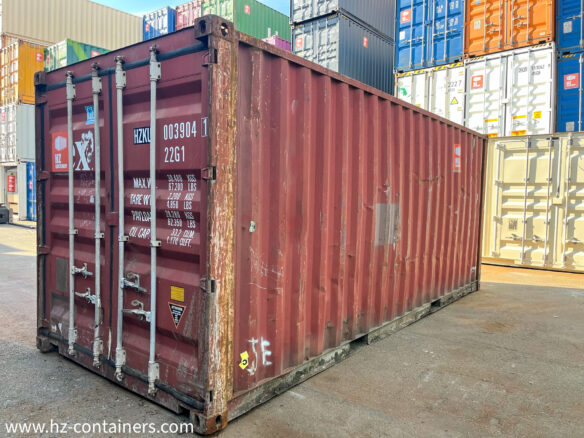

Other container news...
Corner casting steel vs aluminum
Every shipping container in the world — all 40 million of them — rests on eight critical components. Corner castings are the load-bearing blocks at each corner of an ISO shipping container, and they are the universal interface between the container and every crane, twistlock, spreader, and chassis on the planet. When you lift a container, stack it nine high on a ship, or lock it to a truck trailer, every ton of force flows through these fittings.

Construction cabin – selection, tips, dimensions and prices
Every construction project – whether a family house, a development project or a reconstruction – starts with the infrastructure. No construction manager, craftsman or investor who needs an on-site office, a changing room for workers or a safe storage for tools can do without a quality construction cell. But navigating the offer is not easy: residential containers, sanitary cells, storage modules, rental, purchase, refurbished pieces… This guide will give you answers to all the essential questions in one place.
Storage container
A storage container is a lockable steel box designed for the safe and dry storage of materials, tools, goods or equipment. Originally created as a shipping container for maritime transport, its durability and versatility have found their way onto construction sites, corporate premises and private land.
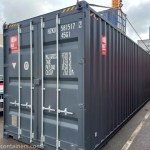
Shipping container 12m (40 ft)
A 12m shipping container is an investment that, if properly selected and cared for, will pay off in decades of trouble-free use. Whether you plan to use it as a warehouse, workshop, garage or the basis for a residential module — the key is careful selection of the condition, a thorough inspection before purchase and high-quality preparation of the base for placement. Take the time to compare offers, check the seller’s references and do not hesitate to personally inspect the container before buying. A properly selected 40-foot container will serve you reliably for many years.