
What does ONE TRIP shipping container mean?
Welcome to our detailed article, where you will find the most comprehensive explanation of the term ONE TRIP shipping container – technical specifications, standards, life cycle, advantages, disadvantages, and practical buying advice. The article is compiled from current information from the best global sources and is intended for both laypeople and professionals in construction, logistics, and development projects.
Primary definition: What is a ONE TRIP container?
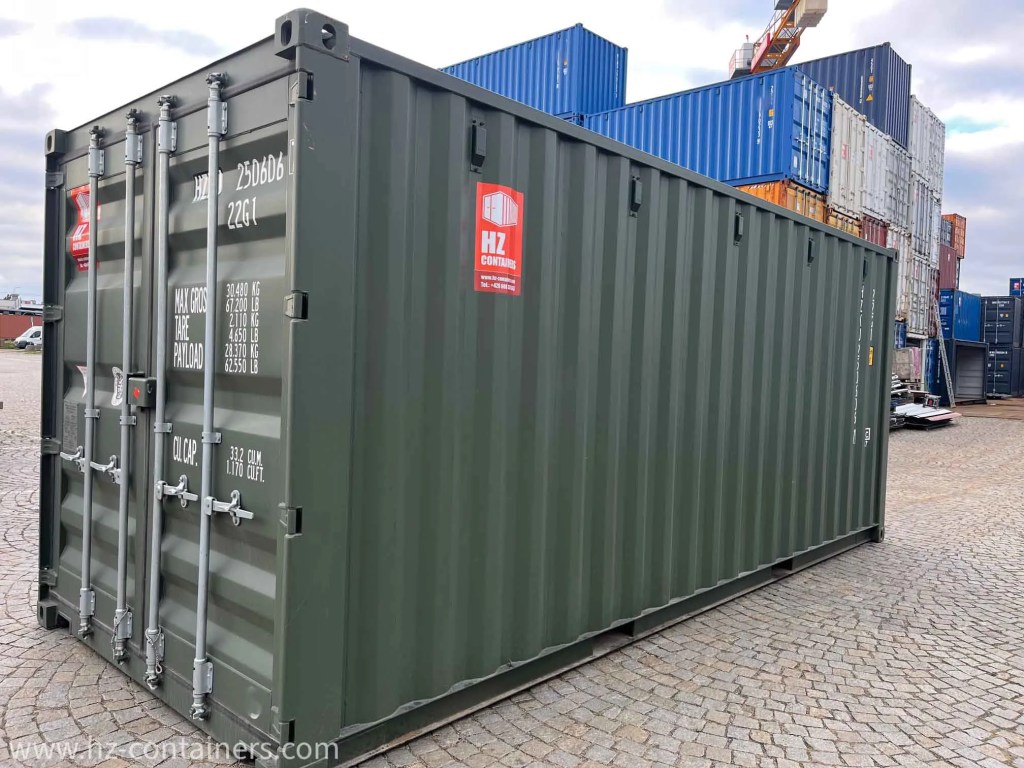
ONE TRIP (also: single trip, almost new) is a shipping container that was manufactured in a specialized factory (most often in China) and, after quality inspection, was loaded with goods and then shipped on a single voyage across the ocean (for example to Europe or North America). After unloading, it was not re‑entered into the international transport system but was offered for sale as an “almost new” container.
Production of ONE TRIP containers
- Material: Exclusively CORTEN A steel (low‑carbon alloy with high corrosion resistance, specially developed for maritime transport).
- Manufacturing standards: All containers comply with strict international ISO standards (ISO 668, ISO 1496‑1) to ensure compatibility, stackability and handling safety.
- Floor: Always marine plywood, thickness for a 20 ft container about 28 mm (1.1 in). The plywood is treated against mold and pests, with no chemical residues.
- Equipment: Welded tie‑down points on the top and bottom rails for secure fastening during transport or on‑site fixing.
- Ventilation: Standard 8–10 ventilation openings that prevent condensation and mold.
Life cycle and inspection of a ONE TRIP container
ONE TRIP containers are, after manufacture and before loading, subjected to a detailed inspection:
- First voyage: After loading, the container is shipped by sea to the destination. During this journey it is exposed only to mild operational influences – handling at the port, stacking and transport.
- Inspection after import: Before being put up for sale each container is inspected again. Checks include: tightness, door functionality, seal condition, floor, absence of holes and extensive corrosion.
- Certification: All ONE TRIP containers offered for sale carry a valid CSC plate (Container Safety Convention), which allows their use for international transport for at least another 6 months (often longer). This is also crucial for export or combined use.
Main technical features of ONE TRIP containers
| Parameter | ONE TRIP container | Detailed description |
|---|---|---|
| Material | CORTEN A (COR‑TEN) steel | High corrosion resistance, long service life |
| Length | 20′ (6.06 m), 40′ (12.19 m), 10′ (3.05 m) | Most common sizes, also 45′, 53′ |
| Width | 8′ (2.44 m) | Standard for all ISO containers |
| Height | 8’6″ (2.59 m), High Cube: 9’6″ (2.89 m) | High Cube offers 30 cm more interior space |
| Floor | Marine plywood, approx. 28 mm thick | Undamaged, chemical‑free, clean |
| Doors | Double, opening angle 270° | Can be equipped with container lockbox for higher security |
| Locking | Lockbox (steel lock cover) | Protects against cutting and drilling |
| Ventilation | 8–10 ventilation openings | Prevents condensation and mold |
| Color | Original factory paint | Minimal chips, no significant corrosion |
| Condition | Excellent/As New | No structural repairs, no alterations |
| Certification | CSC, ISO | Allows sea transport, high safety |
| Warranty | 25 years on material (with some suppliers) | Long‑term trouble‑free use |
Key differences: ONE TRIP vs. used containers (WWT, CW)
| Feature | ONE TRIP | Used (WWT – Wind & Water Tight) | Used (CW – Cargo Worthy) |
|---|---|---|---|
| Age | 1 voyage, younger than 1 year | 10–18 years | 8–15 years |
| Visual condition | Almost new, minimal scratches | Chips, minor rust, dents | Dents, patches, larger rust |
| Structural integrity | 100 % | May have minor repairs | Repaired, still suitable for transport |
| Floor | Like new, clean | Signs of use, possible stains | May be partially repaired |
| Door seals | New, flexible | Used, may be stiff | Functional, but poorer handling |
| Export possibility | Yes, valid CSC | Usually no, requires CSC renewal | Yes, valid CSC |
| Lockbox | Standard | Often missing | Not standard |
| Residual value | Highest | Lower | Medium |
| Price | Highest | Lowest | Medium |
Detailed technical specifications of a ONE TRIP container (example 20 ft)
| Parameter | Value |
|---|---|
| External dimensions (L × W × H) | 6058 × 2438 × 2591 mm |
| Internal dimensions (L × W × H) | 5898 × 2352 × 2393 mm |
| Internal volume | 33.2 m³ |
| Empty weight | approx. 2 200 kg |
| Maximum payload | 28 200 kg |
| Door opening (W × H) | 2 340 × 2 280 mm |
| Structure material | CORTEN A |
| Wall thickness | 2–2.5 mm |
| Floor | 28 mm marine ply |
| Number of ventilation openings | 10 |
| Certification | CSC, ISO |
Safety and construction features
- Container Lockbox: Massive steel cover on the doors prevents drilling or cutting of the lock.
- Tie‑down points: On the top and bottom edges for easy securing during transport or when anchored on a site.
- Ventilation: All containers have 8–10 vent ports to prevent condensation and mold.
- Coating: Industrial two‑component paint applied in a climate‑controlled hall, high UV stability, resistant to seawater salt.
- Floor: High‑load, moisture‑ and pest‑resistant, bonded with natural resins, formaldehyde‑free.
Possible uses of ONE TRIP containers
ONE TRIP containers are ideal for any application that requires maximum service life, aesthetics, and security:
Premium storage solutions
- Corporate storage of documents, goods, seasonal equipment
- Storage of furniture, household items, machinery and equipment
- Temporary warehouses on construction sites
Construction and commercial projects
- Offices, meeting rooms, sanitary modules
- Pop‑up shops, cafés, bistros, mobile sales units
- Creative studios and workshops
Residential projects and conversions
- Modern cabins, recreational units, tiny houses
- Family homes, modular construction, garages, garden sheds
- Student dormitories, employee housing
Special applications and agriculture
- Secure storage of agro‑chemicals, harvests, tools
- Hydroponic farms, laboratories, technical rooms
- Mobile storage for festivals, military and emergency use
Standards and certifications
ONE TRIP containers always meet these standards and requirements:
- ISO 668: Basic dimensional standard for containers
- ISO 1496‑1: Basic construction and safety standards
- CSC (Container Safety Convention): Mandatory for sea transport, ensures structural integrity
- UIC 592‑2: European rail standard for container transport by rail
CSC plate
Each ONE TRIP container carries a valid CSC plate (usually for at least 6 months), which permits its legal inclusion in international transport. For further export use, CSC validity can be renewed by inspection.
Advantages and disadvantages of ONE TRIP containers
Advantages
- Maximum service life (25+ years)
- No need for initial repairs or maintenance
- Clean aesthetic, suitable for representative purposes
- Highest residual market value
- Easy conversion to residential/commercial spaces
Disadvantages
- Higher purchase price (30–50 % more than older used containers)
- Higher logistical costs when transporting from depots (usually only in large logistics centers)
- Limited availability in some dimensions (most common are 20 ft and 40 ft)
Practical buying advice for ONE TRIP containers
- Buy only from verified sellers (check company registration, reviews, ask for a physical inspection).
- Always request photographic documentation of the actual unit, not stock images.
- Verify the CSC plate status and possibility of extension for export or combined use.
- Beware of scams – never send payment in advance without contracts and proof of the container’s existence.
- Consider transport: ONE TRIP containers are often stocked only at major ports or depots, and transport may be more expensive than for a regular used unit.
Market and trends: Recycling and sustainability
- Recycling: ONE TRIP containers are increasingly used in eco‑construction – their long service life and robustness mean lower demand for new material production.
- Secondary use: After logistics service ends, they find new life as storage, residential, or technical modules, reducing environmental footprint.
- Building standards: In some countries containers are already recognized in building codes as modular construction elements.
Common mistakes when buying a ONE TRIP container
- Mistaking a refurbished older container with a new paint job for a ONE TRIP – always request origin and history.
- Overlooking details – minor door damage, seals, floor condition (even a ONE TRIP can suffer from careless handling).
- Not preparing for transport – ensure adequate space and equipment for lifting and handling (crane, forklift).
Related terms and container types
| Container type | Description |
|---|---|
| WWT | Wind & Water Tight, standard used containers |
| CW | Cargo Worthy, suitable for international transport but older than ONE TRIP |
| High Cube | Taller version (9’6″), larger interior volume |
| Double Door | Doors on both ends, easier access |
| Open Side | Full‑length opening side, ideal for storage and handling |
| Reefer (refrigerated) | Cooled containers for food, medicines, etc. |
| Flat Rack | Open sides, used for oversized cargo |

 Czech Republic, Mladá Boleslav
  FREE SHIPPING


Other container news...

Shipping Container Homes
Shipping container home is a residential unit created from one or more steel intermodal shipping containers that have been structurally modified, insulated, and equipped with technical systems to meet the requirements for safe and comfortable living.

Where is a transport container used?
The trasnport container is a phenomenon that gave rise to global logistics, enabled mass transportation of goods and today fundamentally influences modern architecture, storage, industry and innovation. Its uses are almost unlimited – from transportation to housing to infrastructure or humanitarian aid. Thanks to its technical perfection, modularity and robustness, the container is a universal tool for solving the logistical and construction challenges of the 21st century.

What is the purpose of a STACKING CONE?
The stacking cone is a perfect example of how a small, seemingly trivial part determines the safety and efficiency of the entire container transport system. Technologically, it is a precise component that must meet demanding standards for load, durability and resistance to extreme conditions.

Assembly of Container Tank Using ConFoot Legs
The ConFoot container tank folding system is an innovative and safe way to handle ISO containers without the need for heavy equipment. The system offers high flexibility, cost and personnel savings, safety and demonstrably increases the efficiency of logistics operations in industry, construction, transport and the humanitarian sector.