
Assembly of Container Tank Using ConFoot Legs
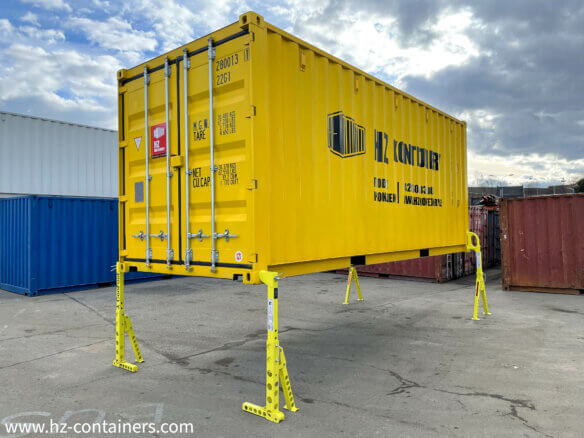
Assembly of container tanks using ConFoot legs represents revolutionary technology in the field of ground handling of ISO containers, particularly with tank containers (cisterns). This method enables safe, quick and efficient disconnection of containers from transport trailers (semi-trailers) without the need for expensive handling equipment (cranes, forklifts, etc.).

Principle:
- The container is lifted to the upper position using the air suspension of the semi-trailer.
- Four support legs ConFoot are inserted into the corner castings.
- After securing the legs, the container is safely lowered onto the legs and the semi-trailer can depart.
- The container remains stably in place – ready for unloading, loading or temporary storage.
Significance:
This procedure dramatically increases flexibility, reduces operating costs and dependence on the availability of heavy equipment, increases safety and efficiency of logistics operations. The solution is designed for operation by a single person – usually the driver himself.
ConFoot Legs: Design, Models, Technical Parameters
ConFoot legs are a patented Finnish invention that fundamentally changes the possibilities of handling containers in the field and in warehouses. Development took place in the 21st century with the aim of eliminating inefficiency when waiting for unloading and reducing dependence on heavy equipment.
Material and Construction
- High-strength steel (special Finnish alloy, up to 6 types of steel).
- Surface treatment for maximum service life and weather resistance.
- Each leg is individually tested for static and dynamic loads.
Certification and Safety
- CE certification according to Directive 2006/42/ES.
- Testing according to standards SFS-EN 1993-1-1 (steel structures), SFS-EN 1993-1-8 (fasteners), SFS-EN 1494 (lifting equipment).
- Load capacity: up to 34 tons per set (standard model).
- Integrated safety mechanisms (magnetic clamps, locking).
Model Range
| Model | Load Capacity (t) | Weight (kg/leg) | Height (mm) | Unique Feature | Common Use |
|---|---|---|---|---|---|
| ConFoot CF | 34 | 24 | 1043–1448 | Standard, 180° doors | All ISO containers |
| ConFoot CFP | 30 | 24 | 1043–1448 | L-shape, 270° doors | Positioning at ramp |
| ConFoot CFU 20 | 20 | 46 (multiple parts) | 0–1500 | Hydraulically adjustable | Lifting/lowering on ground |
| ConFoot CFU 30 | 30 | 46 (multiple parts) | 0–1500 | Hydraulically adjustable | Heavier containers |
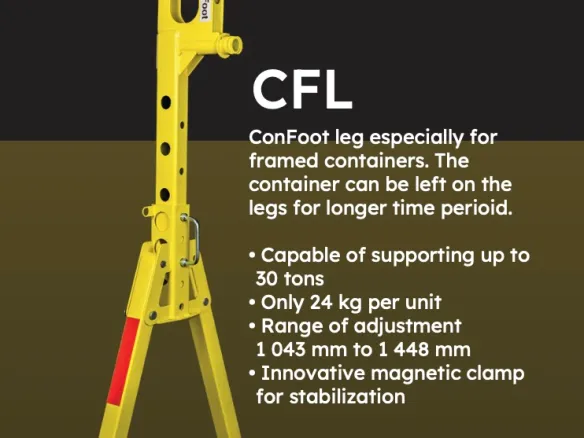
| ConFoot CFL | 34 | 24 | 1043–1448 | For frame containers | Frame and special containers |
Source: ConFoot.cz – technical sheets and specifications, HZ-containers – offer and applications
Key Features
- Portability: the leg can be carried by one person (depending on model).
- Quick installation: container unloading in up to 10 minutes.
- High compatibility: for all ISO containers 20′, 40′, 45′, tank containers, storage and special containers.
- Durability: suitable for intensive industrial use and use in extreme conditions.
Container Tank (ISO Tank Container): Design, Types, Certification
Tank container (ISO tank) is a special intermodal transport unit designed for liquids, gases and bulk materials. It is characterized by a cylindrical stainless steel pressure vessel protected by a robust steel frame of standardized size.
Basic Construction
- Frame: CORTEN steel according to ISO 668 (20′ x 8′ x 8’6″ typically).
- Pressure vessel: Stainless steel (AISI 316L) – resistance to aggressive chemicals.
- Insulation: Mineral wool/PU foam (for food, temperature-sensitive chemicals).
- Heating elements: Steam/glycol hoses for product heating.
- Safety valves: Protection against overpressure.
Capacities and Technical Parameters
| Volume (l) | Gross Weight (kg) | Tare (kg) | Useful Load (kg) | Max. Temperature (°C) | Test Pressure (bar) | Working Pressure (bar) |
|---|---|---|---|---|---|---|
| 21,000 | 36,000 | 3,650 | 32,350 | 120 | 6.00 | 4.00 |
| 24,000 | 36,000 | 3,900 | 32,100 | 120 | 6.00 | 4.00 |
| 25,000 | 36,000 | 3,730 | 32,270 | 120 | 6.00 | 4.00 |
| 26,000 | 36,000 | 4,060 | 31,940 | 120 | 6.00 | 4.00 |
Types and Their Use
| Type | Purpose |
|---|---|
| T1 | Wine, light liquids |
| T4 | Edible and technical oils |
| T11 | Non-aggressive chemicals |
| T14 | Hazardous chemicals, acids |
| T50 | Gases (LPG, ammonia) |
| T75 | Cryogenic gases |
| Rubber-lined | Acid-resistant, rubber-coated |
| Food-grade | Food products |
| Reefer tank | Refrigerated food, chemicals |
| Gas tank | Special gases |
| Silo | Powders, grain |
Certification and Standards
- ISO 1496/3, ISO 668: Dimensional, design and safety standards.
- CSC (Container Safety Convention): Mandatory for international transport.
- IMDG, RID, ADR: Transport of dangerous goods (chemicals, gases).
- Periodic pressure and tightness tests (in the Czech Republic, e.g., Československý Lloyd).
- Bureau Veritas, DNV-GL: International inspection authorities.
More in the article: What certifications does a shipping container have? (HZ-containers)
Principle of Operation and Detailed Assembly Procedure

Step-by-Step Procedure
- Arrival and Preparation:
- The tractor with semi-trailer and tank container stops on a level, compacted surface.
- The air suspension of the semi-trailer is raised to maximum.
- Release of Securing:
- Removal of securing pins (twistlocks) on the chassis.
- Installation of Legs:
- Each leg is inserted into the corresponding corner hole (corner casting) of the container.
- Legs are locked with an integrated pin or magnetic coupling.
- Lowering of Chassis:
- Slowly release air from the semi-trailer suspension – the chassis descends, the container remains on the legs.
- Departure of Tractor:
- Once the chassis is low enough, the driver departs.
- The container safely stands on ConFoot legs.
Reverse Process – Loading Container onto Chassis
- The chassis backs under the container, lowered to minimum.
- The suspension is raised, the container is lifted from the legs.
- Legs are dismantled, the container is secured on the chassis.
Important Warnings:
- The surface must be firm and level.
- The chassis must not contact the legs when approaching.
- Observe load capacities and manufacturer recommendations.
Advantages of the ConFoot System for Logistics and Storage
Main Benefits
- Time Savings: The driver does not have to wait for unloading, the vehicle is immediately available for further transport.
- Cost Reduction: No need to purchase or rent cranes, reachstackers or forklifts.
- Flexibility: Container assembly practically anywhere – construction site, field, festival, industrial area.
- Simple Operation: Only one worker needed, work typically takes up to 10 minutes.
- Safety: Static support, minimal risk of injury compared to crane handling.
- Fleet Optimization: Increased vehicle turnover, reduced unproductive downtime.
Comparison of Traditional and Innovative Methods
| Parameter | Traditional (Crane) | ConFoot Legs |
|---|---|---|
| Costs | High | Low-cost |
| Staff Required | Multiple persons | 1 person |
| Mobility | Limited (infrastructure) | High (anywhere) |
| Safety | Risk of falling | Static stability |
| Time | Dependent on availability | Immediately, anytime |
Key Components and Technical Terminology
- Corner elements (corner castings): Reinforced steel castings at each corner of the container, designed for handling, lifting, securing and installation of support legs.
- Air suspension: System on the semi-trailer chassis, allows height adjustment and serves as the main mechanism for assembly/lifting of containers with CF/CFP legs.
- Twistlock: Securing pin for fastening the container to the chassis.
- Pressure tests: Periodic inspections of tank containers that verify tightness and vessel strength.
- CSC certification: Mandatory label for legal operation in international transport.
Use in Various Industries (Practical Examples)
- Logistics and Transport: Efficient use of tractors, quick container handover to customer, elimination of waiting times.
- Construction: Temporary mobile storage of materials, tools, chemicals directly on the construction site.
- Agriculture: Storage of crops, feed, chemicals for spraying.
- Ports and Terminals: Acceleration of container turnover, reduction of handling equipment overload.
- Humanitarian Missions and Military: Rapid deployment of logistics bases, medical tents, storage spaces in the field.
- Events, Festivals: Temporary facilities, technical storage, secure equipment storage.
Frequently Asked Questions and Practical Tips
What must be the load capacity of the substrate?
The substrate under the legs must withstand the total load of a fully loaded container (up to 8.5 t per leg). Concrete, asphalt or compacted gravel is recommended.
Is it possible to use the system on sloped terrain?
Recommended only on level ground. Height-adjustable models (CFU) allow some compensation for unevenness.
How is protection against corrosion ensured?
Legs are hot-dip galvanized or have a special anti-corrosion coating.
How often is inspection/maintenance required?
Recommended inspection before each use, regular service according to manufacturer’s instructions.
 Czech Republic
 WITHOUT SHIPPING

Other container news...

Contamination of the inner walls of a shipping container: Why this is a normal operating condition and not a reason for a complaint
Dark streaks, scuffs, and marks on the interior walls of a shipping container are a completely normal occurrence during use. They arise naturally during the loading and unloading of goods via handling equipment and have no impact on the container’s watertightness or structural integrity. Find out why these aesthetic marks are not grounds for a complaint and how they can be easily touched up if necessary.

Obligation to Check Tightness When Selling a Reefer Container
Who is responsible for the refrigerant leak check when selling a refrigerated container? Find out what obligations the seller has at the time of handover and why they must provide a PTI report along with the technical data plate. Learn which regulatory requirements and F-gas record-keeping duties become the sole responsibility of the new owner.

New shipping containers
If you are currently considering purchasing a new shipping container, you are not alone. While just twenty years ago containers were used almost exclusively for maritime transport, today they have found their way into construction, storage, business, and even housing. This growing popularity brings with it a host of questions: Which type should you choose? How much does it cost? How do you recognize quality? How can you avoid falling victim to scammers?
New sea shipping containers
If you are currently considering purchasing a new shipping container, you are not alone. While just twenty years ago containers were used almost exclusively for maritime transport, today they have found their way into construction, storage, business, and even housing. This growing popularity brings with it a host of questions: Which type should you choose? How much does it cost? How do you recognize quality? How can you avoid falling victim to scammers?