
What is the purpose of a STACKING CONE?
In the world of modern maritime and intermodal transport, where each vessel carries thousands of containers in a massive “Tetris”, cargo stability and safety are absolutely essential. This is where the stacking cone – a small but indispensable component – ensures that individual containers remain securely in place during transport. Without this “invisible hero”, container shipping would not be possible at today’s scale or with the required safety.
What is a Stacking Cone? Definition and principle
A stacking cone is a robust, usually metal element that is placed between two tiers of stacked ISO containers. Its main role is to prevent horizontal movement of containers relative to each other, thereby eliminating the risk of sliding or shifting caused by rolling, wind, or vibrations during transport.
Construction and dimensions
- Material: High‑strength steel (e.g., S355), often cast or forged.
- Surface treatment: Hot‑dip galvanization for maximum corrosion resistance in harsh marine environments.
- Weight: Typically 2–5 kg (depending on type).
- Shape: Two cones joined at the base, matching the standardized openings in the container corner castings.
- Dimensions: Standard length ≈ 178 mm, base diameter ≈ 100 mm (varies by type and manufacturer).
- Colour/finish: Typically grey metal (zinc), sometimes painted for type identification.
Technical specifications
| Type | Minimum shear strength | Compression strength | Surface treatment | Weight |
|---|---|---|---|---|
| Single stacking cone | 420 kN | 1200 kN | Hot‑dip galvanized | 3–3.2 kg |
| Double stacking cone | 500 kN | 1200 kN | Hot‑dip galvanized | 6.6–9.2 kg |
| Hanging stacking cone | 420 kN | 1200 kN | Hot‑dip galvanized | 2.8–4.2 kg |
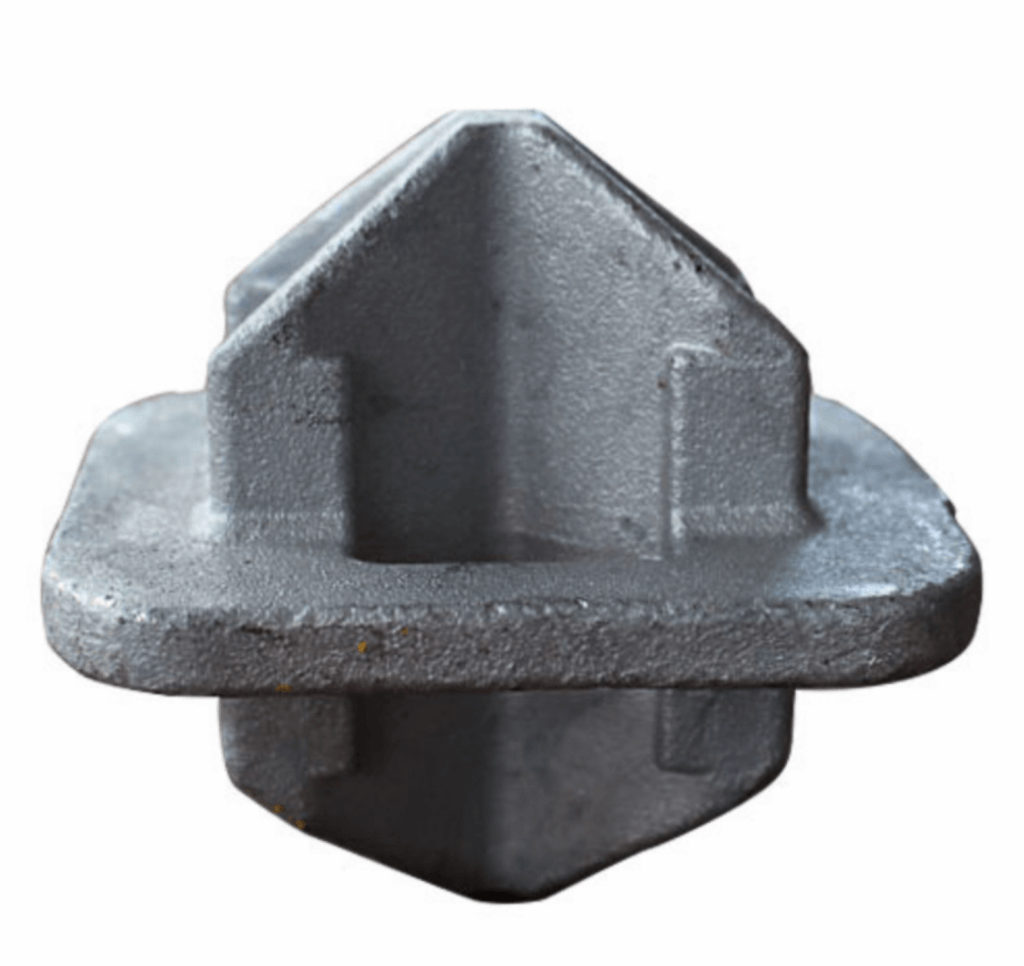
Function and significance of the Stacking Cone in practice
How does a stacking cone work?
- Placement: The cone is inserted into the lower corner casting of an already positioned container.
- Guidance: The upper conical part acts as a guide for the next container, facilitating precise and safe placement even with slight crane misalignment.
- Securing: Once the upper container is set, the stacking cones are clamped between the two containers, preventing horizontal shift.
- Limitation: A standard stacking cone does not lock containers together – it only prevents side movement. Twist locks are used to prevent lifting.
Typical applications
- On board container ships – the primary application, where containers are stacked up to 10–12 tiers.
- In the hold – in cargo spaces where containers sit in “cell guides” and stacking cones ensure exact alignment.
- In ports and depots – for temporary storage, preventing stack movement due to wind or equipment impact.
Types of Stacking Cones and their uses
| Type | Description | Use | Advantages | Disadvantages |
|---|---|---|---|---|
| Single stacking cone | Basic type, double cone without additional mechanisms | Common stacking on land and in the hold | Simplicity, low cost | Manual collection after container lift |
| Hanging stacking cone | Special shape that hangs in the upper container and remains during lifting | Efficient handling on ships, rapid stacking | Time saving, safety | Higher price |
| Double stacking cone | Connects two containers side‑by‑side (horizontally) | Block stacking, increased stability | Greater overall stability | Higher weight |
| Bottom stacking cone | Wider base for the bottom layer of a stack | Foundation of a stack on deck or in a depot | Better weight distribution | Limited applications |
| Cone lockable | Hybrid, partially locks containers together | Higher security requirements | Greater securing level | More complex handling |
Certification and approval of stacking cones
To be used in international maritime transport, a stacking cone must meet strict standards and be approved by major classification societies:
- ABS (American Bureau of Shipping)
- DNV‑GL (Det Norske Veritas – Germanischer Lloyd)
- CCS (China Classification Society)
- Lloyd’s Register, Bureau Veritas and others
Certification ensures that stacking cones have passed tests for:
- Tensile, shear and compressive strength
- Corrosion resistance (surface‑treatment testing)
- Long‑term durability and safety under repeated use
Standards, regulations and safety aspects
International regulations
The use of stacking cones is embedded in several key international documents:
- SOLAS (International Convention for the Safety of Life at Sea)
- CSS Code (Code of Safe Practice for Cargo Stowage and Securing)
- ISO container standards (ISO 1161, ISO 1496‑1) – define dimensions and tolerances of corner castings
Why are stacking cones mandatory?
- They ensure stack stability even under extreme conditions (storms, high waves, vibrations).
- They prevent a “domino effect” – collapse of entire container stacks.
- They protect the environment from cargo loss.
- They enable efficient and rapid handling in ports and at sea.
Comparison: stacking cone vs. twist lock
| Parameter | Stacking cone | Twist lock |
|---|---|---|
| Principle | Passive alignment, prevents shift | Active locking, prevents shift and lift |
| Placement | Between each container layer | Key connection between stacks and ship deck |
| Installation | Manual, no tools required | Turn and secure with mechanism |
| Removal | Automatic when container is lifted | Manual disengagement |
| Use | All layers, including top | Critical in the first and last layer (to deck and top of stack) |
Statics, loads and safety limits
Stacking cones must resist the following forces:
- Shear forces: generated by vessel motion, wind gusts, vibrations.
- Compression force: weight of all containers above (can reach several hundred tonnes).
- Dynamic loading: short‑term impact forces during sailing.
Calculations and limits
- Standard stacking cone shear strength ≥ 420 kN, double cones up to 500 kN.
- Maximum compression load can reach 1200 kN.
- Safety factors are incorporated according to classification society requirements and manufacturer specifications.
Maintenance, inspection and replacement of stacking cones
Service life and upkeep
- Regular visual inspection before each use: look for cracks, deformations, corrosion.
- Immediate replacement of damaged or corroded parts – using a defective cone is prohibited and dangerous.
- Record‑keeping and certification – inventories must include test certificates and approvals.
- Dry storage – despite galvanization, store cones away from direct water and aggressive environments when not in use.
Where and how to purchase a stacking cone?
Specialized suppliers such as HZ‑Containers stock stacking cones in various types with certification.
A typical single stacking cone costs 30–40 EUR per piece (2024).
FAQ – Frequently asked questions about stacking cones
Why can’t I use a stacking cone instead of a twist lock?
A stacking cone only aligns containers and prevents horizontal movement; it does not lock them together. A twist lock is required to securely attach stacks to the ship structure and prevent lifting.
Are stacking cones mandatory for all ships and ports?
Yes, their use is required by international regulations such as SOLAS and the CSS Code. Without them, containers cannot be safely stacked.
How long does a stacking cone last?
With proper maintenance and storage, they last many years. The most common reasons for replacement are loss (falling overboard) or mechanical damage.
Can stacking cones be reused?
Yes, they are designed for repeated use as long as they are not damaged or heavily corroded.
How do I recognise a high‑quality stacking cone?
A quality cone is made from high‑strength steel, carries certification (e.g., ABS, DNV‑GL), is hot‑dip galvanized, and conforms to ISO corner‑casting dimensions.
 Czech Republic
  WITHOUT SHIPPING

Other container news...

Obligation to Check Tightness When Selling a Reefer Container
Who is responsible for the refrigerant leak check when selling a refrigerated container? Find out what obligations the seller has at the time of handover and why they must provide a PTI report along with the technical data plate. Learn which regulatory requirements and F-gas record-keeping duties become the sole responsibility of the new owner.

New shipping containers
If you are currently considering purchasing a new shipping container, you are not alone. While just twenty years ago containers were used almost exclusively for maritime transport, today they have found their way into construction, storage, business, and even housing. This growing popularity brings with it a host of questions: Which type should you choose? How much does it cost? How do you recognize quality? How can you avoid falling victim to scammers?
New sea shipping containers
If you are currently considering purchasing a new shipping container, you are not alone. While just twenty years ago containers were used almost exclusively for maritime transport, today they have found their way into construction, storage, business, and even housing. This growing popularity brings with it a host of questions: Which type should you choose? How much does it cost? How do you recognize quality? How can you avoid falling victim to scammers?

6m shipping container
Are you thinking about buying a 6-meter shipping container but aren’t sure what to look for? You are not alone—this 20-foot container is the best-selling size on the Czech market, and the differences between various types, conditions, and prices can be significant. In this guide, you will find everything you need to know: from exact dimensions and a comparison of categories (such as “one-way,” refurbished, and “Cargo Worthy”) to current prices and shipping advice.