
Used 40 foot High Cube container
A used 40 foot high cube container is one of the most versatile and cost-efficient storage and shipping assets you can buy. It is a standard-length 40-foot intermodal container with one crucial difference from its “standard” sibling: it stands one extra foot tall, at a nominal 9 feet 6 inches instead of 8 feet 6 inches. That single additional foot of vertical clearance changes how the unit is priced, how it loads, and what it can do. This guide covers everything you need to know about dimensions, weight ratings, pricing, condition grades, and the buying process, so you can make a confident decision whether you are storing tools, expanding a warehouse, shipping cargo overseas, or planning a container-built structure.
What Is a 40 Foot High Cube Container?
A 40 foot high cube container is a rectangular steel shipping container measuring 40 feet long, 8 feet wide, and 9 feet 6 inches high on the outside. In metric terms, that is approximately 12.19 meters long, 2.44 meters wide, and 2.90 meters tall. It is the taller variant of the industry-standard 40-foot dry container, and it is often abbreviated as “40ft HC” or written with the apostrophe-height notation “40′ HC.”
The defining trait is the extra foot of exterior height. That additional clearance does not add any floor space — the length and width are identical to a standard 40-foot unit — but it increases the total internal volume and, more importantly, lets you store or transport taller items that would not fit through the doors of a standard container.
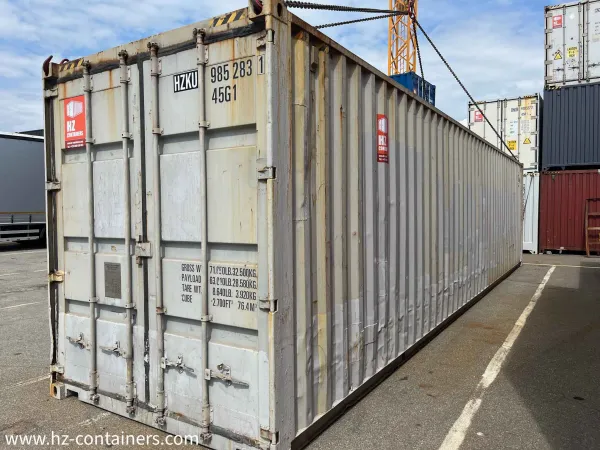
The High Cube Difference Explained
To understand what makes these units distinct, compare the two most common 40-foot configurations side by side:
- A standard 40-foot container has a nominal external height of 8 feet 6 inches (about 2.59 meters).
- A 40-foot high cube container has a nominal external height of 9 feet 6 inches (about 2.90 meters).
That one foot of added height translates into roughly 8 to 9 additional cubic meters of internal volume — about 13 percent more depending on the specific manufacturer’s build. The extra height comes almost entirely from the vertical dimension. The floor footprint stays at roughly 39 feet 5 inches long by 7 feet 8 inches wide on the inside, whether you buy standard or high cube.
Key definition: A high cube container is any ISO intermodal container whose exterior height exceeds the standard 8 feet 6 inches, most commonly by exactly one foot to 9 feet 6 inches. The “high cube” name comes from the taller, more box-like profile visible when you look at the container from the end doors.
A Brief History of the High Cube Design
The high cube concept emerged directly from the economics of cargo shipping. The modern intermodal shipping container was standardized in the late 1950s and 1960s through the work of Malcom McLean and the adoption of ISO dimensional standards. The original standard container was set at 8 feet 6 inches tall to match the existing trucking and rail clearance limits of the era.
As international trade volume grew, shippers faced a persistent problem: light, bulky cargo — furniture, appliances, insulation, and packaged consumer goods — would “cube out” (fill the available volume) before it “weighed out” (reached the weight limit). The container was full of air but could not legally carry any more weight. Carriers introduced the high cube in the 1970s and 1980s to capture that wasted overhead space. By raising the roof one foot, they added roughly 10 to 13 percent more cargo volume without changing the floor plan or, crucially, the weight rating very much.
ISO later codified the 9-foot-6-inch height (designated height code for 2.90-meter units) as a recognized standard, and high cube containers now move on ships, rail cars, and chassis worldwide. Because ocean freight is priced largely by container slot rather than strictly by weight, the high cube quickly became the preferred choice for volume-driven cargo.
Why “Used” Matters
Almost all high cube containers sold to individuals and small businesses are used units that have already spent years in ocean service. A typical used shipping container has been in circulation for roughly 10 to 20 years, having completed dozens of ocean voyages as part of the global fleet. When a container ages out of international cargo service — due to cosmetic wear, minor structural fatigue, or simply because shipping lines refresh their fleets — it is sold into the secondary market.
This second life is why used 40 foot high cube containers are so affordable relative to new ones and so popular for storage, workshops, and building projects. The steel box that once carried consumer electronics from Shanghai to Los Angeles can serve another 15 to 25 years as a weather-resistant storage unit on a farm, a jobsite, or a backyard.
What Are the Exact Dimensions of a 40ft High Cube Container?
The most important thing to understand about container dimensions is the difference between exterior (nominal) dimensions and interior (usable) dimensions. The exterior figures describe the footprint of the box itself — what you need to know for delivery, placement, and stacking. The interior figures describe the space your cargo can actually occupy. These are always smaller than the exterior figures because of the thickness of the walls, floor, and ceiling.
Exact measurements vary slightly between manufacturers, so the table below uses representative figures from major carrier specifications (such as Hapag-Lloyd’s published equipment data). Always confirm the exact measurements of the specific unit you are buying, especially if your cargo is close to a limit.
Exterior vs Interior Dimensions
| Measurement | Metric | Imperial |
|---|---|---|
| External length | 12.19 m | 40 ft 0 in |
| External width | 2.44 m | 8 ft 0 in |
| External height | 2.90 m | 9 ft 6 in |
| Internal length | 12.03 m | 39 ft 5⅝ in |
| Internal width | 2.35 m | 7 ft 8½ in |
| Internal height | 2.70 m | 8 ft 10¼ in |
| Door opening width | 2.34 m | 7 ft 8⅛ in |
| Door opening height | 2.60 m | 8 ft 6¼ in |
| Internal cubic capacity | 76.3 m³ | 2,694 ft³ |
Notice the gap between the external height (9 feet 6 inches) and the internal height (8 feet 10¼ inches). The difference comes from the corrugated steel roof, the steel floor with its supporting cross members, and the structural steel framing that gives the container its strength.
Door Opening and Why Clearance Matters
The door opening height is the figure that most often surprises buyers — and the one that most commonly causes loading problems. Although the interior ceiling of a high cube is roughly 8 feet 10 inches high, the cargo doors only open to about 8 feet 6 inches of vertical clearance. The door header (the steel beam across the top of the opening) reduces the usable clearance.
This matters for a simple reason: anything you want to put inside must first pass through the door opening. An item that is 8 feet 9 inches tall might technically fit once inside, but it could never get through the 8-foot-6-inch door. This is a classic pitfall with tall equipment, racking, or assembled structures.
The rule for buyers is simple: measure the door opening first, not the internal ceiling. If your tallest item — including any pallet or skid it sits on — is close to 8 feet 6 inches, verify the exact door height of the specific unit before committing. Door heights also vary slightly by manufacturer.
How Much Does a Used 40 Foot High Cube Container Cost?
Pricing for a used 40 foot high cube container in the U.S. market is remarkably consistent once you understand the variables that drive it. As a general rule, expect to pay roughly $1,450 to $2,175 for a used high cube, depending on condition grade, location, and current market conditions. Compared to a used standard 40-foot container, you will typically pay about 10 to 20 percent more for the high cube version because of the added steel and the extra interior volume.
Pricing by Condition Grade
Used containers are not sold as a single uniform product. Sellers categorize them by condition, and that grade is the single biggest determinant of price. The two grades you will see most often are cargo worthy (CW) and wind and watertight (WWT), described in detail later in this guide. In short:
- Cargo worthy units are inspected and certified for continued international shipping, so they command a premium.
- Wind and watertight units have no holes or leaks and are structurally sound for storage, but they are not certified for ocean export, so they cost less.
Regional and Market Price Drivers
Beyond condition, four factors move the price of a used 40 foot high cube container:
- Location. Containers at or near ports and major logistics hubs (Los Angeles, Chicago, Houston, Charleston, and the New York–New Jersey corridor) tend to be cheaper because transportation costs are low. The further a unit sits from a depor or port, the more delivery adds to the total, pulling effective prices toward $3,000 or more in remote areas with limited supply.
- Market conditions. Container prices rise and fall with global trade volumes and shipping demand. Periods of heavy import activity leave a surplus of used units in port cities and soften prices; periods of tight supply push them up.
- Availability of the high cube specifically. High cube units are in strong demand for storage and conversion, and they are somewhat less common in the secondary market than standard 40-foot units, which supports a modest premium.
- Volume and delivery. Buying multiple units often triggers a discount, while single-unit delivery to a rural address adds meaningfully to the landed cost.
| Container Type (40-foot) | Typical Used Price (2026) |
|---|---|
| Standard — Cargo Worthy | $1,575 – $2,000 |
| Standard — Wind & Watertight | $1,350 – $1,850 |
| High Cube — Cargo Worthy | $1,675 – $2,175 |
| High Cube — Wind & Watertight | $1,450 – $2,025 |
| New one-way High Cube (for reference) | $2,825 – $3,225 |
For context, a new “one-way” 40-foot high cube — one that has made only a single loaded trip from its Asian factory to North America — typically runs $2,825 to $3,225. That is 40 to 60 percent more than a comparable used unit, which is why used containers dominate the storage and DIY markets.
How Much Weight Can a 40ft High Cube Container Hold?
Understanding weight ratings requires knowing three distinct terms, because buyers frequently confuse them:
- Tare weight is the weight of the empty container itself — just the steel box with nothing inside.
- Maximum gross weight (MGW) is the total the container may weigh when fully loaded, including its own tare weight.
- Maximum payload is the weight of the cargo you can legally put inside, calculated as maximum gross weight minus tare weight.
For a typical 40-foot high cube, these figures break down as follows:
| Weight Measurement | Metric | Imperial |
|---|---|---|
| Tare weight (empty) | 3,900 kg | 8,598 lb |
| Maximum gross weight (MGW) | 32,500 kg | 71,650 lb |
| Maximum payload | 28,600 kg | 63,052 lb |
The payload of about 63,000 pounds is substantial, but it is worth noting an important nuance: the high cube’s extra height does not increase its weight rating. The added roof height is intended for bulky, relatively light cargo, not for carrying more weight. A high cube and a standard 40-foot container typically carry very similar maximum gross weights, because both are limited by the same road and rail axle-loading regulations and chassis capacities.
In practice this means the high cube shines for jobsite storage of tools and equipment, furniture, insulation, and other low-density goods that fill space faster than they hit the weight limit. If you are hauling dense material like steel ingots or heavy machinery, a standard container will likely reach its weight limit long before either unit runs out of room, and the extra foot of the high cube would simply go unused.
How Much Cargo Fits in a 40 Foot High Cube Container?
A 40 foot high cube container offers about 76.3 cubic meters (2,694 cubic feet) of internal volume. That is roughly 8 to 9 cubic meters — about 13 percent — more than a standard 40-foot unit, which holds about 67.7 cubic meters.
To put that volume in practical terms:
- Pallets. A 40-foot high cube typically holds 20 to 22 standard 48-by-40-inch pallets, or roughly 25 to 27 Euro pallets. The exact count depends on whether pallets are floor-loaded or arranged in a mixed pattern.
- Household contents. The contents of a typical 4 to 6 bedroom single-family home can usually fit in a single 40-foot high cube.
- Vehicles. Depending on their dimensions, you can often fit three to four small cars or two larger vehicles.
- Loose or bulk goods. Up to around 500 to 600 bales of hay, or more than 1,100 car tires, depending on packing density.
There is an important caveat that sellers rarely emphasize: the extra height only helps if your cargo can actually use it. If your goods are non-stackable — meaning you cannot pile boxes or pallets on top of each other — a large share of that overhead space will sit empty. Lightweight, stackable, and tall items are where the high cube truly earns its premium. Before paying extra for a high cube, confirm that your load can be stacked to use the added vertical clearance.
What Is the Difference Between a 40ft High Cube and a Standard 40ft Container?
The differences between a 40-foot high cube and a standard 40-foot container are easy to summarize but important to understand, because the two units are otherwise nearly identical. The table below lays out the comparison using representative manufacturer figures.
| Measurement | 40ft Standard | 40ft High Cube |
|---|---|---|
| External height | 8 ft 6 in (2.59 m) | 9 ft 6 in (2.90 m) |
| Internal height | 7 ft 10 in (2.395 m) | 8 ft 10¼ in (2.70 m) |
| Door opening height | 7 ft 6 in (2.29 m) | 8 ft 6¼ in (2.60 m) |
| Internal cubic capacity | 67.7 m³ | 76.3 m³ |
| Internal length | 12.03 m | 12.03 m |
| Typical price premium | — | +10–20% |
As you can see, the length and width are identical, and even the weight ratings are very close. The high cube’s entire value proposition is vertical clearance. That translates into three concrete advantages:
- Taller doorways. The high cube door opening is about a full foot taller, which means tall equipment, racking, and upright fixtures can actually be loaded through the doors — often the deciding factor for buyers.
- More volume. Roughly 13 percent more internal space for stacking bulky, lightweight goods.
- Better headroom. If you plan to convert the container into a workshop, office, or living space, the extra foot of ceiling height makes a real difference for comfort and for installing insulation, lighting, and climate systems while preserving usable headroom.
When to Choose High Cube vs Standard
Choose a high cube if you are storing or shipping tall items, if you plan a habitable conversion where headroom matters, or if your cargo is bulky and light enough to stack high. Choose a standard 40-foot container if your cargo is dense and heavy (where volume doesn’t matter), if you are floor-loading only, or if you are budget-constrained and don’t need the clearance. In many dense-cargo scenarios, a standard container reaches its weight limit before you ever miss the extra foot of height.
What Do Container Condition Grades Mean?
Condition grading is the most confusing part of buying a used 40 foot high cube container, largely because sellers use terms that sound similar but carry very different meanings and very different prices. Understanding these grades is essential to getting fair value.
Cargo Worthy (CW)
A cargo worthy container has been inspected and certified as suitable for continued international shipping. It is structurally sound, watertight, and generally free of significant rust or damage that would compromise its ability to carry cargo on an ocean voyage. Major steamship lines will accept a certified cargo worthy unit for transit. These units command the highest used-container prices because they retain genuine commercial shipping value.
Wind and Watertight (WWT)
A wind and watertight container has no holes and no leaks — rain will not get in, and wind cannot penetrate — but it is not certified for ocean export. The structure is sound enough for secure, long-term on-site storage, but it may have cosmetic dents, surface rust, or wear that disqualifies it from certification. WWT units are the workhorse of the storage market and typically cost several hundred dollars less than an equivalent cargo worthy unit. For most storage applications, WWT is perfectly adequate.
IICL, As-Is, and One-Way “New”
Three other terms you will encounter:
- IICL stands for the Institute of International Container Lessors, which publishes strict inspection standards. An “IICL” graded unit has been inspected against these detailed benchmarks for structural integrity and appearance. It generally sits near the top of the used-quality scale.
- As-is means the unit is sold with no grading or warranty, typically with visible damage, and may have holes, heavy rust, or structural issues. As-is units are cheapest but risky for anything that must stay dry. Reputable dealers often refuse to sell as-is containers.
- One-way / new units are brand-new containers that have made a single loaded trip from the factory to the region. They are effectively new but sold at a discount to brand-new pricing because they have technically been in service.
How to Inspect Before You Buy
When evaluating a used 40 foot high cube container, always:
- Check the doors. Open and close both sets of cargo doors fully. They should swing freely, latch securely, and seal cleanly against the door gaskets.
- Look for light from inside. Step inside, close the doors, and look for any pinholes of light, which indicate gaps, holes, or failed seals.
- Examine the floor. Marine plywood or bamboo floors can rot, especially near the door ends. Press down with your heel to check for soft or spongy spots.
- Inspect the roof and corner castings. Surface rust is normal and largely harmless; deep pitting, holes, or bent corner posts are cause for concern.
- Confirm the grade matches the price. If you paid for cargo worthy, ask to see the inspection certificate and cross-reference it against the physical condition.
Where Can You Buy a Used 40ft High Cube Container and How Is It Delivered?
Used 40 foot high cube containers are sold through dedicated container dealers, depots, and brokers across the United States. Large national dealers maintain networks of depot locations near major ports and cities, which keeps stock accessible in most metro areas. You can also find units through online marketplaces, but buying from an established dealer generally gives you clearer grading, some form of warranty, and dependable delivery.
Delivery Logistics
Delivery is typically handled by a tilt-bed truck or a roll-off-style carrier that can set the container exactly where you want it, if the terrain allows. High cube containers require no special permits in most cases — a 9-foot-6-inch-high container on a standard chassis still sits within normal road clearance — but always confirm with your delivery provider, since stacked or elevated transport configurations can exceed local limits.
Site Preparation Requirements
Before the truck arrives, make sure your delivery site is ready:
- Level, firm ground. The site must be flat, compacted, and able to support both the truck and the container. Gravel pads, concrete, or compacted earth all work.
- Clear access. The delivery truck needs enough clearance to back in and lower the container. Account for the truck’s turning radius and overhead obstructions like tree branches, power lines, and building eaves.
- Foundation or blocks. For long-term placement, many buyers set the container on concrete blocks, railroad ties, or a gravel pad to keep the floor off damp ground and promote airflow underneath, which reduces moisture and rust.
Improper site preparation is one of the most common causes of failed or delayed deliveries, so it is worth resolving before the truck is scheduled.
What Are Common Misconceptions About Used 40ft High Cube Containers?
Several widespread beliefs about used high cube containers are either exaggerated or simply wrong. Understanding the reality behind each will save you money and frustration.
Misconception 1: “High cube containers hold more weight.”
False. The high cube offers more volume, not more weight capacity. Both high cube and standard 40-foot units are limited to very similar maximum gross weights (about 71,650 pounds) by regulation. If you are hauling dense cargo, the high cube’s extra height buys you nothing.
Misconception 2: “All used containers are basically the same condition.”
False. There is a wide gap between a certified cargo worthy unit and a weathered as-is box, and prices reflect that gap. Two containers that look similar in a photo can be worth hundreds of dollars different once graded.
Misconception 3: “The interior height is the clearance you get.”
False. Your load must pass through the door opening, which is about 4 inches shorter than the interior ceiling height. Always measure against the door, not the ceiling.
Misconception 4: “Used containers don’t last long.”
Mostly false. A well-maintained used container typically provides 15 to 25 more years of service after leaving ocean freight, and it can last even longer with basic care such as keeping it off wet ground and maintaining the paint and door seals.
What Is the Future Outlook for Used High Cube Containers?
The market for used 40 foot high cube containers remains strong and structurally stable, driven by a few durable forces. Global trade continues to generate a steady stream of units aging out of ocean service, while the secondary market — storage, construction, retail pop-ups, and the growing container-architecture movement — keeps absorbing that supply.
Two trends are worth watching for buyers. First, the popularity of container-based construction and modular structures has increased demand specifically for high cube units, whose extra headroom makes them far more comfortable for habitation than standard-height boxes. This sustained demand tends to hold high cube prices at a consistent premium over standard units. Second, container pricing overall remains sensitive to shipping-cycle swings. Buyers who can be flexible on timing and location — buying near ports during periods of import surplus — consistently find the best deals.
For most buyers, the practical conclusion is reassuring: the used 40 foot high cube container is a mature, well-understood product with stable availability and predictable pricing, and it will remain the default choice for anyone who needs serious, secure, weather-resistant storage space without the cost of permanent construction.
Frequently Asked Questions
What is a 40 foot high cube container?
A 40 foot high cube container is a standard 40-foot-long, 8-foot-wide intermodal shipping container with a taller-than-standard height of 9 feet 6 inches. The extra foot of height compared to a standard 8-foot-6-inch container provides roughly 13 percent more internal volume and, critically, a taller door opening for loading taller cargo.
What are the dimensions of a 40ft high cube container?
The exterior measures approximately 40 feet long by 8 feet wide by 9 feet 6 inches high. The interior is about 39 feet 5⅝ inches long, 7 feet 8½ inches wide, and 8 feet 10¼ inches high, with a door opening about 8 feet 6¼ inches tall. Exact figures vary slightly by manufacturer.
How much does a used 40 foot high cube container cost?
In the U.S. market, a used 40 foot high cube container typically costs between about $1,450 and $2,175, depending on condition. Wind and watertight units run roughly $1,450 to $2,025, while certified cargo worthy units run about $1,675 to $2,175. Location and delivery distance can push effective prices higher.
What is the difference between a 40ft high cube and a standard 40ft container?
The only meaningful difference is height. A high cube is 9 feet 6 inches tall with an interior height of about 8 feet 10 inches and a door opening of about 8 feet 6 inches. A standard container is 8 feet 6 inches tall with roughly 7 feet 10 inches of interior height. This gives the high cube about 13 percent more internal volume but the same length, width, and nearly the same weight rating.
How much weight can a 40ft high cube container hold?
A typical 40-foot high cube has a tare (empty) weight of about 8,600 pounds, a maximum gross weight of about 71,650 pounds, and a maximum payload of roughly 63,000 pounds. The extra height does not increase the weight rating compared to a standard container.
How much cargo fits in a 40 foot high cube container?
It holds about 76.3 cubic meters (2,694 cubic feet) of volume — roughly 13 percent more than a standard 40-footer. In practical terms, that is 20 to 22 standard pallets (or 25 to 27 Euro pallets), the contents of a 4 to 6 bedroom home, or three to four small cars.
Where can I buy a used 40ft high cube container?
Used high cube containers are sold through national container dealers and depots, most of which maintain inventory near major ports and metro areas. Established dealers offer clearer condition grading, warranties, and managed delivery compared to casual online marketplaces.
How long does a used shipping container last?
A used container that has already spent 10 to 20 years in ocean service typically remains usable for another 15 to 25 years as a storage unit when placed on a dry foundation and given basic maintenance, such as keeping the floor off wet ground and maintaining door seals and paint.
How do you move or deliver a 40ft container?
Delivery is normally handled by a tilt-bed truck or roll-off carrier that can place the unit directly on your site. You must provide level, firm ground, clear access for the truck’s turning radius, and clearance from overhead obstructions. Many buyers set the container on blocks or a gravel pad for long-term placement.
What does “cargo worthy” vs “wind and watertight” mean?
“Wind and watertight” (WWT) means the unit has no holes or leaks and is suitable for secure storage, but it is not certified for ocean shipping. “Cargo worthy” (CW) means the unit has been inspected and certified for continued international transit, which commands a higher price. For most storage needs, WWT is sufficient.
 Czech Republic, Kroměříž
 FREE SHIPPING

Other container news...

How much does a 40 foot shipping container cost?
A 40 foot shipping container is the single most common large-format steel container in the world. Whether you are adding on-site storage, moving freight overseas, or converting a unit into a home or workshop, the first question almost everyone asks is the same: how much does a 40 foot shipping container cost?
The short answer is that a 40 foot shipping container price in the United States typically lands between $1,500 and $7,000 depending on condition, height, location, and delivery. Used, wind-and-watertight 40ft units often start near $1,500–$2,700, while a brand-new one-trip 40ft high cube can exceed $4,000–$6,500. The gap between those two ends of the range is wide because a “shipping container” is not one product—it is a graded commodity whose value shifts with its physical condition, its market, and even the distance from your site to a major port.

Where Can I Buy a 40ft High Cube Container?
A 40ft high cube container represents one of the most versatile and cost-effective storage and shipping solutions available today. Whether you are expanding warehouse capacity, starting a container home project, or need secure on-site storage for a construction site, knowing where to buy one — and what to expect — can save you thousands of dollars and weeks of frustration. This guide walks you through every aspect of purchasing a 40ft high cube container, from understanding what it actually is to comparing sellers, navigating delivery logistics, and handling permits.
How to move a shipping container
Moving a shipping container is rarely as simple as “put it on a truck and drive.” A standard steel container weighs over two tons even when empty, spans 20 to 40 feet (or more), and has no wheels, no hitch, and no built-in way to attach to standard equipment. Whether you are repositioning a storage container across a jobsite, delivering one to a rural property, or relocating a loaded unit across the country, the method you choose determines your cost, your timeline, and whether the move succeeds at all.

Shipping container sizes
Přepravní kontejnery představují neviditelnou páteř světového obchodu. Přibližně 90 % veškerého zboží (s výjimkou volně ložených komodit) se přepravuje v ocelových boxech, které na první pohled vypadají stejně. Přesto se liší svými rozměry, kapacitou i technickými parametry – což má přímý dopad na náklady, efektivitu přepravy i na to, co do nich lze reálně naložit.
Znalost velikostí přepravních kontejnerů není jen zajímavou drobností. Ať už dovážíte zboží, pořizujete použitý kontejner pro skladování či přestavbu, nebo plánujete stěhování, rozdíl mezi standardním dvacetistopým kontejnerem a čtyřicetistopým kontejnerem typu „high cube“ může znamenat rozdíl mezi cenově výhodnou přepravou a drahou zásilkou, která zůstane z poloviny prázdná.