
Open side container
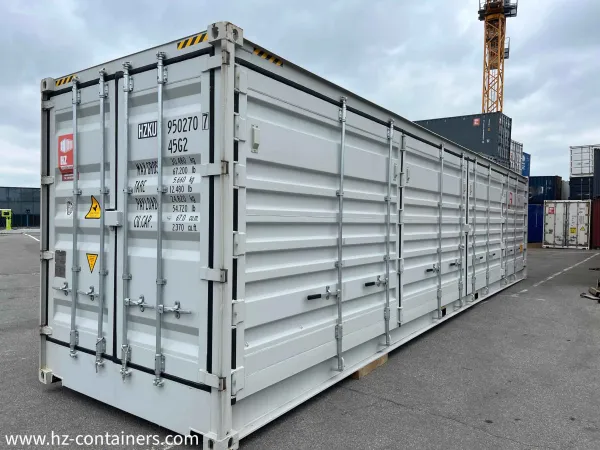
Open side container — also known as a container with side opening, side-opening container, or side door container — is a specialized type of shipping container that, in addition to standard end doors, offers a fully opening side wall along the entire length of the container. This design feature makes it one of the most flexible transport and storage containers on the market. If you have ever faced the problem of how to get long steel profiles, bulky machinery, or heavy pallets into a standard container with narrow end doors, an open side container is exactly the solution you are looking for.
Unlike a standard dry container, where the only access point is through the end door with a width of approximately 2.34 meters, an open side container provides access to the entire length of the side wall — for the 20-foot version, this is almost 6 meters of uninterrupted loading space. The result is dramatically faster and safer cargo handling, whether you use a forklift, crane, or manual loading.
What is an open side container?
Definition and basic characteristics
An open side container is an ISO-certified shipping container in which one entire long side wall is replaced by a system of door panels — most often in a bi-fold (two-leaf) configuration that opens along the entire length of the container. The standard end doors are retained, meaning the container offers two independent access modes: classic end access and full side access.
Key definition: An open side container is a shipping container with a fully opening side wall, which allows loading and unloading along the entire length of the container from the side, thus addressing the spatial limitations of standard containers with end-only access.
Main identification features of an open side container:
- Side doors along the entire length — most often 4 door panels (2×2 leaves) in the 20′ version
- Retained end doors — standard double-leaf doors on the narrow side
- Reinforced construction — more massive corner posts, reinforced top and bottom side rails
- Reduced internal clear height — due to the reinforced floor frame (typically 10–20 cm less than standard)
- Corten steel — the same material as in standard containers (resistant to corrosion)
In the Czech environment, you may encounter several names that refer to this or a very similar type of container:
| Designation | Meaning | Accuracy |
|---|---|---|
| Open Side (OS) | Fully opening side wall | Most accurate designation |
| Side Door (SD) | Side doors, not always full length | Partial overlap |
| Full Side Opening | All 4 sides open | Superset of Open Side |
| Container with side opening | Czech descriptive equivalent | Fully corresponds |
| Side-opening container | Real Czech/current equivalent | Fully corresponds |
Why was the open side container created?
The roots of the open side container go back to the period of standardization of container transport in the 1960s. Although Malcolm McLean launched the containerization revolution in 1956 with standard closed boxes, it quickly became clear that there was a market demand for specialized containers for cargo that simply did not fit in a standard container — whether due to dimensions, shape, or the need for specific handling.
The first open side containers appeared in the 1970s and 1980s in response to the needs of heavy industry and construction. Manufacturers of steel profiles, pipes, building prefabricates, and industrial machines needed a container into which cargo could be inserted from the side — without the need for complicated maneuvering through narrow end doors. Gradually, open side containers evolved into today’s standardized form and are now commonly available in 20-foot and 40-foot versions.
How does the construction of an open side container work?
Technical solution for side opening
The construction of an open side container is significantly more complex than it may seem at first glance. In a standard container, the corrugated Corten steel side walls play a key structural role — they help resist racking forces during lifting, stacking, and transport. When you replace the entire side wall with doors, you must compensate for this structural deficit with other elements.
Manufacturers solve this as follows:
- Reinforced corner posts — more massive than in a standard container
- Reinforced top and bottom side rails — higher profile to compensate for the missing wall
- Additional cross reinforcements in the floor — this is why an open side container typically has a higher floor (and lower internal clear height)
- Bi-fold door panels — 2 to 4 panels of Corten steel, equipped with rubber seals and locking rods
The door panels themselves open in a range of 180° to 270° depending on the manufacturer, which means they can be folded flat along the outer wall of the container and do not obstruct handling.
Materials and safety features
Open side containers are made from the same materials as standard shipping containers:
- Corten steel (COR-TEN A/B) — high-strength steel resistant to atmospheric corrosion. The characteristic rust coating that forms on the surface protects the material from further degradation.
- Rubber seals — around the entire perimeter of each panel and door, ensuring watertightness and airtightness when closed.
- Locking rods — multi-point locking that fixes the panels to the top and bottom frames.
- Plywood or bamboo floor — impregnated against moisture and pests, with a load capacity corresponding to the container class.
When properly closed and locked, an open side container is fully wind and watertight, just like a standard container. This means your cargo is protected from rain, snow, dust, and salt water.
What types and sizes of open side containers exist?
Overview of types and dimensions
On the market, you can encounter several variants. Not every “side-opening” container is the same — the differences are in the range of opening, the number of door panels, and overall accessibility.
| Container type | Length | Height | Side opening range | Number of door panels | Typical use |
|---|---|---|---|---|---|
| 20′ Open Side (standard) | 6,058 mm | 2,591 mm | Full length (one side) | 4 panels (2×2) | Storage, workshops, stalls |
| 20′ High Cube Open Side | 6,058 mm | 2,896 mm | Full length (one side) | 4 panels (2×2) | Higher cargo, better comfort |
| 40′ High Cube Open Side | 12,192 mm | 2,896 mm | Full length (one side) | 4–8 panels | Large machines, vehicles |
| 40′ HC One-Post Open Side | 12,192 mm | 2,896 mm | 2 wide openings (1 center post) | 4 panels (2×2) | Better structural strength |
| 40′ HC 4-Door (3-Post) Open Side | 12,192 mm | 2,896 mm | 4 separate door openings | 8 panels (4×2) | More access points, cheaper |
| Full Side Opening (FS) | 6,058 / 12,192 mm | 2,896 mm | All 4 sides | Variable | Specific logistical needs |
Full side opening vs. side door vs. open side — what is the difference?
These three terms are often confused, but they refer to different things:
- Open Side (OS): One entire long side opens. End doors are retained. This is the “classic” open side container.
- Side Door (SD): Side doors may be only part of the side wall — for example, one pair of doors in the middle. It is not a full opening of the entire wall. More affordable, but less flexible.
- Full Side Opening (FS): An extreme version where all four side walls open. The most expensive variant with the highest degree of accessibility.
What are the dimensions and technical parameters of open side containers?
Detailed technical specifications
The following table provides the exact dimensions, weights, and load capacities of the most common open side containers available on the Czech market:
| Parameter | 20′ DC Open Side | 20′ HC Open Side | 40′ HC Open Side |
|---|---|---|---|
| External length | 6,058 mm | 6,058 mm | 12,192 mm |
| External width | 2,438 mm | 2,438 mm | 2,438 mm |
| External height | 2,591 mm | 2,896 mm | 2,896 mm |
| Internal length | 5,898 mm | 5,910 mm | 12,032 mm |
| Internal width | 2,287 mm | 2,345 mm | 2,288 mm |
| Internal height | 2,302 mm | 2,690 mm | 2,453 mm |
| Internal volume | 31.0 m³ | 37.3 m³ | 67.0 m³ |
| Side opening width | 5,820 mm | 5,820 mm | 11,850 mm |
| Side opening height | 2,190 mm | 2,575 mm | 2,340 mm |
| Empty weight (tare) | 3,060 kg | 2,400 kg | 5,660 kg |
| Maximum payload | 27,420 kg | 28,060 kg | 24,820 kg |
| Max. gross weight | 30,480 kg | 30,480 kg | 30,480 kg |
Important note: The values shown are indicative and may vary slightly depending on the manufacturer and year of manufacture. Always request exact technical sheets for the specific piece before purchase. Pay particular attention to the lower internal height compared to standard containers — the difference is caused by the reinforced floor frame.
Load capacity, weight, and volume — practical implications
Several key practical insights emerge from the technical parameters:
- Higher tare (empty weight): An open side container is heavier than an equivalent standard container — for a 20′ DC, the difference is approximately 800–900 kg. This means that when transporting goods with a limited total vehicle weight, you have a few kilograms less available for the cargo itself.
- Lower internal height: A loss of 10–20 cm of internal clear height can be critical if you plan to transport tall machines or building structures. The High Cube version compensates for this problem to a considerable extent.
- Reduced internal volume: A 20′ DC Open Side has approximately 31 m³ compared to 33.4 m³ for a standard 20′ DC. For a 40′ HC, the difference is even more pronounced — 67 m³ compared to 76 m³.
What are the advantages and disadvantages of an open side container?
Key advantages
1. Unrestricted side access
The biggest advantage is the ability to load goods from the side along the entire length of the container. A forklift can place pallets directly at the right location without complicated maneuvering in a narrow space.
2. Faster loading and unloading
Studies and practical experience show that side access reduces loading time by up to 50% for bulky cargo. You do not have to rotate, move, or temporarily unload goods to get to the rear of the container.
3. Handling of long and bulky items
Steel profiles, pipes, wooden beams, building panels — all of these are very difficult to load into a standard container because they must be inserted at an angle. Open side solves this with direct entry.
4. Full visual inspection of cargo
With the side wall open, you can see the entire contents at once. This facilitates inventory, inspection, and selection of specific items without reloading.
5. Versatility of use
An open side container is not just a transport unit — it serves as a warehouse, workshop, stall, exhibition space, garage, or even a mobile office. Side opening expands the possibilities of its modular use.
Limitations and disadvantages
1. Higher purchase price
Open side containers are more expensive than standard ones — the price difference can be 30% to 60% depending on the type, size, and condition (new/one-way/used).
2. Lower structural rigidity
Despite the reinforcement, an open side container is slightly less rigid when stacking and when exposed to extreme racking forces. Manufacturers take this into account in the maximum stacking capacity for maritime transport.
3. Reduced internal height
The already mentioned loss of 10–20 cm can be limiting. Measure the maximum height of the goods you plan to load carefully before purchasing.
4. Need for side space
To open the side doors, you need at least 2–3 meters of free space along the entire length of the container. In cramped warehouses or overcrowded transshipment points, this can be a problem.
5. Maintenance of seals and hinges
More doors = more moving parts = more maintenance. Seals, hinges, and locking mechanisms require regular inspection and lubrication.
How does an open side container differ from other special containers?
Comparison of Open Side vs Open Top vs Flat Rack
For the right decision, it is essential to understand the differences between the main types of special containers. Each of them solves a different logistical problem:
| Parameter | Open Side | Open Top | Flat Rack |
|---|---|---|---|
| Main access | From the side (full length) | From above (open roof) | From above and from the sides |
| Weather protection | Yes (fully closable) | Partial (tarpaulin) | Minimal |
| Security (against theft) | High | Medium | Low |
| Suitable for oversized cargo | Within container dimensions | Cargo can protrude above the height | Cargo can extend in all directions |
| Forklift handling | Excellent (from the side) | Limited | Excellent |
| Stackability | Yes | Yes | Limited |
| Price (vs. standard) | +30–60% | +20–40% | +15–35% |
| Typical cargo | Machines, profiles, pallets, vehicles | Bulk materials, tall machines | Heavy machines, vehicles, building structures |
When to choose which type?
- Choose Open Side if you need a combination of secure enclosed space and easy side access. Ideal for storage, workshops, transport of machines and materials where you need to protect the goods and at the same time handle them easily.
- Choose Open Top if your cargo exceeds the height of the container or you need to load it from above with a crane. Typically bulk materials, tall structures.
- Choose Flat Rack for extremely heavy or oversized cargo that does not necessarily need weather protection — for example, construction machines, bulldozers, large generators.
What can an open side container be used for?
Industrial and construction use
- Storage of building materials: Steel profiles, pipes, panels, boards, and lumber — everything that is long and difficult to load in a standard container. Open side allows 6-meter profiles to be inserted directly, without maneuvering.
- Tool and machine storage on site: The ability to open the entire side means workers can quickly find and select the tools they need without having to climb into a dark container.
- Transport of industrial machines: Machine tools, generators, compressors — equipment that is too wide or too heavy to be manually pushed through the end door.
Storage, retail, and events
- Mobile retail stalls: Open side containers are increasingly popular as food trucks, cafes, bars, and retail counters. The fully open side forms a natural counter space.
- Exhibition and event spaces: Companies use open side containers as pop-up showrooms, exhibition stands at trade fairs, or presentation spaces directly on site.
- Seasonal storage: Farmers use open side containers to store seasonal equipment, feed, or harvest — simple access speeds up daily work.
Creative and atypical projects
- Modular workshops and garages: Thanks to the side opening, you can use the container as a full-fledged workshop with natural daylight and ventilation when the doors are open.
- Covered work spaces: Two open side containers placed opposite each other with a roof between them create a covered work or storage space.
- Container homes and offices: Architects and designers are increasingly turning to open side containers for modular construction — the open wall is transformed into a glazed facade or terrace.
How much does an open side container cost?
The price of an open side container depends on several factors — size, condition (new, one-way, used), certification, and the current situation on the shipping container market. The following prices are indicative for the Czech market in 2026:
| Container type | Condition | Indicative price (excl. VAT) |
|---|---|---|
| 20′ DC Open Side | Used (AS IS) | 2,000 – 3,500 € |
| 20′ DC Open Side | One Way (after 1 trip) | 4,500 – 6,500 € |
| 20′ DC Open Side | New (IICL6) | 7,000 – 9,500 € |
| 20′ HC Open Side | One Way | 5,500 – 7,500 € |
| 40′ HC Open Side | Used (AS IS) | 3,500 – 5,500 € |
| 40′ HC Open Side | One Way | 6,500 – 9,000 € |
| 40′ HC Open Side | New (IICL6) | 10,000 – 14,000 € |
Price factors to consider: The cost of transport to the destination is not normally included and can range from €150 to €600 depending on the distance and accessibility of the location. Certification (CSC validity for maritime transport, IICL for quality) significantly affects the price — a container without a valid CSC is cheaper, but cannot be used for maritime transport.
How to choose the right open side container?
Key questions before purchase
- What exactly do I need the container for? Transport, storage, or conversion? The answer determines what certification and condition you need.
- What dimensions of cargo will I be loading? Measure the maximum length, width, and height. Do not forget that the internal height is lower in an open side.
- Do I need a full opening of the entire wall or is a side door sufficient? Side door is cheaper, but less flexible.
- What load capacity do I need? Do not forget to subtract the tare of the container from the total permitted weight.
- Do I have enough space for the side opening at the destination? At least 2–3 meters of free space.
- Do I need CSC certification? Only if you are planning maritime transport.
What to watch out for
- Check the exact internal dimensions of the given piece — there are differences of centimeters between manufacturers that can be decisive.
- Check the condition of the seals and hinges — these are the most stressed parts of an open side container.
- Request photos of the specific piece — not catalog images.
- Compare the cost of transport from several sellers — for heavy open side containers, it is not negligible.
- Consider the High Cube version — the extra height often pays off, especially if you plan to work inside the container.
Frequently asked questions
Is an open side container also suitable for maritime transport?
Yes, open side containers are certified to ISO standards and with valid CSC certification they can be used without problems for maritime, rail, and road transport. When purchasing, check that the container has valid CSC.
What is the difference between an open side and a side door container?
A side door container has doors on the side, but not always along the entire length — sometimes it is just one pair of doors in the middle of the wall. Open side means that the entire side wall is openable. Open side provides the highest degree of accessibility.
Can an open side container be stacked?
Yes, open side containers are fully stackable. Thanks to the reinforced construction of the corner posts, they can handle the standard stacking used in ports and on ships. The maximum number of layers depends on the specific model and load.
Is an open side container watertight?
Yes. When all panels and doors are properly closed, an open side container is fully wind and watertight. Quality rubber seals around the perimeter of all openings guarantee protection of the cargo from the weather.
How much does an empty 20′ open side container weigh?
An empty 20′ DC Open Side container weighs approximately 3,060 kg, which is about 800–900 kg more than a standard 20′ DC container. The difference is due to the reinforced construction and the weight of the side door panels.
Why does an open side container have a lower internal height?
The lower internal height (approximately 10–20 cm less) is the result of the reinforced floor frame, which compensates for the structural loss of strength caused by the removal of the solid side wall. If you need full height, go for the High Cube variant.
What is the price difference between a standard and an open side container?
An open side container is on average 30% to 60% more expensive than an equivalent standard container in the same condition. The surcharge reflects the more complex construction, more material, and specialized manufacturing.
Can I use an open side container as a retail stall?
Definitely yes. Open side containers are ideal for food service operations, bars, cafes, and retail stalls. The fully open side wall creates a natural counter and provides excellent customer interaction. When closed, all inventory is safe.
What does the IICL6 designation mean?
IICL (Institute of International Container Lessors) is an international quality standard for shipping containers. The IICL6 (or IICL-6) grade designates a container in very good condition after one maritime trip (one-way), with minimal signs of use, fully functional, and meeting strict criteria.
How often should an open side container be maintained?
It is recommended to inspect the seals and moving parts every 6 months during normal use. Lubricate the hinges and locking mechanisms at least once a year. Shorten the interval when used in a dusty or humid environment. Regular maintenance significantly extends the lifespan of the container.
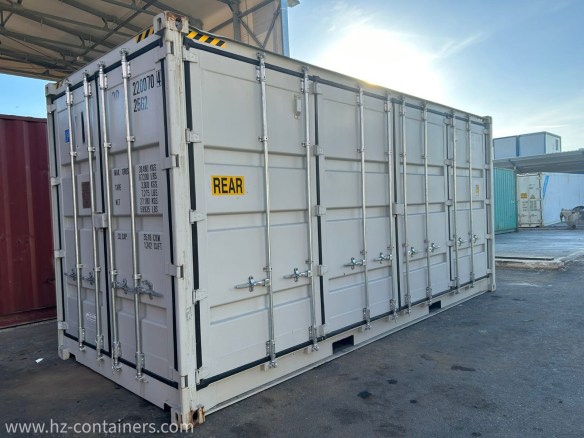
 Italy, Milan
  WITHOUT SHIPPING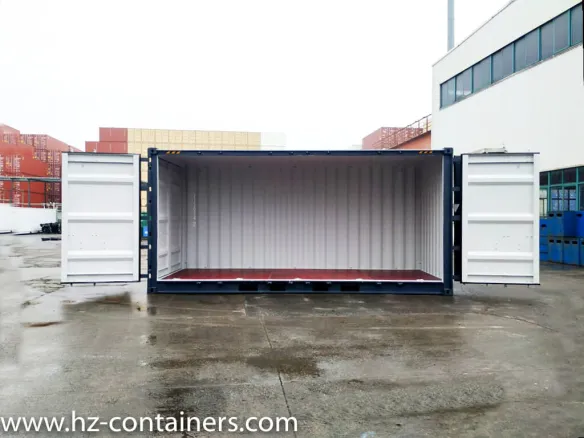
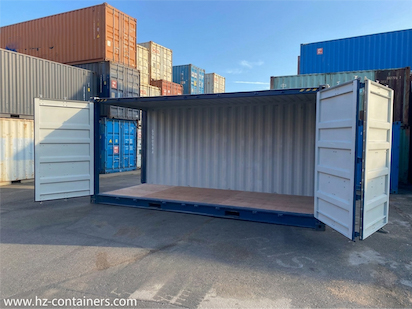

Other container news...

New shipping containers
If you are currently considering purchasing a new shipping container, you are not alone. While just twenty years ago containers were used almost exclusively for maritime transport, today they have found their way into construction, storage, business, and even housing. This growing popularity brings with it a host of questions: Which type should you choose? How much does it cost? How do you recognize quality? How can you avoid falling victim to scammers?
New sea shipping containers
If you are currently considering purchasing a new shipping container, you are not alone. While just twenty years ago containers were used almost exclusively for maritime transport, today they have found their way into construction, storage, business, and even housing. This growing popularity brings with it a host of questions: Which type should you choose? How much does it cost? How do you recognize quality? How can you avoid falling victim to scammers?

6m shipping container
Are you thinking about buying a 6-meter shipping container but aren’t sure what to look for? You are not alone—this 20-foot container is the best-selling size on the Czech market, and the differences between various types, conditions, and prices can be significant. In this guide, you will find everything you need to know: from exact dimensions and a comparison of categories (such as “one-way,” refurbished, and “Cargo Worthy”) to current prices and shipping advice.
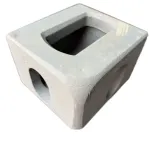
Corner casting steel vs aluminum
Every shipping container in the world — all 40 million of them — rests on eight critical components. Corner castings are the load-bearing blocks at each corner of an ISO shipping container, and they are the universal interface between the container and every crane, twistlock, spreader, and chassis on the planet. When you lift a container, stack it nine high on a ship, or lock it to a truck trailer, every ton of force flows through these fittings.