
Corner of a Shipping Container – Corner Casting
Shipping container corner (Corner Casting, also Corner Block) is an unobtrusive but absolutely essential structural component of every ISO shipping container. This massive cast‑iron steel block with precisely defined three holes is placed in each of the eight corners of a standardized container. Thanks to corner castings it is possible to handle containers safely, stack them, attach them to transport vehicles and connect them to each other, making this element a basic building block of modern global logistics.
Importance of corner castings in logistics:
- Enable safe lifting and handling of containers with cranes, spreaders and other equipment
- Allow stacking of containers up to ten layers without transferring load to walls or roof
- Enable secure fastening of containers to ships, rail wagons and road chassis
- Serve as universal connection points for linking containers into solid blocks
Standardization of corner elements is crucial – it ensures full compatibility in the worldwide transport network.
Material composition and steel selection
What are corner castings made of? They are usually a special cast steel designed for low temperatures. It’s low temperature impact resistance. The corner castings we offer are manufactured according to ISO 1161.
Material: High‑strength cast steel (most commonly CORTEN, CNS‑SCW49, S‑SCW480)
Our Corner Castings meet Certificate 3.2
Why cast steel?
Corner castings are almost exclusively manufactured from high‑quality cast steel. Most commonly plain steel without additional alloying elements is used, which excels in the following properties:
- High tensile and compressive strength – each corner block transfers forces in the range of tens of tonnes
- Excellent toughness – essential for resistance to impacts during loading/unloading and transport
- Weldability – the corner casting is inseparably joined to the container frame by welding
- Wear resistance – the holes must withstand thousands of twist‑lock cycles
- Corrosion resistance – often using weather‑resistant Corten steel that forms a protective patina
- Thermal resistance – retains properties in extreme cold and tropical heat
Material comparison
| Material | Advantages | Disadvantages |
|---|---|---|
| Cast steel | High strength, weldability, low cost | Higher weight, corrosion if unprotected |
| Aluminium | Low weight, corrosion resistance | Lower strength, higher price, poorer weldability |
| Cast iron | Cheaper production, good strength | Lower toughness, weldability, less impact resistance |
From a safety and standardization standpoint, cast steel is unequivocally the preferred material, as confirmed by ISO 1161.
ISO 1161: Basic technical requirements
The ISO 1161:2016 standard defines the construction, dimensions and mechanical properties of corner castings for shipping containers of series 1 (including ISO 668, ISO 1496).
What ISO 1161 specifies:
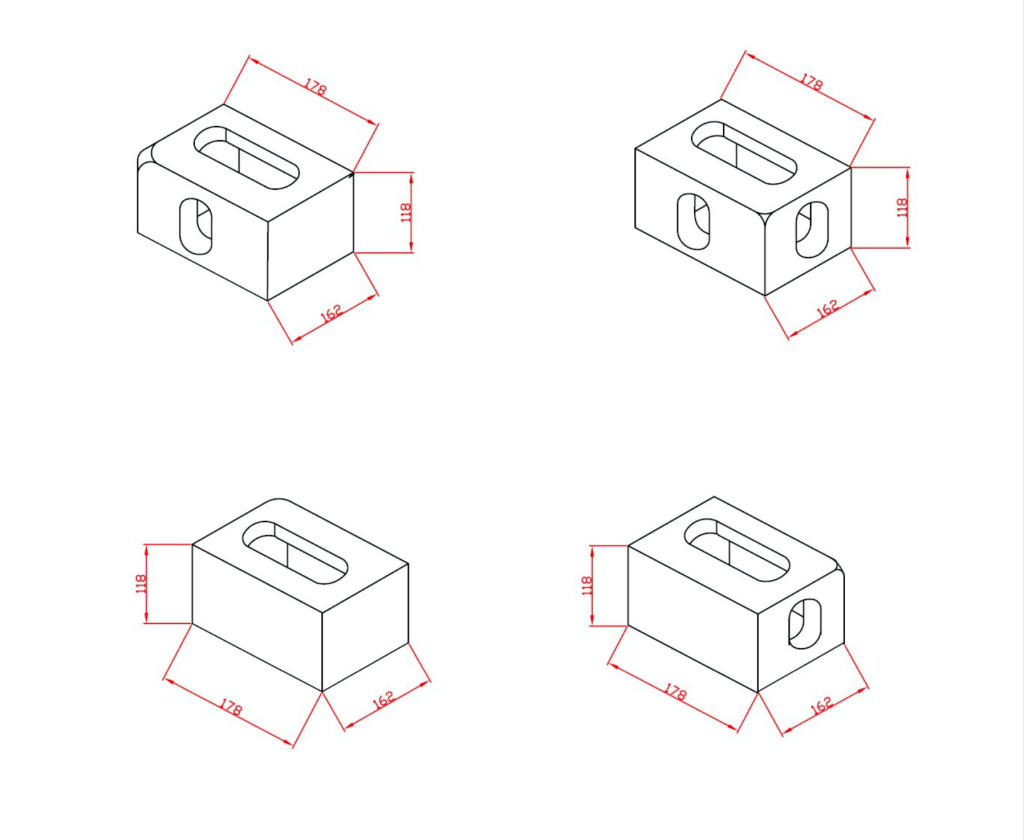
- Exact dimensions – 178 mm (length) × 162 mm (width) × 118 mm (height)
- Shape and hole placement – three holes on each block with precise geometry and tolerances of ±1.5 mm
- Mechanical properties – minimum tensile, compressive and shear strength, impact resistance
- Material requirements – cast steel with precisely defined characteristics
- Testing and inspection procedures – manufacturers must perform destructive and non‑destructive tests, dimensional checks and keep batch records
Because of this standard, all containers and handling equipment are fully compatible and safe worldwide.
Dimensions, weight and types of Corner Castings
Standard dimensions and weight
| Parameter | Value |
|---|---|
| Length | 178 mm |
| Width | 162 mm |
| Height | 118 mm |
| Weight | 10.5–12 kg (depending on type) |
The hole for the twist lock has a diameter of 65 mm (oval), while the other holes vary in shape according to position (top/bottom, side/front).
Simple drawing with dimensions – corner casting dimensions

Types of Corner Castings
The sales set consists of 8 pieces: 2x Top Left (TL), 2x Top Right (TR), 2x Bottom Left (BL) and 2x Bottom Right (BR).
You can find it in our offer as a set of shipping container corner castings 8 pieces
Each ISO container has eight corners, each equipped with a specific type of corner casting according to orientation:
| Type | Location | Hole description |
|---|---|---|
| Top Left (TL) | Upper left corner | Oval side hole, shield‑shaped front hole, large top hole |
| Top Right (TR) | Upper right corner | Mirror image of TL |
| Bottom Left (BL) | Lower left corner | Oval side and front holes, large bottom hole |
| Bottom Right (BR) | Lower right corner | Mirror image of BL |
Each block carries an internal relief marking (TL, TR, BL, BR) for easy identification during manufacturing and repairs.
But if you only need to replace one of the cubes, you can also buy them separately. We supply high-quality, ISO 1161 compliant corner castings individually or in full sets of 8. Whether you are building a container house or repairing a fleet, we have them in stock.
Buy corner castings now:

 Czech Republic
  WITHOUT SHIPPING


Functions and practical use of Corner Castings
Lifting and handling
- Cranes/spreaders: All containers are lifted exclusively by the corner elements; the spreader inserts twist locks into the upper holes and secures the container by rotation.
- Forklifts: Handling of empty containers with hooks/adapters also uses the corner holes.
Stacking
- Load transfer: All weight of stacked containers is transferred only through the corner blocks and pillars – walls and roof bear no load.
- Stability: Precise geometry of corner elements allows stacking up to 10 layers without risk of deformation.
Securing and fastening (Lashing)
- On ship: Twist locks and bridge fittings connect containers vertically and horizontally through the corner blocks.
- On chassis/wagon: Twist locks on the truck or rail chassis secure the container at the lower corners.
- Horizontal connection: Bridge fittings join containers into solid blocks, increasing stability and safety.
Intermodal transport
Corner castings enable rapid transfer between ship, train and road without handling the cargo inside the container.
Interaction with other components
| Component | Relation to corner casting | Function |
|---|---|---|
| Twist Lock | Inserts into corner block holes | Secures the container to chassis, ship and other containers |
| Bridge Fitting | Connects adjacent containers horizontally | Increases stacking stability |
| Spreader | Handles containers via twist locks | Safe and efficient lifting |
| Container Wheels | Attach to lower corners | Provide mobility for empty containers |
Production, quality control and assembly
Manufacturing process
- Casting: Molten steel is poured into a precise mold (usually sand or ceramic).
- Machining: After cooling, exact machining of functional surfaces and holes is performed.
- Marking: Each block is marked with type, batch and often the manufacturer’s logo.
- Testing: Dimensional inspection, mechanical testing (tensile, impact), crack detection (e.g., ultrasonic).
- Certification: The manufacturer must demonstrate conformity with ISO 1161 for marine containers, with third‑party certification bodies (Lloyd’s Register, Bureau Veritas, ABS, etc.).
Assembly to the container
- Welding: Corner blocks are welded to the container frame (high‑quality welds are essential).
- Precision emphasis: Exact dimensions must be maintained for global compatibility and safety.
Maintenance, inspection and service life
- Inspection: Check for cracks (especially in welds), deformation, corrosion or excessive wear of holes.
- Repair: Welding of cracks or replacement of the whole block may only be performed by certified personnel, using original ISO 1161‑compliant parts.
- Service life: A properly maintained corner casting typically lasts 20–25 years, often longer than the container itself.
How do you know it’s time to replace it?
- Visible cracks in the welds.
- Deformation of the holes (oval shape instead of the original), which prevents secure locking with the twist-lock.
- Deep corrosion reducing structural integrity.
Frequently asked questions (FAQ)
Are all corner castings on a container identical?
No, there are four types (TL, TR, BL, BR) differing in hole shape and orientation.
What material are they made of?
Exclusively high‑quality cast steel that meets ISO 1161.
What is their load capacity?
One corner casting can bear up to 86 tonnes without deformation when stacking (the whole container up to 250 tonnes).
Why do they protrude from the container outline?
To transfer the entire weight through the robust frame during stacking or when placed on the ground, not through the walls or floor.
Can they be purchased separately?
Yes, corner castings are readily available and, thanks to standardization, are also suitable for modular construction, shelters, etc.
Corner castings in practice – examples of types
| Type | Photo and description |
|---|---|
| Bottom Right | Steel, milled surface, ISO 1161 certified |
| Top Left | Steel, precisely machined twist‑lock hole |
| Top Right | Mirror of TL, used in upper corners |
| Bottom Left | Lower left corner, milled for precise seating |
Interesting uses beyond transport
- Modular buildings: Corner blocks are popular building elements for houses, offices, shelters and temporary structures made from containers, because they allow easy joining and handling of modules.
- Special applications: Can be used for mobile frames, transport platforms, frames for generators or technological equipment requiring simple transport.


Other container news...

Shipping Container Wheels: The Definitive Guide to Container Casters, End Wheels, Dolly Systems & Mobility Kits
Shipping container wheels are heavy-duty mobility devices — including casters, end wheels, dolly systems, and bolt-on spindle kits — designed to attach to a shipping container’s ISO 1161 corner castings, enabling on-site repositioning without a crane, tilt-bed truck, or specialized lifting equipment.

What is the floor load capacity of a shipping container (kg/point)
The load capacity of a shipping container floor — and especially its expression in kg/point — is one of the least understood, yet essential, technical parameters encountered by anyone who handles, loads, or uses containers for storage or modular construction. While the total payload of a 20-foot container of 28,000 kg is generally known, the point load value determines whether the floor will survive the concentrated pressure of a single wheel of a forklift or the foot of a heavy machine — and this is often the decisive parameter for safe operation.

Shipping Containers Komárno Slovakia
Shipping containers are standardized metal transport units designed primarily for the transport of goods by waterways, especially rivers and seas. In the context of Komárno, located at the confluence of the Váh and Danube rivers in Slovakia, shipping containers play a key role in the logistics infrastructure of the region. They are robust, closed containers that enable the safe and efficient transport of various types of goods. Shipping containers in the city of Komárno are an essential part of the functioning of the local port, which is among the second largest port and transport hubs in Slovakia.

Shipping Containers in the City of Dunajská Streda Slovakia
Shipping containers in Dunajská Streda represent a flexible, economical and ecological solution for logistics, storage and construction. Their popularity is growing, both in traditional applications and in innovative architectural projects. Whether you are looking for a solution for storage, transportation or want to build a modern space, shipping containers offer countless options with an excellent price-quality ratio.