
Transport load wheels for shipping container
Moving a 12-meter steel box weighing up to 30,500 kg used to mean one thing: calling a crane. For decades, that was the only realistic option for relocating a shipping container at a construction site, yard, or depot. Today, that equation has changed. Transport load wheels for container — robust wheel assemblies with twist-lock attachment that mount directly to the ISO corner castings of shipping containers — have transformed container mobility from a specialized, costly operation into a task a small team can handle in under an hour.
This guide is the definitive resource on transport load wheels for container. Whether you manage a logistics yard, build tiny houses from converted containers, or simply need to move a storage container 60 meters across your property, the information that follows will equip you to select, install, and safely operate the right wheel system for your needs.
What Are Transport Load Wheels for Container?
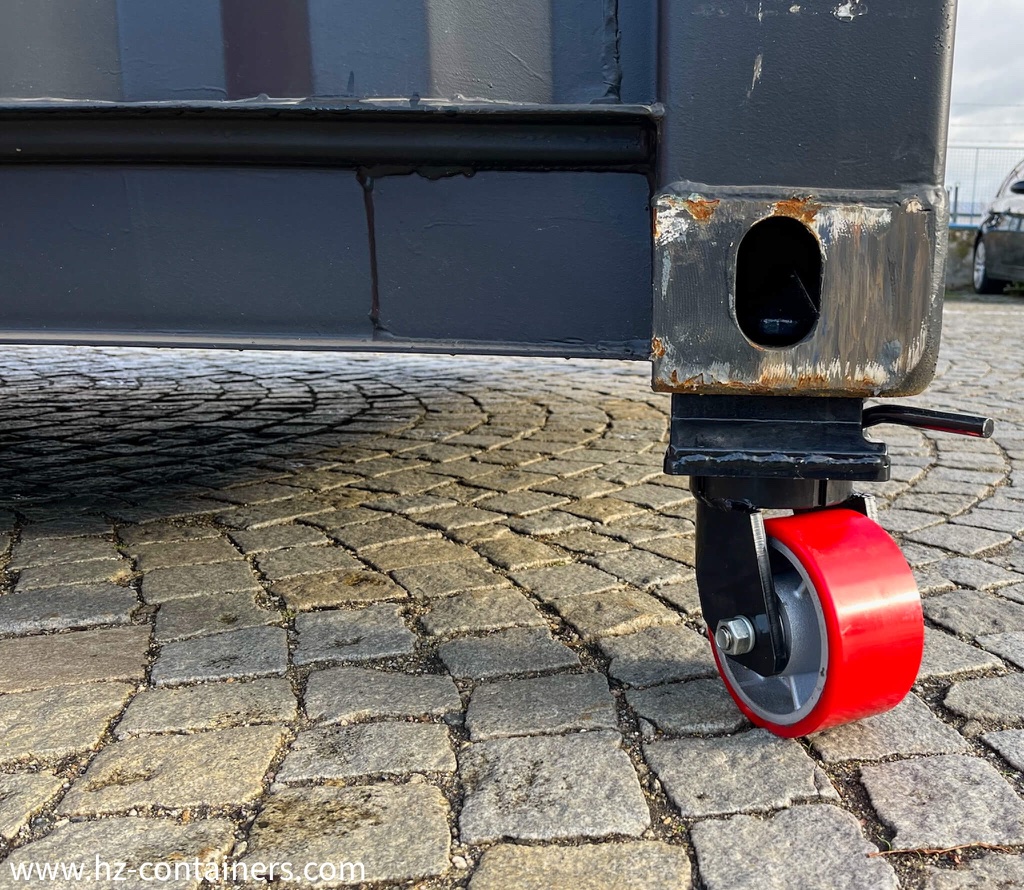
Transport load wheels for container are not just oversized casters bolted onto a steel box. They are a purpose-built category of industrial mobility equipment, designed around one specific interface: the ISO 1161 corner casting. Every intermodal shipping container manufactured since the late 1960s has eight of these standardized steel blocks — one in each corner — with precisely dimensioned oval openings. These castings were originally designed to receive the twist-locks of crane spreaders and the stacking cones of container ships. Today, they also receive the twist-lock top plates of transport load wheels for container.
Where Did Transport Load Wheels for Container Come From?
The story of transport load wheels for container begins with the shipping container revolution itself. In 1956, Malcolm McLean’s converted tanker Ideal X carried 58 containers from Newark to Houston, launching the era of intermodal freight transport. But containers of the 1950s and early 1960s were not standardized. Different shipping lines used different dimensions, different corner fittings, and different handling equipment. The result was chaos at every port.
The International Organization for Standardization (ISO) stepped in, and in 1967 published ISO 1161, which defined corner casting dimensions, opening sizes, and load capacity requirements that every container manufacturer would follow. That single standard enabled the global container shipping industry to exist. It also enabled transport load wheels for container to exist, because for the first time, a wheel manufacturer could design a product that would fit every container, from any manufacturer, anywhere in the world.
The first transport load wheels for container appeared in the 1980s, when container depots and logistics yards were looking for alternatives to crane-dependent relocation. Early designs were essentially large industrial casters with welded twist-lock adapters. They were heavy, manually difficult to install, and had limited load capacity. The market matured significantly in the 2000s and 2010s, driven by the explosion of container-based applications — from pop-up shops to mobile hospitals, military field camps, and the tiny house movement. Today’s transport load wheels for container are precision-engineered products with load capacities up to 16,000 kg per wheel, integrated braking systems, and directional locks that would have been unthinkable in the 1980s.
Caster or Castor? What’s the Difference?
Throughout the industry, you will encounter both spellings. “Caster” is the dominant American English spelling. “Castor” is the traditional British English spelling. Both refer to the same thing: a wheel mounted in a swivel frame that allows a heavy object to be steered and moved. In the container industry, both spellings are used interchangeably. For consistency, this guide uses “caster” throughout, but when shopping, comparing products, or reading technical documentation, you should treat these terms as synonyms.
Core Components of a Transport Load Wheels for Container System
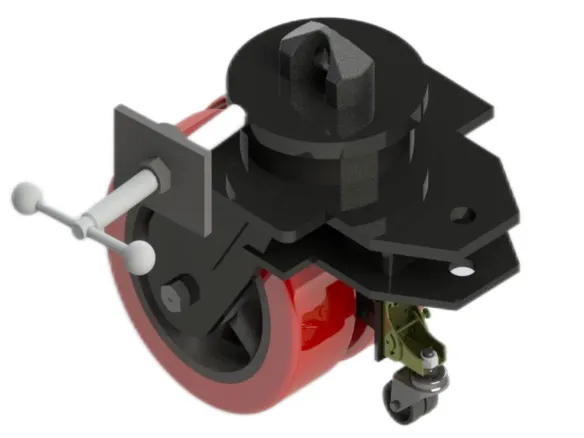
| Component | Function | Materials |
|---|---|---|
| Twist-lock top plate | Locks the caster into the container’s ISO 1161 corner casting | Hardened steel, often galvanized for corrosion resistance |
| Swivel mechanism | Allows the caster to rotate 360° for steering | Forged steel with hardened ball bearings or tapered roller bearings |
| Wheel(s) | Rolling contact surface carrying the load | Polyurethane, nylon, pneumatic rubber, cast iron, or composite |
| Brake mechanism | Immobilizes the wheel when activated | Spring-loaded steel pawl, friction disc, or locking pin |
| Directional lock | Locks the swivel mechanism in a fixed orientation for straight-line towing | Steel pin or lever engaging notches in the swivel bearing |
| Frame / fork | Structural housing connecting the top plate to the wheel axle | Welded steel plate, typically 6–10 mm thick |
Key definition: A transport load wheel for container is a robust wheel assembly with an integrated ISO 1161 twist-lock mechanism, designed to attach to the bottom corner castings of a shipping container, enabling manual or towed relocation without a crane.
How Does the Twist-Lock Mechanism Work on Container Casters?
The twist-lock is the critical interface that enables transport load wheels for container to exist. Without it, you would have to weld, bolt, or clamp the caster to the container — and none of those methods would be safe or practical for a 30-ton loaded box.
Technical Background of the ISO 1161 Corner Casting Interface
The ISO 1161 corner casting contains an oval opening of approximately 124.5 mm × 63.5 mm (4.9 × 2.5 inches) on the bottom face. The twist-lock head on the caster is a machined steel block with a matching oval profile. When the caster is presented to the corner casting from below, the twist-lock head passes through the opening. The operator then rotates the head — typically 90 degrees using a lever or handle — so the oval head is now transverse to the opening and cannot be pulled back out.
It is the same principle used to secure containers on ship decks, truck chassis, and railway wagons. The difference is that with a container caster, the twist-lock is integrated into the caster’s top plate, rather than being a separate securing device.
Step by Step: How Twist-Locks Engage, Lock, and Release
- Alignment: The caster is positioned below the corner casting. The twist-lock head is oriented so its oval profile matches the opening.
- Insertion: The caster is lifted until the twist-lock head fully passes through the opening and seats against the inner surface of the corner casting.
- Rotation: The operator rotates the locking lever approximately 90 degrees. This rotates the twist-lock head so it is now transverse to the opening, creating a positive mechanical lock.
- Tensioning (on premium models): Some top-tier casters include a secondary tensioning mechanism — often a threaded collar or cam lever — that tightens the connection and removes play between the caster and corner casting. This is critical for stability during movement.
- Release: The process is reversed. The tensioner is loosened, the locking lever is rotated back 90 degrees, and the caster is released.
Safety Indicators and Verification
Before moving a container on transport load wheels, you must verify that every twist-lock is fully engaged. Never rely on feel alone. Most quality casters include a visual indicator — a colored tag, pin position, or marked alignment line — that confirms the lock is fully seated. For example, on Blickle and JUNG systems, the locking lever aligns with a marked “locked” position on the top plate. On the Tandemloc AC49000A series, a spring-loaded pin clicks into place when the lock is fully engaged.
Critical safety rule: After locking, give each caster a firm pull. If it shifts or rattles, the lock is not fully seated. A single incomplete lock can cause the container to shift during movement, potentially leading to catastrophic failure.
Common Twist-Lock Failure Modes
- Partial engagement: The twist-lock head has rotated but did not pass beyond the inner edge of the corner casting. The caster may appear locked but will release under load.
- Worn twist-lock heads: Over years of use, the steel head can wear, reducing the locking surface area. A twist-lock head that has lost more than 2 mm of material should be replaced.
- Debris in the corner casting: Dirt, rust, or ice inside the corner casting can prevent full seating of the twist-lock. Always clean the casting opening before installation.
- Corrosion seizure: In marine environments, twist-lock mechanisms can seize. Regular lubrication with marine-grade grease is essential.
What Are the Different Types of Transport Load Wheels for Container?
Transport load wheels for container are not a single product. They are a category of mobility solutions with several distinct configurations, each suited to different loads, surfaces, and operational requirements.
Single-Wheel vs. Dual-Wheel Casters
Single-wheel casters use one wheel per caster assembly. They are lighter, less expensive, and easier to maneuver in tight spaces. Their load capacity typically ranges from 1,200 kg to 3,000 kg (6,600 lbs) per caster. They work well on smooth, hard surfaces such as warehouse concrete or paved yards.
Dual-wheel casters (also called twin-wheel or double casters) mount two wheels on a shared axle within a single swivel frame. The dual-wheel design distributes the load over a larger contact area, reducing ground pressure and improving stability. Dual-wheel casters typically handle loads from 2,500 kg to 16,000 kg per caster. They are the standard for heavy containers, uneven surfaces, and applications where the container may be unevenly loaded.
Rigid, Swivel, and Directionally Lockable Casters
- Swivel casters: The wheel assembly rotates freely 360 degrees around a vertical axis. This allows the container to be steered. In a standard four-caster assembly, all four are typically swivel type, providing maximum maneuverability.
- Rigid casters: The wheel is locked in a single orientation (parallel to the container’s longitudinal axis). Rigid casters are sometimes used at the rear of a container when it will be towed in a straight line, but they are rare in complete container caster sets because they limit flexibility.
- Directionally lockable casters: These are swivel casters with a mechanism that can lock the swivel mechanism in a fixed orientation. When unlocked, the caster swivels freely. When locked, it behaves like a rigid caster. This is the most versatile option, allowing operators to switch between maneuverability (for tight spaces) and straight-line stability (for towing).
Container Casters vs. Container Dollies vs. End-Wheel Systems
One of the most common areas of confusion in the container mobility market is the difference between casters, dollies, and end-wheel systems. They are related but distinct:
| System Type | How It Attaches | Typical Load Capacity | Best For | Approximate Cost |
|---|---|---|---|---|
| Container casters | Individual twist-lock units at each corner | 4–64 tons (set of 4) | On-site relocation, tight spaces, frequent moves | $500–$5,000 per set |
| Container dolly systems | Front steerable unit + rear towed unit, twist-lock to all four corners | 5–60 tons | Towing behind a vehicle, longer distances, highway towing (DOT-approved models) | $2,000–$15,000 per set |
| End-wheel systems | Attach to side or end corner castings, non-swiveling | 10–36 tons | Keeping container low to the ground, minimal clearance height | $1,500–$8,000 per set |
| Hydraulic self-lifting systems | Integrated hydraulic jacks lift the container, then wheels slide underneath | 10–40 metric tons | No separate lifting equipment needed, uneven terrain | $2,000–$12,000 per set |
Self-Lifting Hydraulic Caster Systems
For operations that don’t have a forklift or crane available, self-lifting hydraulic caster systems are a game-changer. Each caster assembly contains a built-in hydraulic jack. The operator positions the casters under the corner castings, pumps the jacks to lift the container off the ground, and then locks the casters. Once all four corners are lifted and locked, the container can be towed. When the move is complete, the jacks are released and the container settles back onto its foundation or the ground.
These systems are particularly valuable for construction sites, remote locations, and operations where scheduling a crane or forklift would add significant cost and delay.
Pneumatic vs. Solid vs. Polyurethane: Choosing the Right Wheel
The wheel material and design determine where the caster can operate and how long it will last:
| Wheel Type | Diameter Range | Best Surfaces | Load Capacity | Noise Level | Durability | Cost |
|---|---|---|---|---|---|---|
| Polyurethane | 4″–8″ | Concrete, asphalt, smooth gravel | High | Low | High (resists flat-spotting) | $$ |
| Nylon | 3.3″–6″ | Smooth concrete, indoor floors | Medium | Medium | Moderate (flat-spot damage on rough surfaces) | $ |
| Pneumatic rubber | 10″–18″ | Gravel, mud, broken pavement, grass | Medium | Very low | Moderate (puncture risk, requires inflation) | $$$ |
| Cast iron / steel | 4″–10″ | Smooth concrete, rails | Very high | High | Very high (damages floors) | $$ |
| Composite | 3.3″–6″ | Concrete, clean asphalt | Medium | Low | Moderate | $$ |
The gold standard for most applications is polyurethane. It offers the best balance of load capacity, floor protection, quiet operation, and durability. JUNG’s proprietary JUWAthan+ polyurethane, for example, is oven-baked to achieve a specific resilience-to-hardness ratio that resists flat-spotting better than even nylon wheels left static under load.
What Load Capacity Must Transport Load Wheels for Container Have?
Load capacity is the most important specification when selecting transport load wheels for container — and also the most frequently misunderstood.
Understanding WLL, Dynamic, and Static Load
- Working Load Limit (WLL): The maximum load for which the caster is rated during normal operation. This is the number you will see in product listings and specification sheets.
- Dynamic capacity: The load the caster can handle when the container is in motion. Dynamic capacities are lower than static because motion introduces impact forces, vibration, and uneven weight distribution.
- Static capacity: The load the caster can bear when the container is at rest. Static capacities are typically 25–33% higher than dynamic because the caster does not experience motion-induced stress.
Always size your casters based on dynamic capacity, not static. The container is going to move — that’s the whole point.
How to Calculate Required Capacity: The 3:1 Safety Factor Rule
The standard industry safety calculation for transport load wheels for container works like this:
- Determine the gross weight of your container (tare weight + cargo weight).
- Divide by 3 (not 4). This is the safety factor. It accounts for the fact that loads are rarely, if ever, perfectly distributed across all four corners. On uneven surfaces, on a slope, or with an unevenly loaded container, one or two casters may briefly bear a disproportionate share of the total weight.
- Select casters with a dynamic WLL at or above this calculated value.
Example calculation for a loaded 20-foot container:
- Tare weight of 20-foot container: ~2,300 kg (5,070 lbs)
- Cargo weight: 10,000 kg (22,000 lbs)
- Gross weight: 12,300 kg (27,070 lbs)
- Required capacity per caster: 12,300 ÷ 3 = 4,100 kg (9,023 lbs) per caster
In this scenario, you would choose casters rated for a dynamic WLL of at least 4,100 kg each. A set of four 5,000 kg casters would provide a reasonable safety margin.
Weight Distribution: Why Uneven Loading Changes the Calculation
A container loaded with heavy machinery at one end and empty space at the other distributes its weight unevenly. In extreme cases, one corner may bear more than 40% of the total load. That is why the 3:1 safety factor is essential — it provides a margin for real-world loading conditions that engineering drawings cannot predict.
| Container Size | Tare Weight | Max Gross Weight | Recommended Caster WLL (per caster, 3:1 safety) | Typical Caster Set |
|---|---|---|---|---|
| 20ft standard | 2,300 kg (5,070 lbs) | 30,480 kg (67,200 lbs) | 10,160 kg (22,400 lbs) | 4× 12,000 kg casters |
| 20ft (empty) | 2,300 kg (5,070 lbs) | N/A | 767 kg (1,690 lbs) | 4× 2,500 kg casters |
| 40ft standard | 3,750 kg (8,268 lbs) | 30,480 kg (67,200 lbs) | 10,160 kg (22,400 lbs) | 4× 12,000 kg casters |
| 40ft (empty) | 3,750 kg (8,268 lbs) | N/A | 1,250 kg (2,756 lbs) | 4× 5,000 kg casters |
| 40ft high cube | 3,940 kg (8,686 lbs) | 30,480 kg (67,200 lbs) | 10,160 kg (22,400 lbs) | 4× 12,000 kg casters |
What Materials Are Transport Load Wheels for Container Made Of?
The wheel material determines how the caster performs on different surfaces, how long it lasts, and what maintenance it requires. The choice is not trivial — selecting the wrong material can destroy a set of wheels within weeks.
Polyurethane: The Gold Standard
Polyurethane (PU) wheels dominate the container caster market for good reason. They offer an exceptional combination of properties:
- High load capacity: Polyurethane handles heavy loads without deformation thanks to its high modulus of elasticity.
- Floor protection: Unlike steel or cast iron, polyurethane does not damage concrete, asphalt, or sealed surfaces.
- Low rolling resistance: PU wheels turn smoothly, reducing the effort needed to move the container.
- Chemical resistance: Polyurethane resists oils, greases, and many industrial chemicals.
- Flat-spot resistance: Unlike nylon, high-quality polyurethane (especially baked formulations like JUWAthan+) resists forming flat spots when left stationary under load.
The downside of polyurethane is cost — it is more expensive than nylon — and it is not suitable for extremely rough terrain where pneumatic tires would provide better impact absorption.
Nylon: Affordable but Limited
Nylon wheels are less expensive than polyurethane and offer good load capacity on smooth surfaces. They have significant drawbacks, however:
- Flat-spotting: Nylon wheels left stationary under load for extended periods develop flat spots that cause vibration and uneven rolling.
- Floor damage: Nylon is harder than polyurethane and can mark or gouge concrete floors over time.
- Noise: Nylon wheels are louder on hard surfaces.
- Poor impact absorption: Nylon transmits impact forces directly to the caster frame and container.
Nylon works well for indoor applications on smooth concrete where the container will be moved frequently and never left stationary on the wheels for more than a few days.
Pneumatic Rubber: When You Need Impact Absorption
Pneumatic (air-filled) rubber wheels are the choice for rough terrain. They absorb impacts from gravel, cracks, expansion joints, and debris that would destroy solid wheels. The large diameter (typically 10–18 inches) provides excellent ground clearance.
Pneumatic wheels have significant limitations for container applications, however:
- Lower load capacity: Pneumatic wheels typically cannot match the load capacity of solid polyurethane or nylon wheels of comparable size.
- Puncture risk: Sharp debris can puncture the tire. On a construction site or scrap yard, this is a real problem.
- Inflation maintenance: Tires need to be checked and inflated regularly. An underinflated tire on a loaded container can fail catastrophically.
- Higher cost: Pneumatic container casters are more expensive than solid alternatives.
Steel and Cast Iron: Only for Extreme Loads
Steel and cast iron wheels are used in specialized applications where load capacities exceed what polyurethane or nylon can handle — typically above 20,000 kg per caster. They are also used on rail-mounted container systems. The main disadvantages are floor damage, noise, and zero impact absorption. Unless you are moving containers on steel rails or over a surface you are willing to sacrifice, steel wheels are rarely the right answer.
Composites and New Materials
Composite wheels — typically a blend of nylon, fiberglass, and proprietary resins — offer a middle ground between nylon and polyurethane. They are quieter than nylon, more durable than budget polyurethane, and increasingly popular for mid-tier applications. Some manufacturers are also experimenting with graphene-reinforced polyurethane, which promises 30–50% improvements in load capacity and wear resistance compared to standard formulations.
How Are Transport Load Wheels for Container Installed?
Installing transport load wheels for container is a straightforward process, but it requires proper lifting equipment and strict adherence to safety protocols. The actual installation takes only 2–5 minutes per caster once the container is lifted.
Pre-Installation Checklist
Before you begin, verify:
- The surface is level, stable, and free of obstacles along the planned route of movement.
- The container’s corner castings are clean and free of debris, rust, or ice. Clean with a wire brush if necessary.
- The casters are the correct model for your container’s gross weight and surface conditions.
- All four casters are present and visually inspected for damage, cracks, or excessive wear.
- Lifting equipment (forklift, container jack, or crane) is rated for the container’s gross weight.
- All workers are wearing appropriate PPE: steel-toe boots, hard hats, high-visibility vests, and gloves.
- The area is clear of non-essential personnel. Establish a safety perimeter of at least 2 meters (6.5 feet) around the container.
Step-by-Step Installation Procedure
Step 1: Lift the container. Using a forklift with forks wide enough to span the container’s width (or container jacks at each corner), lift the container approximately 20–30 cm off the ground. This provides enough clearance to position the casters underneath. If using a crane, lift from the top corner castings using a spreader bar.
Step 2: Position the first caster. Starting at one corner, slide the caster under the corner casting. Align the twist-lock head with the oval opening on the bottom face of the corner casting.
Step 3: Engage the twist-lock. Insert the twist-lock head fully into the corner casting. Rotate the locking lever 90 degrees (or as specified by the manufacturer) until the lock engages. If the caster has a secondary tensioning mechanism, tighten it now to remove any play.
Step 4: Verify the lock. Pull firmly on the caster. It should not shift or rattle. Check the visual indicator (colored tag, pin position, or alignment mark) to confirm full engagement.
Step 5: Repeat for the remaining three corners. Work systematically, one corner at a time. Never assume a lock is engaged — verify each one individually.
Step 6: Lower the container. Slowly lower the container onto the casters. Watch each caster as the load settles. If any caster shifts or the container tilts, stop immediately and recheck all locks.
Step 7: Final inspection. Walk around the container and inspect all four casters. Confirm the container is level and that all wheels are in contact with the ground. If the surface is uneven, one or more wheels may not be touching — this is dangerous and must be corrected before moving the container.
Required Lifting Equipment
- Forklift: The most common method. Requires forks wide enough to span the container (typically 2.5 meters for a 20-foot container). Narrow forks risk punching through the container floor.
- Container jacks: Specialized hydraulic jacks designed for lifting containers at the corner castings. Available in manual and motorized versions. Ideal for sites without a forklift.
- Crane with spreader bar: Overkill for most caster installations, but necessary if the container is being lifted off a truck or from a stacked position.
Common Installation Mistakes
- Installing casters on a slope: The container may roll immediately after being lowered. Always install on a level surface.
- Forgetting to clean the corner castings: Debris prevents full seating of the twist-lock.
- Not verifying all four locks: A single unseated lock can cause the container to shift during movement.
- Using incorrect lifting equipment: Forklift forks that are too narrow can punch through the container floor. Always verify fork width before lifting.
What Surfaces and Terrains Can Transport Load Wheels for Container Handle?
Not all transport load wheels for container work on all surfaces. The wheel material and diameter determine what the caster can safely traverse.
Smooth Concrete and Warehouse Floors
This is the ideal surface for transport load wheels for container. Any wheel type — nylon, polyurethane, or composite — will perform well on smooth, sealed concrete. Rolling resistance is minimal, and the risk of wheels catching on obstacles is low. For indoor warehouse applications, nylon or composite wheels with a 3.3–6 inch diameter are sufficient and cost-effective.
Asphalt and Paved Yards
Asphalt is common in container depots and logistics yards. It is generally smooth enough for polyurethane and nylon wheels, but watch for potholes, cracks, and loose gravel. A wheel diameter of at least 5 inches is recommended for asphalt. Polyurethane wheels last longer on asphalt than nylon because they resist abrasive wear from the rough surface texture.
Gravel and Compacted Earth
Once you leave paved surfaces, the requirements change dramatically. Small-diameter wheels (under 6 inches) will bog down in gravel and sink into soft earth, making movement difficult or impossible. For gravel, you need:
- Wheel diameter of at least 8 inches, ideally 10–12 inches.
- Polyurethane or pneumatic wheels. Nylon wheels will chip and crack on gravel.
- Dual-wheel casters to distribute the load over a larger contact area and reduce bogging.
For compacted earth and mud, pneumatic wheels (10–18 inches) are ideal. They absorb impacts and provide sufficient clearance to traverse rocks, roots, and ruts.
Uneven Terrain and Thresholds
Crossing a threshold — such as a rail, door sill, or drainage channel — is one of the most dangerous moments when moving a container. If a wheel catches on a threshold, the container can tip. The rule: wheel diameter must be at least twice the height of the largest obstacle on the route. A 6-inch wheel safely clears a 3-inch threshold. For anything higher, you need larger wheels or a different method of movement.
Indoor vs. Outdoor Trade-offs
| Factor | Indoor | Outdoor |
|---|---|---|
| Surface | Smooth concrete, sealed floors | Asphalt, concrete, gravel, dirt |
| Wheel material | Nylon, composite, or polyurethane | Polyurethane or pneumatic |
| Wheel diameter | 3.3–6 inches | 6–18 inches |
| Weather exposure | Minimal | Rain, UV, temperature extremes |
| Corrosion risk | Low | High (especially marine environments) |
How Do Transport Load Wheels for Container Compare to Other Container Moving Methods?
Transport load wheels for container are one of several methods for moving a shipping container without a crane. Each method has its place.
Cost Comparison of Container Moving Methods
| Method | Cost Per Move | Equipment Cost | Speed | Labor Required | Best For |
|---|---|---|---|---|---|
| Transport load wheels for container | $0 (after purchase) | $500–$5,000 | Slow (walking pace) | 2–4 people | Frequent on-site relocations, tight spaces |
| Container dolly system | $0 (after purchase) | $2,000–$15,000 | Medium (5–10 mph) | 2–3 people | Towing across a yard, semi-regular moves |
| Forklift | $0 (if on-site) | N/A (existing equipment) | Medium | 1 operator | Quick lifts, very short distances |
| Crane | $500–$1,500+ per mobilization | N/A (rented) | Fast | Licensed operator + team | Heavy lifts, stacking, irregular moves |
| Roll-off truck | $300–$800 per trip | N/A (rented) | Fast | 1 driver | Delivery and pickup, requires road access |
| Sidelifter | $400–$1,000 per trip | N/A (rented) | Fast | 1 operator | Delivery from truck to ground, side space needed |
When Transport Load Wheels for Container Are the Right Choice
Transport load wheels for container are the best choice when:
- You need to move containers frequently (monthly or more often). The purchase price pays for itself after 3–8 avoided crane mobilizations.
- You operate in tight spaces where a roll-off truck cannot maneuver.
- You need precise positioning — for example, aligning a container with an existing structure for tiny house construction.
- You have access to a forklift or container jacks for installation, but not ongoing crane support.
When Transport Load Wheels for Container Are NOT the Right Choice
Transport load wheels for container are not appropriate when:
- The container is fully loaded and exceeds the WLL of the caster set.
- The surface is highly uneven with obstacles exceeding half the wheel diameter.
- The container must be moved more than a mile or on public roads. Container casters are not DOT-approved for highway use.
- You are moving a container once and never again. In that case, renting a roll-off truck is more economical.
What Are the Safety Considerations When Using Transport Load Wheels for Container?
Moving a container weighing thousands of kilograms on manually installed casters is inherently dangerous. These safety protocols are not optional.
Pre-Move Safety Checks
Before every move, no matter how many times you have done it:
- Verify all four twist-locks. Pull on each caster. Check the visual indicators. If any lock is not fully engaged, do not move the container.
- Inspect the wheels. Look for cracks, flat spots, debris embedded in the tread, and bearing play. A wheel failure under load can cause the container to tip.
- Survey the route. Walk the entire path. Remove obstacles, fill potholes, and note slopes and thresholds.
- Confirm the cargo weight. Do not estimate. Use a weight ticket, cargo manifest, or scale reading.
- Check weather conditions. Wind can push a container on wheels. Rain can turn the ground surface to mud. Do not move containers in high winds or on wet, unstable ground.
Personnel Safety
- Safety perimeter: Maintain a minimum distance of 2 meters (6.5 feet) from the container at all times while it is moving. No one walks alongside a moving container.
- Never go under the container: Not during installation, not during movement, ever. If a caster fails, the container drops. There is no warning.
- Communication: The person directing the move (forklift operator, tow vehicle driver, or team leader) must have clear verbal or radio communication with all spotters.
- Spotters: At least two spotters — one at each end — should monitor the container’s path and the behavior of each caster.
Slopes and Ground Stability
- Maximum slope: Most manufacturers recommend a maximum slope of 2–3 degrees (approximately 3–5% grade) for movement on container casters. Steeper slopes increase the risk of uncontrolled container movement.
- Wheel chocks: When the container is at rest on any slope, however slight, use chocks under the wheels on the downhill side of at least two casters.
- Ground bearing capacity: Soft soil can give way under the concentrated load of a container caster. If the soil is soft enough that a wheel leaves an impression deeper than 2.5 cm, the surface is not suitable for movement on wheels.
Locking and Braking Systems
Most transport load wheels for container include brakes or locks. Understand what they do and do not do:
- Wheel brakes prevent the wheel from turning. They prevent rolling, but they do not lock the swivel mechanism. A braked caster can still swivel.
- Directional locks fix the swivel mechanism in the straight-forward position. They prevent the caster from swiveling, but they do not stop the wheel from turning.
- Total locks combine both — they lock both the wheel and the swivel mechanism simultaneously. This is the safest option when the container is parked.
How Do You Maintain Transport Load Wheels for Container?
Transport load wheels for container are industrial equipment. They require regular maintenance to remain safe and functional.
Inspection Schedule
| Frequency | What to Check |
|---|---|
| Before each use | Twist-lock function, wheel tread condition, visible cracks or damage, brake function |
| Monthly | Bearing play, lubrication, corrosion, bolt tightness, tire pressure (pneumatic wheels) |
| Quarterly | Twist-lock head wear (measured with calipers), swivel bearing smoothness, frame integrity |
| Annually | Complete disassembly, inspection, and rebuilding (or replacement) of worn components |
Lubrication and Bearing Maintenance
- Twist-lock mechanism: Apply marine-grade grease to the twist-lock head and the pivot points of the locking lever every 3 months, or monthly in marine or highly corrosive environments.
- Swivel bearings: Most container casters use sealed bearings that do not require regular lubrication. If rotation feels rough or gritty, the bearings are failing and should be replaced.
- Wheel bearings: Check for play by lifting the caster and rocking the wheel side to side. Any perceptible play means the bearings need replacement.
Wheel Tread Wear: When to Replace
- Polyurethane: Replace when the tread is worn to within 3 mm (1/8 inch) of the wheel core. Visible cracking or chunking of the tread is also a trigger for replacement.
- Nylon: Replace when the wheel diameter has decreased by more than 10% from the original, or when flat spots exceed 3 mm in depth.
- Pneumatic: Replace when tread depth is below 2 mm, or immediately if the tire shows sidewall cracks, bulges, or punctures.
Storage Recommendations
When container casters are not in use:
- Store them indoors or under a cover, away from direct sunlight (UV degrades polyurethane and nylon).
- Do not store them with container weight on the wheels for extended periods. This causes flat-spotting in nylon and polyurethane wheels.
- If long-term loaded storage is unavoidable, rotate the wheels 90 degrees every 30 days to distribute stationary load across different points on the tread.
What Are Common Misconceptions About Transport Load Wheels for Container?
The container caster market is full of half-truths and dangerous assumptions. Here are the five most common misconceptions — and the reality behind them.
Misconception 1: “You Can Use Any Heavy-Duty Caster on a Container”
Reality: A standard industrial caster, no matter how heavy-duty, lacks the ISO 1161 twist-lock interface that makes container casters safe. Bolting or welding an ordinary caster to a container compromises the structural integrity of the corner casting and creates a failure point that can fail without warning. Only casters specifically designed and rated for ISO 1161 corner castings should be used on shipping containers.
Misconception 2: “Container Casters Work on Any Surface”
Reality: Container casters are designed for specific surface conditions. A caster with 4-inch nylon wheels will bog down in gravel, catch on cracks, and potentially fail on anything other than smooth concrete. The wheel material and diameter must be matched to the surface. There is no universal container caster that works everywhere.
Misconception 3: “All Four Casters Carry Equal Weight”
Reality: In theory, a perfectly balanced container on perfectly level ground distributes weight evenly across all four corners. In practice, neither condition is ever perfectly met. Uneven loading, surface irregularities, and slopes shift weight to one or two casters. That is why the 3:1 safety factor is essential — it accounts for real-world imbalance that every container move will experience.
Misconception 4: “Container Casters Make Containers Road-Towable”
Reality: Transport load wheels for container are designed for on-site repositioning at walking speed (typically under 4 km/h or 2.5 mph). They are not designed for highway speeds and do not meet DOT standards for road use. Attempting to tow a container on casters at road speeds risks catastrophic caster failure, loss of control, and serious accidents. For highway towing, use a proper container dolly system such as DynaDolly, or a roll-off truck.
Misconception 5: “Once Installed, Casters Require No Maintenance”
Reality: Container casters are subjected to enormous loads, impact forces, corrosion, and bearing wear. They require regular inspection and maintenance. A caster that has not been checked in six months is a safety hazard. The twist-lock mechanism in particular must be lubricated and inspected for wear — a seized or worn twist-lock can release under load.
What Does the Future of Container Caster Technology Look Like?
The container caster industry is evolving rapidly, driven by demand from logistics automation, the modular construction boom, and pressure for sustainability.
Smart Casters: Built-in Sensors and IoT Integration
The next generation of container casters will include built-in sensors that monitor load weight, wheel condition, bearing temperature, and GPS position in real time. A yard manager will be able to see on a tablet exactly where each container is, how much it weighs, and whether its casters are safe for movement. Early adopters in automated port terminals are already testing these systems. Broad commercial availability is expected within 3–5 years.
Material Innovations
Graphene-reinforced polyurethane promises 30–50% increases in load capacity while simultaneously reducing wheel diameter — meaning smaller, lighter casters that can handle the same loads as today’s larger units. Self-healing polyurethane, which uses microcapsules containing a healing agent that rupture and fill cracks when the material is damaged, could extend wheel life by 2–3 times.
Automation and Robotics
Autonomous container positioning systems — essentially robotic container casters that can move a container from point A to point B without a human operator — are already in development. These systems use LiDAR and computer vision to navigate yards and warehouses, positioning containers with millimeter precision. First commercial systems are expected in port and logistics applications within 5 years.
Sustainability
Manufacturers are increasingly focused on recyclable materials and energy-efficient production. Recycled polyurethane wheels, which use industrial waste as feedstock, are entering the market. Some manufacturers are also exploring bio-based polyurethane derived from castor oil (ironically bringing “castor” back to “caster”) as a renewable alternative to petroleum-based polymers.
Frequently Asked Questions
What Are Transport Load Wheels for Container?
Transport load wheels for container are robust wheel assemblies with integrated ISO 1161 twist-lock mechanisms that attach to the bottom corner castings of shipping containers. They enable the container to be rolled and steered across a yard or warehouse floor without a crane, forklift, or roller. They are available in single-wheel and dual-wheel configurations with load capacities from 1,200 kg to 16,000 kg per caster.
How Do Transport Load Wheels for Container Work?
Transport load wheels for container work by locking into the standardized ISO 1161 corner castings found on every intermodal shipping container. Each caster has a twist-lock head on its top plate. The head is inserted into the oval opening of the corner casting and rotated 90 degrees, creating a positive mechanical lock. The caster’s swivel mechanism allows 360-degree wheel rotation, enabling the container to be steered. Directional locks and wheel brakes provide control during movement and safe parking.
What Is the Load Capacity of Transport Load Wheels for Shipping Container?
Load capacities of transport load wheels for container vary considerably. Single-wheel casters typically range from 1,200 kg (2,600 lbs) to 3,000 kg (6,600 lbs) per caster. Dual-wheel casters range from 2,500 kg (5,500 lbs) to 16,000 kg (35,200 lbs) per caster. A set of four casters can support containers from 4 tons to over 64 tons total, depending on the model. Always apply the 3:1 safety factor: divide the container’s gross weight by 3, not 4, to determine the minimum WLL per caster.
How Are Transport Load Wheels for Container Installed?
Installation requires lifting the container with a forklift, container jacks, or crane to create clearance underneath. Each caster is positioned under a corner casting, the twist-lock head is inserted into the opening, and the locking lever is rotated 90 degrees to engage. The lock is verified by pulling on the caster and checking the visual indicator. The container is then lowered onto the casters. The entire process takes 2–5 minutes per corner once the container is lifted. Never walk under the container during installation.
What Is the Difference Between Container Casters and Container Dollies?
Container casters are individual wheel assemblies that attach to each corner of a container. They are designed for slow, manual repositioning within a yard or facility. Container dollies are paired front and rear systems that attach to all four corners and connect to a towing vehicle via a tow bar. Dollies are designed for faster towing (5–10 mph) and, in the case of DOT-approved models like DynaDolly, for highway use. Dollies are generally more expensive but offer higher speed and longer-distance capability.
What Surfaces Can Transport Load Wheels for Container Be Used On?
It depends on the wheel material and diameter. Nylon and composite wheels work on smooth concrete and asphalt. Polyurethane wheels handle concrete, asphalt, and smooth gravel. Pneumatic rubber wheels are needed for rough terrain — gravel, mud, broken pavement, and grass. The general rule: wheel diameter must be at least twice the height of the largest obstacle on the route. Small-diameter wheels (under 6 inches) are limited to smooth, hard surfaces.
How Does the Twist-Lock Mechanism Work on Container Casters?
The twist-lock on a container caster uses the same principle as the twist-locks that secure containers to ships and trucks. A machined steel head with an oval profile is inserted through the oval opening in the bottom face of the ISO 1161 corner casting. The head is then rotated 90 degrees so it is transverse to the opening and cannot be pulled back out. A secondary tensioning mechanism on premium casters eliminates play between the caster and corner casting, ensuring a rigid connection.
What Are the Best Transport Load Wheels for Container for Rough Terrain?
For rough terrain, look for dual-wheel casters with pneumatic rubber tires in the 10–18 inch diameter range. These provide the ground clearance and impact absorption needed for gravel, mud, and uneven surfaces. If pneumatic tires are impractical (due to puncture risk), choose dual-wheel casters with large-diameter polyurethane wheels (8 inches or more). The JUNG Outdoor Series with JUWAthan+ polyurethane wheels is a leading choice for rough asphalt and compacted earth.
How Much Do Transport Load Wheels for Container Cost?
Transport load wheels for container sets range from approximately $500 for a basic single-wheel set with nylon wheels to over $5,000 for premium dual-wheel sets with polyurethane wheels, directional locks, and integrated brakes. Hydraulic self-lifting systems range from $2,000 to $12,000. Container dolly systems (paired front and rear units) range from $2,000 to $15,000. The return on investment for purchasing a set versus repeatedly renting a crane or roll-off truck is typically 3–8 moves.
What Materials Are Transport Load Wheels for Container Made Of?
The most common wheel materials are polyurethane (the gold standard — high load capacity, floor protection, quiet operation, flat-spot resistance), nylon (affordable but prone to flat-spotting and floor marking), pneumatic rubber (best for rough terrain, absorbs impacts but lower load capacity and puncture risk), cast iron/steel (only for extreme loads, damages floors), and composites (mid-tier, quieter than nylon, more durable than budget polyurethane). The frame and twist-lock components are made of welded and machined steel, typically galvanized for corrosion resistance.

 Czech Republic
  WITHOUT SHIPPING

Other container news...
Corner casting steel vs aluminum
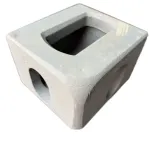
Every shipping container in the world — all 40 million of them — rests on eight critical components. Corner castings are the load-bearing blocks at each corner of an ISO shipping container, and they are the universal interface between the container and every crane, twistlock, spreader, and chassis on the planet. When you lift a container, stack it nine high on a ship, or lock it to a truck trailer, every ton of force flows through these fittings.

Construction cabin – selection, tips, dimensions and prices
Every construction project – whether a family house, a development project or a reconstruction – starts with the infrastructure. No construction manager, craftsman or investor who needs an on-site office, a changing room for workers or a safe storage for tools can do without a quality construction cell. But navigating the offer is not easy: residential containers, sanitary cells, storage modules, rental, purchase, refurbished pieces… This guide will give you answers to all the essential questions in one place.
Storage container
A storage container is a lockable steel box designed for the safe and dry storage of materials, tools, goods or equipment. Originally created as a shipping container for maritime transport, its durability and versatility have found their way onto construction sites, corporate premises and private land.
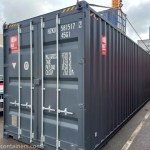
Shipping container 12m (40 ft)
A 12m shipping container is an investment that, if properly selected and cared for, will pay off in decades of trouble-free use. Whether you plan to use it as a warehouse, workshop, garage or the basis for a residential module — the key is careful selection of the condition, a thorough inspection before purchase and high-quality preparation of the base for placement. Take the time to compare offers, check the seller’s references and do not hesitate to personally inspect the container before buying. A properly selected 40-foot container will serve you reliably for many years.