
What is the Permissible Noise Level in dB for Refrigerated Containers?
“Permissible noise level in dB for refrigerated containers” refers to the acceptable noise levels (measured in decibels, dB) generated by cooling units mounted on containers. These containers, also known as reefer containers, are used to transport temperature-sensitive goods, such as food, pharmaceutical products, or chemicals. Noise regulation for these containers is crucial for balancing operational efficiency with environmental protection against noise pollution, public health, and standards for urban noise management.
Noise generated by cooling units is primarily caused by compressors, fans, and auxiliary motors. These components work to maintain specific temperature requirements for transported goods. Permissible noise levels are typically set by local laws, international standards, and specific industrial or environmental regulations.
Key Concepts
1. Noise Levels (Decibels – dB)
Noise levels in reefer containers are measured in decibels (dB), which is a logarithmic unit used to express the level of sound pressure. For comparison:
- Whisper: 30 dB
- Normal conversation: 50–65 dB
- Commercial cooling units: 45–75 dB (depending on the type and model of the unit)
- Urban street noise: 70–85 dB
Reefer containers often operate at levels of 62–72 dB when measured from a distance of 1 meter, with variations depending on unit design, manufacturer, and operating conditions.
2. Cooling During Transport
Cooling during transport refers to systems that maintain a specific temperature for goods during transportation. Commonly used in reefer containers, these systems are essential for long-distance logistics and ensure the integrity of goods subject to spoilage or temperature sensitivity. However, they contribute significantly to urban noise pollution, particularly in residential or mixed-use areas.
Cooling Units

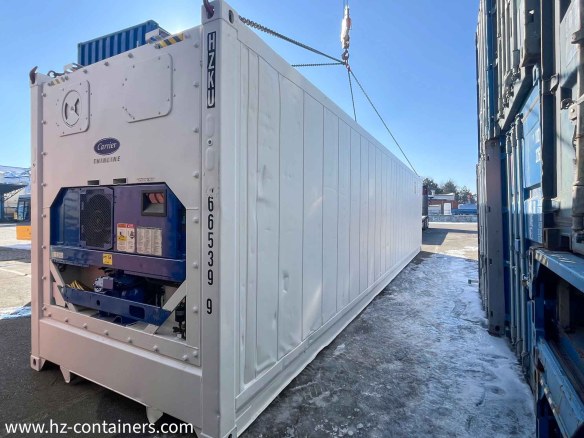
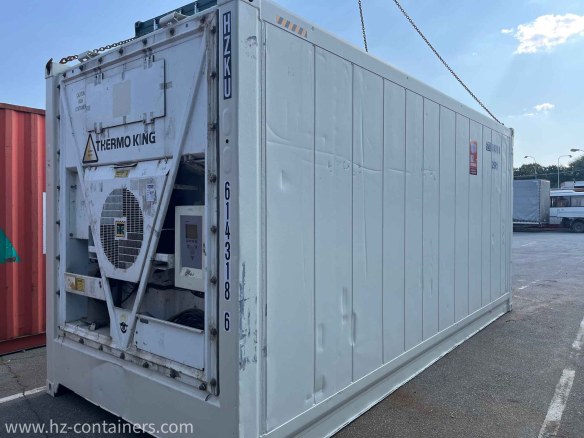
Cooling units are the core of reefer containers. They consist of components such as compressors, evaporators, condensers, and fans. Noise from these units comes from:
- Compressor vibrations: Compressors generate noise when compressing refrigerant gas.
- Ventilation systems: Fans push air through evaporators to regulate temperature, which causes a buzzing or humming sound.
- Diesel engines: Many cooling units use independent diesel engines, which significantly contribute to noise levels, especially in urban areas.
Popular manufacturers include Carrier Transicold, Thermo King, Daikin, and Starcool.
Sources of Noise in Containers
The main sources of noise in reefer containers include:
- Compressor operation: Compressors create noise when compressing refrigerant.
- Ventilation systems: Fans produce buzzing or humming sounds when blowing air through heat exchangers.
- Diesel engines: Independent diesel power units significantly contribute to overall noise, especially in urban areas.
Noise Reduction
Noise reduction includes strategies and technologies aimed at reducing the sound level emitted by cooling units. These may include:
- Anti-noise barriers: Acoustic panels or appropriate container placement to reduce noise propagation.
- Low-noise technology: Advanced compressors, quieter engines, and better insulation.
- Soundproofing: Installation of sound-insulating materials in units or surrounding infrastructure.
Regulations and Standards
1. Global and Local Standards
Noise regulations for reefer containers are enforced through international and local directives:
- ISO standards (e.g., EN ISO 3744:2010): These define acceptable noise levels and measurement methods for cooling equipment in commercial and industrial settings.
- Urban noise ordinances: Cities, such as New York, have specific noise ordinances (e.g., NYC Noise Code) that limit container noise levels in residential or mixed-use zones.
For example:
- In the United Kingdom, noise from commercial cooling equipment should ideally not exceed 45–75 dB depending on the equipment and environment.
- In New York, the maximum permissible noise level for air conditioning or cooling units near residential buildings is 42 dB at a distance of 3 feet from an open window.
2. Permissible Noise Levels
The permissible noise level for cooling units often depends on local zoning laws. For example:
- Industrial zones: Higher noise thresholds (e.g., up to 75 dB during the day).
- Residential zones: Stricter limits (e.g., 40–50 dB depending on time of day).
3. Noise Measurement
Noise from reefer containers is measured using sound level meters. Measurements take into account:
- Distance from the source: Noise is louder closer to the container; regulations often specify distances (e.g., 1 meter, 15 feet) for standardized readings.
- Background noise: High levels of ambient noise in urban areas can make isolated measurements difficult.
Why Is This Important?
1. Environmental Protection
Excessive noise contributes to environmental pollution, which affects both ecosystems and quality of life in urban environments. Regulations aim to minimize noise pollution while enabling efficient operation of refrigerated logistics.
2. Public Health
Noise exposure above 70 dB, particularly in residential areas, can lead to health problems such as stress, hearing loss, or sleep disorders. Limiting container noise protects residents living near industrial zones, ports, or warehouses.
3. Industry Compliance
Transportation and logistics companies must comply with noise regulations to avoid penalties, maintain good community relations, and ensure sustainable practices.
Frequently Asked Questions (FAQs)
Question 1: How is noise from reefer containers measured?
Noise is measured using a sound level meter at specific distances (e.g., 1 meter or 15 feet). Readings are taken in dB(A), which accounts for human hearing sensitivity, or in dB(C) for low-frequency sounds, such as bass vibrations.
Question 2: What are typical noise levels for cooling units?
Cooling units typically operate at levels of 62–72 dB at a distance of 1 meter. However, newer models may be quieter due to advanced low-noise technologies.
Question 3: How can noise from cooling units be reduced?
Noise reduction measures include installing anti-noise barriers, using quiet compressors, and performing regular equipment maintenance to minimize operational noise.
Question 4: Can reefer containers operate in residential areas?
Yes, but operators must comply with stricter noise limits (e.g., below 50 dB) to avoid disturbing residents.
Question 5: Are there penalties for exceeding permissible noise levels?
Yes, exceeding noise limits can result in fines, operational restrictions, or legal action depending on local regulations.
 Czech Republic, Třebíč
  FREE SHIPPING

Other container news...
40 Foot High Cube container cost
A 40 foot high cube container — often abbreviated as 40ft HC, 40′ HC, or 40-foot high cube — is one of the most common shipping container sizes sold on the secondary market. But if you are researching what a 40 foot high cube container costs, you have almost certainly noticed that prices are all over the map. One seller quotes $1,500. Another quotes $7,000. Both could be legitimate.
20 Foot container cost
If you have ever searched for a shipping container, you have almost certainly asked one question first: how much does a 20 foot container cost? The answer is not a single number. It is a range that spans from under $1,000 for a weathered, as-is unit to over $5,000 for a pristine, one-trip container — and that is before delivery, site preparation, or modifications enter the picture.
Buy shipping containers
Buying a shipping container means purchasing a standardized steel intermodal box — typically 10, 20, or 40 feet long — for use as ground-level storage, job site equipment housing, cargo transport, or architectural conversion. The right container can last decades. The wrong one can leak, rust through, or fail inspection the day it arrives. This guide covers every step of the process, from understanding what you’re actually buying to inspecting it in person and preparing your site for delivery.

20 Foot shipping container cost
If you are researching the cost of a 20 foot shipping container, you have likely already encountered wildly different prices — from $999 listings online to quotes exceeding $5,500. That range is not a sign of inconsistency. It reflects real differences in container condition, location, delivery logistics, and the seller you are dealing with.