
Container 20 HC
20 HC container (also known as shipping container 20′ High Cube) is a standardized transport and storage unit that combines the compact footprint of a 20-foot container with an increased height of approximately 2.9 meters. Compared to the classic 20′ DC (Dry Container), it offers roughly 30 cm more vertical space, which means approximately 10–12% more internal volume on the same footprint. Thanks to this feature, it ranks among the most versatile container types on the market — used in maritime, road and rail transport, but increasingly also as a basis for modular buildings, warehouses, workshops or even living spaces.
What is a 20 HC container and what does the abbreviation HC mean?
Origin and history of High Cube containers
Containerization as a global phenomenon began in the 1950s thanks to American entrepreneur Malcolm McLean. The first ISO containers had a standard height of 8 feet (2,438 mm), later increased to 8 feet and 6 inches (2,591 mm), which became the standard for the so-called Dry Container (DC). With the growing volume of international trade and the demand for transporting bulkier but relatively light goods (such as furniture, electronics, textiles, automotive components), the need arose for a container with greater cubic capacity while maintaining standard length and width.
At the end of the 1980s and beginning of the 1990s, the High Cube container appeared on the market with a height of 9 feet and 6 inches (2,896 mm), which today represents the second most commonly sold type of shipping container in the world. In the European context, the 20′ HC has gained particular ground in the last two decades, when demand for flexible storage spaces and modular architecture grew.
What does “HC” mean — High Cube explained
HC = literally High Cube. This designation is used exclusively for containers with increased height — specifically 9′ 6″ (2,896 mm) compared to the standard 8′ 6″ (2,591 mm).
It is not just a marketing designation. The height difference has a fundamental impact on:
- Internal volume — an increase of 10–12% (from ~33 m³ to ~37 m³ for the 20′ variant)
- Interior clear height — approximately 2,690 mm, allowing comfortable work inside and installation of shelving systems
- Conversion possibilities — building permits often require a minimum clear height of 2,500 mm, which 20′ DC does not meet, while 20′ HC does
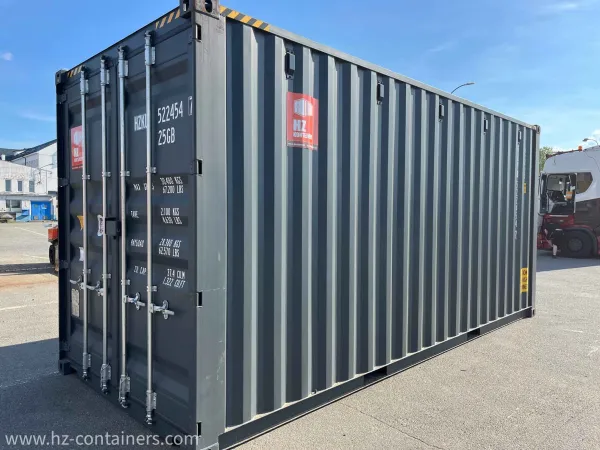
ISO designation and classification (code 25G1)
Every shipping container has its ISO code that precisely identifies its type and dimensions according to international standard ISO 668. For a 20′ HC container, the standard designation is 25G1, where:
| Part of code | Meaning |
|---|---|
| 2 | Container length: 20 feet |
| 5 | Height: 9′ 6″ (High Cube) |
| G | Type: General Purpose (universal, dry container) |
| 1 | Features: with ventilation openings in the upper part |
For comparison, a standard 20′ DC container bears the code 22G1 (height 8′ 6″). This numbering is key in international transport, customs clearance and when searching for a specific container in carrier databases.
What are the exact dimensions of a 20 HC container?
Exact dimensions may vary slightly depending on the manufacturer (e.g., CIMC, Singamas, Maersk Container Industry), but the standard given by ISO 668 is as follows:
External dimensions
External dimensions are critical for logistics — they determine how the container is placed on a ship, wagon or truck:
| Parameter | Metric units | Imperial units |
|---|---|---|
| Length | 6,058 mm | 19′ 10.5″ |
| Width | 2,438 mm | 8′ 0″ |
| Height | 2,896 mm | 9′ 6″ |
Key difference compared to 20′ DC: height 2,896 mm vs. 2,591 mm — that is exactly 305 mm (1 foot) more.
Internal dimensions and usable space
Internal dimensions are slightly smaller due to wall, floor and ceiling thickness (approximately 25–30 mm on each side):
| Parameter | Metric units | Imperial units |
|---|---|---|
| Internal length | 5,898 mm | 19′ 4.2″ |
| Internal width | 2,352 mm | 7′ 8.6″ |
| Internal height | 2,698 mm | 8′ 10.2″ |
| Internal volume | ~37.2 m³ | ~1,315 cu ft |
| Usable floor area | ~14.0 m² | ~151 sq ft |
Door dimensions and clear height
| Parameter | Metric units |
|---|---|
| Door opening width | 2,340 mm |
| Door opening height | 2,585 mm |
A door width of 2,340 mm is sufficient for comfortable handling of EUR pallets (1,200 × 800 mm), which are loaded with a forklift. The door opening height of 2,585 mm means that most delivery vans or taller machines will fit comfortably into the container — which was not possible with 20′ DC with a door height of only ~2,280 mm.
What is the difference between a 20 DC and 20 HC container?
This is one of the most common questions when deciding on a purchase. The difference may seem minor — only 30 cm in height — but in practice it is a fundamental parameter that affects usability and price.
| Parameter | 20′ DC (Dry Container) | 20′ HC (High Cube) | Difference |
|---|---|---|---|
| ISO code | 22G1 | 25G1 | — |
| External height | 2,591 mm | 2,896 mm | +305 mm |
| Internal height | 2,393 mm | 2,698 mm | +305 mm |
| Internal volume | ~33.2 m³ | ~37.2 m³ | +12% |
| Door height | 2,280 mm | 2,585 mm | +305 mm |
| Tare (weight) | ~2,200 kg | ~2,400 kg | +200 kg |
| Payload | ~28,260 kg | ~28,060 kg | −200 kg |
| Indicative price (used) | from ~1,500 € | from ~1,900 € | +400 € |
| Indicative price (one way) | from ~2,500 € | from ~3,250 € | +750 € |
| Suitable for conversion | Limited (clear height) | Yes | — |
When is it worth paying extra for the HC version?
The surcharge for the High Cube version is worth it if:
- You plan rack storage — in a 20′ HC you can install two- or three-tier racks, making efficient use of the entire volume.
- You store taller goods — machines, vehicles, bulky furniture, building materials.
- You are considering conversion — into an office, workshop or dwelling. The clear height of 20′ HC (~2.69 m) allows comfortable insulation of the ceiling and floor without loss of comfortable room height.
- You need to meet standards — building authorities often require a minimum clear height of 2,500 mm for living spaces. In 20′ DC (clear height ~2.39 m), after insulating the floor and ceiling you would drop below 2,200 mm.
- You transport bulky but light cargo — e.g. furniture, insulation, packaging materials, where the limiting factor is volume, not weight.
On the other hand, if you store heavy, low material (e.g. construction steel, bricks, cement bags) and do not need to work inside, a standard 20′ DC may be more economical.
What is the load capacity, weight and capacity of a 20 HC container?
Tare, payload and maximum weight
The technical limits of the 20′ HC container are defined by international standard and are stated on the CSC plate on the container doors:
| Parameter | Value |
|---|---|
| Tare (weight of empty container) | 2,400 kg |
| Maximum payload | 28,060 kg |
| Maximum gross weight (max gross) | 30,480 kg |
The maximum gross weight of 30,480 kg (67,200 lbs) is standard for all 20′ ISO containers regardless of height. This means that a taller HC container is approximately 200 kg heavier when empty (due to taller walls and additional material), which slightly reduces its payload compared to 20′ DC. In practice, however, this difference is irrelevant for most applications — 28 tonnes is more than sufficient for 37 m³ of volume.
Volume in m³ — how much cargo fits?
An internal volume of 37.2 m³ means that a 20′ HC container can hold approximately:
- The contents of 2–3 smaller garages
- A complete apartment set of furniture from a 3-room apartment
- Approximately 370 standard-sized cartons (60 × 40 × 40 cm)
For comparison: 20′ DC holds ~33.2 m³, which is 4 m³ less. This difference corresponds to approximately 40 large cartons more.
How many pallets fit in a 20 HC container?
The number of pallets that fit in a 20′ HC container depends on the type of pallet and the way of storage:
| Pallet type | Dimensions | Quantity per layer | Note |
|---|---|---|---|
| EUR pallet | 1,200 × 800 mm | 11 pcs | 2 rows lengthwise + 1 athwartships |
| EUR pallet (optimized) | 1,200 × 800 mm | 10 pcs | 5+5 lengthwise (standard storage) |
| Industrial pallet | 1,200 × 1,000 mm | 8–10 pcs | Depending on orientation |
| US pallet | 1,200 × 1,000 mm (40″×48″) | 10–11 pcs | One layer |
Thanks to the increased height of the 20′ HC container, it is possible in some cases to stack pallets in two layers, doubling the capacity. With two-layer stacking of EUR pallets (for goods with a height of up to ~1,100 mm per pallet), up to 22 pallets can be loaded into a 20′ HC. For comparison, in 20′ DC, two-layer stacking is significantly more limited due to the lower clear height.
What material is a 20 HC container made of?
CORTEN steel — properties and advantages
Modern shipping containers including 20′ HC are made of weather-resistant CORTEN steel (also known as COR-TEN or atmospheric corrosion-resistant steel). It is a high-strength low-alloy steel with the addition of copper, chromium, nickel and phosphorus, which has several key properties:
- Self-protective patina — upon contact with air and moisture, CORTEN forms a stable layer of rust (patina) on the surface, which prevents further corrosion. Unlike ordinary steel, which rusts through, CORTEN practically stops corrosion once the patina is formed.
- High strength — the yield strength of CORTEN steel is approximately 345 MPa, which is 30–40% more than ordinary structural steel.
- Resistance to extremes — CORTEN withstands salt seawater, UV radiation, temperatures from −40 °C to +80 °C and mechanical stress during transport.
- Low maintenance — a CORTEN steel container does not require regular painting. Lifespan under normal conditions exceeds 20–30 years.
Floor, doors and sealing
- Floor: Waterproof plywood 28 mm thick, impregnated against pests and mold (often treated according to ISPM 15 standard for international transport). Some manufacturers also offer bamboo flooring as a more ecological alternative.
- Doors: Double-leaf, steel, with rubber sealing around the entire perimeter. Each leaf opens 270° and is secured by locking rods.
- Ventilation openings: Small ventilation vents are located in the upper part of the side walls, which prevent moisture condensation inside.
- Corner castings: 8 pcs on all corners — standardized according to ISO 1161, allowing handling by crane, reachstacker or forklift.
Lifespan and durability
With proper use and minimal maintenance, a 20′ HC container reaches a lifespan of:
- Maritime transport: 10–15 years in active service (according to CSC cycles)
- Storage use: 20–30+ years
- Construction use (conversion): 30–50+ years with reasonable protection from weather
What is the use of a 20 HC container?
Storage and logistics
This is the primary and most common use. The 20′ HC container serves as:
- Material warehouse for construction companies, tradesmen and craftsmen
- Seasonal warehouse for e-shops, farmers or event organizers
- Transport unit in intermodal logistics (ship–train–truck)
- Warehouse in a closed area — safe storage of tools, machines, vehicles
Construction and industry
- Construction container — facilities for workers, tool storage on the construction site
- Technical facilities — placement of generators, compressors, pumping equipment
- Waste management — after modification as a waste sorting container
Conversion to dwelling, office or operation
The 20′ HC container is extremely popular as a basis for modular architecture:
- Living container — after insulation, installation of windows, doors and interior fittings, a compact living space (a so-called tiny house) with a usable area of ~14 m² is created
- Garden house or cottage — a quick and affordable solution
- Office — a mobile office on a construction site or in a company premises
- Operation — pop-up bar, refreshment stand, gardening showroom
- Workshop — a space for craft production with sufficient clear height
A clear height of 2.69 m is essential for conversions — after insulating the floor (10 cm) and ceiling (10–15 cm), a comfortable 2.40–2.45 m remains, meeting the requirements for living spaces.
Less traditional uses
- Swimming pool — after waterproofing and embedding into the terrain
- Sauna — thanks to resistance to moisture and temperature changes
- Garage — for a car, motorcycle or as a shelter for equipment
- Facilities for community gardens — tool storage, composting
How much does a 20 HC container cost?
The price of a 20′ HC container depends on several factors: condition, age, manufacturer, current situation on the container market and location. The following table summarizes indicative price ranges on the Czech market (June 2026):
| Container condition | Description | Indicative price excl. VAT | Who it is suitable for |
|---|---|---|---|
| New (One Way) | Manufactured in Asia, made 1 maritime trip to Europe. Almost no signs of use, with valid CSC. | 3,250 – 3,500 € | Demanding customers, conversions, representative purposes |
| Refurbished (IICL, 1–5 years) | Used in maritime transport, but in perfect technical condition. IICL quality certificate. | 2,500 – 2,900 € | Companies, storage, long-term use |
| Used (Cargo Worthy, 5–10 years) | Fully functional, waterproof, with valid CSC. May have surface rust and minor dents. | 1,900 – 2,400 € | Storage, construction, less demanding applications |
| Used (AS IS, 10+ years) | Sold “as is”. May have minor leaks, corrosion. Without valid CSC. | 1,200 – 1,800 € | Non-demanding storage, agriculture, demolition work |
Note: The price of the container must be added transport (usually 150–400 € within the Czech Republic depending on distance) and unloading, which requires a crane or hydraulic arm (50–150 €).
For comparison, the same categories for a 20′ DC container are approximately 300–750 € cheaper, reflecting lower production costs and higher availability on the market.
What influences the price?
- Global demand for transport — container prices correlate closely with the volume of world trade. During logistics crises, prices rise sharply.
- Steel price — CORTEN steel accounts for the majority of the production costs of a new container.
- Regional availability — near large ports (Hamburg, Koper, Gdańsk) prices are lower.
- Seasonality — in spring and summer, demand from construction increases, which can raise prices.
- Color and modifications — standard color is included in the price. Special RAL colors, additional doors, windows or insulation are charged extra.
What to watch out for when buying a 20 HC container?
CSC certification and technical condition
The CSC plate (Container Safety Convention) is an international safety certificate that confirms that the container meets the technical requirements for maritime transport. It is mandatory for any transport by sea or outside the EU.
When inspecting the container, check:
- Validity of the CSC plate — the plate must be legible and contain the date of the last inspection
- Watertightness — check the door sealing, roof and floor. Look inside with the doors closed to see if any light penetrates
- Floor condition — the wooden floor must not be rotten or significantly damaged. Minor scratches are normal
- Corrosion — surface rust (patina) is normal on CORTEN steel. Dangerous is deep corrosion, especially in the corners and at the junction of walls with the floor
- Deformation — significant dents on the walls or ceiling can compromise structural integrity
Transport and placement of the container
A 20′ HC container weighs approximately 2.4 tonnes and for transport requires:
- Truck with hydraulic arm or tractor with semi-trailer
- Space for unloading — a crane or hydraulic arm needs a maneuvering area of at least 10 × 5 m
- Flat, hardened surface — ideally a concrete slab, panels or compacted gravel. The container must not stand directly on clay, as this would cause corrosion of the lower part
- Access road — sufficiently wide and load-bearing for a truck (minimum 3.5 m wide)
Permits and legislation
- Building permit — if you place the container on the land as a temporary structure (up to 2 years), a building permit is usually not needed. For permanent placement or conversion to a living space, it is necessary to consult the local building authority.
- Zoning decision — in some municipalities, consent to the placement of the structure may be required.
- Fencing and security — the container should be properly locked and ideally placed in a closed area.
Common myths and misconceptions about 20 HC containers
Myth 1: “An HC container is just unnecessarily taller — DC is enough for me.”
In fact, the surcharge for HC (~400–750 €) is marginal in long-term use and the increased height provides significantly better storage options, work inside and possible conversion. If you buy a DC once and find you lack height, replacing it with HC will cost you significantly more.
Myth 2: “A used container is low quality and leaky.”
A quality used container in “Cargo Worthy” condition is fully functional, waterproof and with a valid CSC. Surface rust on CORTEN steel is desirable — it protects the material from further corrosion.
Myth 3: “20 HC and 40 HC have the same payload.”
No. The maximum gross weight of 20′ and 40′ containers is the same — 30,480 kg. This means that 40′ HC has a significantly lower payload per m³ with its larger volume. If you transport heavy cargo, 20′ HC is more suitable.
Myth 4: “You can move into a container right away.”
Without insulation, ventilation and heating, the container is extremely hot in summer and freezing in winter. A residential conversion requires complex modifications that can cost 5,000 – 20,000 € depending on the standard.
Myth 5: “No permits are needed to place a container.”
It depends on the location and purpose. Temporary placement on private land usually does not require a permit, but a permanent structure or change of purpose to dwelling does. Always check the conditions at the local building authority.
The future of High Cube containers — trends
High Cube containers, including 20′ HC, are experiencing a renaissance that goes beyond traditional logistics:
- Modular architecture and sustainable housing — growing interest in “tiny houses”, container homes and modular offices is driving demand for HC containers that provide comfortable clear height.
- Urban solutions — container “pop-up” neighborhoods, markets, community centers. In European metropolises (Amsterdam, London, Berlin), entire container villages already operate.
- Ecological aspect — upcycling used containers instead of new construction reduces the carbon footprint. One saved 20′ HC container means approximately 3,500 kg of steel that does not have to be recycled.
- Technological innovations — smart containers with IoT sensors for monitoring temperature, humidity, shocks and GPS position are becoming more accessible even for smaller companies.
- Rising standards — demand for taller containers is growing so much that some carriers are considering a further increase to “Super High Cube” (height 10′ 6″, i.e. 3,200 mm). However, this is still a niche segment.
Frequently Asked Questions
Is a 20 HC container the same as a 20-foot High Cube?
Yes. The designations 20 HC, 20′ HC, 20-foot High Cube and 20′ High Cube refer to exactly this type of container — a 20-foot container with an increased height of 9′ 6″ (2,896 mm). In Czech, the designations “vysoký kontejner” (tall container) or “zvýšený kontejner” (raised container) are sometimes also used.
What is the lifespan of a 20 HC container?
With normal storage use, 20–30 years. In maritime transport, containers are decommissioned after 10–15 years, but for land storage they remain fully functional for further decades. CORTEN steel and quality sealing guarantee a long lifespan even without special maintenance.
Can a 20 HC container be locked and secured?
Yes. Every 20′ HC container has integrated lugs for a padlock and locking rods on the doors. For increased security, a special container lock with a shrouded hasp is recommended, which is resistant to cutting and breaking.
How much does an empty 20 HC container weigh?
An empty 20′ HC container (tare) weighs approximately 2,400 kg. The weight may vary slightly depending on the manufacturer and year of manufacture, typically in the range of 2,350 – 2,450 kg.
Can a 20 HC container be transported by road?
Yes, a 20′ HC container is standardly transportable on public roads. Its external dimensions (6,058 × 2,438 × 2,896 mm) are fully compatible with European legislation for truck transport. The height of 2,896 mm is within the 4,000 mm limit for trucks.
What is the difference between a Cargo Worthy and AS IS container?
- Cargo Worthy (CW): Container in a condition suitable for transport. It is waterproof, has a valid CSC plate and meets the technical requirements for maritime and road transport.
- AS IS: Container sold “as is” — without guarantee of watertightness, often with invalid CSC. Suitable only for static storage, not for transport. The price is 30–50% lower.
Is it better to buy or rent a 20 HC container?
It depends on the length of use:
- Short-term (up to 1 year): Rental is more economical (approx. 50–80 € per month for a used 20′ HC).
- Long-term (over 2 years): Purchase pays off more. At a price of 2,400 € and a monthly rent of 65 €, the purchase pays for itself in approximately 37 months. In addition, the container does not lose significant value after use and can be resold.
Can a 20 HC container be combined with another container?
Yes, using connecting elements (rotary locking couplings, bridge couplings) containers can be connected vertically (stacked on top of each other) and horizontally (next to each other). When stacking, it is important to respect the load capacity of the lower container and use certified connecting elements according to ISO 1161. When joining side by side, it is possible to cut openings in the walls and thus create a larger space.
Does a 20 HC container need a special foundation?
Ideally a hardened, flat and drained surface:
- Concrete slab (recommended thickness 150 mm) — the best solution
- Concrete panels or paving
- Compacted gravel with a thickness of at least 200 mm
- Steel pads or wooden beams (at least 3 pcs across) for temporary placement
The container should never stand directly on the ground — the lower part would corrode and the floor could start to rot.
What are the alternatives to a 20 HC container?
- 20′ DC (Dry Container): Lower, cheaper, ideal for heavy and low material
- 10′ container: Half the length, suitable for small plots, price from approx. 1,500 €
- 40′ HC: Double the length, volume 76 m³, suitable for large warehouses. The price per m³ is more favorable than for 20′ HC
- Storage container (non-ISO): Assembled containers of various dimensions, often lighter and cheaper, but without the possibility of maritime transport
- Refrigerated container (reefer): With integrated insulation and cooling unit, suitable for storage at controlled temperature

 Břeclav, Czech Republic
 FREE DELIVERY


