
Bremen – Germany Container Depot
Bremen and Bremerhaven form one of the largest container hubs in Europe — over 5.2 million TEU pass through here annually. At HZ Containers, we offer the sale of shipping containers in Bremen. On this page, you will learn what containers we offer, how to choose the right piece, how the purchase and pickup process works, and what to focus on when assessing quality.
Why buy used shipping containers from Bremen
Bremen is not just any point on the container shipping map. It was here, on 5 May 1966, that the ship Fairland arrived — the first fully containerised vessel to ever dock in a German port. Since then, the region has become one of the pillars of European logistics.
Bremen — the heart of European container logistics
Today, the Bremerhaven container terminal has 14 berths for the world’s largest container ships. Across an area of 2.9 million square metres, 41 container cranes are in operation. The port handles 5.21 million TEU (Twenty-foot Equivalent Unit) annually, ranking it among the four largest container ports in Northern Europe. The logistics sector here employs over 38,000 people.
For you as a buyer, this means one fundamental thing: an enormous concentration of shipping containers in one place. Where hundreds of thousands of containers are turned over, a strong market for used units naturally develops. Containers that have completed their transport service move to the surrounding depots — including ours.
The advantage of buying from a port location
Thanks to the direct proximity of the port, unnecessary international transports and their associated costs are eliminated. The range is also exceptionally diverse — from standard storage containers through refrigerated to special designs. And because dozens of container companies are based in Bremen, competition keeps the prices of used shipping containers at a reasonable level. For Czech customers, Bremen is also attractive in terms of transport — the distance from Prague is approximately 600 kilometres by motorway, a route manageable in one day.
What used shipping containers we offer at the Bremen depot
The depot in Bremen stores a wide range of shipping containers. The exact current offering changes continuously based on supply and sales — we will gladly send you a specific list of units on request.
Overview of container types and sizes
Containers are primarily distinguished by length, height, and construction type. Here is a basic overview:
| Container type | Length | Width | Height | Typical use |
|---|---|---|---|---|
| 20ft standard | 6.06 m | 2.44 m | 2.59 m | Storage, construction site facilities, transport |
| 40ft standard | 12.19 m | 2.44 m | 2.59 m | High-capacity warehouse, workshop |
| 40ft High Cube | 12.19 m | 2.44 m | 2.90 m | Taller storage spaces, conversions |
| 20ft High Cube | 6.06 m | 2.44 m | 2.90 m | Smaller warehouse with higher ceiling |
| 10ft mini container | 3.00 m | 2.44 m | 2.59 m | Small storages, garden houses |
In addition to standard dry containers, we also offer refrigerated (reefer) containers, open-top containers with removable roof, and flat-rack containers for oversized cargo. Please consult our team for the current availability of special types.
Container quality grades
Every used container is classified according to internationally recognised standards. A proper understanding of these grades will save you both time and money:
| Quality grade | Condition | Suitable for |
|---|---|---|
| IICL / One-way | Almost new. One trip from the factory to Europe. Minimal cosmetic defects, no rust. | Demanding conversions, residential projects, representative purposes |
| Cargo Worthy (CW) | Fit for maritime transport. Valid CSC certification. Light signs of use. | Active transport, export, storage requiring certification |
| Wind & Water Tight (WWT) | Watertight and windproof. Visible cosmetic wear, possibly surface rust. | Dry storage, construction site facilities, farm use |
| AS-IS | Sold as it stands. No condition guarantee. | Projects, spare parts, budget conversions |
How to choose a quality used container
Buying a used container is not complicated, but it pays to know what to look for. The following checkpoints will help you distinguish a quality unit from a problematic one — even without expert knowledge.
What to focus on
Roof — the first and most important inspection. Examine it from the outside and inside. Look for holes, cracks, and deep rust. A watertight roof is essential. If the roof has been leaking, you can tell by dark stains or rot on the floor below.
Floor — shipping containers have a wooden floor, usually made of plywood. Check that it is not soft, rotten, or visibly damaged. The smell of chemicals or mould indicates problems with previous cargo or leaks.
Doors — open and close both panels. They must move smoothly and seal around the entire perimeter. Check the rubber seals — cracked or missing seals mean the container will not be watertight.
Corner castings — castings in the corners of the container. They must not be cracked or deformed. They are critical for crane handling and stacking.
Walls — light dents are common and harmless. Rust-eaten sheets or bulging walls signal a structural problem.
The difference between cosmetic and structural defects
| Cosmetic defect | Structural defect |
|---|---|
| Surface rust on the paint | Deep rust eating through the steel sheet |
| Light dents up to 5 cm | Torn or cracked sheet |
| Faded paint or scraped corners | Deformed corner casting |
| Slightly rusted hinges (still functional) | Doors that cannot be closed |
| Minor scuffs on the floor | Soft, rotten, or mouldy floor |
Surface rust is normal on a used shipping container — the steel container has spent years in a marine environment. Structural defects, on the other hand, mean compromised integrity and the associated risk.
Prices of used shipping containers — what affects the price
The price of a used container is not fixed. It varies depending on several variables and can differ from week to week.
Factors affecting the price
The price of a used shipping container is determined by five main factors. Size — a 20ft container is cheaper than a 40ft one. Quality grade — IICL costs more than WWT and AS-IS. Age — a younger container with fewer voyages under its belt has a higher price. Type — a standard dry container is the most affordable; refrigerated or special containers are more expensive. Market situation — shipping container prices fluctuate based on global demand, season, and port availability.
Indicative price ranges
| Category | Indicative range (EUR) |
|---|---|
| 20ft WWT | 850–1,500 |
| 20ft CW | 1,200–2,000 |
| 20ft IICL | 1,800–2,800 |
| 40ft WWT | 1,100–2,000 |
| 40ft CW | 1,600–2,800 |
| 40ft High Cube WWT | 1,400–2,200 |
| 40ft High Cube CW | 1,800–3,200 |
| Refrigerated (reefer) 40ft | 4,000–7,000 |
The ranges provided serve for basic orientation. Specific prices of containers currently in stock at the Bremen depot will be sent to you on request. We evaluate each container individually according to its actual condition.
How the purchase and pickup of a container from the Bremen depot works
Buying a container is a simple and transparent process that you can handle remotely from the Czech Republic.
Reservation and order
- Inquiry — Contact us by email or phone. Let us know the desired type, size, quality grade, and quantity. We can communicate with you in Czech.
- Offer — We will send you the current list of containers matching your requirements, including photos and prices.
- Reservation — Once the offer is approved, we block the selected container in your name. The reservation is time-limited.
- Payment — After the invoice is issued, you make the payment by bank transfer. The container is yours the moment the payment is credited.
- Pickup — We will arrange a pickup date at the Bremen depot. The standard waiting time from payment to the possibility of collection is 2–5 working days.
Pickup and transport
You collect the container at the depot in Bremen. You will receive the depot address and GPS coordinates when the order is confirmed. Opening hours are standardly on working days — we will specify the exact times before pickup. Entry to the depot is only possible by prior appointment. For pickup, you will need proof of payment (invoice) and a release — a unique code for container collection.
Transport of a container from Bremen to the Czech Republic
The customer arranges container transport — but you are not alone in this, and we are happy to advise.
The distance between Bremen and Prague is approximately 600 kilometres, and the journey takes about 6–7 hours. To transport a standard container, you need a truck with a hydraulic arm (“hook loader”) or a flatbed with the option of loading the container by crane — this will be provided by the depot itself. We can recommend proven carriers who have already transported containers for our customers upon request.
The transport price depends on the distance, container size, and current diesel prices. As a guideline, count on EUR 400–800 for transporting a 20ft container on the Bremen–Prague route. It pays to ask multiple carriers and compare offers.
Why buy from HZ Containers
HZ Containers is an international seller of shipping containers.
We operate on the Czech market — our website and communication are in Czech, so you don’t have to worry about a language barrier. We combine the advantage of buying directly at the port location with the comfort of dealing in your mother tongue.
Frequently asked questions (FAQ)
What is the difference between a new (one-way) and a used shipping container?
A new one-way container has made one trip from the manufacturing plant — typically from China to Europe. It is in almost perfect condition: no rust, undamaged floor, original paint. The price is 30–50% higher than for a used one. A used container has more voyages behind it and bears signs of wear, but is structurally fully functional and entirely sufficient for most dry storage or construction projects.
How do I arrange transport of a container from Bremen to the Czech Republic?
Transport is handled by the customer, either with their own or a contracted carrier. The container can be transported by a truck with a hydraulic arm or on a low-loader trailer. The depot has equipment for loading the container onto your vehicle.
What documents will I receive for the purchased container?
For every container, we issue an invoice, which serves as proof of purchase, and a handover protocol. Containers in CW (Cargo Worthy) grade additionally have a valid CSC certification — a plate placed directly on the container.
What does the CSC marking on a container mean?
CSC stands for International Convention for Safe Containers. The CSC plate on the container confirms that it meets structural and safety standards and is fit for international transport. Certification is renewed at regular intervals.
What are the dimensions of a standard 20ft and 40ft container?
20ft container: external dimensions 6.06 × 2.44 × 2.59 m (length × width × height). Internal volume approximately 33 m³. 40ft container: 12.19 × 2.44 × 2.59 m, internal volume about 67 m³. The High Cube version has a height of 2.90 m and offers 10% more internal space.
Can electricity be installed in a used container or can it be converted into a living space?
Yes, conversions of shipping containers into living units, offices, saunas, or garden houses are common today. HZ Containers specialises in the sale of standard containers — any additional modifications (insulation, electrical installation, windows, doors) are arranged by the customer themselves with a specialised company.
How long does it take before I can pick up the container?
The standard period from order confirmation and payment credit is 5–7 working days. We always arrange the specific pickup date individually based on the depot’s workload and your time options.
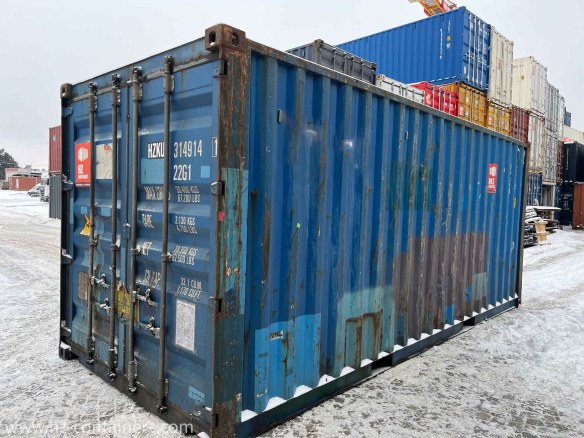
 Bremen, Germany
  WITHOUT SHIPPING

