
Shipping Container 20′ OPEN SIDE – Dimensions
In the dynamic world of logistics, storage, and innovative construction solutions, the shipping container 20′ OPEN SIDE (often referred to as 20′ OS, SD, or side-opening container) represents a key element that radically changes the rules of the game. This glossary article provides a comprehensive answer to the question “What is it?” and explores in detail its dimensions, construction, advantages, and wide range of applications – not only from the perspective of the European market, but also from global technical standards and innovations.
What is a Shipping Container 20′ OPEN SIDE? Definition and Basic Characteristics
A shipping container 20′ OPEN SIDE is a specialized type of intermodal container whose basic dimensions correspond to a standard 20-foot (approximately 6 meters) container according to the ISO 668 standard. However, its defining and revolutionary feature is the ability to open almost fully one of the longer, six-meter walls using folding (most commonly four-panel) doors. These can be opened up to an angle of 270°, allowing access to the entire interior space from the side – fundamentally simplifying loading and unloading, especially for awkwardly shaped items.
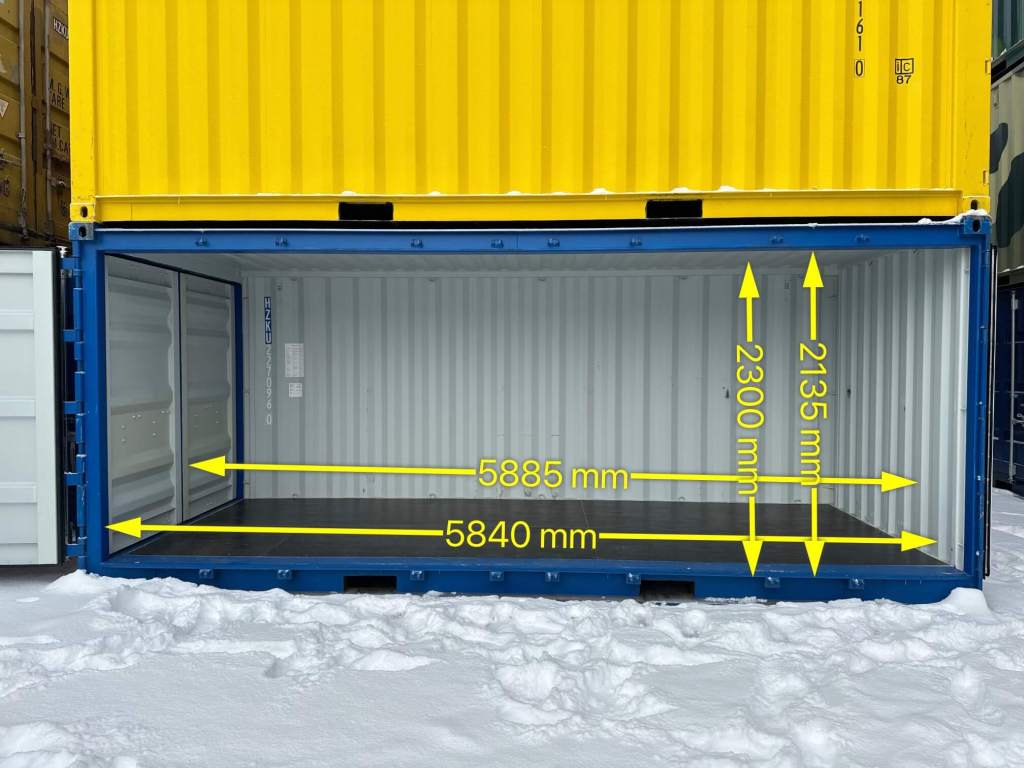
Key features of 20′ Open Side:
- Fully openable side wall (four-panel doors with opening angle up to 270°)
- Retention of standard front doors for maximum flexibility
- Construction according to ISO standards (particularly ISO 668, ISO 1496-1)
- Possibility of certification for international transport (CSC Plate)
- Fully compatible with standard handling and securing systems
This container is an ideal choice for companies and individuals who need to:
- Load and unload goods not only from the front, but also from the side,
- Work with oversized or difficult-to-handle cargo,
- Quickly and flexibly adapt storage or working space.
Detailed Dimensions and Technical Specifications
Precise dimensions and technical parameters are essential for seamless logistics, space planning, and architectural use.
Standard dimensions (according to ISO 668 standard):
| Parameter | Metric units (mm) | Imperial units (feet and inches) |
|---|---|---|
| Outer length | 6 058 | 19′ 10.5″ |
| Outer width | 2 438 | 8′ 0″ |
| Outer height | 2 591 | 8′ 6″ |
| Inner length | 5 898 | 19′ 4.2″ |
| Inner width | 2 288 | 7′ 6″ |
| Inner height | 2 299 | 7′ 6.5″ |
| Side opening width | up to 5 900 | up to 19′ 4″ |
| Side opening height | approx. 2 250 | approx. 7′ 4.5″ |
Note: Dimensions may vary slightly depending on the manufacturer and specific variant.
Weight and capacity:
| Parameter | Metric units (kg) | Imperial units (lbs) |
|---|---|---|
| Tare weight | 2 900–3 100 | 6 400–6 850 |
| Max. payload | 20 900–21 100 | 46 100–46 500 |
| Max. total weight | 24 000 | 52 910 |
| Internal volume (Capacity) | approx. 31 m³ | approx. 1 094 cu ft |

Supplementary ISO technical parameters:
- Containers are dimensioned for stacking up to 7 units on top of each other (ISO 1161) for maritime transport.
- All dimensions and materials are subject to standards:
- ISO 668 (dimensions and marking)
- ISO 1496-1 (testing and trials)
- ISO 1161 (corner castings)
- ISO 830 (terminology)
- CSC (International Convention for Safe Containers)
- UIC (International Union of Railways – registration for rail transport)
- Temperature resistance of the structure: -40°C to +70°C, including retention of strength and tightness.
High Cube (HC) variant:
| Parameter | HC units |
|---|---|
| Outer height | 2 896 mm (9′ 6″) |
| Inner height | approx. 2 698 mm |
| Internal volume | approx. 35 m³ |
Construction, Materials, and Key Features
Materials and construction solutions
Shipping containers 20′ Open Side are made from high-strength COR-TEN steel (SPA-H, CORTEN A/B), which meets demanding requirements for resistance to atmospheric corrosion (so-called “weathering steel”). All key parts such as frame, walls, doors, and floor have specific technical specifications:
- Frame: Solid steel profiles with surface protection, designed for lifting at corners (twistlock), serve for safe stacking and transport.
- Walls: Fully corrugated (vertically profiled) steel sheet with high strength, with additionally reinforced frame at the side opening location.
- Doors: Side four-panel doors with opening capability up to 270°, quality hinges, and sealing around the entire perimeter (EPDM rubber seals – resistant to UV radiation and extreme temperatures). Standard double-panel doors on the front side.
- Floor: 28–30 mm thick water-resistant plywood (marine-grade plywood) or ecological bamboo flooring, tested for point loads up to 7 260 kg (16 000 lbs) per 44 square inches according to SEA BOX specifications.
- Corner castings: Cast steel sleeves, enabling handling by crane, forklift, and securing on a chassis.
- Ventilation: Min. 2–4 ventilation ducts (ABS resin – labyrinth design against water leakage), optionally more for special purposes.
Surface treatment and inspection
- Anti-corrosion coating: Multi-layer epoxy and polyurethane systems, total thickness min. 200 μm (micrometers) for maximum service life, color according to customer preference.
- Testing: Each container undergoes pressure testing for water tightness, dimensional inspection, frame strength verification, and door functionality testing (ISO 1496-1 standards).
Securing and handling elements
- Lashing rings: On floor and ceiling, min. 10 kN (1 000 kg) per point, enable cargo securing with straps and chains.
- Forklift pockets: Standard width 360 mm, height 115 mm (ISO 1161), facilitate handling in warehouses and on construction sites.
- Modification options: Internal shelving, electrical installation, insulation panels, security lockboxes.
Practical Use: More Than Just a Transport Box
Shipping containers 20′ Open Side are today a universal solution not only in logistics, but also in modern modular architecture, industry, and services.
Logistics and Storage
- Oversized and difficult-to-handle goods: Ideal for long profiles, pipes, machinery, which cannot be loaded through front doors.
- Direct access: Allows quick identification and removal of a specific part of the cargo without the need to unload everything else.
- Mobile warehouse: Often used as a secure storage facility on construction sites, in manufacturing plants, in agriculture, and for seasonal storage (e.g., mountain resorts, festivals).

Commercial, event, and architectural use
- Pop-up shops, cafes, bars: When the side wall is opened, a natural sales counter and display window is created. Often used for food trucks, mobile cafes, and festival bars.
- Trade fairs and exhibition stands: Possibility to create an original and secure stand, easily close and transport after the event.
- Mobile stages, podiums, and DJ booths: Robust base with the possibility of quick deployment.
Construction and industrial applications
- Mobile workshops and service bases: Allow equipment with shelving, work benches, compressors, insulation, and electrical installation.
- Secure material storage: Clear and protected storage of construction materials and tools directly on the construction site.
Special applications
- Humanitarian and crisis use: Quick deployment in the field as mobile clinics, warehouses, command centers, or shelters.
- Military: Modifications for military purposes – mobile operations centers, ammunition storage, workshops.
Solving Condensation Problems: Keep Your Cargo Dry
The problem of condensation (“container rain”) is typical for all steel containers – temperature fluctuations cause moisture to condense on walls and ceiling, which can damage sensitive cargo (electronics, textiles, paper).
How to effectively eliminate condensation:
| Method | Description | Suitability |
|---|---|---|
| Passive ventilation | Standard ventilation ducts allow basic air circulation | Short-term storage |
| Desiccants | Special drying bags or rods (e.g., Cargosorb), absorb moisture from the air | Transport, short-term |
| Insulation | Application of sprayed PUR foam/insulation panels. Prevents dew point formation. | Permanent installations |
| Active ventilation | Electric fans for forced air exchange. | Long-term storage/modifications |
Recommendation: For sensitive cargo, minimum 4–6 kg of desiccant per 20′ container (depending on storage duration and type of goods).
Accessories and Upgrades: Maximize Container Potential
The options for modifications and accessories are today so rich that a container can be transformed into a secure warehouse, workshop, shop, or residential module.
Most common accessories and innovations:
- Security locks and lockboxes: Steel enclosures protecting padlocks from cutting
- Handling feet (container legs): Confoot CFP allows you to set up a container without a crane even on uneven terrain.
- Shelving and storage systems: Robust shelves and tool holders as needed.
- Loading ramps: For easy handling with pallet trucks.
- Electrical installation: Lighting, outlets, heating – necessary for workshops, offices, residential modules.
- Internal safety linings: Prevent cargo movement and damage during transport.
Maintenance, Repairs, and Spare Parts
Containers Open Side are among the most durable, yet regular maintenance is recommended:
- Regular inspection: Condition of seals, absence of corrosion, condition of floor and frame.
- Repairs: Welding holes, replacement of damaged flooring, new coatings.
- Spare parts: Hinges, seals, cotter pins, locking bars, ventilation grilles.
- Professional service: Leading European manufacturers and dealers provide comprehensive service including maintenance and supplies of original parts.
Safety and Certification
Each Open Side container must comply with:
- CSC Plate (International Convention for Safe Containers) – mandatory for international transport.
- Certification ISO 668, 830, 1161, 1496-1 – guarantees safe stacking, handling, and transport.
- Testing: Each unit is subjected to pressure, strength, and tightness tests.

 Czech Republic, Třebíč
  FREE SHIPPING

