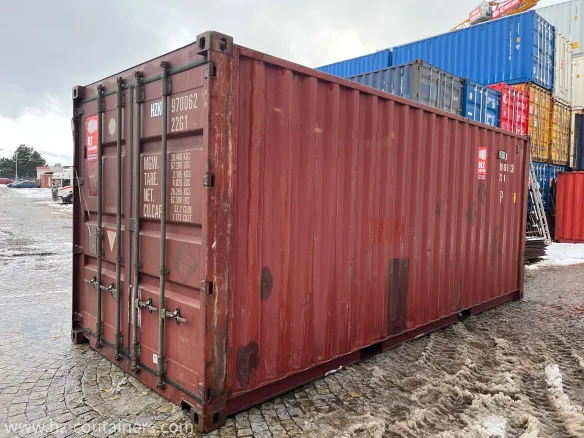
Corner Fittings
What are Container Corner Fittings?
Corner fittings, also called corner castings or corner inserts, are essential structural elements located at each of the eight corners of standard ISO 6346 shipping containers. They are robust steel blocks that form the backbone of container functionality and serve as the primary connection points between containers and various modes of transport, lifting equipment, and other containers in a stack. Made from high-strength cast steel, corner fittings are precisely engineered components that have been globally standardized to ensure compatibility throughout the international shipping industry.
The term “corner fitting” refers to large three-hole blocks made of corten or cast steel that form the structural corners of all ISO shipping containers. Each container uses exactly eight corner fittings – two at the top left corner (TL), two at the top right corner (TR), two at the bottom left corner (BL), and two at the bottom right corner (BR). These fittings weigh approximately 2.5 kilograms each and measure 178 mm × 162 mm × 118 mm according to the ISO 1161 standard. The three holes in each fitting are strategically positioned to accommodate twist-lock mechanisms, bridge clamps, and other securing devices that keep containers stable during transport.
The genius of corner fittings lies in their dual purpose: they simultaneously distribute the enormous weight and stress of loaded containers through a strong structural element while also providing standardized connection points for lifting, stacking, and securing operations. Without corner fittings, the entire modular system of maritime shipping would collapse. They represent one of the most critical innovations in the history of logistics, enabling containers manufactured in different countries and in different decades to work together seamlessly.
How do corner fittings work in shipping containers?
Corner fittings perform several critical functions simultaneously, each essential for the safe and efficient movement of containers across global supply chains. The primary function is structural load bearing – each corner fitting is designed to carry approximately 90 percent of the total container weight during lifting, stacking, and transport operations. When a container is lifted by a crane, the entire weight of the container plus its cargo passes through the four corner fittings at the top. When containers are stacked on top of each other, the weight of all containers above is transferred downward through the corner fittings to those below.
The second main function is intermodal connection. The holes in the corner fittings are precisely standardized so that the same lifting and securing equipment can work with containers worldwide, regardless of manufacturer. A twist-lock designed for ISO 1161 corner fittings will work with corner fittings made in India, China, Europe, or anywhere else. This standardization is what makes the entire container shipping system possible. A container can move from a ship to a truck, to a train, and back to a ship, with seamless connection at each transition, because the corner fittings are identical.

The third function is vertical and horizontal stacking stability. When containers are stacked on top of each other – sometimes reaching heights of ten or more containers on a ship – the corner fittings of the lower containers must align perfectly with the corner fittings of the upper containers. The distance between corner fittings is standardized at 2259 mm in the width direction (dimension P) and either 5853 mm for twenty-foot containers or 11985 mm for forty-foot containers in the length direction (dimension S). This precise spacing ensures that containers nest securely without shifting or tilting, preventing accidents and damage.
The fourth critical function is connection point standardization. The holes in the corner fittings are not all the same shape or size. Top corner fittings have an oval hole on the long side and a shield-shaped hole at the front or rear. Bottom corner fittings have two oval holes on opposite sides and a large stacking hole underneath. This variation in hole geometry is intentional – it prevents incorrect equipment connection and ensures that lifting and securing devices are applied correctly. The oval holes typically measure 2–3 inches in diameter (although they are more oval than perfectly round), while the shield-shaped holes have varying dimensions. The stacking holes on the top and bottom of the fittings are much larger and are specifically designed for vertical stacking cones used when stacking containers in depots or on ships.
What are the four types of corner fittings?
Each ISO shipping container requires eight corner fittings of four distinct types, determined by their position on the container. Understanding these four types is essential, as they are not interchangeable – attempting to use a top fitting where a bottom one should be, or a left fitting where a right one should be, will result in misalignment and potential safety hazards.
Top Left Fitting (TL) is located at the top left corner of the container as seen from the outside. These fittings have an oval hole on the long side of the container and a shield-shaped hole at the front or rear. The stacking hole is located on the top surface of the fitting. Top left fittings are mirror images of top right fittings but are internally marked as TL.
Top Right Fitting (TR) is located at the top right corner and is identical to the top left fittings, except that they are mirror images – the holes are in the same relative positions, but the fitting is rotated. Like all top fittings, they have the stacking hole on top.
Bottom Left Fitting (BL) is located at the bottom left corner and has two oval holes on opposite sides plus a large stacking hole on the bottom surface. Bottom fittings are structurally similar to top fittings but inverted, with the stacking hole at the bottom instead of the top.
Bottom Right Fitting (BR) mirrors the bottom left fitting in the same way that the top right mirrors the top left. The holes are positioned identically to the bottom left fitting, but the fitting is rotated horizontally.
To identify what type of fitting you are looking at, each fitting has two letters cast into its inner surface, visible when looking through the stacking hole: TL, TR, BL, or BR. This marking system ensures that no mix-up occurs during installation or repair.
| Fitting Type | Position | Hole Characteristics | Stacking Hole |
|---|---|---|---|
| TL (Top Left) | Top left corner | Oval on long side, shield-shaped at front | Top |
| TR (Top Right) | Top right corner | Oval on long side, shield-shaped at rear | Top |
| BL (Bottom Left) | Bottom left corner | Two oval on opposite sides | Bottom |
| BR (Bottom Right) | Bottom right corner | Two oval on opposite sides | Bottom |
What are the ISO 1161 standards for corner fittings?
The ISO 1161:2016 standard is the international standard governing the design, dimensions, strength specifications, and functional requirements for corner fittings used in shipping containers. This standard, established by the International Organization for Standardization, is arguably the most critical document in the entire shipping container industry, as it ensures global compatibility and safety.
Standard dimensions: The basic dimensions for all ISO 1161 corner fittings are length 178 mm × width 162 mm × height 118 mm. However, this is not a simple measurement – it includes specific tolerances that must be maintained within millimeters. The internal width of the oval hole must be 98 mm to ensure that twist-locks and other equipment fit correctly without jamming. The steel thickness at the oval hole must be at least 18 mm – this is a critical safety measurement, as thinner fittings indicate non-ISO-compliant components that may fail under load.
Strength requirements: ISO 1161 specifies precise strength requirements for corner fittings, including tensile strength, yield strength, and impact resistance. Cast steel corner fittings must be capable of withstanding the enormous forces generated during lifting, stacking, and transport. Each corner fitting must be able to handle forces in the range of tens of tonnes without deformation or cracking. The standard requires that corner fittings be tested for mechanical strength and that they maintain their integrity under the maximum loads they will experience in service.
Functional requirements: The standard specifies precise hole dimensions and tolerances, the positioning of these holes, and the surface finish of the fittings. All holes must be machined to precise dimensions and positioned within millimeters of their specified locations. The surface finish must be smooth and free of defects that could impede the operation of twist-locks or other equipment.
Certification: All corner fittings sold as ISO 1161-compliant must be certified by recognized classification societies such as GL (Germanischer Lloyd), BV (Bureau Veritas), CCS (China Classification Society), or ABS (American Bureau of Shipping). Certification involves rigorous testing and inspection to ensure that the fittings meet all dimensional and strength specifications.
| Parameter | Value | Unit |
|---|---|---|
| Length | 178 | mm |
| Width | 162 | mm |
| Height | 118 | mm |
| Weight | ~11 kg | kg |
| Wall thickness | min. 19 | mm |
| Internal width of oval hole | 98 | mm |
| Minimum thickness at oval hole | 18 | mm |
What materials are used in corner fittings?
The choice of material for corner fittings is critical, as these components must withstand enormous loads, harsh environmental conditions, and the corrosive effects of salt water for many years of service. Several materials are used, each with distinct advantages and disadvantages.
Cast steel is by far the most commonly used material for corner fittings, particularly in ISO-compliant containers. Cast steel is chosen because it offers an exceptional combination of strength, durability, weldability, and cost-effectiveness. Cast steel contains no alloying elements beyond iron and carbon, giving it excellent machinability and allowing it to be safely welded to the container frame. The steel has a tensile strength of approximately 70–36 degrees (ASTM A27 standard), meaning it can withstand very high loads without deformation. Cast steel can effectively operate at temperatures from -40°C to +50°C, making it suitable for containers transported through arctic regions or tropical ports. The main disadvantage of cast steel is that it is susceptible to corrosion and rusting when exposed to salt water and moisture, which is why ISO containers are typically coated with a protective paint.
Corten steel (also called weathering steel or COR-TEN) is a special type of steel that forms a protective oxide layer on its surface when exposed to the elements. This oxide layer prevents further corrosion, making corten steel ideal for containers that will spend extended periods at sea or in open storage. Many ISO containers use corten steel for their corner fittings, as the material essentially “self-protects” against rusting. The disadvantage is that corten steel is more expensive than standard cast steel and is slightly more difficult to weld.
Ductile iron is sometimes used for corner fittings, particularly in older containers or special applications. Ductile iron is stronger and more impact-resistant than grey cast iron and weighs less than cast steel while providing similar strength. However, ductile iron is less commonly used in modern ISO containers because it is more difficult to weld and does not perform as well at extremely low temperatures.
Aluminum is occasionally used for corner fittings in special applications where weight reduction is critical, such as in refrigerated containers or containers intended for air transport. Aluminum is naturally corrosion-resistant and much lighter than steel, but it is significantly more expensive and does not provide the same load capacity as steel. Aluminum fittings require careful engineering to meet strength specifications and are not suitable for standard cargo containers.
| Material | Strength | Corrosion Resistance | Weldability | Cost | Application |
|---|---|---|---|---|---|
| Cast steel | High | Low (requires coating) | Excellent | Low | Standard ISO containers |
| Corten steel | High | High (self-protecting) | Good | Medium | Marine containers |
| Ductile iron | Medium-high | Medium | Difficult | Low | Older containers |
| Aluminum | Medium | High | Difficult | High | Special applications |
How are corner fittings installed on containers?
Corner fittings are permanently attached to the container frame by welding, the most common and most reliable method of attachment. The welding process involves heating the corner fitting and the container frame to the melting temperature of steel and joining them into a single structural unit. Welding is preferred because it creates a permanent, load-resistant joint that is as strong as the materials themselves.
The welding process for corner fittings is highly specialized and must be performed by qualified welders following strict procedures. The container frame must be properly prepared, with all surfaces cleaned of rust, paint, and other contaminants that could weaken the weld. The welder must maintain precise temperatures and welding speeds to ensure that the weld fully penetrates both the fitting and the frame. After welding, the joint is inspected using non-destructive testing methods such as ultrasonic inspection or radiography to verify that the weld is free of defects.
In some cases, corner fittings may be attached using mechanical fasteners (bolts and nuts) instead of welding, but this method is less common and less reliable than welding. Mechanical fastening requires holes to be drilled into both the fitting and the frame, which weakens both components and creates potential leak points. Mechanical joints can also loosen over time due to vibration and the constant flexing of the container during transport.
Modern container manufacturing uses automated welding systems that ensure consistent, high-quality welds on every corner fitting. These systems precisely position the corner fitting, apply the correct amount of heat and filler material, and monitor the welding process in real time to detect any defects.
What are the common problems with corner fittings?
Although corner fittings are robustly designed, they can suffer damage and degradation during their service life, particularly in harsh marine environments. Understanding common problems is essential for container owners and operators who must maintain their equipment.
Corrosion and rusting are the most common problems affecting corner fittings made from standard cast steel. Salt water, moisture, and atmospheric oxygen all promote the formation of rust on unprotected steel surfaces. Rust is not merely a cosmetic problem – it actually weakens the structural integrity of the fitting by converting solid steel into brittle rust. A corner fitting that has been exposed to salt water for many years may have significant corrosion pitting that reduces its load capacity. This is why ISO containers are regularly repainted and why corten steel is increasingly used for new containers.
Cracks and fractures can develop in corner fittings due to impact damage, overloading, or material fatigue. A container that is dropped during handling, struck by another container, or subjected to shock loading may crack at the corner fittings. Once a crack forms, it will propagate under load, potentially leading to catastrophic failure. Cracked corner fittings must be immediately repaired or replaced, as they represent a safety hazard.
Deformation and bending can occur when containers are overloaded or subjected to lateral forces during transport. If a corner fitting is bent, it will no longer align correctly with other containers in a stack and twist-locks may not fit properly. Bent corner fittings can sometimes be straightened using careful heating and mechanical manipulation, but severely deformed fittings must be replaced.
Hole loss or hole damage can result from impact damage or repeated insertion and removal of twist-locks over many years. If the edges of a hole become damaged or enlarged, twist-locks may not seat properly and could disengage during transport. Damaged holes can sometimes be repaired by welding and re-machining, but this is a specialized repair procedure.
Weld failure at the joint between the corner fitting and the container frame can occur due to poor initial welds, weld corrosion, or material fatigue. If the weld fails, the corner fitting may separate from the container frame, which would be catastrophic. Weld failures are rare in properly manufactured containers but can occur in containers that have been subjected to extreme conditions or in containers manufactured to poor standards.
| Damage Type | Cause | IICL Criterion | Action |
|---|---|---|---|
| Cracks | Impact, fatigue | Zero tolerance | Immediate replacement |
| Deformation | Overloading, lateral forces | Maximum 5 mm | Immediate replacement |
| Hole enlargement | Wear | Maximum 66–127 mm | Immediate replacement |
| Steel loss | Corrosion | Zero tolerance | Immediate replacement |
| Weld failure | Manufacturing defect | Zero tolerance | Immediate replacement |
How do twist-locks and bridge clamps work with corner fittings?
Twist-locks and bridge clamps are the primary devices used to secure containers to each other and to transport vehicles. These devices work by engaging with the holes in the corner fittings.
Twist-locks are the most commonly used securing device. A twist-lock consists of a cylindrical shaft with a locking head that fits into the oval hole of a corner fitting. The twist-lock is inserted into the hole and then rotated 90 degrees, causing the locking head to expand and lock against the sides of the hole. This creates a mechanical lock that prevents the container from moving relative to the transport vehicle or adjacent containers. Twist-locks are used on the top fittings of containers to secure them to transport vehicles and to stack them on top of each other. They are also used on the bottom fittings to secure containers to transport vehicles.
A twist-lock operates in five steps: (1) Positioning – the twist-lock is aligned with the container’s corner fitting; (2) Insertion – the lock head is inserted into the corner fitting hole, providing lateral stability; (3) Rotation – the operator rotates the handle 90 degrees to activate the locking mechanism; (4) Locking – the lock head supports the container weight and secures it against vertical and horizontal movement; (5) Release – for unloading, the handle is rotated back, aligning the head for safe removal.
Bridge clamps (also called spreader bars) are used to handle containers during loading and unloading. A bridge clamp engages with the shield-shaped holes on the front and rear of the container and grips the container from the sides. This allows the container to be lifted and moved without using twist-locks.
Lashing points inside the container are used to secure cargo and prevent items from moving during transport. They differ from corner fittings but work in conjunction with them to ensure overall stability.
The precise dimensions of the corner fitting holes are critical, as twist-locks and other equipment must fit snugly into these holes without jamming or being too loose. If the hole is too small, the twist-lock cannot be inserted. If the hole is too large, the twist-lock will not lock properly. This is why ISO 1161 specifies precise hole dimensions and why corner fittings must be manufactured with extremely tight tolerances.
What is the historical development of corner fittings?
The corner fitting system was developed in the 1950s as part of the broader standardization of shipping containers. Before the development of standardized containers and corner fittings, cargo was transported in wooden crates, barrels, and other non-standard containers. Loading and unloading was extremely labor-intensive and time-consuming, and containers could not easily be stacked or transferred between different modes of transport.
The development of the ISO corner fitting standard was a collaborative effort by shipping companies, port authorities, container manufacturers, and the International Organization for Standardization. The goal was to create a system that would allow containers made by different manufacturers to be used interchangeably and easily transferred between ships, trucks, and trains.
The first ISO shipping containers, developed in the late 1950s, used corner fittings that were similar to modern designs but not yet standardized. Different manufacturers produced corner fittings with slightly different dimensions, causing compatibility problems. The ISO 1161 standard, first published in 1961, established uniform dimensions and specifications for corner fittings, enabling true intermodal transport.
Over the decades, the ISO 1161 standard has been updated several times to incorporate improvements in materials, manufacturing techniques, and testing procedures. The current version, ISO 1161:2016, reflects decades of container shipping experience and incorporates the latest knowledge in materials science and structural engineering.
What are the costs and availability of corner fittings?
Corner fittings are available from many manufacturers and suppliers worldwide. The cost of corner fittings varies depending on the material, manufacturing quality, and whether the fittings are certified to the ISO 1161 standard.
Standard cast steel fittings can be purchased for $40–60 per fitting for basic, non-certified fittings. These are sometimes used for non-marine applications or for containers not subject to international shipping standards.
ISO 1161-certified cast steel fittings typically cost $160–200 per fitting. These fittings are manufactured to precise specifications, tested for strength and dimensional accuracy, and certified by recognized classification societies. A complete set of eight fittings for one container would cost approximately $1,280–1,600.
Corten steel fittings are more expensive than standard steel fittings, typically ranging from $200–250 per fitting or more, depending on the supplier and quantity ordered.
Specialty fittings (aluminum, stainless steel, or other materials) can cost significantly more, sometimes exceeding $300 per fitting.
Leading corner fitting suppliers include Industrial Wheels, Sea Box, JC Casting, Mytee Products, and many other manufacturers located in Europe, North America, and Asia. Many of these suppliers maintain stock and can ship fittings within a few days of ordering. Some suppliers offer discounts for bulk orders or for customers who regularly purchase fittings for container manufacturing or repairs.
What are the inspection criteria and maintenance standards for corner fittings?
Inspection of corner fittings is critical for the safety and efficiency of container operations. The Institute of International Container Lessors (IICL) and the Bimco International Container Committee (BIC) have issued detailed criteria for the inspection and repair of corner fittings.
IICL inspection criteria: According to IICL, corner fittings must be inspected for visible damage, including cracks, deformation, and hole enlargement. Any cracks regardless of size require immediate replacement. Deformation exceeding 5 mm requires immediate replacement. Hole enlargement exceeding 66 mm in width or 127 mm in length requires immediate replacement. Corrosion that reduces wall thickness below the minimum required values requires immediate replacement.
Prohibition on weld repairs: One of the most important rules is that corner fittings cannot be repaired by welding or filling. The only permitted method is complete replacement of the fitting with a new, certified part. The reasons are purely technical and safety-related: welding will alter the metallurgical properties of the steel, weaken the structure, and create potential failure points.
Regular maintenance: Containers should be inspected for damage and wear at least once every sixty days. Corner fittings should be cleaned of salt and corrosion, especially after marine exposure. Protective coatings should be regularly checked and renewed.
Corner fittings are an indispensable part of the global shipping system. Their standardization, robust construction, and critical role in container logistics underscore their importance. Understanding these components is essential for professionals involved in transport, logistics, and container manufacturing, as well as for those interested in the structural engineering of transport systems. Proper maintenance, regular inspections, and timely replacement of damaged fittings are key to safe and reliable cargo transport worldwide.

 Czech Republic
  WITHOUT SHIPPING