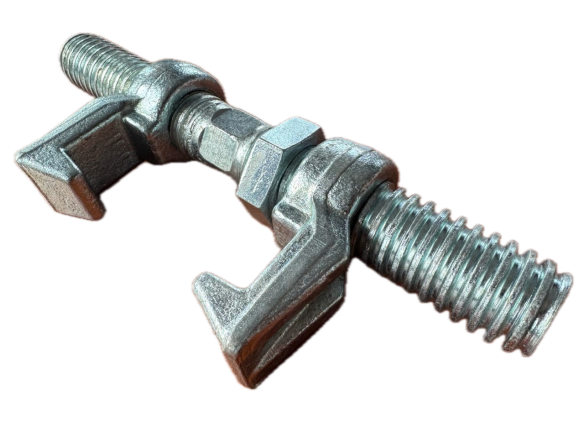
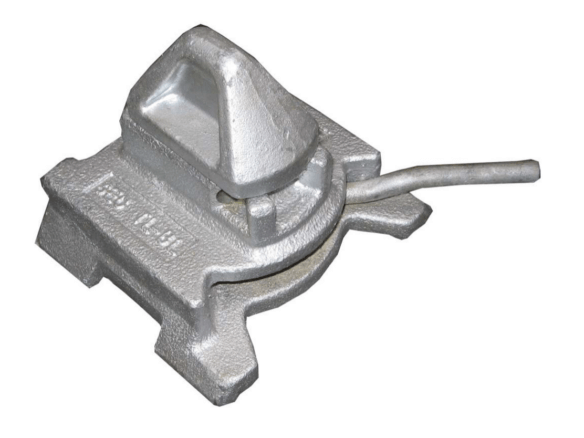
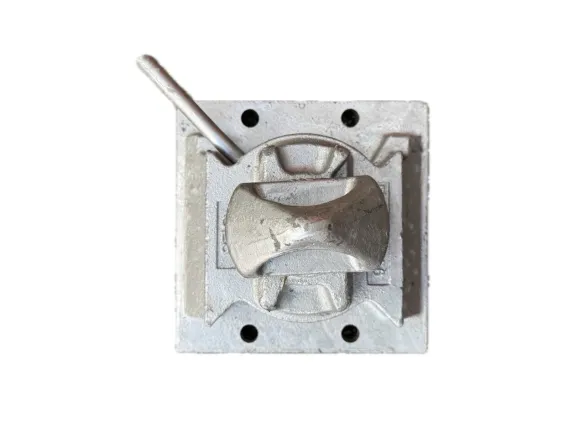
Lashing Bridge Fitting (Container Bridge Clamp)
Container Bridge Clamp (also known as lashing bridge fitting or horizontal connecting member) is a specialized, highly durable mechanical element designed for secure horizontal connection of shipping containers. Its main function is to firmly and reliably connect two adjacent containers (side by side or end to end) through their corner castings.
In practice, it functions as a load-bearing clamping mechanism that “bridges” the gap between the upper corner castings of two parallel containers. The result is a stable, unified structure in which the bridge clamp significantly increases structural integrity and safety of entire container stacks on deck and below deck of ships. This effectively prevents independent movement, shifting, or overturning of containers – which are critical risks especially in demanding conditions of maritime transport.
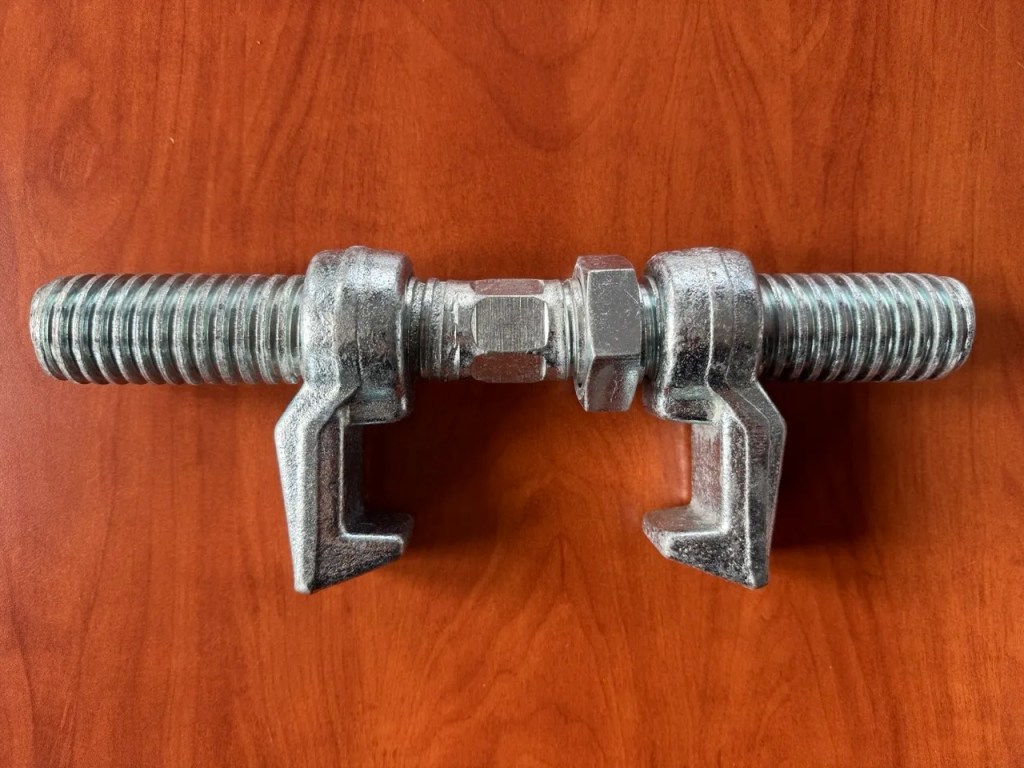
Names Used in Practice
- Bridge Clamp
- Bridge Fitting
- Lashing Bridge Fitting
- Container Bridge Clamp
- Horizontal connecting member (horizontal container clamp)
Basic Functions and Mechanism of Bridge Clamp
Principle of Mechanics and Fastening
Container Bridge Clamp consists of two main parts connected by a threaded shaft. At both ends are heads made of forged steel, designed precisely to fit into oval holes of ISO corner castings. Installation proceeds in three steps:
- Insertion: The clamp heads are inserted into opposite corner castings of adjacent containers.
- Tightening: By rotating the central nut (usually reverse thread or similar element), the protrusions are pulled together.
- Clamping Force: Once the heads are tightened, a strong clamping force is exerted, which firmly fixes the containers in relation to each other. The clamp resists both tensile (pulling) and compressive (pushing) forces.
Table: Overview of Forces Acting on the Clamp
| Type of Force | Characteristic | Protection by Bridge Clamp |
|---|---|---|
| Tensile | Pulling containers apart from each other (e.g., when ship tilts) | Clamp holds containers together like a steel rope |
| Compressive | Pushing containers together (e.g., during wave action) | Solid clamp body prevents deformation and damage |
The mechanism is designed so that the clamp, when properly tightened, will not loosen even due to vibrations or dynamic ship movements. The reliability of such a solution is key for both crew safety and protection of transported goods.
Indispensable Role in Container Securing System (Lashing System)
Horizontal versus Vertical Fixation
In the system of securing container stacks, bridge clamps play a key role in the horizontal plane, while for vertical connection, primarily twist locks and stacking cones are used.
| Type of Securing Element | Direction of Fixation | Main Use |
|---|---|---|
| Twist lock | Vertical | Connection of containers vertically between layers |
| Stacking cone | Vertical | Alignment of containers during stacking, without locking |
| Bridge clamp | Horizontal | Connection of adjacent containers in one layer |
In the top layer of the stack, horizontal stability is critical – this is precisely where the bridge clamp is used most intensively, because containers are not protected from the side by the ship’s frame, but only by other containers.
Complete Assembly of Container Securing on Ship
- Base: Twist locks connect the bottom container with fixed points on the ship’s deck.
- Intermediate Levels: Twist locks between each layer of containers.
- Top Layer: Bridge clamps connect adjacent containers horizontally.
- Diagonal Securing: Lashing bars and turnbuckles diagonally secure entire blocks against twisting (so-called racking forces).
Thanks to this combination, a compact, monolithic structure is created, which significantly increases the stack’s resistance to dynamic loading in extreme conditions of the open sea.
Types, Materials and Technical Parameters of Bridge Clamps
Most Common Types of Bridge Clamps
Overview of Variants by Design and Use:
| Type of Clamp | Length | Characteristic of Use | Typical MBL (Tensile Strength) |
|---|---|---|---|
| Standard (BE-A1) | 260 mm | For standard distances between containers | 100 kN (~10 tons) |
| Standard (BE-A1) | 380 mm | For wider gaps (e.g., reefer containers) | 100 kN/300 kN |
| Adjustable (BE-B1) | Variable (178–428 mm) | Turnbuckle design, for non-standard spacing | up to 300 kN |
- Standard Type (BE-A1): The most commonly used lengths are 260 mm (standard dry containers) and 380 mm (wider gaps for special containers or reefers).
- Adjustable Type (BE-B1): Allows precise tightening and use in various spacings, suitable even for extreme loads.
Materials and Protective Surface Treatments
- Material: High-strength forged (hardened) steel with continuous grain structure, which ensures resistance to fatigue and impact loading.
- Surface Treatment: Hot-dip galvanized for high resistance to corrosion in aggressive marine environment.
- Certification: All clamps must be approved by classification societies (ABS, DNV-GL, CCS, etc.) according to international standards ISO (ISO 1161, ISO 3874, etc.).
Key Technical Parameters
| Parameter | Standard Value | Significance |
|---|---|---|
| Minimum Tensile Strength (MBL) | 100 kN to 300 kN | Indicates the maximum force that the clamp can safely transfer |
| Length | 260 mm, 380 mm, adjustable | Depending on distance between containers |
| Weight | 3–5 kg (depending on type) | Robustness, easy handling |
| Surface | Hot-dip galvanized | Protection against corrosion |
| Certification | ABS, DNV-GL, CCS | Guarantee of international suitability and safety |
Significance and Contribution to Global Shipping Industry
Increasing Safety and Accident Prevention
The greatest contribution of bridge clamps lies in their safety function. Inadequately secured containers can lead to stack collapse and containers falling overboard – which is a serious incident with impacts on environment, crew safety, and shipping economics. Proper use of certified bridge clamps is the first line of defense against these risks.
Maximizing Capacity and Efficiency
Thanks to bridge clamps, it is possible to stack containers into higher and wider blocks without risk of their shifting or overturning. This enables maximum utilization of ship cargo space, which reduces the cost of transporting one container and increases competitiveness of carriers and customers.
Ensuring Supply Chain Reliability
Safe securing of containers is a basic prerequisite for reliability of international trade and timely delivery of goods. A robust securing system including bridge clamps eliminates the risk of cargo damage and minimizes delays in the supply chain.
Compliance with Legislation and Standards
The use of bridge clamps certified according to ISO and approved by classification societies is a legal requirement on all international routes. Every ship must have an approved Cargo Securing Manual (CSM), which defines the exact types and numbers of securing elements used. Non-compliance with these rules can lead to loss of insurance, fines, or vessel detention.
Practical Use in Various Industries
- Maritime Transport: Primary use on container ships, river vessels, ferries, and in ports.
- Land Applications: Modular buildings made from containers, temporary warehouses, mobile facilities (construction, festivals).
- Storage: Safe stacking of containers in warehouses, depots, and terminals.
- Special Projects: Modularization and prefabrication, e.g., in the construction of container hotels, schools, etc.
Certification, Standards and Recommended Practices
- ISO 1161: Standardization of corner castings and fastening holes.
- ISO 3874: Guidelines for handling and securing containers.
- Classification Societies: ABS, DNV-GL, CCS – approve design, strength, and manufacturing processes.
- Cargo Securing Manual (CSM): Cargo securing documentation for each vessel, mandatory for international transport.
Frequently Asked Questions and User Tips
How many bridge clamps are needed for one container?
Usually four bridge clamps are used to connect one container with its neighbor in the top layer of the stack – two on the front and two on the back.
How do I know if the clamp is properly tightened?
It must be tightened to the point where the nut can no longer be manually rotated further. Visually, there must be no gap between the clamp head and the corner casting.
Is it possible to reuse bridge clamps?
Yes, if they are not mechanically damaged or excessively corroded. Visual assessment is always necessary before use.
What is the lifespan of a bridge clamp?
With proper maintenance (cleaning, lubrication, corrosion inspection), it can exceed 10 years of intensive operation.
Related Terms
- Corner Casting: Container corner casting, primary point for handling and securing.
- Twist Lock: Securing mechanism for vertical connection of containers.
- Lashing Bar: Steel bar with turnbuckle for diagonal securing of stack.
- Stacking Cone: Insert for alignment of containers during stacking.
- Cargo Securing Manual (CSM): Mandatory document describing cargo securing for each ship.
- ISO Container: Standardized container according to ISO 668, ISO 6346, ISO 1161.
Conclusion: A Small Element with Key Significance
Container Bridge Clamp is seemingly an inconspicuous component, yet it is critical for the safety and efficiency of global shipping. It enables transporting containers in extreme conditions, ensures stability and cargo protection, and is a necessary condition for compliance with legislation and economic competitiveness. Its proper selection, use, and maintenance are therefore a basic prerequisite for success in modern container logistics.

 Czech Republic
  WITHOUT SHIPPING