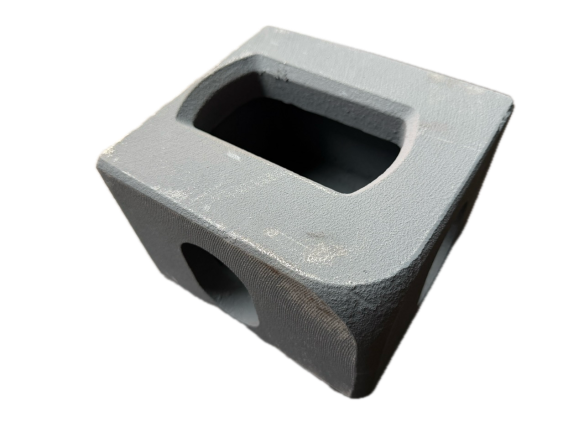
Corner casting dimensions specification
The dimensions specification of corner castings is an essential topic for anyone who works with shipping containers, their production, repairs, purchase of spare parts, or technical modifications. Corner castings, often also referred to as corner cubes or corner castings, may look at first glance like relatively simple steel parts. In reality, however, they belong among the most important elements of the entire container, because it is precisely through them that the container is lifted, stacked, anchored, and secured during transport.
If the dimensions of a corner casting do not comply with the ISO 1161 standard, a problem arises that is not only a manufacturing or assembly issue. It is a safety, operational, and commercial problem. Non-compliant dimensions can mean incompatibility with the twistlock, handling risk with the crane, improper seating during stacking, or the impossibility of using standard fastening techniques in intermodal transport. That is why not only the overall length, width, and height are monitored for these parts, but also the dimensions of the openings, wall thicknesses, the orientation of a specific piece, and manufacturing tolerances.
This guide summarizes precise technical parameters, explains what the ISO 1161 standard actually addresses, and adds context that is missing on many competing websites: why individual dimensions are important, how they relate to the function of the corner casting, and what to watch out for when replacing or purchasing.
What are corner castings and why are they so important for containers?
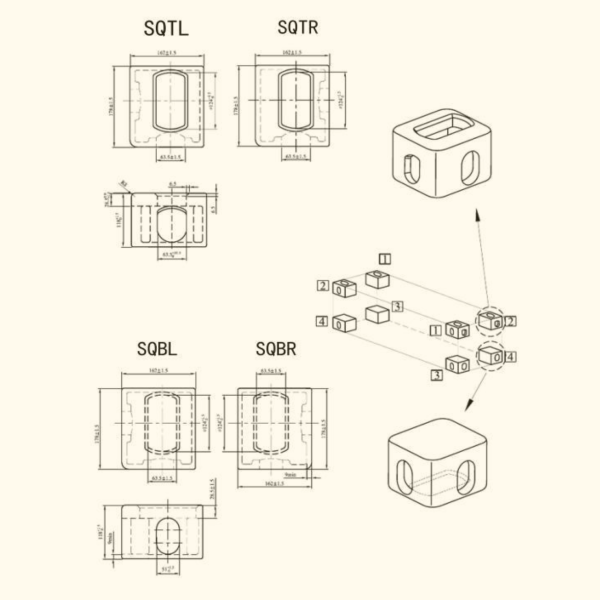
A corner casting is a standardized structural element located in each corner of a shipping container. One container usually has eight of these parts: four at the top and four at the bottom. Each of them creates an interface between the container structure and the handling or securing equipment.
Their importance lies in the fact that they are not just a “corner” of the container in a geometric sense. They are precisely defined load-bearing and functional points. It is into them that twistlocks, lifting elements, and fixing mechanisms on chassis, railway wagons, and ship decks are inserted. Without standardized corner castings, today’s global containerization as we know it would not exist.
What structural role do they fulfill?
Corner castings transfer forces between the external handling system and the container frame. When a container is lifted, the forces do not go randomly through the walls. They go through defined points that must withstand high loads, dynamic impacts, and repeated stress.
In practice, they perform three main tasks:
- enable lifting of the container,
- ensure stacking of containers on top of each other,
- serve as a standard point for anchoring and fixing during transport.
This is why the dimensions specification of corner castings is not addressed merely for manufacturing accuracy. Dimension here is directly linked to the functionality of the entire logistics system.
A corner casting is not an ordinary casting. It is a precisely defined mechanical interface between the container and the world of handling equipment.
Why is “approximately the same part” not enough?
With ordinary steel components, a small deviation can sometimes pass without a major impact. This does not apply to corner castings. The twistlock or other locking element must fit precisely. If the opening is offset, too narrow, too wide, or has an incorrect orientation, it may appear to insert on the first look, but in operation play, poor locking, or dangerous local overload may occur.
That is why corner castings are manufactured according to a standard, not “by similarity.”
What are the standard dimensions of corner castings according to ISO 1161?
The standard dimensions of corner castings according to ISO 1161 are usually given as 178 × 162 × 118 mm. These values represent the basic external dimensions of a standard container corner casting used on series 1 containers.
In technical practice, however, the three-dimensional set of values alone is not sufficient. For a proper understanding, it is also necessary to monitor the dimensions of the openings, the internal width, the wall thickness, and the manufacturing tolerances.
What are the main external dimensions?
Below is an overview of the basic dimensions you will encounter most often:
| Parameter | Typical value | Approximate value in inches | Why it is important |
|---|---|---|---|
| Overall length | 178 mm | 7.01″ | determines compatibility with the frame and container interface |
| Overall width | 162 mm | 6.38″ | affects seating and the standard external outline |
| Overall height | 118 mm | 4.65″ | important for stacking and connection to the frame |
| Internal width of the opening space | approx. 98 mm | 3.86″ | critical for the function of the twistlock and lifting elements |
| Weight of 1 piece | approx. 10.9 to 11 kg | approx. 24 lb | significant for handling, storage, and spare parts |
Manufacturers often also state tolerances, for example ±0.5 mm for some external dimensions and approximately ±1.0 mm for selected internal parameters. The exact tolerance field must always be verified against the technical documentation of the specific part and the required standard conformity.
What are the important internal dimensions and openings?
This is where the difference between the “product dimension” and the actual functional specification breaks. A corner casting is not a solid block. It contains a system of openings, the shape and orientation of which ensure multiple ways of attachment.
Typically, the following areas are monitored:
- top opening for lifting and locking elements,
- side opening for horizontal fixing and handling,
- bottom opening for stacking and locking,
- internal cavity and width, which must accommodate the standard head of a twistlock or other element.
On competing websites, a value of approximately 98 mm is often mentioned as an important internal dimension. This is operationally essential, because incorrect width directly affects compatibility with the standard locking mechanism.
Why are dimensional tolerances critical?
Tolerances are important for the same reason that tolerances on bearings, flanges, or locking mechanisms are important: the system must function repeatedly and safely. With a container, often in demanding conditions, with corrosion, dirt, impacts, and dynamic loads.
An opening that is too tight can cause difficult assembly or the impossibility of locking. An opening that is too loose can cause play, impacts, incomplete seating, and faster wear. In both cases, it is a functional failure, not just a cosmetic defect.
What exactly does the ISO 1161 standard specify?
The ISO 1161 standard specifies the dimensional and functional requirements for the corner fittings of series 1 containers. Its main goal is to ensure that containers produced by different manufacturers, in different countries, and for different transport modes remain mutually compatible.
Without this standard, each manufacturer could follow their own solution. In practice, this would mean that one container could be locked on one chassis but not on another, or that it would work in one port but fail during handling in another.
What parameters does the standard focus on?
ISO 1161 primarily addresses:
- basic external dimensions of the corner casting,
- geometry and position of functional openings,
- interchangeability requirements,
- mechanical function during handling and stacking,
- connection to standard handling and fixing equipment.
In a broader sense, the standard does not operate in isolation. It is part of the entire standardization logic of container transport, where dimension, strength, and function must correspond to the system as a whole.
Why is ISO 1161 so important for global logistics?
The container is successful precisely because it is standardized. If a corner casting has identical dimensions in Europe, Asia, and America, the same container can be lifted by a port crane without structural modifications, secured on a truck chassis, transported by rail, and stacked on a ship.
The ISO 1161 standard is therefore not “just a technical drawing.” It is the foundation of interoperability. From a commercial point of view, it is a standard that reduces friction across the entire transport chain.
How do top, bottom, left, and right corner castings differ?
One of the most common mistakes is the assumption that all eight corner castings on a container are identical. They are not. Different types exist depending on location and orientation, and they differ not only in the direction of fitting but also in the shape or orientation of the functional openings.
Why are there four basic types?
In common practice, four basic variants are distinguished:
- left top,
- right top,
- left bottom,
- right bottom.
Because the container is lifted, secured, and stacked from different directions, the opening geometry must correspond to the specific position in the structure. It is not enough to have “the same cube turned differently,” because some functional surfaces, radii, and opening orientations are defined specifically.
Comparison of basic types
| Corner casting type | Location | Character of openings | Main function | Interchangeability |
|---|---|---|---|---|
| Left top | upper left corner | orientation for top attachment and lifting | lift, upper handling | cannot be freely interchanged with the bottom one |
| Right top | upper right corner | mirror version relative to the left top | lift, upper handling | only as the corresponding right variant |
| Left bottom | lower left corner | adapted for bottom securing and stacking | stacking, chassis, anchoring | cannot be interchanged with the top one |
| Right bottom | lower right corner | mirror bottom variant | stacking, fixing | only the corresponding position |
When cannot the types be interchanged?
Non-interchangeability is not a theoretical detail. During service or when purchasing a spare part, it is necessary to verify:
- the position of the part on the container,
- the orientation of the openings,
- the right/left version,
- the top/bottom version,
- conformity with the manufacturer’s documentation and ISO 1161.
Using the wrong variant may result in the casting physically fitting into the corner, but not functioning properly with the handling equipment.
How do corner casting openings work during lifting, stacking, and anchoring?
Corner casting dimensions only make sense when connected to their function. The openings are not designed randomly. Each opening has a specific role in handling and loading.
Which opening works with the twistlock?
A twistlock is a locking mechanism whose head is inserted into the opening of the corner casting and, after being turned, typically by 90°, creates a mechanical lock. This connects the container to the chassis, ship deck, another container, or handling frame.
For this to work, the following must be true:
- the opening is correctly shaped,
- internal dimensions are precise,
- the walls are strong enough,
- seating surfaces are in the standard position.
An incorrect opening dimension does not just mean “worse assembly.” It can mean that the lock will not be turned into a safe position or will not transfer forces as it should.
How does the side and bottom attachment work?
The side and bottom openings enable various ways of handling and fixing. In intermodal transport, it is key that the same container corner can serve for multiple attachment techniques depending on whether the container is being lifted, transported, or stored.
This requires a compromise between:
- geometric accuracy,
- material robustness,
- sufficient clearance for function,
- resistance to deformation under load.
How does the load flow through the structure?
The load is not only transferred locally into the casting itself. The corner casting is a node that transfers forces into the corner posts and frame profiles of the container. If the casting is of poor quality or poorly fitted, the problem is transferred further into the entire structure.
That is why it is important to understand the corner casting dimension as part of a structural chain, not as an isolated part.
What material are corner castings made of and why?
Corner castings are most often made of cast steel or high-strength cast steel. The reason is simple: the part must combine precise geometry, impact resistance, good weldability, and high ductility.
Why not ordinary structural steel in a simple weldment?
Theoretically, it would be possible to create a corner from multiple parts, but a standard casting has several advantages:
- precise and repeatable geometry,
- better integration of complex opening shapes,
- high local strength,
- standardized manufacturing parameters,
- easier achievement of compatibility with ISO 1161.
A complex shape with multiple functional openings is solved more effectively by casting than by welding from several segments.
How does the production proceed?
Production usually includes:
- design and model of the casting,
- casting, often into a sand mold,
- cleaning and removal of runners,
- possible machining of functional surfaces,
- dimensional inspection,
- material and strength tests,
- certification or inspection according to the customer’s requirements.
With quality manufacturers, not only the chemical composition and strength are monitored, but also surface defects, internal defects, dimensional accuracy, and conformity with documentation.
What is the weight, load capacity, and strength specification of corner castings?
One standard corner casting for an ISO container usually weighs approximately 10.9 to 11 kg. This relatively small component, however, transfers very significant loads, especially when stacking fully loaded containers and during dynamic handling.
Why is weight not just a logistical parameter?
Weight indirectly indicates the volume of material and robustness of the part, but by itself does not say whether the casting is of quality. More important is what the:
- material strength is,
- wall geometry is,
- casting quality is,
- absence of cracks or cavities is,
- dimensional accuracy in critical areas is.
A lighter uncertified part may be tempting in price, but if it does not meet the required parameters, it represents an operational risk.
How do dimensions relate to load capacity?
Corner casting dimensions are not just a question of compatibility. They have a direct effect on how forces are distributed in the walls and edges of the openings. If the walls were weaker or the openings shaped differently, higher stress peaks, faster material fatigue, and a greater risk of damage during repeated operation would occur.
Precise geometry thus helps not only for the element to “fit,” but also to function safely in the long term.
Can corner castings be repaired, or must they be replaced?
In most professional applications, a conservative rule applies: a significantly damaged corner casting is usually replaced, not repaired improvisationally. The reason is the safety significance of this part.
What failures occur most often?
Typical problems include:
- deformation after impact,
- cracks,
- dents or wear of the openings,
- corrosion,
- poorly performed older repairs,
- loss of dimensional accuracy.
For less important parts, a minor repair could be acceptable. With a corner casting, however, every change in geometry affects compatibility and load transfer.
When is replacement safer than repair?
Replacement is usually the right choice if:
- a functional opening is damaged,
- a crack has occurred,
- the casting has lost its original geometry,
- it is not possible to document material and dimensional conformity after repair,
- it is a container used in professional transport.
That is precisely why, when purchasing a spare part, it is important to verify not only that it is a “corner cube,” but that it is the correct type, correct orientation, and actual conformity with ISO 1161.
How are corner casting dimensions specifications used in practice?
Corner casting dimensions specifications have the greatest value when you can make practical decisions from them. This concerns purchase, service, production, and modifications.
How to verify compatibility when purchasing?
When purchasing a spare part, check at minimum:
| Control point | What to verify | Why it is important |
|---|---|---|
| Standard | conformity with ISO 1161 | basic prerequisite of compatibility |
| Type | top/bottom, left/right | wrong type may not work |
| Dimensions | 178 × 162 × 118 mm and critical internal parameters | without them the part may not fit |
| Tolerance | manufacturer’s confirmation or drawing | decides on function with twistlock |
| Material | cast steel / cast steel corresponding to specification | affects strength and weldability |
| Weight | approx. 11 kg as an indicative value | helps reveal suspicious deviations |
| Certification | inspection documentation, possibly a third party | reduces the risk of non-compliant part |
Where are these specifications most important?
They are most important in the following situations:
- replacement of a damaged corner casting,
- production or repair of a container frame,
- purchase of parts from a new supplier,
- container modifications for construction or technological use,
- checking compatibility with the handling system.
In atypical projects, for example with container modules for buildings, there is sometimes an attempt to use cheaper or “similar” corner parts. This is a short-sighted solution. If the module is to use standard lifting and anchoring equipment, a standard corner casting remains the safest choice.
What are the most common misconceptions about corner casting dimensions?
Around this topic, several incorrect assumptions are repeated, leading to incorrect purchase or assembly.
Mistake 1: It is enough if the dimension is approximately the same
It is not enough. With corner castings, millimeters matter, and sometimes even smaller deviations in specific functional locations. Not only the external dimension is decisive, but also the position and shape of the openings.
Mistake 2: All corner cubes are interchangeable
They are not. Top and bottom variants differ functionally and geometrically. The left and right version can be mirrored. Interchanging them without verification is a common mistake.
Mistake 3: ISO 1161 means only general similarity
It does not. Conformity with ISO 1161 means that the part meets defined requirements for geometry and function. A “similar shape” without documented conformity is insufficient for professional use.
Where are corner castings and their technical specifications developing?
The basic dimensional standard is probably not going to change dramatically, because the strength of the container system is based precisely on stability and compatibility. Development is therefore heading more towards areas of production, control, and condition monitoring.
What trends are most likely?
In practice, mainly the following can be expected:
- better non-destructive quality control of castings,
- more precise manufacturing processes,
- better tracking of material origin,
- digitalization of inspection and maintenance,
- in some applications, integration of identification elements for asset management.
The future will therefore probably not bring a new basic corner casting dimension, but a greater emphasis on quality, traceability, and operational safety.
Frequently asked questions
What are the standard dimensions of corner castings?
The standard dimensions of corner castings according to ISO 1161 are usually 178 × 162 × 118 mm. In addition, the dimensions of the openings, internal width, and manufacturing tolerances are also important.
What is the ISO 1161 standard?
ISO 1161 is an international standard that specifies the dimensional and functional requirements for the corner castings of series 1 containers. Its goal is to ensure global compatibility during handling and transport.
How does a corner casting work on a container?
A corner casting functions as a standardized fastening and load-bearing point. Through its openings, the container is lifted, stacked, and secured using twistlocks and other mechanisms.
What is the difference between a top and a bottom corner casting?
Top and bottom corner castings differ in position, orientation, and functional geometry of the openings. They are not automatically interchangeable, although they may have the same basic external dimensions.
What material are corner castings made of?
Most often from cast steel or high-strength cast steel. The material must provide impact resistance, ductility, weldability, and a long service life.
What weight can corner castings bear?
The exact load-bearing capacity depends on the system and the load of the entire container, but corner castings are designed to safely transfer very high forces during stacking and handling. That is why not only the weight of the part is important, but also its certified quality.
Can a corner casting be repaired, or must it be replaced?
In case of significant damage, replacement is usually recommended. The reason is that even a small change in geometry or a hidden crack can compromise safety and compatibility.
How does a twistlock work with a corner casting?
A twistlock is inserted into the opening of the corner casting and mechanically locked by turning. This creates a secure connection between the container and the transport or stacking system.
How many corner castings does a container have?
A standard shipping container has eight corner castings: four top and four bottom.
Why are dimensional tolerances so important?
Because they determine whether the corner will properly cooperate with the twistlock, lifting equipment, and stacking elements. Even a small deviation can lead to operational or safety problems.
 Czech Republic
  WITHOUT SHIPPING