
Types and Features of Padlocks for Shipping Containers
Securing shipping containers is a cornerstone of global trade, logistics, and safe storage, whether in ports, transport, or on construction sites. Steel containers represent a robust barrier, but their most vulnerable point is the doors – and especially the locking system. By choosing the right padlock for a shipping container, you can significantly influence the level of protection against theft, unauthorized entry, sabotage, and vandalism. This glossary of terms will help you navigate the world of security locks for containers, understand the differences between individual types, materials, standards, and real risks. It draws from Czech and foreign expert sources, manufacturer and user experience, and current security trends.
Basics of Container Security: Why Lock Selection is Key
A shipping container lock is not just a “door plug.” In practice, it is the only point that can prevent a thief from quickly breaking in and stealing goods or equipment. Investment in a quality container lock protects not only the contents themselves, but also the continuity of the supply chain, your business, and often your reputation.
Unlike ordinary padlocks, which can be easily overcome with bolt cutters, grinders, or even crowbars, specialized locks for shipping containers are designed for maximum resistance to:
- mechanical damage (cutting, grinding, drilling, prying)
- manipulation (picking, bumping, decoding attempts)
- weather effects (corrosion, freezing, dust, UV radiation)
- sophisticated break-in attempts (for example, using industrial tools)
- long-term outdoor deployment (years without maintenance)
Below you will find a detailed glossary of all essential terms, types of locks, security standards, and technical details you should know before making a selection.
Types of Locks for Shipping Containers and Their Properties
Most Commonly Used Lock Types:
| Lock Type | Main Advantages | Disadvantages | Typical Use |
|---|---|---|---|
| Padlock in lock box | Maximum shackle protection, cutting resistance, suitable directly in container pocket | Correct size required, does not fit all lock boxes | Standard container, storage, transport |
| Disc padlock (“hockey puck”) | Hidden shackle, very difficult to cut, compact | Requires compatible hasp/lock box, higher price | Warehouses, containers with lock box |
| Crossbar (rod) lock/hasp system | Connects both door wings, resistance to prying and forcing | Higher purchase price, more difficult handling | Long-term storage, high theft risk |
| Internal lock | Hidden, not visible from outside, high security | Requires professional installation, more expensive | Sensitive or valuable cargo |
| Digital smart lock | Remote management, access overview, geofencing | Higher price, power requirement, possible electronics failure | Modern logistics, shared access |
Key Terms and Technical Details
Anti-Drill Plate (Drill-Resistant Plate)
- Definition: Thickness 3–8 mm, material: hardened steel, tungsten carbide, sometimes ceramic composite. Located in front of the cylinder plug pins.
- Significance: Protects against the most common lock attack – drilling. In quality locks, the plate rotates when drilling is attempted or has multiple layers of varying hardness.
- Real experience: Locks without this protection can be drilled in less than 1 minute with a standard cordless drill.
Shipping Container Security
- Physical security: Layered protection: combination of lock in lock box, security seals, and possibly a crossbar system.
- Procedural security: Regular lock inspection, access logging, lock replacement when personnel changes.
- Technological security: GPS tracking, digital keys, alarms.
- Standards: Compliance with ISO 17712, C-TPAT recommendations, AEO, TAPA.
- Practical recommendation: Even the best lock is useless if improperly installed or if a lock box is not used!
Bolt Seal
- Description: Pin diameter min. 8 mm, steel with plastic sheath for easy visual inspection.
- Use: Essential for international transport, where a “High Security” class seal is required according to ISO 17712.
- Advantage: Each seal has a unique number, which is recorded in transport documents; serves as proof of integrity.
Disc Padlock
- Construction: Circular body made of hardened steel, shackle is almost completely covered.
- Protection: Resistant to cutting – shackle is accessible only in one small part; the disadvantage is the need for precise dimensions for the lock box.
- Maintenance: Regularly lubricate the mechanism, protect against freezing in winter.
Geofencing
- Principle: Defining a virtual zone where the lock can be opened (e.g., only in the port area).
- Use: Protection against lock opening outside the permitted area; ideal for companies with multiple locations or mobile storage.
ISO 17712
- Three seal levels:
- Indicative (I): basic, plastic, for low risk.
- Security (S): higher resistance, often metal, for medium risk.
- High Security (H): only these are accepted for international freight transport.
- Requirements: Testing for tension, shear, impact. Seal must withstand min. 1,000 kg tension.
- Practical note: Many “cheap” seals claim ISO compliance, but do not actually meet it – always request a certificate!
Hardened Steel
- Properties: Hardness according to Rockwell scale HRC 45–65, resistance to cutting and drilling several times higher than ordinary steel.
- Application: Hardened steel is used not only for the shackle, but also for the lock body core and protective elements.
- Maintenance: Regularly check for signs of corrosion, if necessary treat the surface with protective oil.
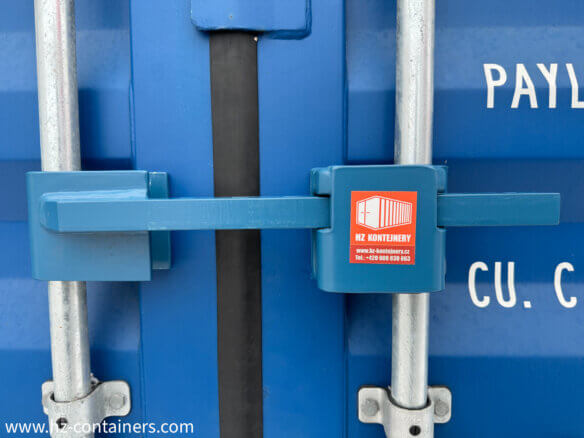
Crossbar Lock (Hasp System)
- Construction: Two horizontal arms made of hardened steel that connect the locking bars of both door wings.
- Advantage: Resistance to prying and forcing doors – distributes the force of attack across the entire width of the doors.
- Practical parameters: Weight of typical lock 3–5 kg, adjustable spacing for different container types.
- Certification: Always verify compatibility with the specific type and size of doors!
Lock Box (Locking Pocket)

- Purpose: Protects the body and shackle of the padlock from direct attack by pry bars, grinders, saws, or hammers.
- Material: Steel thickness min. 4 mm, often with corrosion-resistant surface treatment.
- Installation: Most new containers have a lock box from the factory; older ones can be welded on additionally.
- Disadvantage: It is necessary to choose a lock exactly according to the dimensions of the lock box – an unsuitable/large lock cannot be used.
NFC (Near Field Communication)
- Use: Modern smart locks allow opening via NFC chip or mobile application.
- Advantage: Low risk of signal “eavesdropping,” does not require internet at the point of use.
- Security: Access can be blocked/changed at any time; ideal for shared containers.
Tamper Resistance
- Lock-picking: Quality locks have “mushroom” shaped pins, special springs, or magnetic or disc mechanisms.
- Bumping: Require locks with bumping protection – special key profile, reinforced springs.
- Drilling: Anti-drill plate, hardened pins, multi-layer protection.
- Prying: Dual ball mechanism, reinforced shackle, lock box.
- Practical experience: Cheap locks can often be opened with a pick in tens of seconds.
Weather Resistance
- Material: Stainless steel, brass, coating (chrome, zinc, lacquer).
- Covers: Rubber covers for key hole, sealed mechanisms.
- Maintenance: Regularly lubricate, especially before winter. We recommend silicone spray or special lock lubricants.
- Testing: Quality locks are tested for salt resistance (ASTM B117 – min. 48 hours without corrosion).
Seal
- Types:
- Bolt Seal
- Cable Seal
- Plastic Pull-Tight Seal
- Function: One-time protection, proof of tampering.
- Recommendation: Always use in combination with a lock, never instead of it!
Shrouded/Hidden Shackle
- Design: Shackle is covered by lock arms or lock box, or is entirely inside the body (disc padlock).
- Advantage: Practically prevents shackle cutting, the only way to attack is destructive breaking of the entire lock.
- Disadvantage: Higher price, higher weight.
Shackle
- Material: Hardened steel, boron alloy.
- Thickness: The thicker the shackle, the better; standard is 10–15 mm.
- Length: Short shackle = less space for thief tools.
- Maintenance: Regularly check for corrosion and burrs, lubricate.
Padlock
- Construction: Body, shackle, insert, locking mechanism.
- Specifics for containers: High resistance, hidden shackle, compatibility with lock box, at least dual shackle locking.
- Selection: Choose only locks designed for outdoor use, with corrosion protection certification and drill protection.
- Recommended brands: Abloy, Abus, IFAM, Mul-T-Lock, HZK004 (specialized for containers).
- Manufacturing standards: Container locks often meet EN 12320 (European standard for padlocks).
Internal Lock
- Installation: On the inside of the door, operated by key or electronically.
- Advantage: Lock and key hole are not visible from outside, thief does not know where to attack.
- Disadvantage: Higher investment, greater installation complexity.
Additional Security Layers and Practical Tips
Combination of Security Elements
- Lock box + padlock is now considered the minimum for storage and transport of more valuable goods.
- Crossbar/hasp lock provides protection against door forcing – ideal for long-term standing on a construction site or in a yard.
- Seal always as a supplement, never instead of a lock!
- Digital lock for companies with multiple users, possibility of remote access management, and need for access logging.
Lock Maintenance in Practice:
- Regular lubrication – especially before winter, use silicone lubricants.
- Check seals and covers – prevents freezing and water ingress.
- Regular lock replacement – especially if there is suspicion of break-in attempt or personnel change.
Most Common Container Security Mistakes:
- Using a common cheap lock – easily overcome.
- Inappropriate lock size – does not fit in lock box, or is too small.
- Neglecting maintenance – lock rusts, freezes, cannot be opened.
- Missing lock box – shackle remains vulnerable.
- Poorly chosen seal – low quality, easily overcome, without certificate.
 Czech Republic
  WITHOUT SHIPPING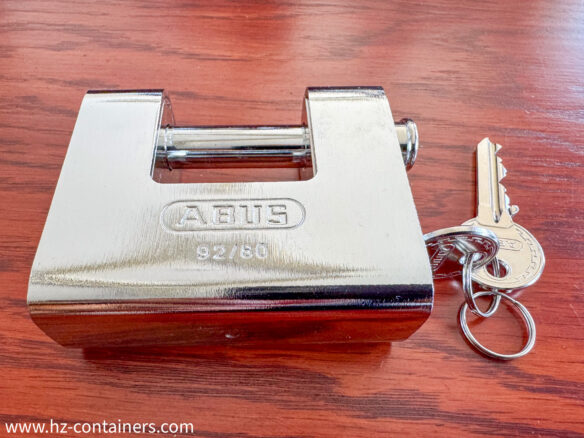
Other container news...

The OPNBar leverage tool
The OPNBar leverage tool is a professional-grade, multi-purpose hand tool designed specifically for the shipping container and trucking industry. Manufactured by Shipping Container Safety International (SCS International) and proudly Made in the USA, the OPNBar is fundamentally a 3-in-1 trucker tool that combines a shipping container door leverage bar, a tire thumper, and a 5th wheel pull hook into a single, compact steel implement. The name “OPNBar” is a direct reference to its primary function: it is the bar that “opens” containers.

40 Foot Container Dimensions
If you have ever booked ocean freight, planned a warehouse layout, or designed a modular building project, you have asked the same question: what are the exact 40 foot container dimensions — and what do they mean for what you can actually load? The numbers are standardized worldwide, but the practical implications of those numbers are surprisingly nuanced. A 40-foot container is not simply 40 feet of usable space, and its weight limits are not what most people assume. This guide covers every measurement, every weight rating, and every loading consideration you need to make informed decisions about the world’s most common shipping container.
Quick Answer: A standard ISO 40-foot shipping container measures 12.19 m (40 ft) long × 2.44 m (8 ft) wide × 2.59 m (8 ft 6 in) high externally and provides approximately 67.7 m³ (2,390 ft³) of usable internal volume. The maximum gross weight is 30,480 kg (67,200 lbs), with a typical payload capacity of approximately 26,700–26,800 kg (58,900–59,000 lbs).
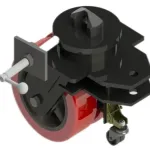
Shipping container wheels
Moving a 12-meter-long steel box that weighs up to 67,200 pounds was, for decades, exclusively a job for a crane and a licensed operator. That reality has changed. Shipping container wheels — an umbrella term covering a family of mobility solutions — now let a single person reposition a 20ft or 40ft container across a yard, warehouse, or construction site without calling in heavy equipment. This guide covers every aspect of container wheel systems: what they are, how they work, the types available, what they cost, and how to choose the right kit for your container.
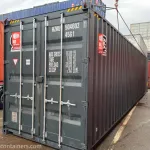
Can You Modify a 40ft High Cube Container?
The short answer is yes — you absolutely can modify a 40ft high cube container, and it is one of the most popular container types for modification projects worldwide. But the real question is not whether you can modify one; it is how to do it correctly, safely, legally, and within budget. This guide answers every dimension of that question, drawing on engineering principles, real-world pricing data, and the collective experience of thousands of modified container projects.
Key Takeaway: A 40ft high cube container offers 320 square feet of floor space with an extra foot of ceiling height compared to a standard container — making it the ideal canvas for offices, workshops, homes, retail spaces, and industrial applications. The extra height is particularly valuable when you add insulation and still want comfortable headroom.