
Shipping Container Safety
Why is shipping container safety absolutely critical?
Global trade as we know it today could not exist without shipping containers. Every day, millions of tons of goods travel across seas, roads and railways in these standardized steel boxes. Their mass expansion in the 1960s meant a revolution in logistics and forever changed the face of world trade.
With the growth in transport volumes and the emergence of complex logistics chains, however, the need for safety has also increased dramatically – not only to protect goods worth billions of dollars, but above all to protect human lives in ports, on ships and during handling. An improperly designed, damaged or poorly maintained container can cause fatal accidents, devastating cargo damage and serious environmental disasters.
For these reasons, a complex system of international standards and certifications was created, the most important of which is the International Convention for Safe Containers (CSC). This convention, together with ISO standards and other standards, sets not only design requirements, but also precise conditions for regular maintenance, inspection and certification. Everything is designed so that every container – regardless of where it is manufactured and used – is safe, reliable and fully compatible with global logistics infrastructure.
Basic regulatory framework
Main international standards and regulations
Shipping container safety is based on a set of international conventions, technical standards and control mechanisms. These regulations detail the requirements for design, manufacture, testing, operation and maintenance of containers. The combination of CSC convention requirements and ISO standards is particularly important.
Table: Comparison of key standards and their significance
| Standard/Convention | Scope of application | Main requirements | Note |
|---|---|---|---|
| CSC (Convention for Safe Containers) | Safety of operation, inspection, labeling | Strength tests, inspection, label, recognition within signatory states | Applies to all shipping containers in international transport |
| ISO 668 | Dimensions, classification | Standardized dimensions and maximum weights (20′, 40′, 45′, etc.) | Ensures compatibility worldwide |
| ISO 1496 | Construction and testing | Details of construction, testing procedures, materials | Specifies requirements for various types of containers |
| ISO 1161 | Corner elements (corner castings) | Material, dimensions, strength, placement | Key for lifting/stacking |
| ISO 6346 | Marking | Coding, identification, marking | Unique identification, BIC codes |
International Convention for Safe Containers (CSC)
Basic characteristics
- Adopted: 1972, in force since 1977
- Administrator: International Maritime Organization (IMO)
- Purpose: To ensure that all shipping containers used in international transport are safe, sturdy, regularly inspected and easily identifiable.
- Scope: Applies to containers with minimum dimensions and corner elements that allow crane handling and stacking.
Two main objectives of the convention:
- Ensuring the safety of persons: Containers must withstand extreme loads during handling, stacking, transport at sea and on land.
- Supporting international trade: By introducing uniform safety rules that replace various national standards and thus facilitate global transport.
Technical annexes of the convention:
- Annex I: Legislative and procedural requirements – approval, testing, inspection, maintenance, labeling.
- Annex II: Strength tests and structural integrity – detailed description of testing methods.
Principle of mutual recognition
Once a container is certified and marked in one signatory country, it is automatically recognized in other states that have signed the convention. This is the basis for easy movement of containers between continents.
International Maritime Organization (IMO)
- Specialized UN agency for maritime transport.
- Role in container safety: Creates and updates the CSC convention, coordinates changes according to technology/logistics developments, issues guidelines and recommendations.
- IMO website: Source of current convention texts, lists of signatory states and technical annexes.
International Organization for Standardization (ISO)
Main role of ISO in container safety
- ISO standards determine the basic design parameters, materials, dimensions and marking of containers.
- They apply to all manufacturers, thereby ensuring interchangeability, compatibility and reliability in the global transport system.
- For example: Every 20′ container from China is identical to one from Germany and can be lifted, stacked and transported using the same equipment anywhere in the world.
Key ISO standards for shipping containers
| Standard | Description | Significance |
|---|---|---|
| ISO 668 | Basic dimensions and classification of containers | Standardization of dimensions, enables stacking and handling |
| ISO 1496 | Construction, materials, testing | Ensuring strength and safety of construction |
| ISO 1161 | Corner elements – corner castings | Compatibility with lifting/fastening equipment |
| ISO 6346 | Marking and identification | Unique identification numbers, BIC codes |
CSC Safety Approval Plate
What is the CSC Safety Approval Plate?
- CSC plate is a mandatory official document that must be permanently attached to every container intended for international transport.
- Made of non-corrosive material (usually stainless steel, aluminum) with permanently embossed data.
- Certifies that the container has met all CSC convention requirements (design strength, successful tests, regular maintenance).
Where do we find the CSC plate?
- Standard location: on the left outer side of the door.
- Minimum size: 200 x 100 mm.
- All data must be clearly legible even after years of operation.
Mandatory information on the CSC plate
| Item | Significance |
|---|---|
| “CSC SAFETY APPROVAL” | Clear title of the plate |
| Country of approval and reference number | Identification of the authority that approved the design |
| Date of manufacture (month, year) | For tracking service life and planning inspections |
| Manufacturer’s number | Unique ID of the specific container |
| Maximum gross weight | Highest permissible weight including cargo (kg/lb) |
| Allowable stacking load | Maximum load on corner castings during stacking |
| Racking test load value | Resistance to lateral forces |
| Inspection data | Date of next inspection (PES) or ACEP scheme number |
Example of a real CSC plate
| CSC SAFETY APPROVAL |
|---|
| Country of Approval: GERMANY |
| Approval Reference: D-HH-1234 |
| Date Manufactured: 12-2020 |
| Manufacturer’s No: 123456789 |
| Maximum Gross Weight: 30,480 kg |
| Allowable Stacking Weight: 192,000 kg |
| Racking Test Load Value: 15,240 kg |
| ACEP No.: DE/ACEP/0001 |
Combined data plate
Currently, the CSC plate is often combined with other certifications on a single “combined data plate”. This plate may include:
- Customs plate: Verification that the container can be used for transport under customs seal (according to the Customs Convention on Containers, CCC).
- Wood treatment plate: Proof of phytosanitary treatment of the floor (according to ISPM 15), often required especially in Australia, Canada, USA.
- Owner’s plate: Identification of the operator, BIC code, operational number, etc.
Inspection and maintenance – guarantee of long-term safety
Responsibility of the container owner
- Primary responsibility: Ensuring that the container is safe at all times and meets CSC requirements.
- Who is the owner? Usually a shipping company, leasing company or end user (for SOC containers).
- The obligation can be contractually transferred to the lessee/operator, but the final responsibility remains with the owner.
CSC inspection programs
Two basic inspection schemes:
| Scheme | Description | Interval | Data on plate |
|---|---|---|---|
| PES (Periodic Examination Scheme) | Regular physical inspections at predetermined intervals | First inspection within 5 years of manufacture, next max. every 30 months | Date of next inspection “NED” (Next Examination Date) |
| ACEP (Approved Continuous Examination Program) | Continuous inspection with each major repair, handling in depot, etc. | Continuously, precisely according to operation | Number of approved ACEP program |
Note: In practice today, the vast majority of large operators use ACEP, which is more flexible, faster and reduces bureaucracy.
Seven-point container inspection (7-Point Container Inspection)
The mere presence of a CSC plate is not enough – the condition of the container must comply with regulations throughout its service life. Therefore, the standard is the so-called 7-point inspection:
| Inspection point | What is checked | Typical risks | Notes |
|---|---|---|---|
| Undercarriage | Condition of load-bearing partitions under the floor | Corrosion, cracks, deformation | Important for safe seating |
| Doors | Functionality of locks, hinges, seals | Leaks, malfunction, signs of intrusion | Important element for cargo protection |
| Right side | Panels, beams, joints | Dents, holes, repair welds | Check inside and outside |
| Front wall | Condition, ventilation openings | Damage, leaks | Verify internal length |
| Left side | Same as right side | – | – |
| Floor | Surface, flatness, hidden spaces | Holes, rot, hidden compartments | Key for safe cargo placement |
| Roof | Inside and outside | Cracks, leaks | Especially after hail, falling objects |
Examples from practice: What inspectors most often discover
- Corrosion and cracks in the undercarriage – main cause of loss of structural integrity.
- Damaged or non-original corner elements (corner castings) – risk during lifting and stacking.
- Hidden floor damage, roof leaks – endanger cargo and handling safety.
- Improper repairs or unauthorized modifications – unsuitable welds, different materials, which may mean CSC certification is invalid.
Key safety and structural elements of the container
Structural integrity
- Basic requirement: The container must withstand extreme loads (stacking up to 9 containers, dynamic forces during voyage, lifting at transport hubs).
- Loss of structural integrity is grounds for immediate decommissioning!
- Condition of corner castings, frame, panels and floor – all of this is regularly checked by inspectors according to the CSC scheme.
Corner elements (Corner castings)
- 8 pieces on each container (4 top, 4 bottom corners).
- ISO 1161 standard precisely defines dimensions, material (cast or forged steel), required strength.
- They enable:
- Lifting – automatic crane locks, high-lift trucks.
- Stacking – precise seating of one container on another.
- Fastening – secure attachment on ship, wagon, trailer.
Strength tests
Before being put into operation, each container must undergo rigorous tests according to the annexes of the CSC convention and ISO 1496.
| Type of test | Description | Typical value |
|---|---|---|
| Stacking test | Simulation of load of 9 fully loaded containers stacked on top of each other | 192,000 kg |
| Lifting test | Lifting by corner castings with load | 2x max. weight |
| Racking test | Resistance to lateral deformation (e.g. sea waves) | 15,240 kg |
| Floor test | Static and dynamic deck load | min. 5 |

 Czech Republic, Prostějov
  FREE SHIPPING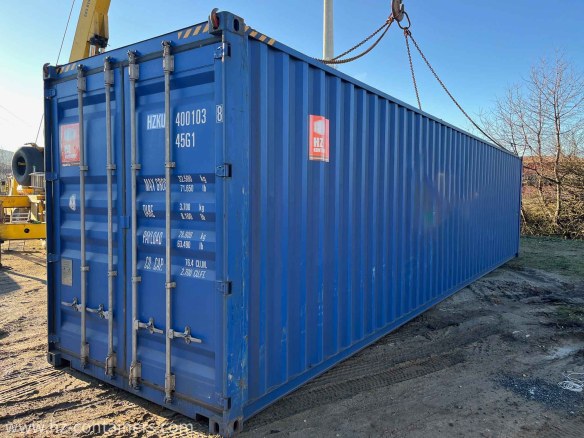

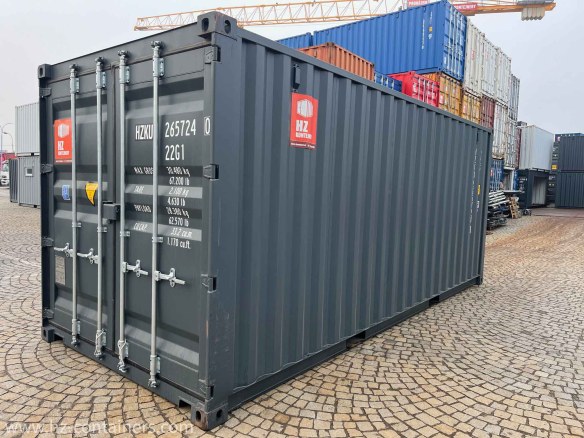
Other container news...

High Cube container specifications
A high cube container — also referred to as an HC container, HQ container, or high-cube — is an intermodal shipping container that stands one foot taller than the standard ISO container. While a standard general-purpose container measures 8 feet 6 inches (2.59 m) in external height, a high cube container extends to 9 feet 6 inches (2.89 m). This extra 12 inches of vertical clearance translates into approximately 10–15% more cubic capacity without altering the container’s footprint — the same length and width are maintained, meaning the container occupies the same floor space on a vessel, chassis, or storage yard.
Shipping container parts
A shipping container looks like a simple steel box from the outside, but it is an assembly of dozens of precisely engineered shipping container parts — each governed by international standards, each designed to survive decades of ocean transit, crane lifts, and stacking loads that would crush an ordinary structure. Whether you are buying a used container, planning a container home, troubleshooting a repair, or simply building your logistics vocabulary, understanding every individual component is the difference between making an informed decision and an expensive mistake.

40 Foot Container Dimensions
If you have ever booked ocean freight, planned a warehouse layout, or designed a modular building project, you have asked the same question: what are the exact 40 foot container dimensions — and what do they mean for what you can actually load? The numbers are standardized worldwide, but the practical implications of those numbers are surprisingly nuanced. A 40-foot container is not simply 40 feet of usable space, and its weight limits are not what most people assume. This guide covers every measurement, every weight rating, and every loading consideration you need to make informed decisions about the world’s most common shipping container.
Quick Answer: A standard ISO 40-foot shipping container measures 12.19 m (40 ft) long × 2.44 m (8 ft) wide × 2.59 m (8 ft 6 in) high externally and provides approximately 67.7 m³ (2,390 ft³) of usable internal volume. The maximum gross weight is 30,480 kg (67,200 lbs), with a typical payload capacity of approximately 26,700–26,800 kg (58,900–59,000 lbs).

Cargo worthy container
If you have ever shopped for a used shipping container, you have almost certainly encountered the term cargo worthy — often abbreviated as CW or CWO (Cargo Worthy Only). It is one of the most important classifications in the container industry, yet it is also one of the most misunderstood. A cargo worthy container is not a container that looks new. It is not necessarily a container that has a valid CSC plate. And it is definitely not the same as a wind and watertight container. This guide explains what cargo worthy really means — from its technical definition and historical origins to the precise structural criteria, inspection process, cost implications, and common misconceptions that trip up even experienced buyers.