
Refrigerated shipping container
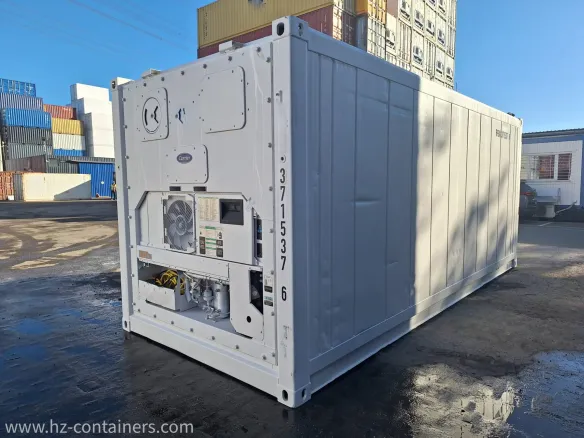
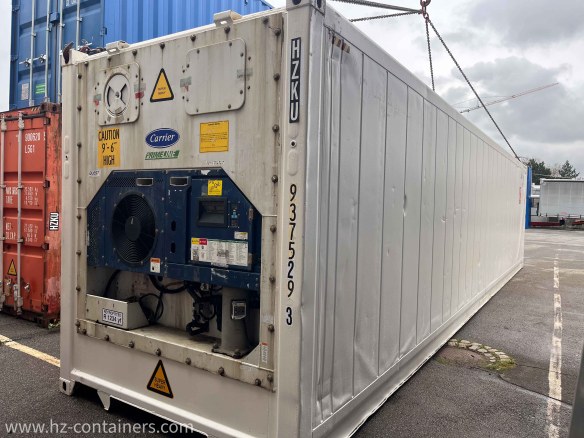
A refrigerated shipping container—commonly called a reefer—is a temperature-controlled intermodal container used to transport and store cargo that must be kept at a specific temperature, humidity, or atmosphere. Unlike a standard “dry” shipping container, a reefer is insulated like a giant thermos and fitted with a built-in refrigeration unit that actively cools (or, in some models, heats) its contents while plugged into an external power source.
These containers are the backbone of the cold chain: the unbroken sequence of temperature-controlled production, storage, and distribution that keeps food fresh, medicines potent, and industrial goods stable as they cross oceans, continents, and climates. If you have ever eaten an avocado shipped from Peru, received a frozen vaccine, or bought flowers flown from Kenya, a refrigerated shipping container almost certainly played a part in getting that product to you intact.
The term “reefer” is simply maritime shorthand for “refrigerated” and has nothing to do with anything else the word might suggest in other contexts. In logistics documentation you will also see it written as RF container or refrigerated freight container, all referring to the same equipment.
What Exactly Is a Refrigerated Shipping Container?
A refrigerated shipping container is best understood as two things combined into one standardized metal box: an insulated cargo chamber and an integrated, electrically powered refrigeration unit.
The Insulated Body
The box itself looks much like any other ISO shipping container from the outside, but its construction is fundamentally different. The walls, roof, and floor are layered with high-density insulation—typically rigid polyurethane foam—sandwiched between inner and outer steel skins. This insulation is what allows the container to hold a stable internal temperature even when the outside air swings from freezing to well over 40°C (104°F) on a vessel deck or a desert terminal.
The interior is lined with materials chosen for hygiene and ease of cleaning. Food-grade stainless steel or aluminum inner linings are common, because reefers routinely carry edible cargo that must not be contaminated. The corners and seams are sealed to be watertight, and the floor is specially engineered—a detail explored later in this guide—to channel cold air beneath the cargo.
The Refrigeration Unit
At the front wall of the container sits the refrigeration unit, a self-contained machine roughly the size of a large household appliance built into the box. Most modern reefer units are electrically driven and operate on three-phase power, typically in the range of 380–460 volts. They have no engine of their own; instead they draw electricity from whichever source is available:
- On board a vessel, the unit plugs into the ship’s electrical grid.
- In a container terminal or depot, it plugs into shore power.
- On truck or rail during inland legs, it runs from a portable generator set, or genset, clipped to the chassis or undercarriage.
This “plug-in” design is a crucial practical detail: a reefer only cools while it is connected to power. If the plug is pulled, the insulation will slow the temperature drift, but it will not hold things cold indefinitely.

Where Did Refrigerated Shipping Containers Come From?
The story of the reefer is really two parallel stories—one about refrigeration at sea, and one about containerization—that finally merged in the middle of the 20th century.
Refrigeration Before Containers
The desire to move perishable goods across oceans is centuries old. Early attempts relied on ice, salt, and insulated holds. A genuine turning point came in the late 19th century. In 1877, the French engineer Ferdinand Carré demonstrated mechanical vapor-compression refrigeration on a commercial scale by shipping frozen meat a great distance—a feat that proved temperature-controlled ocean transport was viable at industrial volumes.
From there, dedicated reefer ships proliferated. By the early 20th century, specialized vessels carrying bananas and other temperature-sensitive produce were common on major trade routes. These ships had refrigerated holds and, later, insulated individual compartments. But the cargo was still handled loose or in small, awkward units—labor-intensive and vulnerable to damage at every transfer point.
The Containerization Revolution
The second thread began in 1956, when the American trucking entrepreneur Malcolm McLean introduced the standardized intermodal container, allowing one sealed box to move by truck, rail, and ship without its contents ever being unpacked. Containerization transformed global shipping, cutting loading costs and transit times dramatically. But in its early years, this revolution was largely limited to dry, non-perishable cargo, because the humble steel box could not keep anything cold.
The breakthrough that married the two ideas is generally credited to the U.S. firm Matson Navigation, which around 1960 fielded the first insulated containers equipped with their own refrigeration machinery. These early units could maintain temperature autonomously as long as they were supplied with power, making it possible to move chilled and frozen cargo through the same intermodal system that was revolutionizing dry freight.
Maturation and Standardization
Through the 1970s, refrigerated containers designed specifically for container vessels came into widespread use, gradually displacing traditional refrigerated ships for many cargo types. Standardization of the reefer’s dimensions to the same ISO footprint as dry containers (20-foot and 40-foot modules) meant reefers could be stacked, loaded, and handled with identical equipment, unlocking enormous efficiency gains.
Today the global reefer fleet numbers in the hundreds of thousands of units, carrying an estimated value of cargo that runs into the hundreds of billions of dollars annually. Manufacturers such as Carrier Transicold, Thermo King, and Daikin dominate the refrigeration-unit market, while the boxes themselves are built by the major container manufacturers and managed by ocean carriers and leasing companies.
How Does a Refrigerated Shipping Container Work?
A reefer does not simply “blow cold air” the way a household refrigerator does. It is a precision machine designed to maintain three tightly controlled conditions at once: temperature, airflow, and in many units humidity and atmosphere.
The Core Cooling Cycle
At the heart of the unit is a standard vapor-compression refrigeration cycle—the same physics behind your kitchen fridge, scaled up and hardened for marine conditions:
- A compressor pressurizes a refrigerant gas, heating it.
- The hot gas passes through a condenser, where it sheds heat to the outside air and condenses into a liquid.
- The liquid flows through an expansion valve, dropping sharply in pressure and temperature.
- The cold refrigerant passes through an evaporator coil inside the container, absorbing heat from the cargo space.
- The refrigerant returns to the compressor, and the cycle repeats.
Two internal fans circulate air across the evaporator and through the cargo, while a microprocessor controller monitors sensors and cycles the compressor to hold the set temperature within a tight tolerance—often within a fraction of a degree.
The T-Floor: Why Airflow Matters as Much as Temperature
Perhaps the single most misunderstood aspect of reefer operation is that temperature control depends entirely on airflow. Cold air alone cannot keep a full container of product at a uniform temperature; that air must be made to move through and around every box, case, and pallet.
This is achieved with the T-bar floor, a raised, ribbed floor with “T”-shaped aluminum extrusions. Here is the sequence:
- The refrigeration unit draws warm air from the top of the container.
- It cools that air and pushes it down behind a vertical baffle on the front interior wall.
- The chilled air travels under the cargo through the channels of the T-floor, entering the body of the container through ventilation slots.
- The cold air rises through and around the cargo, absorbing heat.
- As it warms, it rises to the top and is pulled back into the unit to be re-cooled.
This is a bottom-delivery, top-return airflow pattern built around natural convection. The entire system depends on the cargo not blocking those floor channels. Every reefer has load-limit markings—lines near the ceiling and floor—that must not be exceeded, and cargo must be spread evenly so air does not create “chimneys” or short-circuit its path. Overloading a reefer is the single fastest way to ruin perishable cargo, regardless of what the set temperature reads.
Fresh Air and Gas Exchange
Some cargo, especially fresh fruits, vegetables, and live plants, keep “breathing” after harvest through a process called respiration. This consumes oxygen and releases carbon dioxide, moisture, heat, and ethylene gas—a naturally produced hormone that accelerates ripening and decay. Left sealed, this process would rapidly suffocate and spoil the load.
Reefers therefore carry a fresh air vent that can be opened by a controlled amount to let outside air in and expel built-up gases. The correct setting varies by commodity: apples need significant air exchange, while frozen cargo wants the vent firmly closed. Newer units automate this balance, and some are equipped with controlled-atmosphere capabilities (discussed later) that go much further than simple venting.
Humidity and Condensation Control
Because temperature and moisture move together, reefer units also manage relative humidity. The standard range for most units is between 60% and 85%, though some can drive it lower, near 50%. A dehumidification function removes excess moisture, while the evaporator naturally condenses water out of the air. Drains in the floor release accumulated water while being designed to keep outside water and insects from getting in.
A related problem is “container rain”—condensation that forms when warm, moist air inside the box meets cold surfaces such as the ceiling. Moisture absorbers, proper pre-cooling discipline, and correct ventilation all help keep the dew point below surface temperatures, protecting cardboard packaging, labels, and the cargo underneath.
What Temperature Range Can a Refrigerated Container Reach?
The answer depends on the container class, and the range is wider than most people assume.
Standard Reefers
A standard reefer is typically rated to maintain temperatures roughly between +25°C and −25°C (about +77°F to −13°F), which covers the vast majority of chilled and frozen cargo. Many mainstream units extend that window to −30°C to +30°C (−22°F to +86°F), giving them the flexibility to carry either frozen goods or products that need to be kept warm in cold climates.
Specialized and Extreme-Cold Units
The global fleet includes significant numbers of specialized units:
- Deep-freeze or “super freezer” containers can hold temperatures down to −35°C or even −70°C (−94°F), used for ultra-low-temperature pharmaceuticals and certain high-value frozen products.
- Heated or dual-purpose units can maintain positive temperatures well above ambient—some models reach +45°C—for cargo that must not freeze in transit, such as certain chemicals, beverages, or instruments.
The table below summarizes the general classes:
| Container Type | Typical Temperature Range | Common Cargo |
|---|---|---|
| Standard 20′ Reefer | −30°C to +30°C (−22°F to +86°F) | Chilled produce, dairy, meat, frozen food |
| Standard 40′ Reefer / High Cube | −25°C to +25°C (some to −35°C) | Frozen seafood, meat, general cold chain |
| Super Freezer | Down to −60°C or −70°C | Ultra-low-temperature pharma, biologics |
| Heated / Dual-Temperature | Up to +45°C (and cooling) | Temperature-sensitive non-frozen goods |
| Controlled Atmosphere (CA) | Cool/chill range + gas control | Avocados, bananas, apples, long-haul produce |
Important caveat: A reefer maintains temperature; it does not rapidly change it. Goods are expected to be pre-cooled or pre-heated to their target temperature before loading. A reefer full of warm fruit will take a very long time to reach set point, and by then damage has already begun. “Pre-cooling” the cargo is a non-negotiable step in professional cold-chain practice.
What Are the Standard Dimensions and Specifications?
Refrigerated shipping containers share the same external footprint as dry ISO containers so they can be stacked and handled by standard equipment, but their interior space is slightly smaller because of the insulation and the front-mounted refrigeration unit.
The specifications below are representative figures from major carriers; exact numbers vary by manufacturer, model, and vessel type.
20-Foot Reefer
| Specification | Metric | Imperial (approx.) |
|---|---|---|
| Tare weight | 3,080 kg | 6,790 lbs |
| Payload capacity | ~27,400 kg | ~60,400 lbs |
| Internal length | 5.44 m | 17.9 ft |
| Internal width | 2.29 m | 7.5 ft |
| Internal height | 2.27 m | 7.5 ft |
| Cubic capacity | ~28.3 m³ | ~999 cu ft |
40-Foot High Cube Reefer
| Specification | Metric | Imperial (approx.) |
|---|---|---|
| Tare weight | ~4,480 kg | ~9,880 lbs |
| Payload capacity | ~29,500 kg | ~65,000 lbs |
| Internal length | 11.58 m | 38.0 ft |
| Internal width | 2.29 m | 7.5 ft |
| Internal height | 2.40 m | 7.9 ft |
| Cubic capacity | ~67.3 m³ | ~2,380 cu ft |
The high cube (one foot taller than standard) is especially popular for reefer cargo because it provides additional headroom, which improves airflow over the top of the load and allows slightly more pallet stacking. A standard 40-foot reefer holds about 59 m³, while the 45-foot reefer extends interior length to around 11.57 m with a capacity near 67 m³.
How Is a Refrigerated Container Different From a Dry Container?
The differences between a reefer and a standard dry container run far deeper than “one is cold.” They affect construction, cost, energy use, and how and where each can be deployed.
| Feature | Dry Container | Refrigerated (Reefer) Container |
|---|---|---|
| Insulation | None (single steel skin) | Thick polyurethane insulation throughout |
| Temperature control | None (ambient) | Active cooling/heating to a set point |
| Power requirement | None | Requires three-phase electrical supply |
| Interior lining | Steel or plywood | Hygienic stainless steel / aluminum |
| Floor | Flat plywood | Ribbed T-bar aluminum floor for airflow |
| Tare weight | Lighter (e.g., ~2,200 kg for 20′) | Heavier (e.g., ~3,080 kg for 20′) |
| Purchase cost | Lower | Higher |
| Operating cost | Minimal | Electricity or genset fuel, plus maintenance |
| Primary use | General/durable cargo | Perishable and temperature-sensitive cargo |
Cost Implications
Reefer rates and prices are higher for well-documented reasons. On the freight side, reefer ocean rates typically run 50–100% higher than dry rates for comparable lanes, because reefers consume electricity on board, require more handling and monitoring, and occupy premium slots. For equipment purchase, a new 20-foot reefer can cost roughly $30,000 or more, while a used working unit commonly falls in the $7,000–$20,000 range depending on age and condition, and non-working (insulated-only) units are cheaper still. These figures are directional—prices fluctuate with market conditions, geography, and the age of the machine.
Weight and Volume Penalties
Because insulation and the refrigeration unit add mass, a reefer carries slightly less payload than a dry container of the same footprint and offers slightly less internal volume. This matters when planning loads: a 40-foot reefer’s interior is a few centimeters smaller in each dimension than a dry box, which can change pallet counts and packing plans.
What Is Refrigerated Shipping Container Used For?
Reefer cargo falls into a few broad families, each with its own temperature and handling requirements.
Fresh and Chilled Food
This is the largest category by volume. Fruits, vegetables, dairy, eggs, fresh meat, and seafood are shipped chilled—above freezing but cool enough to slow bacterial growth and respiration. Many of these products are “live” and benefit from ventilation and controlled atmosphere to extend shelf life during multi-week voyages.
Frozen Food
Frozen meat, seafood, fruits, vegetables, and prepared meals travel at deep negative temperatures, typically around −18°C (0°F) or lower. Frozen cargo wants a tightly sealed container with no fresh-air exchange and a stable, cold environment.
Pharmaceuticals and Healthcare
Vaccines, biologics, clinical samples, and temperature-sensitive drugs are among the most demanding reefer cargo, often requiring validation, real-time temperature data logging, and chain-of-custody documentation. Some must be held in the 2–8°C (36–46°F) cold range, while others require ultra-low temperatures from specialized super freezers.
Floral and Agricultural
Cut flowers, live plants, and seeds are high-value, extremely perishable cargo. They need careful temperature control (often just above freezing to slow metabolic activity without frost damage) and precise air exchange. The global flower trade—Kenya and Ecuador to Europe and North America—runs almost entirely on reefers.
Chemicals and Specialty Industrial Goods
Certain adhesives, solvents, resins, and specialty chemicals must not freeze or overheat, so they ship in temperature-controlled units. Some are simply ambient-sensitive and need a stable environment rather than active chilling.
Non-Shipping Storage Applications
A growing share of reefers never sails on a ship at all. Businesses, farms, hospitals, and event operators buy or rent converted or retired refrigerated containers for on-site cold storage. A used reefer wired to mains (or a genset) becomes an instant, relocatable walk-in cooler or freezer—a flexible alternative to building permanent cold rooms, and typically far cheaper and faster to deploy.
What Is Controlled Atmosphere and How Is It Different?
Controlled atmosphere (CA) and modified atmosphere (MA) are advanced reefer features that manage the composition of the air inside the container, not just its temperature.
How It Works
Fresh produce keeps respiring in transit—absorbing oxygen and releasing carbon dioxide, ethylene, and moisture. By deliberately lowering oxygen, raising carbon dioxide, and managing nitrogen, a CA system slows the produce’s metabolism to a near-dormant state, which dramatically extends its marketable life. Sensors continuously monitor gas levels, and the system adds or removes gases to hold a precise recipe tuned to the commodity.
CA is distinct from simple fresh-air venting. Venting merely replaces stale air with outside air; CA actively controls the internal gas ratios to a much finer degree.
Why It Matters
For long sea voyages—avocados from Latin America, apples from New Zealand, bananas from Central America—CA can add days or even weeks of shelf life, allowing shippers to use slower, cheaper ocean routing instead of air freight and to reach distant markets while the product still looks and tastes fresh. The technology is also central to reducing the chronic food-waste problem, since slower ripening translates directly into less spoilage at the destination.
What Are the Common Misconceptions About Refrigerated Containers?
Several myths about reefers persist even among people who work near them. Understanding the truth behind them prevents costly mistakes.
Myth 1: A reefer can cool cargo from warm to cold quickly.
The unit maintains temperature; it does not rapidly chill warm product. Cargo must be pre-cooled before loading, or spoilage will already be underway by the time the box reaches set point.
Myth 2: Lower temperature is always better.
Not so. Chill-sensitive produce can suffer “chilling injury” (cellular damage and loss of texture) if held too cold, and certain goods must not freeze. The correct set point is commodity-specific, not “as cold as possible.”
Myth 3: You can load a reefer exactly like a dry box.
Packing a reefer to the ceiling blocks the T-floor and ceiling airflow paths, creating hot pockets and spoiled cargo. Load lines and even weight distribution are mandatory.
Myth 4: If the power goes out, the insulation keeps things cold.
Insulation slows temperature change but does not stop it. An unpowered reefer will drift toward ambient temperature over hours. Continuous power—and monitoring—is essential for a secure cold chain.
Myth 5: All reefers are the same.
Standard, deep-freeze, heated, dual-temperature, controlled-atmosphere, and offshore (DNV) units are meaningfully different machines with different capabilities, certifications, and price points.
What Does the Future Hold for Refrigerated Shipping Containers?
The reefer segment is one of the most actively innovating corners of the logistics industry, driven by rising energy costs, stricter regulatory pressure on refrigerants, and surging global demand for cold-chain capacity.
Efficiency and Refrigerant Transition
Older reefer units relied on refrigerant gases with high Global Warming Potential (GWP). The industry is steadily transitioning to units using ultra-low-GWP refrigerants, with some newer designs cutting energy consumption on the order of 50% compared to traditional models. Since a container fleet can consume enormous amounts of electricity, these efficiency gains are both an environmental and a hard financial win.
Telematics and Visibility
Modern reefers are increasingly network-connected. Real-time GPS tracking, temperature data logging, and remote monitoring let shippers and carriers see a container’s condition from anywhere and respond instantly to alarm conditions. Machine-to-machine alerts, predictive diagnostics, and automated compliance reporting are becoming standard rather than optional.
Automation and Cold Chain Integration
Reefers are being woven into broader automated logistics systems—smart ports, automated stacking, and end-to-end cold-chain platforms that track a product’s temperature history from farm or factory to final delivery. This traceability is increasingly required by food-safety and pharmaceutical regulators.
Alternative Power and Sustainability Targets
Solar-assisted reefer designs, shore-power electrification at ports, and more efficient genset technology are all aimed at reducing both emissions and operating cost. As the industry works toward lower-carbon operations, the reefer—long a heavy energy consumer—is a central focus of decarbonization efforts.
Frequently Asked Questions
What is a reefer container?
A reefer container is a refrigerated, insulated intermodal shipping container equipped with its own cooling unit, used to transport and store temperature-sensitive cargo. “Reefer” is maritime shorthand for “refrigerated.”
How cold can a refrigerated shipping container get?
A standard reefer typically reaches between −25°C and −30°C (−13°F to −22°F). Specialized “super freezer” units can go as low as −70°C (−94°F) for ultra-low-temperature cargo.
What is the temperature range of a reefer container?
Most standard reefers operate from about −30°C to +30°C (−22°F to +86°F). The exact range depends on the container type, model, and manufacturer.
How does a reefer container get power?
Reefers are electrically powered, usually on three-phase current of 380–460 volts. On ships they use the vessel’s grid; in terminals and depots they use shore power; on trucks and rail they run from a portable generator set (genset).
Can a reefer container both cool and heat?
Yes. Many reefers are dual-purpose and can maintain temperatures above ambient to prevent cargo from freezing or getting too cold in cold climates. Some units range from deep freezing up to +45°C.
How much does a refrigerated shipping container cost?
Pricing varies widely. A new 20-foot reefer can cost roughly $30,000 or more, while used working units commonly range from about $7,000 to $20,000, and non-working insulated units cost less. Ocean reefer freight rates typically run 50–100% higher than dry rates.
What is the difference between a reefer and a dry container?
A dry container is an uninsulated steel box with no temperature control. A reefer is insulated, has an integrated refrigeration unit, requires electrical power, and is designed to maintain a set temperature, airflow, and humidity.
What is a T-floor in a reefer container?
The T-floor is a ribbed aluminum floor with T-shaped channels that distributes cold air beneath the cargo so it can rise evenly through the load. It is essential to the reefer’s bottom-delivery airflow system.
Why must cargo be pre-cooled before loading a reefer?
Because a reefer maintains temperature rather than rapidly changing it. Loading warm cargo means spoilage begins before the box reaches its set point, and the unit works far harder to cool the full load.
What is controlled atmosphere in a reefer container?
Controlled atmosphere (CA) actively regulates oxygen, carbon dioxide, and nitrogen levels inside the container to slow produce respiration and ripening, extending shelf life for long-haul shipments of fruits and vegetables.
Can I use a refrigerated container for stationary cold storage?
Yes. Many businesses buy or rent used reefers wired to mains power or a genset as relocatable walk-in coolers or freezers. It is often faster and cheaper than constructing a permanent cold room.
What are load lines in a reefer container?
Load lines are markings near the ceiling and floor that indicate the maximum safe fill level. Loading past these lines blocks airflow and can ruin perishable cargo, even if the temperature reading stays correct.
 Hamburg, Germany
 WITHOUT SHIPPING


Other container news...

Shipping container types
Roughly 80% of everything you own traveled to you inside a steel box. Shipping containers—also called cargo containers, ISO containers, or “conex” boxes—are the backbone of global trade, carrying about 90% of the world’s non-bulk cargo across oceans, rails, and highways. Yet a “shipping container” is not one single object. It is a family of specialized steel boxes, each engineered for a specific kind of cargo: some vent, some freeze, some open from the top, and some have no walls at all.

40 foot container storage uses
The 40 foot container has moved far beyond its original job of hauling cargo across the ocean. Today, the phrase “40 foot container storage uses” describes an enormous and still-growing field: everything from an extra garage behind a house to a full retail storefront, a mobile office, an indoor farm, or a temporary shelter. Because the 40 foot container is the most common size in global shipping, it is also the most abundant, the most affordable, and the most widely converted for storage and building purposes.

How tall is a 20-Foot shipping container?
A 20-foot shipping container stands 8 feet 6 inches (8′ 6″) tall on the outside, or 2.59 meters. Inside, the usable height is slightly less — roughly 7 feet 9–5/8 inches (2.39 m) — because the floor, roof panels, and corner castings consume several inches of the total height.
That is the short answer. But “how tall” hides important nuance: the number changes depending on whether you are measuring a standard unit or a high cube unit, whether you are measuring the exterior or the interior, and whether you actually need to fit something through the door opening, which is the shortest vertical dimension on the entire box.

Shipping container wheel movement kits
A shipping container wheel movement kit is a bolt-on (or twist-lock) hardware system that lets a single person attach wheels to the corner castings of a 20 ft or 40 ft shipping container and reposition it — often without a crane, forklift, or flatbed truck. Instead of hiring a heavy-haul trucker every time you want to nudge a container a few feet on your property, the right wheel kit turns a 4,000–10,000 lb steel box into something a pickup truck, skid steer, or a couple of strong backs with a come-along can move.