
Shipping Container 20’HC
Shipping Container 20’HC (High Cube) is a robust, standardized transport unit with increased height, designed for safe and efficient transport and storage of goods worldwide. Compared with a standard 20‑foot container (so‑called 20’DC – Dry Container), the 20’HC is about 30 cm taller, providing greater internal volume and more comfortable handling of bulky or voluminous cargo.
The abbreviation “HC” means “High Cube” – i.e., increased cubic space. This variant is especially sought after for transporting light but bulky cargo, engineering products, moving, or for conversions into residential or commercial spaces, such as shipping container homes.
Modern 20’HC containers are made of weather‑resistant CORTEN steel, which ensures long service life and minimal maintenance even in extreme maritime transport conditions. Because of this, 20’HC containers are also used outside logistics as the basis for modular buildings, warehouses, technical facilities, garages, or mobile offices.
Key Features and Technical Specification
Exact Dimensions (High Cube Container Dimensions)
Dimension parameters are the main distinguishing feature compared with standard containers. Even with minimal deviations (depending on the manufacturer), all containers are produced according to strict ISO standards, guaranteeing compatibility and easy handling within the global transport infrastructure.
| Parameter | Metric Units | Imperial Units | Note |
|---|---|---|---|
| External Length | 6 058 mm | 19′ 10.5″ | Standard length for 20′ containers |
| External Width | 2 438 mm | 8′ 0″ | Standard container width |
| External Height | 2 896 mm | 9′ 6″ | Key difference from standard (8′ 6″) |
| Internal Length | 5 898 mm | 19′ 4.2″ | Reduced by wall thickness |
| Internal Width | 2 287–2 352 mm | 7′ 6″–7′ 8.6″ | Width depends on type and manufacturer, usually narrowest at the corners |
| Internal Height | 2 698 mm | 8′ 10.2″ | About 31 cm more than 20’DC |
| Door Opening Width | 2 340 mm | 7′ 8.1″ | Allows handling of Euro pallets |
| Door Opening Height | 2 585 mm | 8′ 5.8″ | High doors for oversized goods |
| Usable Area | 14.5 m² | 156 sq ft | For storage and modifications |
| Internal Volume | 37.2–37.4 m³ | 1 315–1 320 cu ft | 10–12 % more than 20’DC |
Note: Stated dimensions may vary by a few millimetres depending on the manufacturer or specific model; always verify actual values in the supplier’s technical sheet.
Capacity and Weight
In addition to dimensions, it is important to know load capacities and weights for safe handling, storage, and transport.
| Parameter | Metric Units | Imperial Units | Description |
|---|---|---|---|
| Tare (empty weight) | 2 300–2 420 kg | 5 070–5 335 lbs | Weight of the empty container |
| Maximum Payload | 28 060–28 180 kg | 61 880–62 130 lbs | Cargo weight that can be safely loaded |
| Maximum Gross Weight | 30 480 kg | 67 200 lbs | Tare + maximum payload |
Warning: The maximum payload must never be exceeded, not only for safety but also to meet road and rail transport requirements.
International Standards and Certifications
- ISO 668, ISO 1496‑1: Define basic dimensions, markings, and strength parameters of containers, including the High Cube variant.
- CSC plate (Convention for Safe Containers): Mandatory for all containers used in international transport. Confirms that the container meets safety requirements for strength, durability, and stackability.
- TIR, UIC, Custom Seals: Additional certifications enabling container use in various transport regimes and markets.
Key Terminology
- Intermodal transport: Allows movement of the container between ship, train, and truck without unloading the contents.
- TEU (Twenty‑foot Equivalent Unit): Unit for expressing container ship capacity – 1 TEU = 1 × 20′ container (DC or HC).
- CONEX box: Historical name, especially in military contexts.
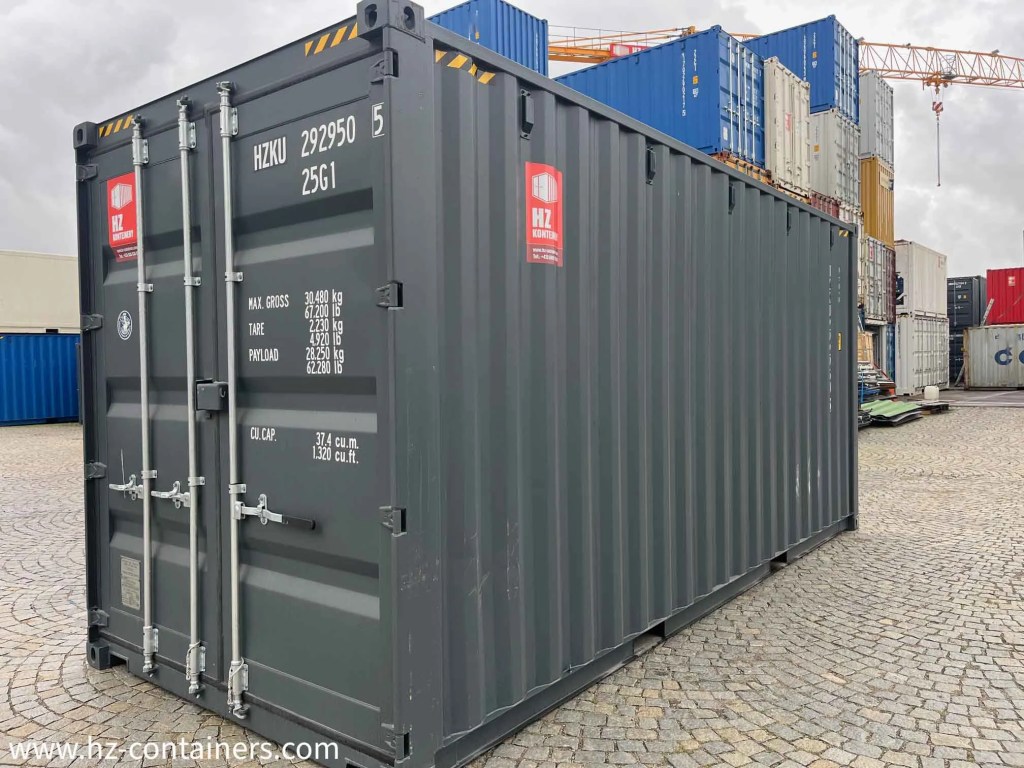
Construction and Materials: What Is a 20’HC Container Made Of?
Main Construction Elements
- Body and Frame: Highly resistant weathering CORTEN steel (COR‑TEN A/B), whose chemical composition creates a protective corrosion‑resistant layer. Strong, long‑lasting, minimal paint work.
- Floor: Marine‑grade plywood, 28 mm thick, often combined with bamboo (higher load capacity and more eco‑friendly). The floor is impregnated and resistant to mold, termites, and moisture, handling point loads up to 5 000 kg/m².
- Walls and Roof: Corrugated steel sheet, 1.6–2.0 mm thick. Corrugation greatly increases wall rigidity while keeping weight low.
- Doors: Double‑leaf, can open up to 270°. Four robust locking bars with optional security cover (Lockbox). Doors are sealed with high‑quality EPDM rubber around the entire perimeter.
- Corner Castings: Massive steel fittings with standardized holes – used for lifting, stacking, anchoring, and fixing the container.
- Ventilation Openings: Typically 4–8 small side openings that prevent condensation, mold, and ensure airflow.
- Forklift Pockets: Allow handling of an empty container with a forklift (not present on all models).
Surface Treatment
- Anti‑corrosion primer and two‑component topcoat (often in RAL colours). Optional additional markings, reflective elements, or logos can be applied.
Comparison: 20’HC vs. Other Container Types
20’HC vs. 20′ Standard (DC/GP)
| Feature | 20’HC | 20’DC | Difference/Impact |
|---|---|---|---|
| External Height | 2 896 mm (9′ 6″) | 2 591 mm (8′ 6″) | +30 cm, key difference |
| Internal Height | ≈ 2 698 mm | ≈ 2 393 mm | +31 cm, more comfortable handling, more space |
| Internal Volume | ≈ 37.4 m³ | 33.2 m³ | +12 % |
| Usable Area | 14.5 m² | 13.9 m² | – |
| Price | Slightly higher | Standard | Difference is often negligible |
| Typical Uses | Oversized goods, conversions | Standard transport | HC is more suitable for conversions and bulky cargo |
20’HC vs. 40’HC
- Length: 40’HC is twice as long, offering a volume of about 76 m³.
- Handling and Logistics: 20’HC is more compact, easier to handle in tight spaces, and cheaper to transport.
- Price per m²: Generally lower for 40’HC.
- Use Cases: 20’HC – smaller projects, mobility, narrow sites; 40’HC – large warehouses, big residential constructions (shipping container homes).
20’HC vs. 20′ Reefer (Refrigerated Container)
- Construction: Reefer has insulated sandwich walls, stainless‑steel interior, and a cooling unit.
- Internal Dimensions: Smaller due to thick insulation and equipment.
- Use: HC is universal for general cargo; Reefer is for food, pharmaceuticals, live plants.
Uses and Applications of the 20’HC Container
Transport and Logistics
- Intermodal transport: Seamless transfer between ship, train, truck, and warehouse.
- Oversized goods: Machinery, equipment, high pallets, building materials.
- Double‑stacking pallets: Allows two layers of Euro pallets (for lighter cargo).
- Agricultural machinery, industrial components: Larger dimensions, longer pipes, rolls.
Mobile and Temporary Warehouses
- Construction: Storage of tools, materials, equipment on site.
- Retail: Event back‑of‑house, seasonal storage, pop‑up sales space.
- Private use: Storing furniture, motorcycles, garden equipment, boats.
Conversions and Modular Architecture
- Living units: Tiny houses, shipping container homes, cabins, recreational structures.
- Offices, workshops, garages: Quick installation, high security.
- Sales stalls, cafés, bars: Unique design, mobility.
- Technical facilities: Server rooms, power stations, substations.
Benefits for Conversions
- Adequate clear height – after insulation and ceiling installation, still comfortable 2.4–2.5 m.
- Easy installation of services: HVAC, air‑conditioning, electrical, security.
- Compliance with building codes – some authorities require a minimum living‑space height.
Container Grades (Condition and Quality)
Choosing the right condition influences both price and possible uses of the container. Common categories:
| Grade | Description | Suitable Use |
|---|---|---|
| New / One‑Trip | New container after a single voyage from the factory (usually China–Europe). Minimal wear, modern finish, ideal for conversions and representative purposes. | Conversions, representation, export |
| Cargo Worthy (CW) | Used, still certified for export (valid CSC plate), structurally sound, watertight, may have cosmetic defects. | International transport, storage |
| Wind and Watertight (WWT) | Not guaranteed for export, but watertight, no holes, suitable for storage. | Warehouses, back‑of‑house, not for export |
| As Is | Sold as‑is, no guarantee of watertightness, often with significant defects. | Temporary enclosures, construction sites |
Tip: For long‑term building projects and residential conversions, such as shipping container houses, we recommend new or one‑trip containers for better floor condition and lower risk of hidden defects.
Legislation and Maintenance
- Building permits: Conversions to residential or commercial spaces require building permits. Authorities often demand a minimum clear height (usually 2.5 m), which the 20’HC meets even after insulation.
- Re‑certification/Inspection: When re‑using in international transport, a renewed CSC plate is required (inspection every 30 months).
- Maintenance: Regular checks of seals, paint condition, floor, and door mechanisms.
 Czech Republic, Liberec
  FREE SHIPPING


Other container news...

Where Can I Buy a 40ft High Cube Container?
A 40ft high cube container represents one of the most versatile and cost-effective storage and shipping solutions available today. Whether you are expanding warehouse capacity, starting a container home project, or need secure on-site storage for a construction site, knowing where to buy one — and what to expect — can save you thousands of dollars and weeks of frustration. This guide walks you through every aspect of purchasing a 40ft high cube container, from understanding what it actually is to comparing sellers, navigating delivery logistics, and handling permits.

How to move a shipping container
Moving a shipping container is rarely as simple as “put it on a truck and drive.” A standard steel container weighs over two tons even when empty, spans 20 to 40 feet (or more), and has no wheels, no hitch, and no built-in way to attach to standard equipment. Whether you are repositioning a storage container across a jobsite, delivering one to a rural property, or relocating a loaded unit across the country, the method you choose determines your cost, your timeline, and whether the move succeeds at all.

Shipping container sizes
Přepravní kontejnery představují neviditelnou páteř světového obchodu. Přibližně 90 % veškerého zboží (s výjimkou volně ložených komodit) se přepravuje v ocelových boxech, které na první pohled vypadají stejně. Přesto se liší svými rozměry, kapacitou i technickými parametry – což má přímý dopad na náklady, efektivitu přepravy i na to, co do nich lze reálně naložit.
Znalost velikostí přepravních kontejnerů není jen zajímavou drobností. Ať už dovážíte zboží, pořizujete použitý kontejner pro skladování či přestavbu, nebo plánujete stěhování, rozdíl mezi standardním dvacetistopým kontejnerem a čtyřicetistopým kontejnerem typu „high cube“ může znamenat rozdíl mezi cenově výhodnou přepravou a drahou zásilkou, která zůstane z poloviny prázdná.

Contamination of the inner walls of a shipping container: Why this is a normal operating condition and not a reason for a complaint
Dark streaks, scuffs, and marks on the interior walls of a shipping container are a completely normal occurrence during use. They arise naturally during the loading and unloading of goods via handling equipment and have no impact on the container’s watertightness or structural integrity. Find out why these aesthetic marks are not grounds for a complaint and how they can be easily touched up if necessary.