
Freezer Shipping Container
A freezer shipping container — interchangeably called a refrigerated shipping container or reefer container — is an insulated intermodal container equipped with an integrated refrigeration unit capable of maintaining internal temperatures from approximately +30°C (+86°F) down to as low as -70°C (-94°F), depending on the model. Unlike a standard dry shipping container, whose purpose is simply to keep cargo dry and secure, a freezer shipping container actively controls temperature, humidity, and ventilation to preserve frozen, chilled, or temperature-sensitive goods during transport and stationary storage.
These containers are the unsung backbone of global cold chain logistics. Every piece of frozen seafood landed at market, every vaccine dose administered in a remote clinic, every crate of fresh berries shipped across an ocean — a reefer container was involved somewhere in that journey. But their use extends well beyond shipping. Restaurants rent them during kitchen renovations, farms deploy them at harvest, pharmaceutical companies use them for ultra-cold storage, and disaster relief agencies rely on them for emergency food distribution.
This guide covers everything you need to know about freezer shipping containers: how they work, what temperatures they can achieve, how much they cost to buy or rent, what power they require, how they compare to alternatives, and the practical details that matter when you are the person responsible for keeping thousands of dollars of inventory from spoiling.
What Is the Difference Between a Freezer Container and a Standard Shipping Container?
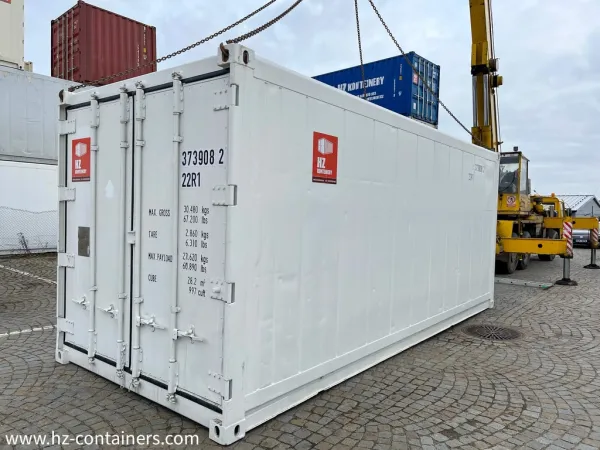
At a glance, a reefer container looks similar to a standard shipping container — same corrugated steel exterior, same cargo doors, same corner castings for crane handling. The differences are internal and mechanical, and they are substantial.
Freezer shipping containers are not simply standard containers with an air conditioner bolted on. They are purpose-built from day one with integrated insulation, specialized flooring, stainless steel interiors, and a refrigeration unit that is part of the container’s structural design.
The table below highlights the key differences between a standard dry shipping container and a refrigerated container:
| Feature | Standard Dry Container | Freezer / Reefer Container |
|---|---|---|
| Construction | Corrugated Corten steel walls, plywood floor | Corten steel exterior, 4–5 inches of polyurethane foam insulation, food-grade stainless steel interior panels |
| Floor | 28mm marine plywood | Aluminum T-bar rail flooring with channels for cold air circulation |
| Insulation | None | Polyurethane foam — R-value ~15–20 |
| Temperature Control | None (ambient) | Integrated refrigeration unit; adjustable from -30°C to +30°C (standard) or down to -70°C (super freezer) |
| Tare Weight (20ft) | ~2,200 kg (4,850 lbs) | ~2,900 kg (6,400 lbs) |
| Tare Weight (40ft) | ~3,800 kg (8,380 lbs) | ~4,890 kg (10,780 lbs) |
| Interior Volume (20ft) | ~33 m³ (1,170 ft³) | ~28 m³ (1,000 ft³) — reduced by insulation and unit |
| Internal Walls | Bare Corten steel (can rust, retain odors) | Stainless steel (food-grade, washable, corrosion-resistant) |
| Power Required | None | 460V 3-phase 30A or 220V single-phase (varies) |
| Typical New Price (20ft) | $3,000–$5,000 | ~$33,000 |
| Primary Use Case | Secure dry storage, general cargo transport | Temperature-controlled transport and stationary cold storage |
The weight penalty and reduced interior volume are the trade-offs for active temperature control. A 20ft reefer sacrifices roughly 15% of its volume to insulation and the refrigeration unit itself. A 40ft high cube reefer mitigates this somewhat by adding extra height.
How Did the Refrigerated Shipping Container Come to Exist?
The Age of Ice and Brine
The quest to move perishable goods across oceans predates the shipping container by over a century. Before mechanical refrigeration, ships relied on natural ice harvested from frozen lakes, packed into insulated holds with sawdust. It was imprecise, unreliable, and limited to short routes.
The breakthrough came in 1876, when French engineer Charles Tellier installed a methyl-ether refrigeration system aboard the cargo ship Le Frigorifique. The vessel successfully transported chilled meat from Buenos Aires to Rouen, France — proving that mechanical cold chain was viable. Tellier’s system could maintain approximately 0°C (32°F), enough to keep meat fresh for weeks at sea.
Fred Jones and Mobile Refrigeration
In the 1930s, Frederick McKinley Jones — an African American inventor who would later co-found Thermo King — developed the first portable air-cooling unit designed to be mounted on trucks. His invention transformed food distribution by enabling overland transport of perishables without ice. Jones received over 60 patents, and his work laid the foundation for the refrigeration units that would eventually be miniaturized and mounted on shipping containers.
The Container Revolution
The modern shipping container was invented by Malcolm McLean in 1956, but his first containers were dry boxes. The refrigerated container arrived in the 1960s, as the ISO standardization framework made it possible to design a single insulated box that could travel by truck, rail, and ship without unloading the cargo inside.
Early reefers used clip-on refrigeration units — separate diesel-powered units attached to an insulated container at the port or on the vessel. By the 1970s, the integral reefer had become standard: a container with the refrigeration unit built into the front wall, requiring only an external electrical connection to operate. This design remains the global standard today.
The Super Freezer Era
The 2010s and 2020s saw the rise of super freezer containers capable of reaching -60°C to -70°C. Thermo King’s SuperFreezer and Carrier Transicold’s deep-freeze variants were developed primarily for pharmaceutical cold chain — specifically, the mRNA COVID-19 vaccines that required storage at -70°C. These containers represent the cutting edge of portable refrigeration technology, combining extreme temperature capability with precise digital control and satellite-based remote monitoring.
How Does a Freezer Shipping Container Work?
The Vapor-Compression Refrigeration Cycle
A freezer shipping container uses the same fundamental thermodynamics that power your kitchen refrigerator — scaled into a 20- or 40-foot steel box. The process involves four components working in a continuous loop:
- Compressor: Low-pressure refrigerant gas is compressed into a high-pressure, high-temperature gas. This is the energy-intensive step — the compressor is what draws the bulk of the container’s electrical load.
- Condenser: Mounted on the exterior end wall of the container, the condenser coil releases heat into the outside air. As the high-pressure gas cools, it condenses into a high-pressure liquid. This is why you feel warm air blowing from the front of a running reefer.
- Expansion Valve: The high-pressure liquid passes through a narrow opening that drops its pressure dramatically. The sudden pressure drop causes the refrigerant temperature to plummet — a principle known as Joule-Thomson cooling.
- Evaporator: The cold, low-pressure refrigerant flows through the evaporator coil mounted inside the container. A fan blows air across the coil, cooling the air before it circulates through the cargo space. The refrigerant absorbs heat from the cargo area and returns to the compressor as a low-pressure gas, and the cycle repeats.
Think of a reefer container as a giant household refrigerator turned on its side. The compressor and condenser sit outside, the evaporator and fan sit inside, and everything runs on electricity instead of gas.
Airflow: Why the Floor Matters
Standard reefer containers use T-bar aluminum flooring — named for the T-shaped aluminum extrusions that form the floor surface. These T-bars create channels running the length of the container beneath the cargo. Cold air from the evaporator enters at floor level and travels through these channels, rising vertically through the cargo stack before returning to the top of the refrigeration unit.
This bottom-to-top airflow pattern is essential for even temperature distribution. Without it, cargo at the top would freeze while cargo at the bottom stayed warm. The T-bar design also prevents pallets from blocking airflow, since air can move beneath even a fully loaded pallet position.
Proper loading is critical. Gaps must be left between the cargo and the container walls, and between the top of the cargo and the ceiling. If cargo is packed tightly against the walls, air cannot circulate and hot spots develop. Most reefer containers have red load lines painted on the interior walls — cargo should never be loaded above or against these lines.
Insulation: What Keeps the Cold In
The walls, ceiling, floor, and doors of a freezer shipping container are lined with 4 to 5 inches of polyurethane foam insulation, sandwiched between an outer skin of Corten steel (weathering steel, highly corrosion-resistant) and inner panels of food-grade stainless steel. The insulation achieves an approximate R-value of 15 to 20, which — combined with the continuous operation of the refrigeration unit — maintains stable internal temperatures even when ambient temperatures exceed 38°C (100°F).
The stainless steel interior serves a dual purpose: it is non-porous and easy to sanitize (critical for food and pharmaceutical applications), and it reflects radiant heat, contributing marginally to the thermal performance. Door gaskets are the weak point in the insulation system — a torn or compressed gasket can compromise the entire thermal envelope.
What Temperature Ranges Can a Freezer Shipping Container Achieve?
Standard Reefer Temperature Ranges
Standard reefer containers maintain temperatures between -30°C and +30°C (-22°F to +86°F), adjustable in 0.1°C increments via a digital microprocessor controller. This range covers the vast majority of cold chain applications.
The appropriate set point depends entirely on what you are storing. The table below maps common cargo types to their recommended temperature ranges:
| Cargo Category | Temperature Range | Examples |
|---|---|---|
| Deep Frozen | -25°C to -18°C (-13°F to 0°F) | Frozen meat, seafood, ice cream, frozen prepared meals |
| Standard Frozen | -18°C to -10°C (0°F to +14°F) | Frozen vegetables, frozen dough, juice concentrate, frozen bakery |
| Chilled / Refrigerated | 0°C to +5°C (+32°F to +41°F) | Dairy, fresh meat, deli items, eggs, beverages |
| Cool Storage | +5°C to +15°C (+41°F to +59°F) | Chocolate, certain cheeses, wine, craft beer, tropical fruit |
| Pharmaceutical (Standard) | +2°C to +8°C (+36°F to +46°F) | Vaccines, insulin, biologics, lab reagents |
| Pharmaceutical (Ultra-Cold) | -40°C to -70°C (-40°F to -94°F) | mRNA vaccines, gene therapies — requires super freezer unit |
| Floral | +1°C to +4°C (+34°F to +39°F) | Cut flowers, bulbs, live plants in dormancy |
| Fresh Produce | +1°C to +13°C (+34°F to +55°F) | Leafy greens (+1°C), tomatoes (+10°C), bananas (+13°C) |
Super Freezer Containers: Ultra-Low Temperature Limits
Super freezer containers — also called deep-freeze or ultra-low temperature containers — push well below the standard reefer range. These specialized units can achieve and maintain temperatures as low as -60°C (-76°F) or -70°C (-94°F), depending on the manufacturer and model.
The key players in the super freezer space are:
- Thermo King SuperFreezer: Available in 10ft, 20ft, and 40ft configurations. The 40ft model reaches -65°C (-85°F); smaller units reach -70°C (-94°F). Designed specifically for pharmaceutical cold chain.
- Carrier Transicold NaturaLINE (deep-freeze variant): Maintains down to -40°C as standard, with specialized configurations for lower temperatures.
- CIMC TLC Super Freezer Container: Temperature range of -60°C to -10°C, designed for long-distance transportation and storage of deep-frozen cargoes.
The primary driver of super freezer adoption was the COVID-19 pandemic. The Pfizer-BioNTech vaccine required storage at -70°C, creating unprecedented demand for ultra-cold portable storage. Super freezer containers that had been niche products overnight became essential infrastructure.
Can a Super Freezer Container Also Cool, or Only Freeze?
A common misconception is that super freezer containers only operate at their lowest temperature — that they are binary “on at -60°C” or “off.” This is not the case.
Super freezer containers are adjustable across their entire temperature range. A container rated for -70°C can be set to +5°C for chilled pharmaceutical storage, or -20°C for standard frozen goods, or any temperature in between. The “super freezer” designation refers to the unit’s capability floor — how low it can go — not a fixed operating point. The digital controller allows operators to dial in a set point and the unit maintains it with the same precision as any other reefer.
The practical implication: you can buy or rent a super freezer container for its ultra-cold capability during one season and use it as a standard refrigerated container during another. The higher purchase and operating costs are the trade-off for this flexibility.
What Are the Power Requirements for a Freezer Shipping Container?
A reefer container does not generate its own electricity. It must be connected to an external power source — shore power at a depot, shipboard power at sea, a generator set (genset) on a truck or at a remote site.
Standard Configuration
The most common electrical configuration for reefer containers is:
- 460V, 3-phase AC, 30-amp circuit — at 50Hz or 60Hz
- Power cable with an ISO standard CEE 17 (IEC 60309) plug, typically 18 meters (59 feet) in length
- Internal circuit breakers and fuses for surge protection
- Auto-correction for phase rotation on startup
Some units accept 208/230V, 3-phase with a minimum 50-amp breaker. Voltage tolerance is typically ±15%, giving flexibility in real-world power conditions.
Single-Phase Operation
A subset of 20ft reefer containers can operate on 220V single-phase power with a 50-amp circuit. This is important for locations — smaller restaurants, churches, residential event venues, small farms — that lack 3-phase service. Always confirm single-phase compatibility before delivery. Most 40ft units require 3-phase and will not accept single-phase.
You cannot plug a reefer container into a standard 120V household outlet. The power draw exceeds what a standard circuit can supply by an order of magnitude. Attempting to do so will trip the breaker or damage the equipment.
Off-Grid Power: Generator Sets (Gensets)
When grid power is unavailable, a diesel-powered generator set mounts directly to the container chassis or sits on a trailer nearby. Genset considerations:
- Rental cost: $50 to $150 per day, depending on fuel prices and generator capacity
- Fuel consumption: 4 to 8 gallons (15 to 30 liters) of diesel per day, depending on the container size, ambient temperature, and set point
- Noise: Gensets are loud — plan placement accordingly in noise-sensitive environments
- Runtime between refueling: With an integrated fuel tank, typically 24 to 72 hours
How Much Power Does a Refrigerated Container Consume?
Power consumption varies significantly based on container size, ambient temperature, set point, cargo load, and door-opening frequency. General benchmarks:
- Typical range: 70 to 170 kWh per day for a 40ft container in moderate conditions
- 20ft container: Approximately 5.8 to 8.5 kW under load
- 40ft container at 45°C (113°F) ambient: Average of ~4.2 kW continuous draw
- Super freezer (-60°C) at high ambient: Significantly higher consumption — up to 11 kW or more — due to the extreme temperature differential
At a commercial electricity rate of $0.12/kWh, a standard 40ft reefer costs roughly $8.40 to $20.40 per day to operate — approximately $250 to $600 per month. A super freezer can double that.
What Sizes Are Freezer Shipping Containers Available In?
Refrigerated containers are most commonly available in two standard ISO sizes, with specialty sizes also produced:
| Specification | 20ft Reefer | 40ft High Cube Reefer |
|---|---|---|
| Exterior Length | 20 ft (6.06 m) | 40 ft (12.19 m) |
| Exterior Width | 8 ft (2.44 m) | 8 ft (2.44 m) |
| Exterior Height | 8 ft 6 in (2.59 m) | 9 ft 6 in (2.90 m) |
| Interior Length | 17 ft 8 in (5.39 m) | 37 ft 8 in (11.48 m) |
| Interior Width | 7 ft 5 in (2.26 m) | 7 ft 5 in (2.26 m) |
| Interior Height | 7 ft 5 in (2.26 m) | 8 ft 5 in (2.57 m) |
| Door Opening Width | 7 ft 5 in (2.26 m) | 7 ft 5 in (2.26 m) |
| Door Opening Height | 7 ft 3 in (2.21 m) | 8 ft 3 in (2.51 m) |
| Usable Volume | ~28 m³ (~1,000 ft³) | ~60 m³ (~2,120 ft³) |
| Tare Weight | ~2,900 kg (6,400 lbs) | ~4,890 kg (10,780 lbs) |
| Max Gross Weight | ~24,000 kg (52,900 lbs) | ~30,480 kg (67,200 lbs) |
| Max Payload | ~21,400 kg (47,180 lbs) | ~26,000 kg (57,320 lbs) |
| Standard Pallet Capacity | 10 euro pallets | 23–24 euro pallets |
Additional sizes available from specialty manufacturers include:
- 10ft reefer containers: Compact units for tight spaces, small businesses, or mobile vending applications. Interior volume approximately 425 ft³.
- 24ft reefer containers: An intermediate size that bridges the gap, offered by some rental companies when a 20ft is too small and a 40ft is overkill.
- 53ft domestic reefer containers: Used in North American trucking, not designed for intermodal shipping. Larger interior volume but not ISO-compatible for vessel loading.
The 40ft High Cube is the most common for large-volume applications because the extra foot of height provides roughly 13% more internal volume than a standard-height 40ft reefer.
How Much Does a Freezer Shipping Container Cost?
Reefer containers are significantly more expensive than standard dry containers — roughly six times the price on average — because of the refrigeration unit, insulation, stainless steel interior, and T-bar flooring.
Purchase Pricing
| Condition | 20ft Reefer | 40ft Reefer |
|---|---|---|
| New | ~$33,000 | ~$40,000 |
| One-Trip (near-new) | ~$25,000–$30,000 | ~$30,000–$37,000 |
| Used (good condition) | $8,000–$17,000 | $8,000–$25,000 |
| Used (as-is / non-working) | $3,500–$6,000 | $5,000–$10,000 |
New units come with a manufacturer warranty on the refrigeration system and a full service life. One-trip containers have made a single ocean voyage and arrive in near-new condition at a meaningful discount. Used containers vary enormously — the price range reflects the condition of the compressor, the integrity of the insulation, and the seller’s willingness to provide service records.
The refrigeration unit brand significantly affects price. A used 40ft reefer with a Thermo King Magnum Plus unit commands a premium over one with an older Carrier ThinLINE. Units with R-134a refrigerant (the standard) are also priced differently than the newer R-513A (lower GWP) units.
Rental Pricing
| Container Size | Monthly Rental (Approx.) |
|---|---|
| 10ft Reefer | $500–$900 |
| 20ft Reefer | $650–$1,800 |
| 40ft Reefer | $1,000–$3,000 |
Rates fluctuate with season (summer demand is higher), term length (longer commitments reduce the monthly rate), and delivery distance. Watch for billing cycle differences: some providers use 28-day cycles, resulting in 13 billing periods per year instead of 12. A 30-day billing cycle saves roughly 8% annually at the same daily rate.
Additional costs to budget for:
- Delivery and pickup: $200–$800 each way, depending on distance and accessibility
- Genset rental: $50–$150/day (if grid power is unavailable)
- Electrician installation: $500–$2,000 one-time for site power hookup
- Monthly electricity: $250–$600 for a 40ft unit
What Are the Most Common Applications for Freezer Shipping Containers?
Restaurants and Foodservice
Restaurants are the single largest segment of stationary reefer container users. The most common scenario is a kitchen renovation: when a contractor tears out the walk-in cooler, the restaurant needs temporary cold storage for 4 to 12 weeks. A 20ft reefer parked behind the building keeps the entire inventory at safe temperatures. Beyond renovations, restaurants use them for seasonal overflow (holiday catering, wedding season), food truck commissaries, and outdoor event operations.
Pharmaceutical and Medical Storage
Hospitals, pharmacies, and public health agencies use refrigerated containers for vaccine storage during mass immunization campaigns and facility expansions. Standard vaccines require +2°C to +8°C — well within a standard reefer’s range. For ultra-cold vaccines (mRNA type), super freezer containers at -70°C are the portable solution. Data loggers track every temperature fluctuation for regulatory compliance.
Agriculture, Floral, and Produce
Farmers use reefer containers when permanent cold storage fills up ahead of schedule during harvest. A 40ft reefer on a farm can hold thousands of pounds of produce at precise temperatures. Florists and flower distributors depend on them during peak seasons like Valentine’s Day and Mother’s Day, where even a few degrees of temperature deviation drastically shortens vase life. Produce packers use them for pre-cooling and staging before shipment.
Disaster Relief, Events, and Construction
Emergency management agencies deploy reefer containers for disaster relief food distribution — they arrive on a flatbed, connect to a genset, and become a field kitchen’s cold storage in under an hour. Event producers use them for outdoor music festivals and sports events. Construction crews on remote sites store temperature-sensitive epoxy resins, adhesives, and sealants.
How Does a Freezer Shipping Container Compare to a Walk-In Freezer?
| Feature | Freezer Shipping Container (Reefer) | Walk-In Freezer |
|---|---|---|
| Mobility | High — crane or tilt-bed truck transportable; designed for intermodal shipping | Low — permanent or semi-permanent installation; not designed for frequent relocation |
| Installation | Drop and plug in (after electrician hooks up power); typically operational same day | Requires on-site assembly, flooring, and professional installation; may take days to weeks |
| Power | 460V 3-phase 30A (standard); some 220V single-phase | Typically 208–230V single-phase or 3-phase, depending on size |
| Accessibility | Cargo doors (designed for pallet loading); cumbersome for frequent walk-in access | Personnel door with easy-open latch; optimized for frequent entry and exit |
| Interior Volume | 1,000–2,120 ft³ (20ft–40ft) | Highly variable; typically smaller per footprint due to wall construction |
| Energy Efficiency | Moderate — heavy-duty transport units consume more power than necessary for stationary use | Higher — units optimized for stationary operation with better insulation-to-power ratio |
| Durability | Built for marine environment; Corten steel, stainless interior; highly durable but seams can corrode | Panel construction; fiberglass options available; generally less impact-resistant than steel |
| Noise Level | High — transport-grade refrigeration units are loud | Low to moderate — units designed for indoor/near-building operation |
| Purchase Cost | $8,000–$40,000 | $15,000–$40,000+ for equivalent volume |
| Best For | Temporary needs, remote sites, multi-location rotation, bulk pallet storage | Permanent installations, daily personnel access, restaurants, grocery stores |
The decision between a reefer container and a walk-in freezer comes down to mobility versus accessibility. A reefer container shines when you need cold storage that can move — to a different site, to a different city, onto a ship. A walk-in freezer shines when the cold storage is staying put and people will be walking in and out dozens of times per day.
What Maintenance Does a Freezer Shipping Container Require?
Reefer containers are mechanically more demanding than standard dry containers. A neglected reefer will fail — usually the compressor, and usually at the worst possible time.
Monthly Tasks
- Clean condenser coils with compressed air or a soft coil brush. Dirty coils are the leading cause of compressor failure. When coils are caked with dust and debris, the compressor works harder, runs hotter, and dies sooner.
- Inspect door gaskets for cracks, tears, or compression set. A failed gasket lets warm, humid air into the container continuously. The unit will run nonstop trying to compensate, driving up power consumption and shortening equipment life.
- Check the drain line for blockages. A clogged drain causes water to pool inside the container or ice to build up on the evaporator coils, reducing efficiency and creating a slip hazard.
Quarterly Tasks
- Have a certified refrigeration technician check refrigerant levels. Low refrigerant almost always indicates a leak — not normal usage. Refrigerant does not get consumed in a sealed system.
- Test thermostat calibration. Place an independent digital thermometer at multiple points inside the container and compare readings to the controller’s displayed temperature. Calibration drift over time is common.
- Inspect all electrical connections and wiring for corrosion, heat discoloration, or loose connections.
Annual Tasks
- Full refrigerant system service including pressure testing, filter-drier replacement, and compressor oil analysis.
- Structural inspection: Look for rust, punctures, or delamination of the interior stainless steel panels. Any breach in the interior wall exposes the insulation to moisture, which degrades thermal performance over time.
- Door hinge and lock lubrication and adjustment.
Can You Convert a Standard Shipping Container Into a Freezer?
Yes — and it is an increasingly popular approach for farms, small food businesses, and hunters who need cold storage on a budget. But understanding the scope of work and the realistic total cost is essential.
The Conversion Process
- Clean and prepare: Remove any rust, seal the floor, and ensure the container is structurally sound. Any existing holes or gaps become thermal leaks.
- Install insulation: Closed-cell spray foam (2–3 inches, R-13 to R-19) provides the best air seal and moisture resistance. Rigid foam board (XPS or polyiso, 3–4 inches) is the DIY-friendly alternative. Walls, ceiling, and the container doors all need to be insulated.
- Install a vapor barrier: Moisture is the enemy. A continuous polyethylene vapor barrier on the warm side of the insulation prevents condensation inside the wall cavity, which leads to mold and insulation degradation.
- Install interior walls: Plywood, FRP (fiberglass-reinforced plastic) panels, or metal sheeting over the insulation. Food applications require washable, non-porous surfaces.
- Install flooring: Insulate the floor and cover it with aluminum diamond plate, marine-grade plywood with a non-slip coating, or a poured epoxy floor with built-in drainage.
- Install the refrigeration unit:
- CoolBot system with a standard window AC unit: The most popular DIY approach. A CoolBot controller overrides the AC unit’s thermostat, allowing it to cool to refrigerator or freezer temperatures (~$300–$400 for the controller, plus the AC unit). Works well for cooler temperatures (0°C to +4°C); less effective and harder on the compressor for true freezer temperatures (-18°C and below).
- Split refrigeration system: A dedicated commercial condensing unit and evaporator. More expensive ($2,000–$5,000+) but more reliable and efficient, especially for freezer temperatures.
- Used reefer unit: Mounting a salvaged container refrigeration unit requires significant fabrication and electrical work.
- Install a personnel door (optional): Cutting and installing a walk-in door makes the container practical for frequent access.
Cost Breakdown: DIY vs. Used Reefer
| Item | DIY Conversion (Est.) | Buying a Used Reefer |
|---|---|---|
| Container (used 20ft) | $2,000–$4,000 | — |
| Insulation materials | $1,500–$3,500 | — |
| Interior walls & vapor barrier | $800–$2,000 | — |
| Flooring | $500–$1,500 | — |
| Refrigeration unit | $400 (CoolBot+AC) to $5,000 (commercial split) | — |
| Personnel door installation | $500–$1,500 | — |
| Electrical work | $500–$1,500 | $500–$2,000 |
| Labor (if not DIY) | $3,000–$8,000 | — |
| Total | $4,000–$15,000 | $8,000–$17,000 |
A DIY conversion can be cheaper than a used reefer if you have the skills and time to do most of the work yourself. However, a used reefer is purpose-built, tested, and operational the day it arrives. For business-critical applications where downtime means lost inventory, the reliability of a factory reefer usually justifies the premium.
What Should You Inspect Before Buying a Used Freezer Shipping Container?
Buying a used reefer container is a significant investment. A thorough inspection prevents purchasing a unit that will cost more in repairs than it saves in purchase price.
- Run the refrigeration unit for a minimum of 4 hours at the lowest temperature you expect to use. Verify that it reaches and holds the set point. Listen for unusual noises — knocking, hissing, or grinding from the compressor are red flags.
- Inspect both cargo doors. They should swing freely through their full range of motion, latch securely, and the gaskets should seat flush against the door frame with no visible gaps. Run your hand around the seal while the unit is running — you should not feel cold air escaping.
- Examine interior panels. Look for rust, dents, or punctures in the stainless steel lining. Any breach can allow moisture into the insulation, reducing thermal performance and potentially causing corrosion behind the panels where you cannot see it.
- Check the T-bar flooring. Look for bent, crushed, or corroded T-bar rails. Bent rails restrict airflow; corroded rails eventually fail and are expensive to replace.
- Request service records. The seller should provide hours of operation on the compressor, dates of refrigerant service, and any repair history. A unit with 15,000+ hours on the original compressor is nearing the end of its service life.
- Verify thermostat calibration. Bring an independent digital thermometer and compare readings at multiple points inside the container to what the display shows.
- Inspect for refrigerant leaks. Oil stains around fittings, the compressor, or along refrigerant lines indicate past or present leaks. The refrigerant carries oil through the system — where oil leaks, refrigerant has leaked.
- Test electrical connections. Check the power cable for cuts or repairs, inspect the plug for bent or corroded pins, and verify that the control panel functions without error codes.
What Are Non-Operating Reefer (NOR) Containers?
A Non-Operating Reefer (NOR) is a refrigerated container with the refrigeration unit turned off. Instead of carrying temperature-sensitive cargo, a NOR carries dry goods — paper products, textiles, electronics, or any cargo that fits inside the insulated box.
NOR containers serve an important logistical function. Reefer containers typically move from production regions (South America, Southeast Asia) to consumer markets (North America, Europe). But there is often not enough refrigerated cargo flowing in the return direction. Rather than ship empty containers back, carriers offer NORs at discounted rates for dry cargo headed toward reefer-demand regions. This reduces wasted container movements and lowers costs for shippers of non-perishable goods on those trade lanes.
NORs are not a substitute for refrigerated storage — they have no active cooling. But their insulation provides some thermal buffering for cargos sensitive to extreme temperature swings during transit.
Which Refrigeration Unit Brands Are Available?
The refrigeration unit is the heart of a freezer shipping container. Three manufacturers dominate the global market:
| Brand | Key Models | Temp Range | Refrigerant | Notable Features |
|---|---|---|---|---|
| Carrier Transicold | PrimeLINE, NaturaLINE, OptimaLINE | -30°C to +30°C (standard) | R-134a, R-513A (NaturaLINE) | NaturaLINE uses CO₂ (R-744) as refrigerant — lowest GWP; PrimeLINE is the most widely deployed unit globally |
| Thermo King | Magnum Plus, SuperFreezer, Precedent | -35°C to +30°C (Magnum); -70°C to +30°C (SuperFreezer) | R-134a, R-452A | SuperFreezer dominates the ultra-cold segment; Magnum Plus known for durability in high-ambient conditions |
| Daikin | LXE, Zestia | -30°C to +30°C | R-134a, R-513A | Strong presence in Asian and European markets; Zestia series designed for energy efficiency |
Refrigerant Types and Environmental Impact
The industry is transitioning away from R-134a (GWP of 1,430) toward lower-GWP alternatives:
- R-513A (Opteon XP10): GWP of 631 — a near drop-in replacement for R-134a with similar performance characteristics
- R-452A (Opteon XP44): GWP of 2,140 — used in some Thermo King units for its efficiency at very low temperatures
- R-744 (CO₂): GWP of 1 — the NaturaLINE system. Environmentally ideal but requires higher system pressures and specialized components
When buying a used reefer, the refrigerant type matters. R-134a is being phased down under the Kigali Amendment to the Montreal Protocol. A unit using R-513A or R-744 will face fewer regulatory headwinds over its remaining service life.
Frequently Asked Questions
What is a freezer shipping container?
A freezer shipping container, also called a refrigerated container or reefer, is an insulated intermodal shipping container with an integrated refrigeration unit that maintains internal temperatures from +30°C down to -30°C (standard) or as low as -70°C (super freezer). It is used for transporting and storing frozen, chilled, and temperature-sensitive cargo.
How cold can a reefer container get?
Standard reefer containers reach -30°C (-22°F). Specialized super freezer containers can reach -60°C to -70°C (-76°F to -94°F). The specific minimum temperature depends on the container model and refrigeration unit installed.
Can I plug a reefer container into a standard electrical outlet?
No. Most reefer containers require 460V, 3-phase power with a 30-amp dedicated circuit. Some 20ft units accept 220V single-phase with a 50-amp circuit. A standard 120V household outlet cannot supply enough power for a refrigerated container. For sites without adequate power, a diesel generator set (genset) is the standard solution.
How much does it cost to rent a refrigerated container per month?
Monthly rental rates range from approximately $650 to $3,000, depending on container size (10ft, 20ft, or 40ft), rental term length, seasonal demand, and delivery distance. Additional costs include electricity ($250–$600/month), delivery/pickup fees, and genset rental ($50–$150/day) if grid power is unavailable.
How long does a reefer stay cold without power?
With doors closed and the container fully loaded, a well-insulated reefer maintains safe temperatures for approximately 4 to 6 hours after power loss. Frozen cargo holds temperature longer than chilled cargo because of the thermal mass of frozen product. For applications where power reliability is critical, a backup generator with an automatic transfer switch is recommended.
What is the difference between a refrigerated container and an insulated container?
A refrigerated container (reefer) has an active, powered refrigeration unit that mechanically cools the interior. An insulated container has foam-insulated walls but no active cooling — it only slows the rate of heat transfer. Insulated containers work for short-duration transport of pre-chilled goods but are not suitable for multi-day storage or frozen cargo.
Can you live in a converted freezer container?
While insulated reefer containers have been converted into homes — their built-in insulation gives them a head start on thermal performance compared to a standard container — several challenges exist. The stainless steel interior and T-bar flooring are not ideal living surfaces. The structural modifications needed (cutting windows, installing ventilation, adding plumbing) can compromise the insulation envelope. The electrical system is designed for a refrigeration unit, not residential power distribution. A reefer conversion is possible but requires substantial modification, and a purpose-built insulated container or standard container with added insulation is often a more practical starting point.
What is the lifespan of a reefer container?
In shipping service, reefer containers typically have an operational life of 12 to 15 years before they are retired from intermodal transport. For stationary on-site use (no saltwater exposure, no crane handling, no vessel vibration), a well-maintained reefer can function reliably for 20+ years. The refrigeration unit — especially the compressor — is the limiting component. With proper maintenance (clean coils, intact gaskets, regular refrigerant service), the compressor can last 15,000 to 25,000 operating hours before requiring rebuild or replacement. The steel structure, if kept free of significant rust, can last decades.
More container news...

What Are the Internal Dimensions of a 40 Foot Container?
A standard 40-foot dry shipping container has internal dimensions of 12,032 mm in length, 2,352 mm in width, and 2,395 mm in height — or approximately 39 feet 5⅝ inches × 7 feet 8⅝ inches × 7 feet 10¼ inches. These figures come from the published specifications of major shipping lines and align with the ISO 668 international standard for Series 1 freight containers. The internal capacity is roughly 67.7 cubic meters (2,390 cubic feet).

what is the internal dimensions of a 40 foot container
A standard 40-foot shipping container has internal dimensions of approximately 12.032 meters (39 feet 5⅝ inches) in length, 2.352 meters (7 feet 8⅝ inches) in width, and 2.395 meters (7 feet 10¼ inches) in height. These internal dimensions are significantly smaller than the external dimensions because the corrugated steel walls, structural frame, corner posts, and the floor system—composed of plywood and steel—occupy valuable space intended for cargo.

What Is the Shipping Cost for a 40ft High Cube Container?
The shipping cost for a 40ft high cube container is not a single number — it is a layered calculation spanning purchase price, international ocean freight, and local ground delivery. A used 40ft high cube container typically costs $1,550 to $5,500 to purchase, while a new one-trip unit runs $2,800 to $9,000 depending on condition, location, and whether delivery is included.

Shipping container types
Roughly 80% of everything you own traveled to you inside a steel box. Shipping containers—also called cargo containers, ISO containers, or “conex” boxes—are the backbone of global trade, carrying about 90% of the world’s non-bulk cargo across oceans, rails, and highways. Yet a “shipping container” is not one single object. It is a family of specialized steel boxes, each engineered for a specific kind of cargo: some vent, some freeze, some open from the top, and some have no walls at all.