
Container wheel kit
A container wheel kit is a heavy-duty mobility solution — spanning bolt-on spindle hubs, twist-lock casters, dolly systems, and hydraulic towing assemblies — designed to attach to a shipping container’s ISO 1161 corner castings, enabling on-site repositioning without a crane, tilt-bed truck, or licensed operator.
Moving a 40-foot steel box that weighs up to 67,200 pounds without a crane sounds like a logistical impossibility — and for decades, it was. The development of the container wheel kit changed that equation entirely. Whether you manage a container yard, run a construction site, own a converted container home, or simply need to reposition a storage unit every few months, understanding how these wheel systems work, what they cost, and which type suits your surface and load is essential knowledge. This guide covers every dimension of the topic: from the ISO standard that makes it all possible to the material science inside the wheel treads, from budget bolt-on kits under $300 to German-engineered dolly systems that rival the cost of a used car.

What is a container wheel kit?
A container wheel kit is not a single product but a category of mobility solutions unified by one design principle: they interface with the standardized corner castings found on every ISO shipping container. Instead of lifting a container onto a flatbed trailer or calling in a crane, operators attach wheels directly to the container’s structure — transforming a stationary steel box into a rollable, towable unit that can be maneuvered around a yard, warehouse, or work site.
The term “container wheel kit” functions as a catchall. In practice, the industry uses several more specific names for different configurations:
- Bolt-on spindle hub kits — hub-and-spindle assemblies that bolt through the container’s existing corner casting apertures, accepting standard trailer tires. These are the most common budget option.
- End wheels — non-swiveling wheel assemblies that mount to the side or end corner castings, keeping the container close to the ground.
- Container casters — swiveling or rigid wheel assemblies with a twist-lock top plate that locks into the bottom corner casting. They offer 360-degree maneuverability.
- Container dolly systems — paired front-and-rear units (one steerable, one trailing) that bolt to all four bottom corners and connect to a tow vehicle via a tow bar.
- Hydraulic self-lifting systems — wheel assemblies with integrated hydraulic jacks that lift the container off the ground before towing.
What unites them all is the ISO 1161 corner casting — the standardized 7 × 6 × 4.5-inch steel block with oval apertures found at all eight corners of every intermodal container manufactured since the late 1960s. These castings are engineered to carry the full weight of a loaded container, whether stacked nine-high on a ship or suspended from a spreader crane. A container wheel kit exploits this same load path: instead of a crane’s twist-lock picking the container up from above, the wheel kit secures from below.
The twist-lock mechanism is the universal language of container handling. A simple 90-degree rotation of a steel lug inside the corner casting’s oval aperture creates a mechanical lock rated for tens of thousands of pounds — no bolts, no welding, no permanent modification required.
This standardized interface means a container wheel kit purchased from one manufacturer will fit a container built by any other manufacturer anywhere in the world. It also means the wheels can be attached for a move and detached for storage, preserving the container’s structural integrity and stackability.
| Kit Type | Attachment Method | Swivel Capability | Typical Capacity (per set) | Best Use |
|---|---|---|---|---|
| Bolt-On Spindle Hub | Bolts through corner casting apertures | None (fixed axle) | 8,800–15,000 lbs | Straight-line towing on paved surfaces |
| End Wheels | ISO attachment pins into corner castings | None (fixed) | 11,000–20,000 lbs (static) | Light forklift repositioning |
| Twist-Lock Casters | Twist-lock top plate into bottom corner castings | 360° swivel (selectable lock) | 6,600–22,000 lbs per caster | Tight-space maneuvering, warehouses |
| Dolly Systems (Front + Rear) | Twist-locks on all four corners | Front unit steerable, rear fixed | 10,000–60,000 lbs combined | Frequent on-site moves, heavy loads |
| Hydraulic Self-Lifting | Hydraulic jack + twist-lock per wheel | Varies (casters or fixed) | 22,000–88,000 lbs (10–40 metric tons) | Rough terrain, fully loaded containers |
Where did container wheel kits come from?
The story of the container wheel kit begins not with wheels but with a trucking entrepreneur from North Carolina. Malcolm McLean launched the first container ship — the Ideal X — in 1956. His insight was elegantly simple: instead of loading loose cargo piece by piece (the centuries-old “break-bulk” method), put everything into a standardized steel box and move the box. By the late 1960s, the International Organization for Standardization had codified container dimensions and corner casting specifications, and the intermodal shipping container as we know it was born.
The mobility problem on land
The containerization revolution solved global shipping — but it created an unexpected problem on land. At ports, rail yards, and distribution centers, containers arrived by the thousands and needed to be repositioned constantly. Cranes could lift them, but crane time was expensive, scheduling was inflexible, and mobilization fees could run $500 to $1,500 per lift. Forklifts could nudge empty containers, but fork widths rarely matched container floor cross-members, risking structural damage. Tilt-bed trucks worked for delivery but were impractical for moving a container 200 feet across a yard.
The first crude solutions appeared in European ports in the 1970s and 1980s: heavy-duty casters welded to steel plates, manually bolted to container corners. These early container casters were dangerously unreliable — welds cracked, wheels flat-spotted on rough concrete, and the lack of a standardized twist-lock interface meant every setup was a custom fabrication job.
From cranes to casters to bolt-on kits
Two developments accelerated the container wheel kit market. First, manufacturers began integrating the ISO 1161 twist-lock geometry into caster top plates, eliminating the need for custom fabrication. Second, the growth of container-based construction — tiny homes, pop-up retail, mobile offices, disaster relief units — created demand beyond the traditional port and logistics market. People who bought a single container for a backyard office or a construction site storage unit didn’t have crane budgets. They needed a container wheel kit they could install themselves with basic tools.
Today, the market spans from $200 bolt-on spindle kits available on Amazon to $15,000 JUNG dolly systems engineered in Germany with furnace-baked polyurethane wheels capable of handling 60,000 pounds across broken pavement. The core principle remains unchanged: leverage the corner castings that every container already has.
What are the different types of container wheel kits?
Understanding which container wheel kit you need requires knowing the differences between types — not just their names, but their load paths, surface requirements, and operational trade-offs.
Bolt-on spindle hub kits (end wheels)
The most common and affordable entry point. These kits include two hub-and-spindle assemblies that bolt directly through the oval apertures in the container’s bottom corner castings. A lug pattern (typically 5-lug, 6-lug, or 8-lug) accepts standard trailer tires. Ratchet straps wrap around the assembly and the container structure to prevent the hub from rotating out of the corner casting under load.
Advantages: Low cost ($200–$600), uses standard trailer tires (replaceable anywhere), simple installation with basic hand tools, no hydraulic lifting required for empty containers.
Limitations: No swivel capability — the container moves only in a straight line or wide turns. The wheels attach to one end only; the other end drags or is lifted by a forklift. Not suitable for uneven terrain beyond packed gravel. The ratchet strap retention method requires careful tensioning.
Twist-lock caster wheels
Caster-based container wheel kits use a heavy-duty caster frame with a twist-lock top plate. The twist-lock mechanism rotates 90 degrees inside the corner casting, locking the caster to the container from below. Casters come in single-wheel and dual-wheel configurations, with polyurethane, nylon, or pneumatic tire treads.
Advantages: 360-degree swivel provides full maneuverability in tight spaces. Directional locks let you convert any caster from swiveling to fixed for straight-line towing. Installation takes approximately one minute per caster once the container is lifted. Individual casters can be used as replacement parts.
Limitations: The container must be lifted off the ground — requiring a forklift, container jacks, or a crane — before the casters can be inserted from below. Ground clearance is limited by caster wheel diameter (typically 3.3 to 6.6 inches). Small-diameter nylon wheels perform poorly on rough or cracked surfaces.
Container dolly systems
A container dolly system is the professional-grade solution. Two steel-frame units — a front steerable unit and a rear straight-line follower — lock onto all four bottom corner castings via twist-locks. The front unit includes a tow bar with a towing eye that connects to a forklift, yard tug, or pickup truck. The rear unit tracks in a straight line behind the front.
Advantages: Highest capacities (up to 60,000+ lbs combined for 30-ton JUNG sets), engineered for repeated use, purpose-built wheel materials for specific surfaces (indoor vs. outdoor configurations), DOT-approved highway towing available on certain models (DynaDolly).
Limitations: High purchase cost ($2,000–$15,000+), requires a tow vehicle, maximum speed typically 5–10 mph, storage footprint when not in use.
Hydraulic self-lifting towing systems
These are the heavyweights. Each wheel assembly includes an integrated hydraulic jack. The operator positions the assembly under the corner casting, engages the twist-lock, and pumps the hydraulic jack to lift the container off the ground. Once all four corners are lifted, the container rolls on the wheel assemblies. Capacities range from 10 to 40 metric tons.
Advantages: Self-contained — no separate forklift or jack needed to lift the container. Pneumatic rubber tires provide high ground clearance (18+ inches) for dirt, gravel, and broken pavement. Handles fully loaded 40-foot containers.
Limitations: Expensive ($2,000–$12,000+), heavier individual components (harder to transport and store), hydraulic maintenance adds long-term cost.
| Type | Price Range | Capacity (per set) | Install Time | Swivel | Surface Compatibility | Tow Vehicle Required |
|---|---|---|---|---|---|---|
| Bolt-On Spindle Hub | $200–$600 | 8,800–15,000 lbs | 15–30 min | No | Paved, packed gravel | Yes (forklift/truck) |
| End Wheels | $500–$1,100 | 11,000–20,000 lbs (static) | ~1 min | No | Smooth, hard surfaces | Yes (forklift) |
| Twist-Lock Casters (set of 4) | $800–$2,500 | 26,400–88,000 lbs total | ~5 min | Yes (with lock) | Concrete, asphalt | Yes (forklift/tug) |
| Dolly System (14–30 ton) | $5,000–$15,000+ | 28,000–60,000 lbs | 10–20 min | Front steerable | Indoor/outdoor configurable | Yes (tow vehicle) |
| Hydraulic Self-Lifting | $2,000–$12,000+ | 22,000–88,000 lbs | 20–40 min | Varies | All, including rough terrain | Yes (tow vehicle) |
How do container wheel kits work?
Every container wheel kit, regardless of type, relies on the same fundamental mechanical interface: the ISO 1161 corner casting.
The twist-lock mechanism explained
A corner casting is a hollow steel block measuring approximately 7 inches tall, 6 inches wide, and 4.5 inches deep, with oval apertures on three exposed faces. The twist-lock — a steel lug shaped like an elongated oval — slides through the bottom aperture on the caster’s top plate. When rotated 90 degrees, the lug’s longer axis catches behind the narrower internal dimension of the aperture, creating a positive mechanical lock.
Think of it like a key in a lock: the lug enters in one orientation and rotates to lock in another. The locking action is typically spring-loaded to prevent accidental disengagement. Most modern twist-locks include a visual indicator — a colored tab or pin position — so the operator can confirm each lock is fully engaged before moving the container.
How corner castings carry the load
A container’s corner castings are not bolted-on afterthoughts. They are integral to the container’s structural frame, welded to the corner posts, top rails, and bottom rails during manufacturing. This load path means the entire structural integrity of the container backs up the connection. When a container wheel kit attaches to these castings, it engages the same engineered load points that hold the container on a ship in 30-foot seas.
For bolt-on spindle kits, the mechanism is simpler but no less important. The spindle assembly’s lug plate slides into the corner casting aperture and rotates into position, much like a twist-lock. Ratchet straps then wrap around the hub and container structure, applying tension that prevents the assembly from rotating back out under load. This is why proper strap tension is critical — a loose strap means the entire kit can disengage during a move.
Tow bars and towing configurations
Most container wheel kits designed for towing include or offer a tow bar accessory. The tow bar connects to the front wheel assemblies (or front dolly unit) via a pin or ball hitch and terminates in a towing eye compatible with standard hitch sizes. This allows the container to be pulled by:
- A forklift (most common on yards and construction sites)
- A yard tug (purpose-built for trailer maneuvering)
- A pickup truck (adequate for empty or lightly loaded containers on level ground)
- A skid steer loader (with appropriate hitch adapter)
Directional locks and swivel mechanics
Many caster-based container wheel kits include a directional lock: a mechanical pin or lever that prevents the caster from swiveling. When engaged, the caster behaves like a fixed wheel, useful for straight-line towing. When disengaged, the caster swivels freely for 360-degree maneuverability. On a four-caster setup, the typical configuration is to lock both rear casters and leave the front casters free to swivel — this provides stable tracking while allowing the tow vehicle to steer.
How much weight can container wheel kits hold?
Weight capacity is the single most important specification of any container wheel kit — and the single most misunderstood.
Understanding load ratings: static vs. dynamic
Manufacturers typically publish two numbers:
- Static load rating: The maximum weight the wheel assembly can support when stationary. This number is always higher because the load is evenly distributed and there are no impact forces.
- Dynamic load rating: The maximum weight the wheel assembly can support while in motion. This accounts for shock loads, uneven weight distribution, and momentum.
For example, the ContainGo End Wheel has a static load rating of 10,000 lbs per wheel but a dynamic rating of 5,500 lbs. The difference is not marketing fluff — it reflects real physics. When a container rolls over a crack or pebble, the momentary impact force on the wheel can exceed the static weight by a factor of two or more.
Capacity by kit type
| Kit Type | Typical Dynamic Capacity (per wheel) | Typical Combined Capacity | Suitable For |
|---|---|---|---|
| Basic bolt-on 6-lug | 4,400 lbs | 8,800 lbs | Empty 20ft container (~5,070 lbs tare) |
| Heavy-duty bolt-on 8-lug | 7,500 lbs | 15,000 lbs | Empty 40ft container (~8,200 lbs tare) or lightly loaded 20ft |
| Single caster wheel | 6,600–11,000 lbs | 26,400–44,000 lbs (4 casters) | Loaded 20ft containers |
| Dual caster wheel | 11,000–22,000 lbs | 44,000–88,000 lbs (4 casters) | Fully loaded 40ft containers |
| 14-ton dolly system | N/A (system rating) | 28,000 lbs | Empty 20ft + partial load |
| 30-ton dolly system | N/A (system rating) | 60,000 lbs | Near-maximum 40ft gross weight |
The 2.5 safety factor rule
Industrial wheel manufacturers recommend dividing the total load (container tare weight + cargo weight) by 2.5 when selecting a container wheel kit. For a loaded 20-foot container at 25,000 lbs gross weight:
25,000 ÷ 2.5 = 10,000 lbs required capacity per caster
This safety factor accounts for uneven weight distribution (cargo is rarely perfectly centered), uneven ground surfaces, and dynamic forces during movement. Ignoring this rule is the most common cause of container wheel kit failure — a single caster overloaded on a slope or obstacle can collapse catastrophically.
How much does a container wheel kit cost?
Container wheel kit pricing spans two orders of magnitude, from under $250 to over $15,000. The price directly correlates with capacity, engineering quality, and material durability.
Budget bolt-on kits ($200–$600)
These are the Amazon and eBay staples: brands like VEVOR, VXB, and generic import manufacturers dominate this tier. A typical 2-pack 6-lug or 8-lug kit includes hub assemblies, ratchet straps, and screw pin anchors. Tires and wheels are usually purchased separately or come as part of a bundle.
What you get: Basic functionality for occasional use. Alloy steel construction, cold-rolled for moderate durability. Suitable for moving an empty 20ft or 40ft container across a paved yard a few times per year.
What you give up: No swivel capability. Limited corrosion resistance. Ratchet strap retention requires diligent tension checks. Replacement parts availability can be inconsistent. These kits are not designed for daily commercial use or loaded containers.
Mid-range caster and end wheel sets ($500–$1,500)
Products like the EZY Wheels 6-LUG kit from Container Nut ($574.99), the USA Containers Wheel Movement Kit, and single-container casters from Mytee Products and Pacific Marine fall into this range.
What you get: Better materials (thicker gauge steel, polyurethane or composite wheel treads), twist-lock mechanisms on casters, directional locks, and often USA-made quality control. These kits handle more frequent use and can manage lightly loaded containers.
What you give up: Still not rated for fully loaded 40-foot containers. Ground clearance limitations persist with caster-based designs. The container still needs to be lifted for caster installation.
Premium dolly systems ($2,000–$15,000+)
JUNG (Germany), DynaDolly (USA), and hydraulic self-lifting systems occupy the professional tier. A 14-ton JUNG dolly set starts around $5,000; a 30-ton set exceeds $15,000.
What you get: Engineered for daily commercial use over years. JUNG’s patented JUWAthan+ polyurethane wheels are furnace-baked for a specific hardness-elasticity blend that resists flat-spotting. DOT-approved highway towing on select models. Hydraulic self-lifting eliminates the need for a separate lifting mechanism.
The ROI case: A 20-ton JUNG set at $8,000 replaces approximately 8 crane mobilizations at $1,000 each. For operations moving containers weekly, the payback period is under six months.
Price comparison table
| Brand / Model | Type | Capacity | Price (Approx.) | Best For |
|---|---|---|---|---|
| VEVOR 8-Lug Kit | Bolt-on spindle | 8,800 lbs | $250–$350 | Occasional empty container moves |
| VXB 2-Pack 6-Lug | Bolt-on spindle | 8,800 lbs per wheel | $270–$300 | Budget DIY moves |
| EZY Wheels 6-LUG | End wheels | ~8,800 lbs set | $575 | Regular yard repositioning |
| EZY Wheels Premier Kit 6-LUG | End wheels + lift jack | ~8,800 lbs set | $830 | Complete self-contained solution |
| Mytee Single Caster | Twist-lock caster | 6,600 lbs per caster | $200–$400 each | Tight-space maneuvering |
| Mytee Dual Caster | Twist-lock dual caster | 11,000 lbs per caster | $400–$600 each | Heavier loads, tighter spaces |
| ContainGo End Wheels | End wheels with ISO pins | 5,500/10,000 lbs (dynamic/static) | $1,000–$1,100 | Commercial yard use, USA-made |
| JUNG 14-Ton Dolly Set | Front + rear dolly | 28,000 lbs | $5,000–$7,000 | Frequent moves, loaded 20ft |
| JUNG 30-Ton Dolly Set | Front + rear dolly | 60,000 lbs | $12,000–$15,000+ | Frequent moves, loaded 40ft |
| DynaDolly 5–15 Ton | Highway dolly trailer | 10,000–30,000 lbs | $3,000–$8,000 | DOT highway towing with pickup |
| Hydraulic Self-Lifting (10-ton) | Hydraulic casters | 22,000 lbs | $2,000–$4,000 | Self-contained rough terrain |
| Hydraulic Self-Lifting (40-ton) | Hydraulic casters | 88,000 lbs | $8,000–$12,000+ | Fully loaded containers, rough terrain |
How do you install a container wheel kit?
Installation procedures vary significantly by kit type, but all share one rule: verify every connection before moving the container.
Bolt-on spindle kit installation
- Prepare the surface. Ensure the container sits on level, firm ground. Chock the opposite end wheels or corners to prevent unexpected movement.
- Align the lug plate. Insert the spindle assembly’s lug plate through the bottom corner casting aperture on the container end you want to roll.
- Rotate into position. Turn the assembly 90 degrees so the lugs catch behind the casting’s internal edges.
- Apply ratchet straps. Wrap the ratchet strap around the hub assembly and the container’s corner post or bottom rail. Tension the strap until there is no play in the assembly. This is the critical step — a loose strap can allow the hub to disengage during towing.
- Install wheels and tires. Bolt the wheel to the hub using the provided lug nuts. Torque to specification.
- Repeat on the opposite corner.
- Lift the non-wheeled end with a forklift (using proper fork pockets or a spreader bar) and tow at walking speed or less.
Typical install time: 15–30 minutes for two operators.
Tools required: Lug wrench, ratchet handle, possibly a torque wrench. No power tools needed.
Twist-lock caster installation
- Lift the container. Use a forklift, container jacks, or a crane to raise the container at least 2–3 inches above the caster height. All four corners must be accessible from below.
- Position each caster under a corner casting, aligning the twist-lock lug with the oval aperture.
- Insert and lock. Push the caster upward until the top plate contacts the casting. Rotate the twist-lock handle 90 degrees until it clicks into the locked position. Verify the visual indicator shows “locked.”
- Set directional locks as desired — typically, lock the two rear casters and leave the front two free to swivel.
- Lower the container gently onto the casters. The container weight seats the twist-locks fully.
- Attach the tow bar to the front casters or designated towing points.
Typical install time: Approximately 5 minutes for four casters after lifting.
Tools required: None for the caster attachment itself. Lifting equipment required.
Common installation mistakes
- Skipping the twist-lock verification. An unlocked caster will detach when the container moves. Tug each caster to confirm it’s seated before lowering the container.
- Uneven lifting. If the container tilts during lowering, one caster may bear disproportionate weight before the others engage.
- Relying on ratchet straps alone. Ratchet straps are retention devices, not primary load-bearing components. The lug plate inside the corner casting carries the load. If the lug plate isn’t fully seated, no amount of strap tension will make the connection safe.
- Ignoring wheel condition. Nylon wheels develop cracks without visible warning. Polyurethane wheels show crazing (fine surface cracks) before failure. Inspect wheels before every move.
What is the difference between container casters, end wheels, and dolly systems?
The three terms are often used interchangeably but describe fundamentally different mobility strategies.
Swivel vs. fixed direction
Container casters swivel. Each caster rotates 360 degrees around its vertical axis, giving the container the ability to pivot in place, crab sideways, or navigate tight corners. This is invaluable inside warehouses or yards with limited maneuvering room. The trade-off is that an uncoordinated set of four swiveling casters can behave unpredictably — this is why directional locks exist.
End wheels are fixed. They mount to the end of the container and roll in one direction only. The container moves like a trailer — the towing vehicle dictates the path, and the end wheels follow. This is simpler, cheaper, and more stable for straight-line moves but useless for tight maneuvering.
Dolly systems combine both: the front dolly swivels (steered by the tow bar), and the rear dolly tracks fixed. This mimics the behavior of a standard road trailer.
Ground clearance and surface compatibility
- Casters with 3.3–5.5 inch wheels provide 6.6–11.8 inches of total ground clearance from the bottom of the container. Small obstacles like expansion joints, pebbles, or uneven concrete seams can stop a caster dead.
- End wheels using standard trailer tires provide significantly more clearance — 16-inch tires offer roughly 8 inches of clearance at the hub, plus the tire’s sidewall deflection absorbs smaller obstacles.
- Hydraulic self-lifting systems with 18-inch pneumatic tires provide the highest clearance, clearing curbs, deep gravel, and broken pavement.
Speed and maneuverability
- Casters: 1–3 mph maximum. Designed for precision positioning, not transit.
- End wheels: 3–5 mph. Can be towed across a yard or site at walking-to-jogging pace.
- Dolly systems: 5–10 mph on-site. DynaDolly systems are DOT-rated for highway speeds.
- Hydraulic self-lifting systems: 3–5 mph. Optimized for short-distance moves over challenging terrain.
| Characteristic | Casters | End Wheels | Dolly Systems |
|---|---|---|---|
| Swivel capability | 360° (lockable) | None | Front steerable, rear fixed |
| Ground clearance | Low (6.6–11.8 in) | Medium to high (tire dependent) | Medium to high (configurable) |
| Max speed | 1–3 mph | 3–5 mph | 5–10 mph |
| Maneuverability | Excellent | Poor (straight line only) | Good (trailer-like) |
| Install complexity | Requires lifting | No lifting needed | Moderate |
| Cost range | $200–$600 per caster | $500–$1,100 per set | $3,000–$15,000+ per set |
| Best surface | Smooth concrete | Paved, packed gravel | All surfaces (configurable) |
Can you use container wheel kits on a tiny house container?
The short answer is yes — but with important caveats.
Container-based tiny homes have surged in popularity over the past decade. They’re cost-effective, structurally robust, and modular. But once a container is converted into a living space — with insulation, drywall, plumbing, electrical, cabinetry, and furnishings — it weighs considerably more than an empty container. A fully finished 40-foot container home can weigh 15,000 to 25,000 pounds, and that’s before occupants and belongings.
Structural considerations
Container homes often have modifications that affect the load path to the corner castings. Cutouts for windows and doors remove structural steel from the walls. Interior framing adds weight but not necessarily strength. Before attaching a container wheel kit to a converted container, verify that:
- The corner castings are intact and unmodified. Some builders cut into or weld over corner castings during conversion, which can compromise the twist-lock interface.
- The weight distribution is known. A container home with a heavy kitchen on one end and an empty living area on the other will load the wheels unevenly.
- The floor structure is reinforced. Container floors are designed for distributed cargo loads, not point loads from furniture legs, but the flexing introduced by wheel-based movement is different from stationary loads.
Permanent vs. temporary mobility
Most container homes are designed as permanent or semi-permanent structures. Wheels are typically used for initial placement and occasional repositioning — not for frequent relocation. If you plan to move a container home regularly, a trailer-based system (such as a DynaDolly or a permanently mounted chassis) is more appropriate than a temporary container wheel kit.
Foundation transitions
One clever use of a container wheel kit in tiny home construction is the foundation transition. Builders can construct the home off-site on temporary supports, install wheels for transport to the final site, and then lower the container onto its permanent foundation. The wheels are removed and stored for any future relocation. This approach combines the cost-effectiveness of off-site construction with the flexibility of on-site mobility.
What surfaces can you move a container on with wheel kits?
Surface compatibility is the factor that most first-time buyers overlook — and the one that most frequently leads to frustration.
Concrete and asphalt
Smooth, sealed concrete is the ideal surface for every container wheel kit type. Casters glide with minimal resistance. End wheels track predictably. Dolly systems operate at their rated speeds.
The caveat is unsealed or damaged concrete. Expansion joints wider than 0.5 inches can catch small-diameter caster wheels. Spalled concrete (surface flaking) creates resistance that strains the twist-lock connections. Asphalt in hot weather can soften enough for casters to sink and gouge the surface — polyurethane wheels are less prone to this than nylon.
Gravel and packed earth
Gravel is where budget bolt-on kits fail. Loose gravel shifts under small-diameter wheels, causing the container to bog down. The wheels dig in rather than roll. Packed earth (hard-packed dirt, caliche, or crushed stone compacted with a roller) works better, but only with larger-diameter pneumatic tires — 16-inch minimum, 18-inch preferred.
For gravel yards, a hydraulic self-lifting system or a dolly set with oversized pneumatic tires is the only reliable solution. The 18-inch pneumatic tires on hydraulic systems roll over gravel and small rocks that would stop a caster instantly.
Uneven terrain and slopes
Never move a container on wheels across a slope exceeding 3–5 degrees without a controlled tow vehicle. An unbraked container on a slope is a multi-ton projectile. Even on a 2-degree grade, a 10,000-pound container generates approximately 350 pounds of downhill force — enough to overcome the static friction of most caster setups.
For uneven terrain, the priority list is:
- Level the path as much as possible before moving.
- Use the largest-diameter wheels available.
- Move at the slowest controllable speed.
- Use a spotter walking alongside to watch for obstacles.
Wheel material and surface compatibility matrix
| Wheel Material | Smooth Concrete | Rough Concrete | Asphalt | Gravel | Packed Earth | Mud/Dirt |
|---|---|---|---|---|---|---|
| Nylon | Excellent | Poor | Fair | Not suitable | Not suitable | Not suitable |
| Polyurethane (standard) | Excellent | Good | Good | Poor | Not suitable | Not suitable |
| Polyurethane (JUWAthan+ / furnace-baked) | Excellent | Excellent | Excellent | Fair | Fair | Poor |
| Composite | Good | Fair | Fair | Not suitable | Not suitable | Not suitable |
| Pneumatic rubber (16–18 in) | Good | Good | Good | Good | Good | Fair |
| Steel (solid) | Poor (surface damage) | Not suitable | Not suitable | Not suitable | Not suitable | Not suitable |
What safety precautions should you take with container wheel kits?
More containers are damaged by improper wheel kit use than by any other cause. The physics are unforgiving: a moving container cannot be stopped quickly by human force, and a failed connection releases stored energy instantaneously.
Pre-move checklist
Before every move, regardless of kit type:
- Verify the container’s gross weight. Use a weigh ticket, shipping manifest, or truck scale. Never estimate. An empty 20-foot container weighs approximately 5,070 lbs; an empty 40-footer weighs roughly 8,200 lbs. Add cargo weight. Confirm the total is within the wheel kit’s dynamic load rating (not the static rating).
- Inspect all four connection points. For twist-lock systems, tug each caster or dolly unit to confirm the lock is fully seated. Check visual indicators. For bolt-on systems, verify ratchet strap tension — the strap should not have any slack.
- Inspect wheel condition. Look for cracks, flat spots, bearing play, and tread separation. Nylon wheels can crack without warning. Polyurethane wheels show crazing before failure. Replace any wheel with visible damage.
- Check ground conditions. Walk the planned path. Remove large debris. Identify slopes, soft spots, and obstacles. If moving across asphalt on a hot day, verify the surface will not deform under wheel pressure.
- Confirm the tow vehicle’s capacity and hitch compatibility. The tow bar eye must match the hitch pin size. The tow vehicle must outweigh the combined container-plus-dolly load — a 6,000-lb pickup truck cannot safely control a 25,000-lb loaded container on any slope.
During the move
- Speed limit: Walking pace (3 mph) or less for casters and end wheels. 5 mph maximum for dolly systems on level ground.
- Personnel clearance: Maintain at least 6 feet of clearance around the container at all times. No one walks alongside a moving container. No one stands between the container and a fixed object.
- Never go under the container while it is supported only by wheel assemblies or jacks. If you need to inspect or adjust underneath, lower the container onto solid blocking first.
- Spotter communication: Use hand signals or radios. The tow vehicle operator should have a clear line of sight to the spotter at all times.
Common safety failures
The three most frequently reported container wheel kit accidents:
- Caster disengagement on a slope. An unlocked twist-lock releases under side-load on uneven ground. The container drops onto its corner casting, crushing the caster and potentially tipping.
- Ratchet strap failure. A bolt-on spindle kit’s strap loosens mid-move. The hub rotates out of the corner casting. The container drops onto one corner, bending the corner casting and rendering it unusable for future wheel kit attachment.
- Runaway container on a grade. The tow vehicle loses traction or the hitch fails. Without brakes, a 10,000+ pound container accelerates freely. The only safe response is distance — which is why personnel clearance is non-negotiable.
How do you maintain container wheel kits?
A container wheel kit is a capital asset, not a disposable accessory. Proper maintenance extends its service life from months to years.
Bearing inspection and greasing
Wheel bearings carry the entire load and are the most stressed component in any mobility system. Inspect bearings every 10 moves or every 3 months, whichever comes first. Signs of bearing failure include:
- Grinding or roughness when rotating the wheel by hand
- Excessive play (the wheel wobbles on the axle)
- Heat after use (a bearing running hot indicates inadequate lubrication or impending seizure)
- Rust-colored grease leaking from the seal (water contamination)
Most container wheel kit bearings use standard trailer wheel bearing grease (NLGI Grade 2 lithium complex). Repack bearings annually or after any exposure to submerged conditions (floodwater, deep mud).
Tire and wheel material longevity
- Nylon wheels: Inspect for cracks every use. Replace at the first sign of damage. Service life: 6–18 months under regular use.
- Polyurethane wheels: Look for crazing (surface crack networks), chunking (pieces breaking off the tread edge), and flat-spotting (a flat area from sitting loaded in one position). Service life: 2–5 years for standard polyurethane, 5–10 years for furnace-baked JUWAthan+.
- Pneumatic tires: Check pressure before every move. Underinflated tires overheat and fail at the sidewall. Inspect tread for cuts and embedded objects. Service life: 3–7 years, same as trailer tires — replace on age, not just wear.
Rust and corrosion prevention
Container wheel kits live outdoors, often in the same yards as the containers they move. Steel components will rust. Mitigate with:
- Wipe down exposed steel after use in rain or snow.
- Apply a corrosion inhibitor (fluid film, LPS 3, or similar) to bolt threads, hinge points, and the twist-lock mechanism every 6 months.
- Store the kit indoors or under a waterproof cover when not in use for extended periods.
- Never store a kit with ratchet straps still tensioned — the constant load deforms the strap fibers and reduces retention force over time.
Storage best practices
- Store wheel assemblies off the ground on pallets or shelving to prevent moisture wicking from concrete or soil.
- If storing pneumatic-tired kits, inflate tires to the maximum rated pressure and place on a surface that won’t flat-spot the rubber over time (wood is better than concrete).
- Label components by container compatibility if you own multiple kits for different containers.
- Keep ratchet straps clean and dry. Mud and grit embedded in the webbing accelerate fiber wear.
What are common misconceptions about container wheel kits?
Several persistent myths lead buyers to purchase the wrong kit or use it unsafely.
“Any wheel kit can move a loaded container.”
False. Most budget bolt-on kits are rated for 8,800 to 15,000 lbs combined — enough for an empty 40-foot container but nowhere near the 67,200-lb maximum gross weight of a loaded 40-footer. Using an under-rated kit with a loaded container is not a calculated risk; it is a guaranteed failure.
“The static load rating is the number that matters.”
False. The dynamic load rating — always lower — governs safe operation during movement. The static rating applies only when the container is stationary. Confusing the two has caused numerous failures.
“Ratchet straps are backup — the lug plate does all the work.”
Partially true, dangerously simplified. The lug plate carries the vertical load, but the ratchet straps prevent rotation. A bolt-on spindle kit’s lug plate can rotate out of the corner casting if the straps are loose. The straps are not backup; they are essential retention.
“Container casters work on any surface.”
False. Small-diameter nylon casters perform well on smooth concrete and fail quickly on gravel, cracked asphalt, or uneven pavement. Surface compatibility is a primary design constraint, not an afterthought.
“You don’t need a spotter for a short move.”
False. A spotter is mandatory for every move, regardless of distance. A 10-second reposition across a yard is when complacency causes accidents.
What is the future of container wheel kit technology?
The container wheel kit market is evolving in several directions, driven by demand from modular construction, disaster relief logistics, and warehouse automation.
Electric and autonomous mobility
Several manufacturers are developing electrically powered container casters with integrated motors and battery packs. These “smart casters” would allow a single operator to reposition a container using a remote control or tablet interface, eliminating the need for a tow vehicle entirely. Early prototypes exist in European port automation projects, though commercial availability for individual buyers is still several years away.
Advanced materials
The shift from nylon to polyurethane was the first wave. The next wave includes glass-fiber-reinforced composites that match polyurethane’s elasticity with significantly higher load ratings, and self-lubricating bearing materials that eliminate the need for routine greasing. JUNG’s furnace-baked JUWAthan+ process points toward a future where wheel material is chemically tuned for specific surface types at the point of manufacture.
Integration with container tracking systems
As IoT sensors become cheaper and more durable, container wheel kits are likely to integrate load cells (for real-time weight monitoring), accelerometers (for tilt and impact detection), and GPS trackers. A fleet manager could monitor the location, weight, and condition of every container on wheels from a single dashboard — valuable for rental fleets, construction logistics, and disaster relief operations.
Standardization beyond ISO 1161
The ISO 1161 corner casting has been the universal interface for seven decades, but it was never designed with wheel kits in mind. Industry groups are discussing a supplementary standard — a dedicated mobility interface that would coexist with the corner casting, providing a purpose-built attachment point for wheel kits without compromising the casting’s primary lifting function. Adoption is years away, but the conversation signals that container mobility is no longer an afterthought.
Frequently asked questions
Can you put wheels on a shipping container?
Yes. Any ISO-standard shipping container manufactured since the late 1960s has corner castings that can accept a container wheel kit. The kit type you choose — bolt-on spindle, casters, end wheels, or a dolly system — depends on your load weight, surface conditions, and budget. No permanent modification to the container is required.
How do you install wheels on a shipping container?
Installation varies by kit type. Bolt-on spindle kits insert through the corner casting aperture and are secured with ratchet straps. Twist-lock casters lock into the bottom corner castings from below after the container is lifted. Dolly systems use twist-locks on all four corners and connect to a tow vehicle. Most kits install in 5 to 30 minutes with basic hand tools.
How much weight can container wheels hold?
Budget bolt-on kits typically hold 8,800 to 15,000 lbs combined (empty containers only). Industrial caster wheels hold 6,600 to 22,000 lbs per caster. Dolly systems range from 28,000 lbs (14-ton) to 60,000 lbs (30-ton). Hydraulic self-lifting systems handle up to 88,000 lbs (40 metric tons). Always use the dynamic load rating, not the static rating, when selecting a kit.
What types of container wheel kits are available?
Five main types: bolt-on spindle hub kits (most affordable), end wheels (no lifting required), twist-lock casters (360-degree swivel), container dolly systems (front steerable + rear follower, highest capacity), and hydraulic self-lifting systems (integrated jacks for rough terrain).
How much does a container wheel kit cost?
Prices range from $200–$600 for budget bolt-on kits, $500–$2,500 for casters and end wheels, $3,000–$15,000+ for professional dolly systems, and $2,000–$12,000 for hydraulic self-lifting systems. The price correlates with capacity, material quality, and intended frequency of use.
What are shipping container wheels used for?
Container wheels are used for on-site repositioning — moving containers around yards, warehouses, construction sites, and storage facilities without a crane or tilt-bed truck. Applications include relocating storage containers, repositioning container homes, maneuvering mobile offices, and handling containers in ports and distribution centers where crane access is limited or expensive.
Do you need a tow bar with a container wheel kit?
For end wheels and bolt-on spindle kits, a tow bar is optional — the non-wheeled end of the container is lifted by a forklift. For dolly systems, the tow bar is integral and connects the front dolly unit to the tow vehicle. For four-caster setups, a tow bar is highly recommended for controlled towing; attempting to push or pull an unconnected container on four swiveling casters is unsafe.
What is the difference between container casters and end wheels?
Container casters swivel 360 degrees and lock into bottom corner castings via twist-locks. The container must be lifted for installation. End wheels are fixed-direction assemblies that mount to the side or end corner castings without requiring the container to be lifted. Casters provide maneuverability in tight spaces; end wheels are simpler, cheaper, and suitable for straight-line towing.
Can container wheel kits be used on gravel?
Only systems with large-diameter pneumatic tires (16 inches or larger) perform reliably on gravel. Small-diameter caster wheels (3.3 to 6.6 inches) dig into loose gravel and stop. For gravel yards, hydraulic self-lifting systems or dolly sets with pneumatic tires are the only practical options.
How long do container wheel kits last?
With proper maintenance, quality kits last 5–10 years of regular use. Nylon wheels may need replacement every 6–18 months. Polyurethane wheels last 2–5 years (standard) or 5–10 years (furnace-baked). Bearings should be inspected every 10 moves and repacked annually. Corrosion protection is essential for outdoor storage.

 Czech Republic
  WITHOUT SHIPPING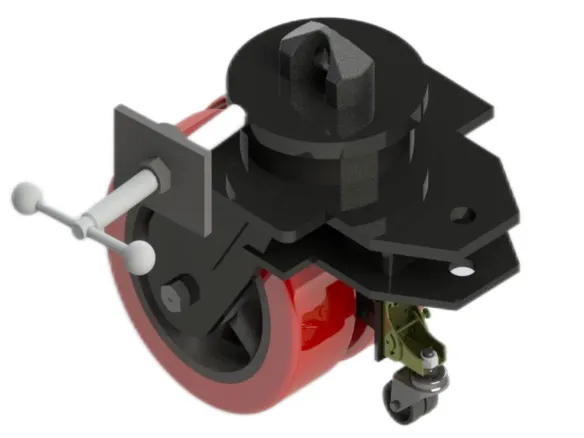


Other container news...

Obligation to Check Tightness When Selling a Reefer Container
Who is responsible for the refrigerant leak check when selling a refrigerated container? Find out what obligations the seller has at the time of handover and why they must provide a PTI report along with the technical data plate. Learn which regulatory requirements and F-gas record-keeping duties become the sole responsibility of the new owner.

New shipping containers
If you are currently considering purchasing a new shipping container, you are not alone. While just twenty years ago containers were used almost exclusively for maritime transport, today they have found their way into construction, storage, business, and even housing. This growing popularity brings with it a host of questions: Which type should you choose? How much does it cost? How do you recognize quality? How can you avoid falling victim to scammers?
New sea shipping containers
If you are currently considering purchasing a new shipping container, you are not alone. While just twenty years ago containers were used almost exclusively for maritime transport, today they have found their way into construction, storage, business, and even housing. This growing popularity brings with it a host of questions: Which type should you choose? How much does it cost? How do you recognize quality? How can you avoid falling victim to scammers?

6m shipping container
Are you thinking about buying a 6-meter shipping container but aren’t sure what to look for? You are not alone—this 20-foot container is the best-selling size on the Czech market, and the differences between various types, conditions, and prices can be significant. In this guide, you will find everything you need to know: from exact dimensions and a comparison of categories (such as “one-way,” refurbished, and “Cargo Worthy”) to current prices and shipping advice.