
40ft Open Side Container
A 40ft open side container is a specialized ISO shipping container in which one entire 40-foot-long wall is replaced with folding or multi-panel doors that open to provide unobstructed access along the entire side of the unit. Unlike a standard shipping container – where the only entry is through 7-foot-8-inch-wide double doors at one end – an open side container lets you reach every pallet, every piece of equipment, and every inch of stored cargo from the side, without having to dig through layers of stock. The standard end doors remain intact, giving you two fundamentally different access methods in a single unit.
Understanding this type of container matters because it solves a problem that standard containers simply cannot: the inability to load, unload, or access cargo that sits deep inside a 40-foot box through a single narrow opening. Whether you run a construction site, operate a warehouse, run a pop-up retail business, or are converting a container into a workspace, the open side configuration changes everything about how you interact with the space.
What is a 40ft open side container?
Definition and basic concept
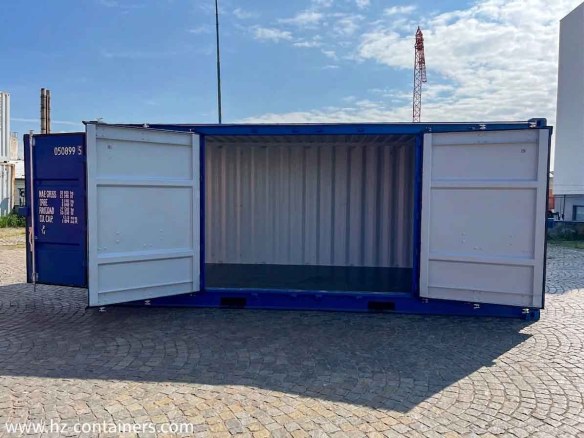
A 40ft open side container is a steel shipping container, built to ISO standards, that has a full-length side opening in addition to the standard cargo doors at one short end. The side opening is formed by two or four folding door panels that are attached to the top and bottom rails of the container frame. When fully opened, these panels fold 180 to 270 degrees and lie flat against the exterior of the container, creating a completely unobstructed opening along the entire 40-foot length.
Key difference: An open side container is not the same as a container with side doors. A container with side doors has a single personnel door or a small cargo door in the side wall. An open side container replaces the entire side wall with door panels. The difference in access – and in price – is substantial.
The container remains a fully enclosed, lockable, watertight steel box when the side doors are closed and secured. The side door panels are made from the same corrugated Corten steel as standard container walls, with rubber gaskets along every seam and heavy locking rods that secure the panels at multiple points along the top and bottom rails.

How it differs from a standard container
The difference between a 40ft open side container and a standard 40ft container is not merely cosmetic. It is a structural and operational difference that affects everything from manufacturing cost to how a forklift driver spends their day.
In a standard container, the corrugated side walls are load-bearing. They contribute to what engineers call “torsional rigidity” – the container’s ability to resist twisting and bending when lifted by a crane, stacked eight high on a ship, or transported over rough roads. When you remove an entire side wall and replace it with hinged doors, you lose that structural contribution. To compensate, manufacturers reinforce the frame with heavier corner posts, thicker top and bottom side rails, and additional cross members. The floor structure on the open side is often built higher than in a standard container to accommodate the additional load and the door mechanisms.
This reinforcement is the main reason a 40ft open side container costs significantly more – often roughly double – the price of a standard 40ft unit.
What are the different types of 40ft open side containers?
Not all open side containers are the same. The term “open side” is used broadly in the industry, but there are three distinct configurations, each with different levels of access, structural integrity, and price. Understanding which one you are actually buying is essential.
Full open side (classic folding doors)
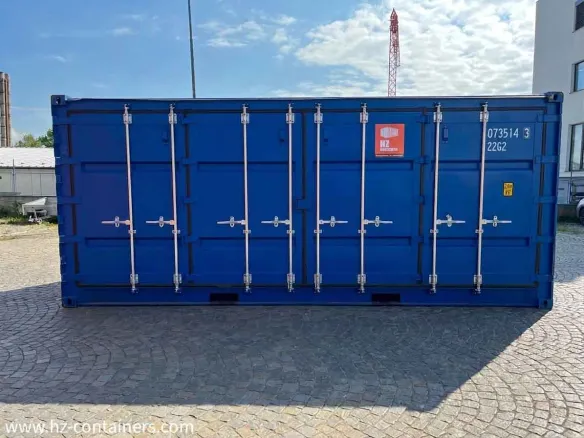
The classic and most sought-after configuration. Four folding door panels cover the entire 40-foot side of the container. Two panels are hinged on the left and two on the right. When fully opened, they fold out to give you a clear, unobstructed opening along the entire length of the container. There are no intermediate posts – just open space from one end to the other.
This design provides maximum access but requires the most structural reinforcement. The floor on the open side is significantly raised – sometimes by several inches – to accommodate the door mechanisms and additional structural members that compensate for the missing wall. This raised floor slightly reduces the usable interior height compared to a standard container of the same exterior height.
Single-post open side
A compromise between full access and structural simplicity. This configuration has two large door panels with one central post. The post provides additional frame rigidity, meaning the floor does not need to be built as high as in a full open side. The opening is divided into two large sections instead of one continuous span, but most loading operations can still proceed without obstruction. The single-post design is less common than the full open side and the 4-door variant, but can be the right choice when you need substantial side access at a lower cost than a full open side.
4-door (3-post) open side
This configuration has four sets of standard container doors – like those you would find at the short end of a container – arranged along one 40-foot side, with three posts between them. Each set of doors opens independently. The result is a container with many entry points, but it stretches the definition of “open.” Three intermediate posts divide the side opening into four separate sections.
This is the least expensive of the three configurations and is most often confused with a true open side. When an offer says “open side” without further specification, ask whether it is a full open side, single post, or 4-door. Always request a photo of the side with the doors fully open.
| Feature | Full open side | Single post | 4-door (3-post) |
|---|---|---|---|
| Side access width | Continuous 40ft opening | Two openings ~20 ft | Four openings ~8 ft |
| Intermediate posts | None | 1 | 3 |
| Forklift access | Full length, any angle | Good, minor obstacle | Only by sections |
| Structural rigidity | Requires reinforced floor | Moderate reinforcement | Closest to standard |
| Interior floor height | Raised (reduces clear height) | Slightly raised | Minimal or no raise |
| Price category | Highest (2x+ standard) | Middle | Lowest of the three |
| Best use | Maximum access, long materials, pop-up retail | Balanced access and price | Organized storage zones, frequent selective access |
What are the specifications and dimensions of a 40ft open side container?
Standard vs. high cube dimensions
A 40ft open side container is available in two height configurations: standard height (8 ft 6 in exterior) and high cube (9 ft 6 in exterior). The high cube variant provides an extra foot of vertical space, which is especially valuable in open side containers because the raised floor construction on the open side already reduces the usable interior height. The extra foot in the high cube helps compensate for that loss.
| Specification | 40ft standard open side | 40ft high cube open side |
|---|---|---|
| Exterior length | 40′ 0″ (12.19 m) | 40′ 0″ (12.19 m) |
| Exterior width | 8′ 0″ (2.44 m) | 8′ 0″ (2.44 m) |
| Exterior height | 8′ 6″ (2.59 m) | 9′ 6″ (2.90 m) |
| Interior length | ~39′ 4″ (12.03 m) | ~39′ 4″ (12.03 m) |
| Interior width | ~7′ 8″ (2.35 m) | ~7′ 8″ (2.35 m) |
| Interior height | ~7′ 6″ to 7′ 10″ (2.29–2.39 m) | ~8′ 1″ to 8′ 6″ (2.46–2.59 m) |
| Side door opening (W×H) | ~39′ × 7′ 6″ (11.9 × 2.29 m) | ~39′ × 7′ 10″ (11.9 × 2.39 m) |
| End door opening (W×H) | ~7′ 8″ × 7′ 5″ (2.34 × 2.26 m) | ~7′ 8″ × 7′ 10″ (2.34 × 2.39 m) |
| Volume capacity | ~65–70 m³ (2,300–2,470 ft³) | ~74–76 m³ (2,610–2,680 ft³) |
Note: Interior dimensions vary by manufacturer and the specific structural reinforcement used. The raised floor on the open side reduces usable height compared to a standard container of the same external dimensions. Always verify the dimensions against the CSC plate on the specific unit you are buying.
Weight specifications
The tare weight (empty weight) of a 40ft open side container is significantly higher than that of a standard 40ft container. A standard 40ft container typically has a tare weight of approximately 3,700–3,900 kg (8,160–8,600 lbs). A 40ft open side container – due to the reinforced frame, heavier door hardware, and raised floor construction – has a tare weight ranging from 4,000–6,600 kg (8,800–14,500 lbs), depending on the configuration.
| Weight specification | 40ft standard open side | 40ft high cube open side |
|---|---|---|
| Tare weight | ~5,200–6,100 kg (11,460–13,450 lbs) | ~4,000–6,600 kg (8,800–14,510 lbs) |
| Maximum gross weight | ~30,480–32,500 kg (67,200–71,650 lbs) | ~28,000–32,500 kg (61,730–71,650 lbs) |
| Maximum payload | ~24,300–26,300 kg (53,570–58,000 lbs) | ~22,000–26,100 kg (48,500–57,500 lbs) |
The higher tare weight is not a design flaw – it is the necessary consequence of the engineering solution that enables the side opening. The CSC plate affixed to every ISO-certified container lists the exact tare, gross, and payload for that particular unit. Never rely on generic specifications when loading; always check the plate.
How does a 40ft open side container work structurally?
The engineering solution behind the side opening
To understand why an open side container is designed the way it is, you first need to understand what the corrugated walls of a standard container actually do. They are not merely a weather barrier. The corrugated steel panels act as shear walls – resisting the diagonal forces that try to twist the container when it is lifted by the four top corner castings using a spreader crane. This resistance to twisting is called torsional rigidity and is a fundamental requirement of ISO 1496, the standard that governs container construction.
When you remove an entire side wall and replace it with hinged doors, you remove that shear wall. The container frame now must resist twisting forces on its own. To accomplish this, manufacturers:
- Increase the thickness of the corner posts. The four corner castings and posts become the primary load path for vertical and diagonal forces.
- Reinforce the top and bottom side rails on the open side with heavier steel profiles, often using square section profiles or I-beams instead of standard pressed channel profiles.
- Add additional cross members under the floor to distribute loads and maintain frame rigidity.
- Build up the floor construction on the open side. This raised section contains the lower door track and locking mechanisms, and also contributes to structural reinforcement. The result is that the interior floor height on the open side is higher than on the closed side, creating a slight slope or step.
The folding door panels themselves are designed to fold 180 to 270 degrees, depending on the manufacturer. When closed, they are secured by locking rods – vertical steel rods with cam mechanisms – that engage into catches on the top and bottom rails at multiple points. Rubber gaskets are compressed along every seam, creating a watertight seal.
Weather resistance and security
When a 40ft open side container is closed and properly locked, it is watertight and wind-resistant, meeting the same weather resistance standards as a standard container. The door panels are made from the same corrosion-resistant Corten steel as standard container walls. Continuous rubber gaskets line every seam between the door panels and the frame, and between the door panels themselves.
Security is a common concern with open side containers because of the additional door seams. In practice, a properly maintained open side container with all locking rods secured is no less secure than a standard container. The locking rods secure the side panels at multiple points along the top and floor rails – typically four to six locking points per panel. When all rods are secured and locked with a padlock, the panels cannot be forced open without destroying the locking mechanism, which would require heavy tools and considerable time.
The practical security consideration is not the container’s inherent strength, but operational discipline: every locking rod must be secured every time the container is closed. A partially secured side panel is a vulnerability that a standard container does not have.
How does a 40ft open side container compare to other container types?
Open side vs. standard container
The most basic comparison in the container world. A standard container is optimized for one thing: efficiently packing standardized cargo that will be loaded once (at origin) and unloaded once (at destination) through the end doors. An open side container is optimized for repeated access, oversized cargo, and workflows where being limited to the end doors is a barrier.
| Feature | Standard 40ft container | 40ft open side container |
|---|---|---|
| Primary access | End doors only | End doors + full side opening |
| Forklift loading | End loading only; no turning inside | Side loading at any point; full access |
| Long material loading | Difficult – must angle through end doors | Direct side loading |
| Inventory visibility | Front to back only; middle items require searching | Full interior visible with side open |
| Tare weight | ~3,700–3,900 kg | ~5,000–6,600 kg |
| Price (new) | $3,000–$5,000 | $5,700–$13,500 |
| Best for | One-time transport, long-term enclosed storage | Repeated access, forklift workflows, retail, conversions |
Open side vs. side door container
This is the most common point of confusion among buyers. A side door container has a single door – usually a personnel door or one section of cargo doors – built into one side wall. The rest of the side wall remains intact. An open side container has the entire side wall replaced with door panels.
A side door container is useful for accessing a specific area of the container without opening the end doors, but it does not provide the full-length, unobstructed access that an open side container provides. It is also significantly cheaper, because the structural modification is smaller – you cut a door opening into an existing wall, rather than replacing the entire wall.
If you need to load 20-foot lumber, operate a forklift along the entire length of the container, or open the entire side as a retail display, you need an open side container. If you only need a secondary access point to reach a specific shelf or tool rack, a side door container may suffice.
Open side vs. open top container
These two container types solve different access problems. An open top container has a removable roof – usually a tarpaulin cover on a removable frame – that allows cargo to be loaded from above by crane. An open side container provides side access.
Open top containers are ideal for oversized cargo that will not fit through the end doors and must be lowered in from above. Open side containers are ideal for cargo that fits within the container height but requires side access for forklift loading, long material handling, or frequent retrieval. These two types are not interchangeable; they solve different loading axes.
Open side vs. tunnel container
A tunnel container (also called a double-door container) has cargo doors at both short ends. This provides pass-through access, which is useful when you need to load from one end and unload from the other – for example, in a production line where materials enter at one end and finished products exit at the other.
A tunnel container does not solve the side access problem. You still only have the 7′–8″ width of the end doors. An open side container provides full side access, which is a fundamentally different capability. Some specialized containers combine both features – side doors and double end doors – but these are rare and custom-built.
What is a 40ft open side container used for?
Industrial and storage applications
The most common use case for a 40ft open side container is industrial storage, where forklift access is essential. Imagine a 40ft standard container filled with palletized goods. To reach a pallet at the far end, a forklift driver must drive 40 feet inside, set down the pallet, and back out 40 feet – for every single pallet. Multiply that by 20 pallets and the cycle time is enormous.
With an open side container, the forklift approaches from the side, sets the pallet in its designated place, and moves on to the next. No driving into the container, no backing out, no rearranging cargo. This workflow change can reduce loading and unloading time by 60–80% in high-volume operations.
Construction sites use open side containers to store and organize long materials – lumber, pipes, rebar, structural steel – that would be difficult or impossible to angle through standard end doors. Warehouses at capacity deploy them as overflow storage in parking lots or loading docks, where forklift operators treat the open side as an extension of the warehouse floor.
Commercial and retail uses
The full-length side opening of a 40ft open side container creates a natural storefront. When the side doors are open, the entire interior becomes a display surface – a 40-foot long, 8-foot deep retail counter. This has made open side containers popular for:
- Pop-up retail stores at street fairs, festivals, and seasonal markets
- Food and beverage stands – hot dog stands, coffee bars, cocktail bars
- Exhibition booths at trade shows and industry events
- Farmers market stalls with products displayed along the full-length opening
- Community museums and information centers
The container provides security when closed and a fully open display when open, without the need for temporary tents or tables.
Agricultural and specialized uses
Farmers and agricultural businesses use open side containers for equipment storage, feed, and harvested crops. The side access makes it easy to sort supplies and access specific items without unloading everything. The fully enclosed, watertight design protects contents from rain, sun, and pests when closed.
Other specialized applications include:
- Military logistics – open side containers allow selective unloading of specific cargo items without emptying the entire unit, which is critical in field operations
- Emergency preparedness centers – communities pre-position supplies (water, blankets, non-perishable food) in open side containers for rapid distribution during disasters
- Protected agriculture – hydroponic growing operations use the long, narrow shape of the containers for row growing, with the side opening providing ventilation and access
- Mobile workshops – the side opening creates a covered work space with tool storage inside, protected from the elements when not in use
How much does a 40ft open side container cost?
New (one-trip) container prices
A new or one-trip 40ft open side container – meaning a unit that has made a single cargo journey from the factory in Asia to a port and is then sold – typically costs between $5,700 and $13,500, depending on configuration, location, and market conditions.
The price range reflects the three types of open side containers:
- 4-door (3-post): $5,700–$8,000 – the most affordable variant
- Single post: $7,000–$10,000 – mid-price range, less common
- Full open side: $8,000–$13,500 – the premium variant with maximum access
These prices are for the container alone. Transportation costs are additional and vary significantly depending on the distance from the depot, site accessibility, and whether a tilt-bed truck or flatbed with forklift is required for unloading.
For comparison, a new standard 40ft high cube container typically costs $3,000–$5,000. The open side configuration carries a 2x to 3x price premium, which is due entirely to the additional manufacturing complexity and structural reinforcement.
Used container prices
Used open side containers are less common on the secondary market than standard containers, simply because fewer of them are produced. When available, used 40ft open side containers range from approximately $3,400 to $7,000, depending on condition, age, and configuration. Wind and watertight (WWT) units – those that are structurally sound and watertight but have cosmetic wear – are at the lower end of the range. Cargo worthy (CW) units with valid CSC certification are at the higher end.
Factors affecting price
Several variables affect the final price of a 40ft open side container:
- Location: Containers in major port cities (Los Angeles, Houston, New York/Newark, Savannah) are generally cheaper due to higher supply. Inland transport adds significant cost.
- Condition: One-trip units command a premium. Used units are priced by grade – cargo worthy, wind and watertight, or as-is.
- Height: High cube units (9′6″) cost more than standard height units (8′6″).
- Configuration: Full open side costs more than 4-door/3-post.
- Market conditions: Container prices are sensitive to global trade volumes, shipping rates, and steel prices. Prices surged in 2021–2022 and have moderated since.
- Modifications: Any customizations – shelving, paint, insulation, electrical wiring, additional doors – add to the base price.
What should you know before buying or renting a 40ft open side container?
Delivery and site preparation
An open side container is heavier than a standard container of the same length, which has implications for delivery. The delivery truck must be able to reach the site, and the ground where the container will be placed must be level, compacted, and able to support the loaded weight. A 40ft open side container with a full payload can weigh over 30,000 kg (66,000 lbs).
The container is typically delivered on a tilt-bed truck that slides the container onto the ground. You need a straight approach distance of at least 120 feet for the truck to drive in and maneuver. Overhead clearance must account for the height of the truck plus the container. Low-hanging branches, power lines, and building eaves are common obstacles.
Inspection checklist
When inspecting a 40ft open side container before purchase or rental, pay special attention to these areas:
- Door gaskets: Open and close every side panel and both end doors. Check that all rubber gaskets are intact, flexible, and in full contact. Damaged gaskets mean water ingress.
- Locking rods: Activate and deactivate every locking rod. They should move smoothly and seat firmly into their catches. Stiff or bent rods should be addressed before the container is put into service.
- Floor condition: Inspect the marine plywood floor for soft spots, delamination, or chemical stains. Pay special attention to the raised section of floor on the open side. This area is more stressed and more expensive to repair.
- Rust and corrosion: Surface rust on Corten steel is normal and protective. Deep pits, perforations, or rust at structural joints are not. Check corner posts, bottom rails, and door hinges.
- CSC plate: Verify that the CSC safety approval plate is present, legible, and within its validity period. This is essential if the container will be used for transport.
- Door operation: Open all side panels fully and fold them back. They should swing freely and fold flat against the exterior without binding.
Common misconceptions
“Open side containers are less secure than standard containers.”
This is false when the container is properly maintained and all locking rods are secured. The locking mechanism secures the side panels at multiple points. The vulnerability is not in the design but in operator discipline – a partially locked panel is a risk.
“All open side containers are the same.”
As detailed above, there are three distinct configurations – full open side, single post, and 4-door – with very different access levels and prices. Always verify which type you are buying.
“Open side and side door are the same thing.”
They are not. A side door container has a single door cut into the side wall. An open side container replaces the entire wall with door panels. The difference in access and price is substantial.
“A raised floor means the container is defective.”
The raised floor on the open side is a design feature, not a defect. It contains the structural reinforcement and door mechanisms that enable the side opening.
“Open side containers cannot be stacked.”
They can be stacked, but with limitations. The reinforced frame of an open side container is designed to handle stacking loads, but the specific stacking rating varies by manufacturer and model. Always check the CSC plate for the test stacking load value.
Where did the open side container come from?
The open side container is a relatively recent innovation in the history of shipping containers, which themselves date back to the 1950s. The ISO standard for shipping containers was first published in 1968, establishing the 8-foot width and the corner casting system that enables intermodal transport. For decades, the standard dry box with end doors dominated.
Side-opening containers emerged as a specialized variant in the 1980s and 1990s, driven primarily by military logistics requirements. Military supply chains needed containers that allowed selective unloading – the ability to access a specific item without unpacking the entire unit. An open side container allowed soldiers to open the side, retrieve the needed equipment, and close it again. This capability was valuable enough to justify the higher manufacturing cost.
From military use, the design spread to industrial and commercial applications. Construction companies adopted them for on-site material storage. Event organizers saw the potential for pop-up retail. In the 2010s, the rise of one-trip container availability – when containers made in Asia make a single loaded journey and are then sold instead of being returned empty – made open side containers accessible to a much broader market. Today, major container depots in the United States store open side units alongside standard containers, available in both 20-foot and 40-foot lengths, in both standard and high cube heights.
What does the future hold for open side container design?
The open side container is evolving in several directions:
Integration of modular construction.
With the growth of modular and prefab construction, open side containers are being designed with standardized connection points for combining multiple units into larger structures. The open side of one container can be joined to the open side of another to create a 16-foot wide interior space, or to the end doors of another to create an L-shaped configuration.
Smart container technology.
IoT sensors for temperature, humidity, door status, and GPS location are being integrated into container frames. For open side containers, door status sensors are particularly relevant – they can alert operators if a side panel is left unsecured.
Sustainable modifications.
The conversion market is increasingly using open side containers as the basis for solar-powered retail kiosks, off-grid workspaces, and greenhouses. The side opening provides natural light and ventilation, reducing the energy needed for lighting and climate control.
Growing adoption in retail and hospitality.
The pop-up retail trend shows no signs of slowing, and open side containers are increasingly recognized as the ideal platform for temporary storefronts. Some municipalities are updating zoning regulations to allow container-based retail, which could further expand the market.
What are the most frequently asked questions about 40ft open side containers?
What is a 40ft open side container?
A 40ft open side container is an ISO shipping container with a full-length side opening – the entire 40-foot side wall is replaced with folding or multi-panel doors that open fully to provide unobstructed access along the entire side of the container. The standard end doors remain intact, giving you two different access methods.
How much does a 40ft open side container cost?
A new (one-trip) 40ft open side container costs between $5,700 and $13,500, depending on the configuration (4-door, single post, or full open side), height (standard or high cube), and location. Used units range from approximately $3,400 to $7,000. Transportation costs are additional.
What are the dimensions of a 40ft open side container?
Exterior dimensions are approximately 40′ L × 8′ W × 8′6″ H (standard) or 9′6″ H (high cube). Interior dimensions are approximately 39′4″ L × 7′8″ W × 7′6″–8′6″ H, with height varying as a result of the raised floor on the open side. The side door opening is approximately 39′ wide.
How does an open side container differ from a standard container?
A standard container has only end doors and relies on the corrugated side walls for structural torsional strength. An open side container replaces one entire side wall with door panels, which requires a reinforced frame, heavier corner posts, and a raised floor construction. It provides the full-length side access that a standard container cannot offer.
What is the difference between an open side and a side door container?
A side door container has a single door cut into the side wall – the rest of the wall remains intact. An open side container replaces the entire side wall with door panels. An open side provides full-length, unobstructed access; a side door provides a single secondary entry point.
Can an open side shipping container be modified?
Yes, open side containers are often modified for retail, workshops, offices, and residential conversions. Popular modifications include adding shelving, insulation, electrical wiring, windows, HVAC, custom paint, and interior finishes. The side opening is particularly valuable for retail conversions, where it serves as the storefront.
How much weight can a 40ft open side container hold?
Maximum payload ranges from approximately 22,000 kg to 26,300 kg (48,500–58,000 lbs), depending on the specific configuration and manufacturer. Tare weight is higher than a standard container, so payload capacity is slightly lower relative to gross weight. Always check the CSC plate for the exact rating of your specific unit.
What are the different types of open side containers?
There are three types: full open side (4 folding doors, no intermediate posts, maximum access), single-post open side (2 large door panels with one central post), and 4-door/3-post open side (4 separate sets of doors with 3 posts between them, least expensive). Always verify which type you are buying.
Are open side containers wind and watertight?
Yes, when properly maintained and fully closed with all locking rods secured, a 40ft open side container is wind and watertight. Rubber gaskets line every seam between the door panels and the frame. The door panels are made from the same corrosion-resistant Corten steel as standard container walls.
Can I stack a 40ft open side container?
Yes, but with limitations. The reinforced frame of an open side container is designed to handle stacking loads, but the specific test stacking load rating varies by manufacturer and model. Always check the CSC plate for the test stacking load value before stacking. The raised floor construction on the open side may also affect how the container sits on the unit below.
 Constanța, Romania
  WITHOUT SHIPPING

Other container news...

Obligation to Check Tightness When Selling a Reefer Container
Who is responsible for the refrigerant leak check when selling a refrigerated container? Find out what obligations the seller has at the time of handover and why they must provide a PTI report along with the technical data plate. Learn which regulatory requirements and F-gas record-keeping duties become the sole responsibility of the new owner.

New shipping containers
If you are currently considering purchasing a new shipping container, you are not alone. While just twenty years ago containers were used almost exclusively for maritime transport, today they have found their way into construction, storage, business, and even housing. This growing popularity brings with it a host of questions: Which type should you choose? How much does it cost? How do you recognize quality? How can you avoid falling victim to scammers?
New sea shipping containers
If you are currently considering purchasing a new shipping container, you are not alone. While just twenty years ago containers were used almost exclusively for maritime transport, today they have found their way into construction, storage, business, and even housing. This growing popularity brings with it a host of questions: Which type should you choose? How much does it cost? How do you recognize quality? How can you avoid falling victim to scammers?

6m shipping container
Are you thinking about buying a 6-meter shipping container but aren’t sure what to look for? You are not alone—this 20-foot container is the best-selling size on the Czech market, and the differences between various types, conditions, and prices can be significant. In this guide, you will find everything you need to know: from exact dimensions and a comparison of categories (such as “one-way,” refurbished, and “Cargo Worthy”) to current prices and shipping advice.