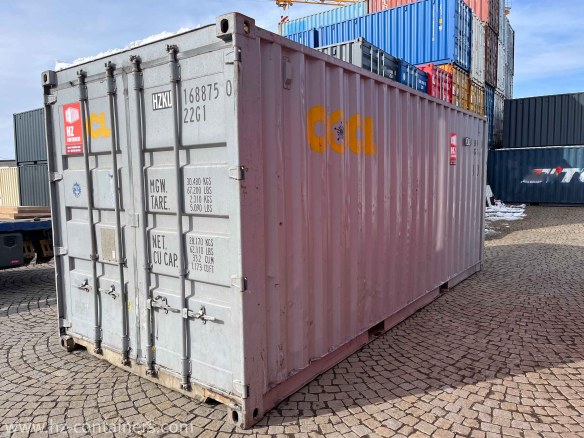
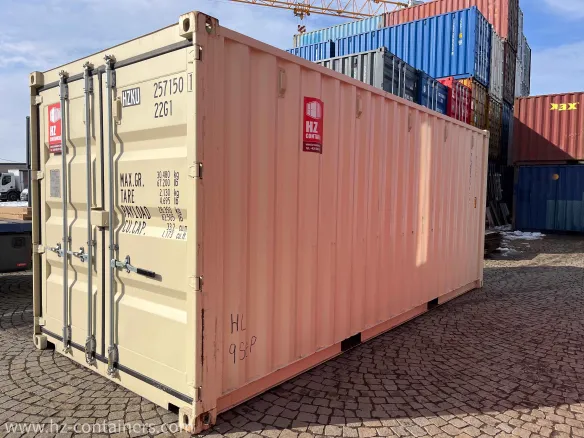
Steel Shipping Box
Steel shipping box, often referred to as shipping container, cargo container, or ISO container, is a robust, standardized steel box developed for safe, efficient, and repeated transport and storage of goods within the global supply chain. These containers are designed to withstand extreme weather conditions (temperature range from -40 °C to +70 °C), salt water, mechanical stress, and stacking up to 9 containers high (depending on type and age).
Thanks to the intermodal concept, containers can be easily moved between ship, train, and road transport without the need to handle the contents. This is a key factor in efficient cargo logistics: more than 90% of global piece goods trade is transported in containers.
Synonyms and Most Common Technical Terms
- Shipping container (most common in English)
- Cargo container
- ISO container
- Transport container
- Storage container (when used stationary)
- High Cube container (HC) – increased height
- Pallet Wide – container adapted for Euro pallets
- Conex box, Sea Can – military, international terms
Key Features and Construction: What Does It Consist Of?
Modern shipping container is the result of a combination of precise standards, highly durable materials, and long-tested design solutions. Careful manufacturing and regular inspections ensure that each container meets strict requirements for load capacity, water tightness, and safety.
Material: Corten Steel and Its Advantages
- Corten steel (Weathering Steel, e.g., ASTM A588, S355J2W) is specially alloyed for maximum lifespan in extreme conditions.
- When exposed to weather, a passive rust layer (patina) forms on the surface, preventing further corrosion spread.
- Typical wall thickness: 1.6–2.0 mm (corrugated sheets), frame beams up to 6 mm.
- In addition to corrosion resistance, it stands out with high tensile strength (up to 500 MPa) and excellent weldability.
Structural Elements
| Element | Function | Material | Specifics |
|---|---|---|---|
| Corner elements (corner castings) | Handling, stacking, twist-lock fixation | Cast steel | 8 per container – critical for safety |
| Frame (bottom, top, longitudinal/cross members) | Load capacity, rigidity, protection against deformation | Rolled profiles from corten steel | Withstand loads up to 34,000 kg (20′ container) |
| Walls and roof | Cargo protection, structural rigidity | Corrugated corten sheet | Corrugation increases rigidity and resistance to puncture |
| Floor | Load capacity, hygiene | Marine plywood (28–36 mm), bamboo | Water-resistant, impregnated against pests, meets ISPM 15 standards |
| Doors | Access, safety | Steel, rubber seals | 2 doors, 4 locking bars, option for security box (lockbox) |
| Pockets for forklift | Handling with forklift | Steel | Usually on 20′ containers, spacing matches industrial forklift tines |
Corner Elements (Corner Castings)
- Ensure stacking, transport, and fixation (twist-locks) according to ISO 1161.
- Each of the eight corners has precise dimensions and holes for handling by crane, spreader, or forklift.

Floor
- Most commonly marine plywood with thickness 28–36 mm, bonded with water-resistant adhesive.
- Bamboo floor: higher hardness, more ecological, quickly renewable material, lower carbon footprint.
- Maximum point load on floor: up to 5,460 kg/m² (depending on type and age).
Doors
- Doors have multi-chamber rubber seals that prevent water, dust, and pest ingress.
- Each door is secured with two locking bars (cam-lock), option to add lockbox for increased security against break-ins.
Pockets for Forklift
- Dimensions approximately 360 × 115 mm, distance between centers 2,050 mm (according to ISO).
- Allow handling of empty container up to approximately 3,000 kg.
Types of Shipping Containers and Their Parameters
Several basic types of standardized containers exist on the market:
| Type | Length (external) | Width (external) | Height (external) | Capacity (volume) | Max. gross weight (MGM) | Useful load (Payload) |
|---|---|---|---|---|---|---|
| 20′ Standard (DV/DC) | 6,058 mm | 2,438 mm | 2,591 mm | 33.2 m³ | 30,480 kg | 28,200 kg |
| 40′ Standard (DV/DC) | 12,192 mm | 2,438 mm | 2,591 mm | 67.7 m³ | 30,480 kg | 26,970 kg |
| 40′ High Cube (HC) | 12,192 mm | 2,438 mm | 2,896 mm | 76.4 m³ | 30,480 kg | 26,610 kg |
| 45′ High Cube (HC) | 13,716 mm | 2,438 mm | 2,896 mm | 86.0 m³ | 32,500 kg | 29,500 kg |
| 20’/40′ Pallet Wide | see above | 2,462–2,500 mm | see above | +5–10% volume | see above | see above |
Note: Pallet Wide containers enable more efficient transport of Euro pallets (up to 30 pcs in a 40′ container, compared to 25 pcs in a standard one).
Other Specialized Types
- Open Top – with removable roof (tarpaulin), suitable for oversized cargo.
- Flat Rack – without side walls, for heavy and bulky machinery.
- Reefer (refrigerated container) – integrated cooling unit, connection to electrical grid (380V), temperature range -30 °C to +25 °C.
- Tank Container – for liquids, gases, chemicals.
- Double Door / Tunnel – doors on both ends, easy loading and unloading.
Standardization and Certification: ISO Standards and Safety
International Standards
- ISO 668 – Dimensions and maximum weights
- ISO 1496 – Design and test conditions
- ISO 1161 – Corner elements (corner castings)
- ISO 6346 – Marking and identification of containers
Each container is marked with a unique code according to ISO 6346 (four-letter owner prefix, six-digit number, check digit) and equipped with a so-called CSC label (Convention for Safe Containers), which guarantees compliance with all safety requirements for international transport.
Safety and Inspection
- Each container must undergo regular safety inspection – so-called CSC inspection (usually every 30 months).
- Corrosion, tightness, floor condition, door functionality, frame integrity, and corner elements are checked.
- A container without a valid CSC label MUST NOT be used in international transport.
Life Cycle and Secondary Use
First Phase: Active Service
- Average lifespan in maritime transport: 10–15 years (depending on maintenance, intensity of use, and climate conditions).
- Regular inspections, possible repairs (welding, seal replacement, corrosion treatment).
Second Phase: Second Life
After being retired from transport, containers are further utilized:
Storage Containers
- Immediately ready for use as storage units on construction sites, in companies, and households.
- Storage of construction equipment, seasonal supplies, tools, vehicles, etc.
Modifications and Container Architecture
- Mobile offices – fully equipped, insulated, with electrical installation, air conditioning.
- Residential homes – from simply modified tiny houses to multi-container complexes.
- Pop-up shops, cafes, bistros – quick construction, mobility, original design.
- Technology modules – data centers, substations, pumping stations, laboratories.
- Military/emergency use – command centers, mobile hospitals, storage and residential modules.
- Industrial use – as security boxes (lockboxes), generator modules, workshops.
Ecological and Sustainable Trends
- Construction from used containers significantly reduces carbon footprint (steel recycling, minimization of construction waste).
- Modern trend of upcycling – creative conversion of retired containers into new functional objects.
Maintenance, Repairs, and Typical Issues
Maintenance
- Regular inspection of door tightness and seal condition.
- Treatment of damaged paint, prevention of deep corrosion, especially in the area of corner elements and floor.
- Inspection and possible replacement of floor boards (most often in areas with intensive moisture).
- For storage purposes, it is recommended to place on a solid surface and slightly elevated (for floor ventilation).
Typical Damage
- Puncture of walls or roof by heavy load (requires professional welding repair).
- Frame deformation due to improper handling by crane or forklift.
- Floor wear from intensive loading or moisture penetration.
- Damage to door mechanisms or seals (preventing water and dust ingress).
Repairs
- Specialized companies offer complete service including replacement of wall panels, frame parts, floors, and door systems.
- Repairs should be performed in accordance with IICL (Institute of International Container Lessors) standards to maintain CSC certification.
Latest Trends and Future of Shipping Containers
- Automation and digitalization: RFID chips, GPS tracking, smart door locks, and humidity/temperature sensors.
- Special coatings: New types of anti-corrosion coatings extend lifespan up to 30 years.
- Hybrid and multifunctional containers: Combination of various functions (e.g., cooling unit + office).
Demand and Market
- Growing market for used containers for construction, logistics, and private sector.
- Increased demand for High Cube and Pallet Wide variants for optimized transport and storage.
Steel shipping box – shipping container represents not only the backbone of modern logistics but also an inspiring building element for a wide range of industries. Its success is the result of precise standardization, advanced materials, and continuous innovations in design, safety, and ecology. Durability, modularity, and the possibility of repeated use make the shipping container one of the most universal and sustainable products of our time.
 Czech Republic, Rožnov pod Radhoštěm
  FREE SHIPPING